
Yeah, it’s a dramedy.
Sad and dark and funny.
July 7. Take a gander.
Yeah, it’s a dramedy.
Sad and dark and funny.
July 7. Take a gander.
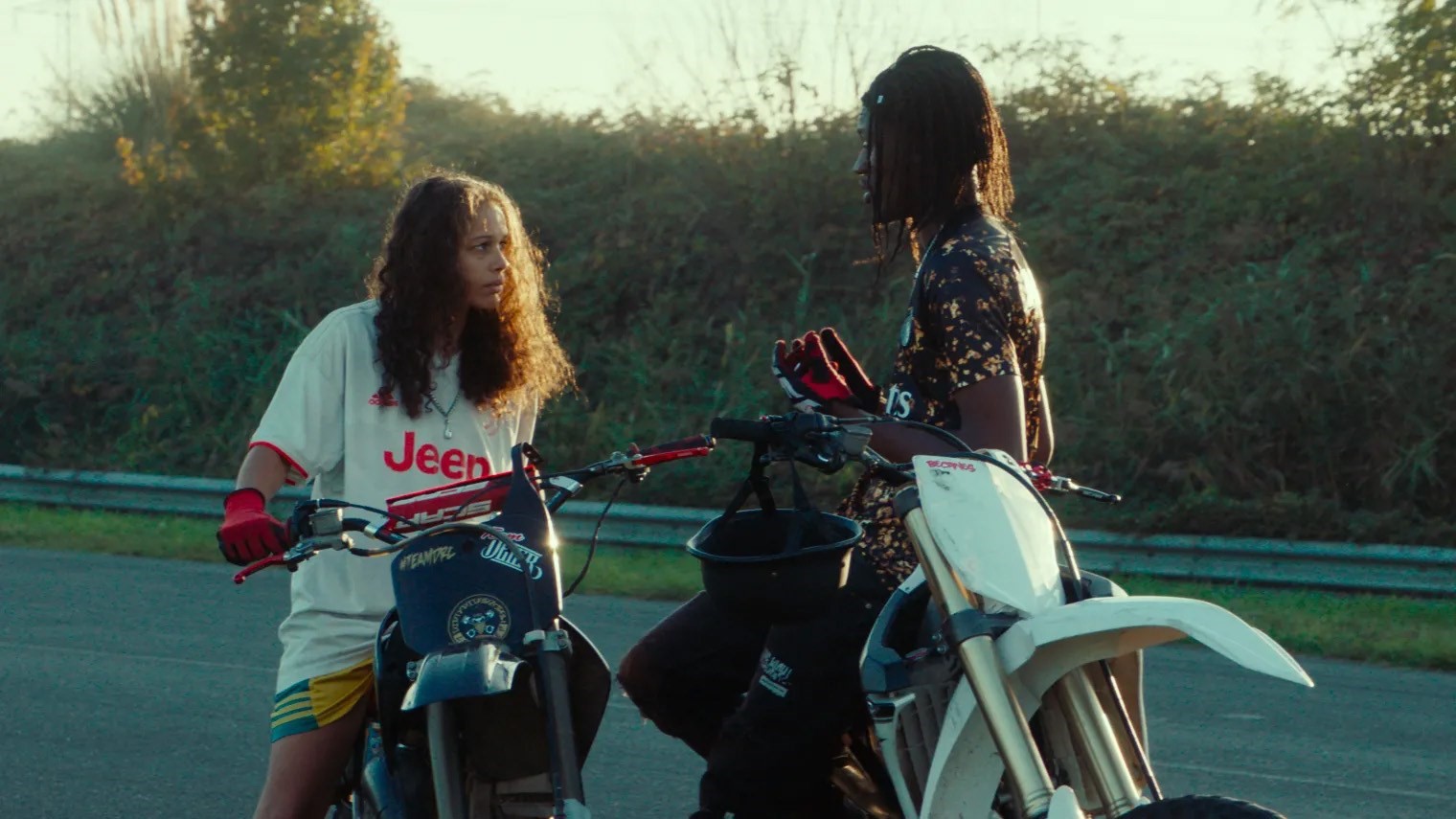
Put the French thriller “Rodeo” in enough theaters, and the main thing greeting the next “Fast/Furious” iteration — along with tens of millions at the box office — would be hoots of laughter.
“Rodeo” is an unblinking, gritty and nervous thriller about a young hothead who only comes alive or feels at peace enough to smile when she’s on her bike. It’s a “Gone in 60 Seconds”/”Bicycle Thieves”/”Fast and Furious” mashup with heat and fear and fury and not even the barest hint of sentiment.
There’s novelty in the fact that Julie (Julie Ledru) is a tough-as-nails young woman who knows how to check out any new-to-her motorcycle, assessing the clutch, the brakes and throttle, holding her hand over the exhaust to see if it is “missing.” Details like that make or break a gearhead tale wrapped in a character study like this one.
Julie rages at the world, a Guadalupe-born high-mileage 20something still living at home with her student younger brother and never-seen mother in a housing project.
We meet her mid-rage. Somebody’s stolen her latest bike, and no one can calm her from her fury. When she collects herself, she makes a call, pulls herself together, fills a filched purse with rocks and shows up to test ride another dirt bike.
We see what someone who knows her means when he tells her “S–t sticks to you.” She’s trouble, and troubled.
Julie can manage a disarming smile through her cut-rate dentistry, tame her unruly hair just a smidge and lie without compunction. Julie’s an old hand at test-ride-and-fly thefts.
“I was born with a bike between my legs,” she boasts (in French with English subtitles).
“Rodeo” is about what happens when she finds her “tribe,” the reckless, outlaw, stunt-riding and traffic disrupting “B-Mores.”
Yeah, the name could use some work.
Things go wrong at an impromptu rally/gathering, but “the noobie” keeps her cool.
Next thing we know, she’s in their shop, recruited to help in the “steal, modify and re-sell” side of the allegedly legitimate business they run at the behest of Domino, who directs and controls one and all from his prison cell.
Next thing she knows, she has a wary ally (Yanis Lafki) and a sexist creep nemesis or two, guys in the gang who don’t want her around and aren’t squeamish about how they get their wish.

Director/co-writer Lola Quivoron’s debut feature quivers with indie film energy — on foot, in fights and on bikes. We’re treated to a tribute ride for a fallen comrade, a parade of stunts by riders showing off and the measures taken when “The cops! The cops!” show up (smoke bombs, chaos, and a few bikers get hurt). The film rocks along on lots of hand-held camerawork and close-ups of her unconcerned-with-her-looks heroine.
Ledru, making her big-screen debut, is unaffected naturalism defined. She doesn’t dress down. She takes it to extremes. The dark circles under her eyes have dark circles under them.
Antonia Buresi plays Domino’s wife, trapped in her apartment with an acting-out 4-year-old by a control-freak husband who rules her life with an iron fist, and does it from behind bars.
Buresi co-wrote the script with Quivoron, and they manage to set up expectations and sweep them aside more than once. We think we know what the big action beats will be — conditioned by the early “Fast and Furious” movies — and sometimes, they’re simply checked-off to make way for the next twist.
“Rodeo” is so good it’s almost sure to inspire a Hollywood remake. Catch it in the original French grit, because while we know Zazie Beetz can ride, who knows if they’ll meet her quote?

Rating: unrated, violence, gruesome injuries, drug abuse, profanity
Cast: Julie Ledru, Yannis Lafki, Antonia Buresi, Louis Sotton and Junior Correia
Credits: Directed by Lola Quivoron, scripted by Antonia Buresi and Lola Quivoron. A Music Box release.
Running time: 1:46

Imagine “Weekend at Bernie’s” as a caper comedy directed by John Waters’ Filipina sister.
That’s “Partners in Crime,” a campy Filipino romp filled with drag performers, only because they’re Filipino, they’re of a culturally accepted “third gender,” baklâ.
Watching the film, you never entirely forget who and what the characters and often the folks playing them are. Because “drag” is funny, something humorless American homophobes fail to appreciate. But seeing baklâ accepted in different careers, guises and walks of life lets us move on from the femine-identifying thing and concentrate on what’s important. In this case, that would be, “Are they funny?“
“Crime” is about a popular TV presenter, Jack Cayanan, played by the award-winning and perfect-drag-named Vice Ganda. Campy and over-the top, “Madame” Jack hosts his own game show, which of course calls for production numbers and the like.
But Jack faces a crisis every performer dreads. Years of using and over-using his voice, pitching it towards a more feminine sound, wreck it. His bitchy rivals grab the chance to kvetch about how “haggard” and “old” Jack is looking. But just as he’s losing it all, a bubbly young beauty, Barbara Nicole Rose Albano (Ivana Alawi) comes to his rescue.
Working as a “team,” they relaunch his career as “their” career, making public appearances, hosting contests and the like. “JaBar,” as they bill themselves, are a winning combo. But she’s kind of in love with Jack, and he has to explain the facts of attraction to her, whom he loves as a “friend” and “colleague” and nothing more.
The real test of this team is when the network lady comes a calling with new offer. Jack is back, and time without Barbara, who is enraged at the betrayal.
When the rating-obsessed boss wants a show-stopper interview with the reclusive Don Bill, “the richest man in the Philippines” (in Tagalog and Filipino with English subtitles), who has survived “99 assassination attempts,” Jack resolves to get it. So does Barbara.
With each accepting the help of their baklâ or simply over-the-top female sidekicks, they pose as wait staff for Don Bill’s (Rez Cortez) birthday party.
That’s where death and blackmail and a deadly contest to “find the Don’s ‘coins'” ensues.
Unfortunately, one thing that doesn’t ensue is “hilarity.” A few stretches work up a spirited campy head of steam, and the tale finishes with a flourish. But the movie bogs down in a lot of inane, unamusing chatter and comic bits that don’t quite land.
Yes, the ex-teammates are forced to sneak around Don Bill’s estate hauling his body around as if he’s merely drunk or napping or not particularly talkative today. That delivers some laughs but wears thin.
The comical caper problem solving is inventive exactly once. But for the most part this script struggles to find what should be obviously funny in all this, as the performers, especially Ganda, strain to make the limply-written shtick outrageously amusing by camping it up.
“Partners in Crime” never manages to be more than a hit or miss affair, a one-day “Weekend at Bernie’s” that doesn’t have nearly as much fun with its best sight gag — a corpse — and can’t find enough laughs in that parody of femininity that drag often is to make up for it.

Rating: TV-MA, violence, profanity, adult situations
Cast: Vice Ganda, Ivana Alawi, Rez Cortez, MC Calaquian and Kenneth Ocampo
Credits: Directed by Cathy Garcia-Molina, scripted by Jonathan Albano and
Cathy Garcia-Molina. A Netflix release.
Running time: 1:48
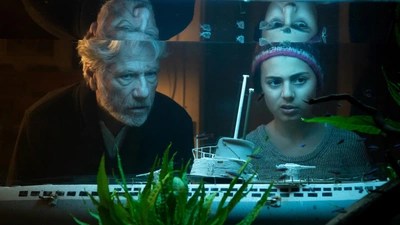

“A Handful of Water” is a feel good immigration tale that doesn’t quite the deliver the feels.
A choppy, untidy narrative, abrupt shifts in temperament and a vague grasp of right, wrong, morality and the law drag this slight, sentimental drama off course.
Jürgen Prochnow plays Konrad, a sad, solitary widower in a suburban semi-detached whose days are a drab routine of loneliness. He’s got a huge tropical fish tank and busybody neighbor and a car he longer drives. And every few days, his daughter (Anja Schiffel) checks in on him and nags him about this adoption ceremony that’s coming up.
She’s married a woman, and the 80something Konrad has had to get used to that. Now, she’s adopting her wife’s children from a previous marriage, so there’s another thing the old grump has to accept.
He’s not big on immigrants and “gypsies.” So, as is the way of such stories — “A Man Called Ove,” “A Man Called Otto” — let’s hurl some into his life.
We meet Thurba, her mother and two brothers just as German authorities are knocking at the door to deport them. Tweenage Thurba (Milena Pribak) bolts. When we hear a cop mutter “We can’t deport them” without all of the children in hand, we’re allowed to wonder if mother and child know that and are gaming the system.
When Thurba visits a couple of her countrymen involved in human trafficking for help and one asks why her mom didn’t “just break her arm” (in Arabic and German with English subtitles), that’s reinforced. You can appreciate and sympathize with the desperation of migrants fleeing violence (they’re from Yemen) and cringe at the ways tolerance and “official” compassion are twisted by those who would manipulate the rules as just another means to their end.
Thurba breaks into Konrad’s house, but the cops aren’t coming because someone stole some of his cookies. When she slips in again, he shoots her in the arm. And hen he tries to throw the shrieking child into the night, she passes out.
Konrad instantly softens. Thurba, freaking out when he locks her in, breaks out and takes longer to make a connection. But eventually she’s back, “helping with the fish” he tells his nosy neighbor. He gradually pieces together their story — her dad died, they were “imprisoned” in Bulgaria on their trek, and they’re just trying to get to the UK, where her uncle lives.
And there’s one more problematic element to this. This isn’t about a German coming to accept someone from another culture and empathize with their plight, welcoming them as neighbors. This is about a German resolving to help these Yemeni refugees reunite in Germany and aid their further travels so that they become Britain’s “problem.”
Konrad’s favorite saying is “Enemy is on the rise,” denoting how things are changing and never will be what they were (his explanation of the phrase). That metaphor is as slippery as the “handful of water” usage in this script. Something got lost in the translation.
The kid is unaffected and believable in the part. And it’s always great to see Prochnow as a leading man, over 40 years since “Das Boot” made him a star.
But “Handful of Water” just reminds us of how slippery the broad issue of human migration is, once you get past the emotional, compassionate points and into the ethics, moral obligations, rights and entitlements of it all.

Rating: unrated, violence
Cast: Jürgen Prochnow, Milena Pribak, Anja Schiffel and Pegah Ferydoni.
Credits: Directed by Jakob Zapf, scripted by Ashu B.A., Marcus Seibert and Jakob Zapf. An IndiePix release.
Running time: 1:34


Today’s trip “Around the World with Netflix” is a nostalgic and cute Italian comedy the tells us “You can go home again.” Or as the Neopolitans put it, “The happy bird makes its next in its own valley.”
“A Breath of Fresh Air” is a star vehicle co-written by Italian comic Aldo Baglio, known for such seasonal farces as “I Hate Summer” and “The Santa Claus Gang.” In this comedy, titled “Una boccata d’aria” in Italia, he plays a frazzled Milan pizzeria owner about to lose his restaurant and his mind over the obligations piling up around him.
Salvo’s supporting a grad student daughter (Ludavica Martino) in Amsterdam who hasn’t told him that she’s quit her MBA program, or that she’s pregnant by her musician boyfriend.
His dead-weight son Enzo (Davide Calgaro) goofs around in the kitchen, distracted by his dreams of music producer/DJ stardom.
And his wife (Lucia Ocone) is cold comfort in all this, perhaps because she’s in the dark about how bad things really are.
A scooter accident lets Salvo see a vision of his ever-disapproving dad (Tony Sperandeo). He’s he one who gives him the “bird/nest/valley” aphorism. He’s the one who always called Salvo “useless.” And that vision tells Salvo that he’s died.
The fact that there’s in inheritance sends Salvo winging southward, to Southern Italy where his Sicilian dad ran a farm overrun with snails. He must make up with his sullen, estranged brother Lillo (Giovanni Calcagno), convince him to sell the place, and hope he can recover his repossessed pizzeria.
Here’s what Salvo never told his wife and kids. That his dad was still living, that he has a brother. His long-long crush Carmela (Manuela Ventura) is back in this sleepy little village. Oh, and by the way, Salvatore had his own pop stardom dreams. He wrote and recorded a corny Neapolitan single in honor of “Carme” in his long-haired youth.
The only way ALL of this can come out is for the whole family to eventually follow him south to find out the truth and take this comedy to its logical conclusion.
I think the first movie to teach me about Italian regionalist prejudice was Lina Wertmüller’s charming “Ciao, Professore!” Hearing and reading subtitles about northern Italian attitudes towards those “rednecks” in the south, from Naples on over to Sicily, was an eye opener.
Here, Salvo lets us know that these “bumpkins” and “rednecks” (in Italian with English subtitles) were a big reason he left. But when he returns, he’s mobbed by old friends who help him close down the bar with wine-soaked sing-alongs.
Sure, it’s the sort of small town where the longtime mayor finally died, only to have his son take over the job. Old grudges, like old flames, never die.
And the snail situation at the family farm is so severe that I wondered if they weren’t raising them for restaurants. Considering the seething resentment Lillo harbors over this solitary life of labor, frustration and misery convinces one otherwise.
“Fresh Air” isn’t a challenging comedy. But it does manage to upend expectations, here and there. And Baglio, who cowrote the script with director Alessio Lauria and others, mugs and fumes and lies and gestures wildly enough to keep it amusing, or at least help it merrily make its way toward the finish line.
Knowing when to end a film, drop the mike, is an art, and these folks have given us all we need to know about whatever “happily ever after” is coming. They don’t show it because there’s no need. We jus tknow.
Maybe it’s the sunny, sleepy, overgrown and gone to seed scenery talking, but while this “Breath” isn’t all that, it’s not that bad.

Rating: TV-14
Cast: Aldo Baglio, Lucia Ocone, Giovanni Calcagno, Manuela Ventura, Ludavica Martino and Davide Calgaro
Credits: Directed by Alessio Lauria, scripted by Aldo Baglio, Valerio Bareletti, Morgan Bertacca and Alessio Lauria. A Netflix release.
Running time: 1:36
My favorite memory of the landmark Canadian Internet browsing browsing phone was at a mid-90s screening at the Toronto Film Festival.
I’m sitting near the back, and those damned green screens completely decorated the auditorium, distracting one from the latest excesses of Lars Von Trier.
What a hoot. “Crackberry” it was.
Jay Baruchel, Glenn Howerton, and I see Cary Elwes and Canada’s Finest, Michael Ironside in the cast.
Coming…soon.
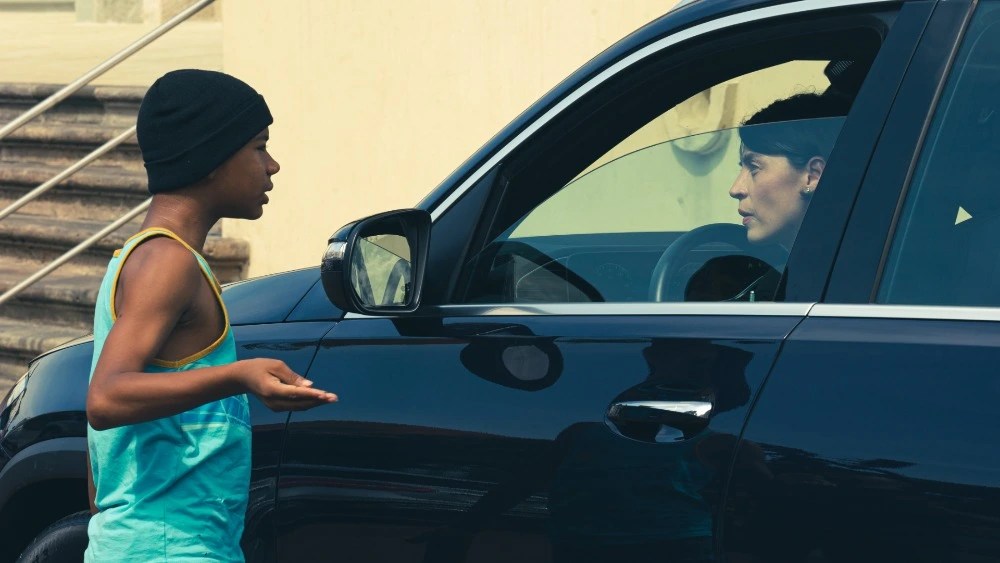
The boy looks like any one of the hundreds of hustling teens on Panama City’s streets. His scam is using traffic cones to sell parking spots with implied “Be a shame if something happened to your nice car” “protection” in the bargain.
But Alicia, a 40ish Mexican architect, isn’t in the mood for a shake down. She ignores, argues with and then pays the kid under his asking price.
As she sits, smoking, on her balcony, she watches the boy who goes by “Chief.” And Chief watches her. When she leaves for work, selling pricey high-rise condos in tropical Panama’s ocean view building boom, he’s washed her Audi, unbidden. More arguing, more angry bickering and more under-paying.
It’s not until he shows up at her door, bloodied by a gunshot wound, that she’s truly forced to deal with Chief. And even after she’s scooped him up and spirited him to a hospital, she keeps her distance, ignoring pleas from nurses and guards for her name and the patient’s identity.
They don’t know she lives on “Plaza Catedral.” But he does. And when he escapes from the hospital, the homeless urchin named makes a beeline for her address. Like it or not, solitary, self-pitying Alicia has a new responsibility in her life.
Panamanian writer-director Abner Benaim’s debut drama — he’s made documentaries and a lone comedy before now — was Panama’s submission for Best International Feature film at the Oscars a couple of years back.
It’s a simple, downbeat tale built on familiar themes, with generally predictable story beats and plot points.
Yes, Alicia — played with a guarded, calloused fragility by Ilse Salas — has a secret pain. All those people asking how she’s doing, the friends dragging her out for drinks? She’s newly divorced. And as we quickly figure out, she used to have a son.
Of course one relates to the other.
Chief has a real name, “Alexis.” But he has no home. Calling a doctor she knows about how long it should take for him to recover only earns Alicia a lecture.
“The younger they are, the more dangerous they are,” he tells her (in Spanish with English subtitles).
But warning or not, even with nightmares about what he might do to her or her property, Alicia finds herself taking care of this uneducated, gang-affiliated street kid, played by real-life street teen Fernando Xavier De Casta.
There’s not a lot of street grit to this story, which is mostly told from Alicia’s entitled point-of-view. The burden Benaim faced making this was in finding something new to do with this situation, a new angle to attack this chronic Third World/Central and South American condition.
He doesn’t. Whatever Chief is mixed up in is bound to infiltrate Alicia’s life. Whatever his presence does for the sleepwalk of grief that is her daily existence is not guaranteed to be a change for the better.
Benaim has made a sharply-observed account of a Panamanian social ill as it impacts two people — one who lives it, the other who “sees” it for the first time. The problem is he doesn’t observe enough that’s new and doesn’t do anything novel with this familiar set-up.
A glimpse of crowded, cosmopolitan Panama and the people left behind in its tax haven/vacation-get-away building boom is all we get. A glimpse is no longer enough.

Rating: unrated, violence, alcohol abuse, smoking, profanity
Cast: Ilse Salas, Fernando Xavier De Casta and Manolo Cardona
Credits: Scripted and directed by Abner Benaim. A Samuel Goldwyn release on Netflix.
Running time: 1:33
No, this trailer gives away…nothing.
But that cast, with André Dussollier, in a drama about the Biggest End of Life Decision from
François Ozon, who gave us “8 Women” and “Swimming Pool?”
That’s worth marking April 14 on your calendar.



What a fascinating, layered character “Return to Seoul” is built around.
Frederique is ever-so French — aloof, patronizing and occasionally downright rude. She is young, bourgeois and pretty, an only child. That adds headstrong, impulsive and sexually assertive to the mix.
But she was born Korean, and she has returned — on what could be a deep-seeded quest, or a youthful whim — to find her birth parents. There’s a rootlessness to her, a “sadness” one Korean who befriends and aids her notes. Frederique is looking for Yeon-hee, the Korean baby she once was, the people who gave her up for adoption and their reasons for doing it.
Screenwriter Laure Badufle, co-writer and director Davy Chou and actress Park Ji-min craft a deeply-considered, utterly-intriguing character in “Freddie.” She is 25 when we meet her. She’s a former pianist, she lets on. Her trip was sudden, we gather.
And she’s done no homework, has no idea how to manage what she’s attempting to achieve in a two week vacation. Being headstrong, she has no idea how notion of the hoops that must be jumped through, of how traumatic this could be for her and others, and she carries not a single care for how she comes off in polite, well-mannered Korea.
“Bull in a china shop” comes to mind.
Chou and Park portray this quest in the most serious tones. But there’s a hint of culture clash comedy to Freddie’s manners and arrogance.
The first Koreans she meets and befriends — hostel clerk Tena (Guka Han) and her friend Dongwan (Son Seung-Beom) — are tickled to have someone they can speak French to. The film gives us a delicious appreciation of Francophone haughtiness as Freddie, from time to time, simply must remind some impertinent local (in English) “I am FRAUNCH!”
Efforts to pass on Korean customs and manners — one doesn’t refill one’s own glass at the table — are met with smiling assertions of her privilege. She barges in on other tables, toasts all around, inviting one and all to join them.
She might bed this guy. She won’t bother to teach him the meaning of “Hit it and quit it.” “He’ll get over it.” And the fact that no one joins her isn’t keeping Freddie from being the only dancer at the music pub (with DJ) they visit. She dances like everyone is watching, and likes it.
Freddie is so brusque and over-the-top that it would only take a simple phrase, never muttered but often thought, to tip this over into dark comedy.
“What a bitch” may not be said aloud. But we and some of the Koreans helpless in preventing Freddie from making a scene have to think it.
Freddie bristles at the “rules” of the adoption agency that knows where her parents are. She thinks nothing of imposing on kindly Tena to serve as translator when she finally gets to meet her weepy, guilt-stricken Dad (Oh Kwang-rok). There’s just as little thought given to brushing off his tipsy clinginess.
Park lets us see Freddie cringe, and the indecisive yearning Yeon-hee feels underneath that burn-it-all-down exterior.
“Return to Seoul” takes a conventional story and adds in all the touchy considerations such tales typically leave out. Maybe the birth parent doesn’t want to see you, be reminded of what must have been a devastating experience for them. Maybe recognizing how little you have in common with them would give anyone second thoughts about all this, mid-adventure.
One interesting twist here it the way the script suggests that the adoption agency — in business since shortly after the Korean War — has seen it all before and has an idea of what this abandoned child is going through, even if she’d never accept that.
How might such a childhood, viewed through the sobering reality of adulthood, impact your self-esteem and willingness to allow yourself to get close to anyone? Freddie isn’t just “sad.” We see her, years later, summon a lover to join her in Korea (where she’s remained) only to tell him (Yoann Zimmer) how easily she could delete him from her life.
Again, nobody says it but you can’t avoid thinking it — Quelle chienne!
Screen newcomer Park makes this character selfish to the point of hateful, but always worthy of our compassion and pity.
“Return to Seoul” shows us that no “simple” adoption from another culture is ever simple, that even if those uprooted try to “come home again” there will be issues. And with or without therapy, those can take years and a lot of life experience to work out.
Rating: R for brief drug use, nudity and language
Cast: Park Ji-min, Oh Kwang-rok, Guka Han, Kim Sun-young, Yoann Zimmer and Louis-Do de Lencquesaing
Credits: Directed by Danny Chou, scripted by Laure Badufle and Davy Chou. A Sony Pictures Classics release.
Running time: 2:00

The wonder of “Joyland,” Pakistan’s contender for this year’s Best International Feature Oscar, is that such a marvel exists.
A more bitter than sweet transgender love triangle romance filmed and set in the Muslim world? How could this be?
Director and co-writer Saim Sadiq’s movie judges without judgement, a tale set in a Pakistan that acknowledges without really accepting that people like its big city drag performers exist.
That’s a fine line to walk in any Islamic state, and even this one banned the film before reaching an accord that allowed it to compete for an Oscar — grudging “acceptance” at last.
It’s a subtle and subtly-acted story told at a slow simmer, adding twists even as it takes an inevitable turn towards tragic. Many a transgender tale is cast in operatically-tragic terms. But here, anything less would feel like a cheat.
Permanently unemployed Haider (Ali Junjeo) spends his days helping sister-in-law Nuuchi (Sarwat Gilani) run the extended family household in Lahore City, having tickle fights with his young nieces, cleaning and cooking and helping look after his tyrannical dad (Salmaan Peerzada).
His wife Mumtaz (Rasti Farooq) is happy enough to be a breadwinner, doing makeup for brides in a local salon, out of the house and challenged by the public every day.
All Haider has to do is turn a deaf ear to the judgement his dictatorial father and older brother (Sameer Sohail) pass on as they treat him like a servant.
Brother Saleem and Nuuchi have been trying to produce a male heir, but daughters have been the result every time. That’s another thing for Abba (Peerzada) to insult him about — no “man’s” job, living off his wife, no offspring.
Haider figures one way to take the heat off is to look for work. A pal sets him up with an interview for a dance gig. Haider can’t dance. The job pays well, but it’s at an “erotic revue,” where he’ll be a backup dancer.
And his boss and choreographer will be Biba, transgender, out and living her pre-surgery “best life” in a place where one wrong move, one misjudged encounter could be her last.
He’s hired, despite having no experience or talent. He begs his friend not to tell his father or family what he’ll be doing. “Theater manager” he’ll tell them.
But the disruption under their roof is as instantaneous and cruel as it is soft-spoken. Nuuchi’s just had her fourth child.
“Who will help her run the house?”
Saleem and his Abba decide. And Haider folds and goes along with them. Just like that. Farooq lets us see how crushed Mumtaz is, an enterprising professional woman with a job and a work life sentenced to the grind of caring for children “who aren’t even MINE (in Punjabi with English subtitles)” and tending house for her aged, tyrannical invalid of a father-in-law.
Cruelest of all, Haider becomes his boss Bibi’s fixer, her Man Friday, running errands, play-acting to get her into photo shoots, sticking up for her on public transit where traditional Muslim women bristle at Bibi, “a man” in women’s clothes, taking a seat next to them, staying out all hours.
Haider stays late at rehearsals, accompanies Bibi on her nightly rounds and neglects Mumtaz. The older brother’s family even imposes on their bed, parking their restless bed-wetter oldest daughter in there with them.
Whatever this movie has to say about transgender rights and transgender romance, Mumtaz is the one who won my pity. When she blurts that “I want to run away” at one point, we pray that she will.
Because Haider, the sibling too sensitive to slaughter a goat to celebrate the birth of his brother’s latest daughter, too meek to stand up to his brother and dad, is falling for bossy, sexy come-on queen Bibi.
Columbia U. alum Sadiq and his co-writer Maggie Briggs use their first feature to invite the world to see a Pakistan never seen on the screen. All male audiences lap up the drag revues. Bibi tempts fate by dancing and flirting with the rough trade in local bars, which may serve alcohol but also draws the line at not admitting women.
A romance is coming, and if we know one thing about love triangles, it’s that virtually nobody will survive that experience unscathed.
Sadiq lets his film carry on past its logical climax. “Joyland” seems to judge, but withholds judgement on Bibi’s callous pursuit of a man in a traditional marriage. Haider’s guilt is left mostly unspoken.
But Farooq sees to it that your heart just breaks for Mumtaz, in an arranged marriage (seen in flashback) and trapped in a house that has become her prison, an entire family cavalierly crushing her spirit and frustrating her every desire with no more thought they they think her status demands.
For all the eye-opening novelty and hoped-for “change” that “Joyland” — named for the carnival/club district of Lahore — provides, in Mumtaz we see the ugly reality of “the now” in a patriarchy that’s still just one bad election from being Iran or Afghanistan all over again.
Rating: unrated, sexual situations, profanity
Cast: Ali Junejo, Rasti Farooq, Alina Khan, Sarwat Gilani and Salmaan Peerzada
Credits: Directed by Saim Sadiq, scripted by Saim Sadiq and Maggie Briggs. An Oscilloscope Labs release.
Running time: 2:06

 Movie Nation