

With women’s rights and leadership role in society under assualt in many corners of the world, the time seems right for a fresh look at Egypt’s “Queen Cleopatra,” an “iconic” woman “who bowed to no man,” as producer/narrator Jada Pinkett Smith says in the opening narration of the new Netflix docu-drama series.
The historical record leaves little doubt. Cleopatra she was smart, cunning even, a shrewd operator in a politically-turbulent time.
“Vixen or strategist, collaborator of maverick,” the actress and podcaster/influencer Smith wonders in that narration? Whatever “her truth,” this much is undeniable. She “walked through the sandstorm of history and left footprints so deep that no man could ever erase them.”
This four part biography — tracing her from the day she took the pharoanic throne with her “husband/brother” Ptolemy XIII through her trials, alliances and dalliances with first Julius Caesar and then his protege Mark Antony (whom she married) and to her fall and death — recreates the key moments in her life and career in a modern vernacular with a British headed by Adele James, a Black British actress who backs up a central assertion of this series.
Cleopatra wasn’t just a tough, brilliant woman. She wasn’t just “Egyptian.” She was Black. And rolling this out now not only refutes “traditional” Western depictions of the queen (Liz Taylor et al), it beats the big screen “Cleopatra” starring Israeli actress Gal Gadot of all people to the punch by a year or more, Egyptian lawsuits be damned.
That assertion of her racial heritage, like much of what’s in this account of Cleopatra’s life, seems perfectly defensible. Let’s bring out the historians, air that thesis out and let young Cleo tame the epic Afro she’s wearing when we meet her into something more regal when she dons the crown.
But that’s where “Queen Cleopatra” trips up.
The Oprah-acolyte Smith’s assertion that this is “Her Truth” is telling. So is the first assertion of Cleopatra’s race introduced in the series.
“My grandma told me, ‘I don’t care what they tell you in school. Cleopatra was Black!”
Oh really? Professor Shelley P. Haley is the retired Hamilton U. academic who says that, and who has to know granny isn’t exactly an unimpeachable authority on the matter. It’s not the last “Oh really?” this “history” runs up against.
“Everyone can imagine her in their own way,” another of the six-and-only-six experts appearing on camera here asserts.Oh really?
Still, the series does a decent job of making the case that since we don’t know who Cleopatra’s mother was, only that her father was the Macedonian descendant of one of Alexander the Great’s generals, Ptolemy XII Auletes. So it’s possible and indeed acceptable, based on the little contemporary art and few contemporary accounts describing her, that she was of Nubian/Macedonian (Greek) descent and darker skinned than your average Egyptian of the day.
But the approach here is limited, more History Channel (“History Channel lite”) in its authority than your typical PBS or BBC produced history.
The historians and authors — one is a “PhD candidate” — are almost all women and their use of “emojis” and “ghosted” and other Twitter vernacular in making sweeping statements about “the Egyptian people LOVED her” and “the Roman elite were DISGUSTED by her” can’t help but make them come off as lightweights.
The titles that list their credentials leave off where most of them teach, giving the impression of the producers cherry-picking “performers” without necessarily having the imprimatur of “tops in their field.”
That’s VERY History Channel, BTW.
The settings for the reenactments are decent if inexpensive. The reenactments themselves are a tad stiff, occasionally perfunctory, not quite “The Tudors” sexual, but with the stilted (Brit-accented) Speech of History sprinkled with more approachable, common usages.
“You can’t share my bed and LIE to me!”

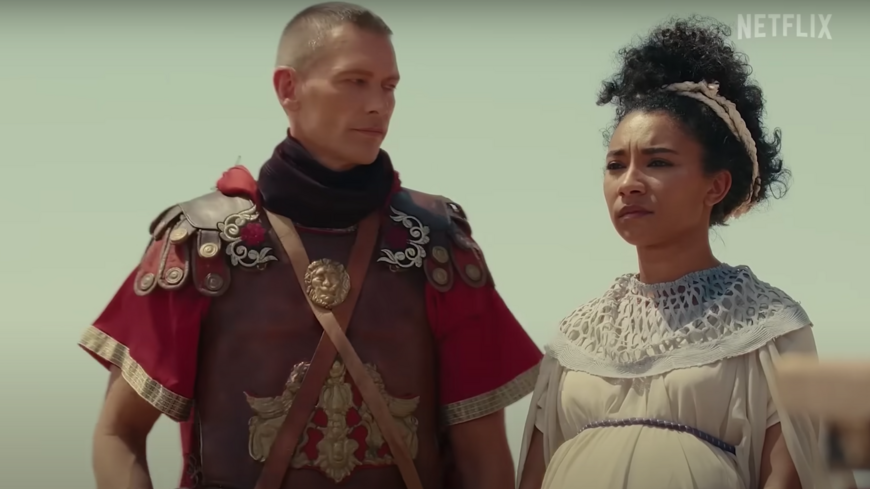
While “Queen Cleopatra” can be relied upon to relate her Greatest Hits — the smuggled-in-to-an-audience-with-Caesar-rolled-up-in-a-rug business “probably never happened,” but hell, let’s re-enact anway — it lacks the gravitas to come off as anything that truly rewrites her story.
The scripts set up a thesis — that she was an agent of her own destiny, not just swept along with it, that she was accomplished, learned and cunning and Black — and never quite closes the deal.
If you’re going to make a Big Assertion about her race, even one that’s more generally accepted now than ever before, why not hunt down more historians to talk about that? If Rome was “DISGUSTED” by her, why doesn’t one of these academics ponder the notion that plebian Rome might have been, you know, racist?
Limiting your scope, cheaping out on the research and then cutting corners on the least expensive part of the production — “experts” — just makes us wonder if you had trouble finding lots of accomplished historians to back you up. And no, they don’t have to be old, white men to be “accomplished.” I was waiting for that one voice pushing back against this or that, and it never comes.
Make your assertion, then make your case, covering as many sides of the debate as possible. Because the rest of us aren’t going to take grandma’s or Jada Pinkett Smith’s word for it, even if we never miss an installment of her podcast.

Rating: TV-14, violence, sexual situations
Cast: Adele James, Craig Russell, John Partridge, Andira Crichlow, Callum Banforth, narrated by Jada Pinkett Smith.
Credits: Created/produced by Ben Goold, and Jada Pinkett Smith and Jimmy Abounouom. A Netflix release.
Running time: 4 episodes @50 minutes each.



















 Movie Nation