
Blumhouse’s holiday offering, set in a not quite abandoned theme park.
Yeah, that’s a nightmare wait to happen.
Oct 27.
Blumhouse’s holiday offering, set in a not quite abandoned theme park.
Yeah, that’s a nightmare wait to happen.
Oct 27.
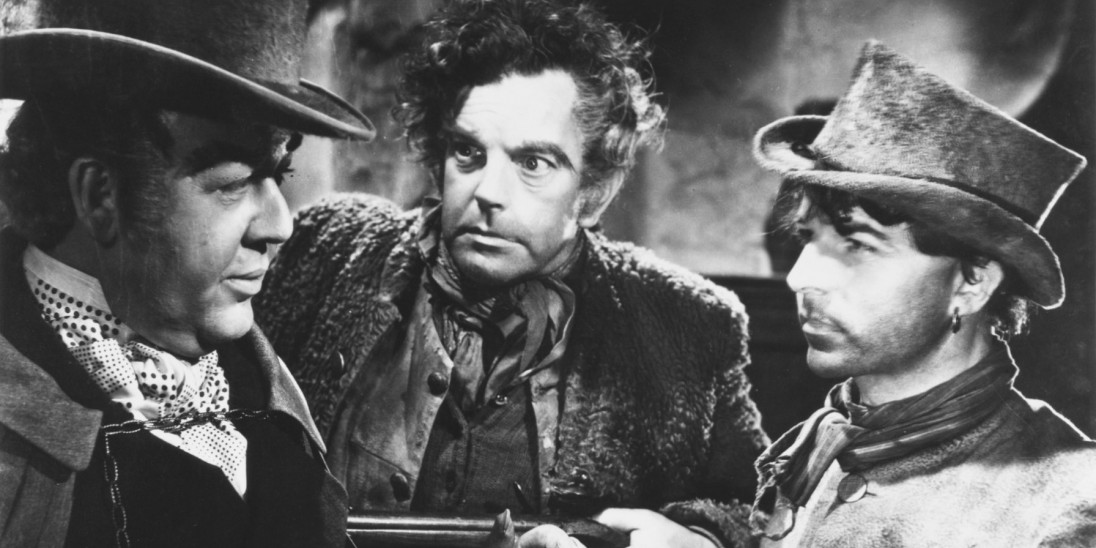
It’s all-too-telling that “Jamaica Inn” is left out of the summary of the career of “The Master of Suspense” on that font of all crowdsourced knowledge, Wikipedia.
Let’s all skip from “The Lady Vanishes” (1938) to “Rebecca” (1940). Hitch certainly wanted us to.
“Jamaica Inn” (1939) is a rare Alfred Hitchcock period piece and rare misfire, his first-ever adaptation of a Daphne Du Maurier novel and last film before “Going Hollywood,” under contract to David O. Selznick, which would spread his fame even further and ensure his legend through decades of hits and an iconic TV series to boot.
This film has never enjoyed a great reputation, and occasional attempts to paint it as better than its repute are but Hitchcockian clickbait. It’s far from terrible, thanks to the overbearing villainous turn by Charles Laughton, a first-ever starring role for Maureen O’Hara, and reliable support led by Robert Newton.
But it plants its first shipwreck early in the opening act, one of the clumsiest model toy boat effects of its day, intercut with shots of a captain and mate at the wheel, blasted by water plainly emanating from a fire hose.
Things don’t improve markedly during the course of the film, which due to its titular inn, comes to resemble a violent, melodramatic door-slamming farce, with only that fine English ham Laughton providing laughs in between the door-slams.
The spooky real-life Jamaica Inn in coastal Cornwall inspired Du Maurier, destined to be the popular novelist for whom the term “middle-brow” was seemingly invented. Historical fiction based on real history — the Inn was infamous for smugglers — the story concerned the murderous locals, who don’t wait for storms and troubled vessels to founder on their rocky shore. Like their unscrupulous peers in Key West and other dangerous sailing passages, they are “wreckers,” willing to manipulate signal lanterns and navigation aids to lure mariners to their doom.
Those who don’t perish in the wrecks and done in to ensure no witnesses survive.
The newly-renamed O’Hara — she’d appeared as a Maureen Fitzsimmons in a couple of little-seen Irish pictures — stars as Mary Yellan, a young Irish woman who has lost her mother and come to stay with her Aunt Patience (Marie Ney) and her husband, the innkeeper Joss.
We’ve seen what a brute he (Leslie Banks) is, the ringleader of the wreckers, cutthroat ensurer of the “no witnesses” policy. The loutish way he comes on to the strange young Irishwoman who comes to his door doesn’t end even after his loyal but long-suffering wife intervenes.
Mary was warned away from the place by passengers and the driver of the coach she arrived in, who refused to deposit her at such a disreputable establishment. She got there through the good offices of Squire Pelgallan, the spendthrift Sir Humphrey (Laughton) entertaining his fellow poshes at the manor up the road. He gallantly takes her to her destination, but not without a lot of leering.
Mary’s arrival at Jamaica Inn comes as the wreckers are starting to gripe about their shares of the loot they take in for all that treachery and murder. She secretly spies the summary judgment of Joss and the leaders about the “troublemaker” who’s causing that unrest, the newest wrecker, Jem Trehearne, played by the great Robert Newton.
When Mary interferes with his hanging, she and Jem flee the rough justice of the murderous mob. But there’s a leader they don’t know about, a puppetmaster arranging the wrecking. He is the aloof, posh magistrate, Sir Humphrey himself.
Running to him with their news of an awful scandal does them no good at all. They’re trapped between a murderous mob, a violent sea and a “protector” who is nothing of the sort.
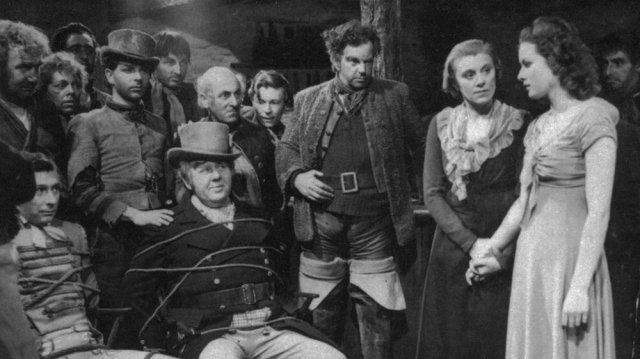
This adaptation doesn’t entirely founder on the rocks. But the viewer is a couple of steps ahead of the action, start to finish. The innocents take forever to figure out the obvious.
Sometimes, it seems only the many doors on the many rooms of the multi-floor (split level) inn and the need to stretch the screenplay out to 100 minutes are keeping our intrepid (reluctant) couple from doing the math and outsmarting their pursuers and their sea of troubles.
In adapting the film, the villainous vicar of the novel is folded into the character of the local squire and magistrate, who is renamed here. Apparently, you couldn’t criticize clergy in films intended for the American market pre Monty Python.
The limited settings and time frame make one wonder how all this “action” can be confined to so small a space, with seemingly everyone on the moors in cahoots on the wrecking scam, and willing to kill to keep their secrets.
But this being a middle-brow melodrama, there’s a lot of wholly illogical “tie’em up” until later when he or she or they should be dispatched and dumped over a cliff at one’s earliest convenience.
Still, Laughton is a stitch as Sir Humphrey, a riot of foppish menace and upper class airs delivered in comically contemptuous dialogue.
“All fine fellows,” Sir Humphrey says of his “wrecking crew.” “A trifle dessicated, but one can’t have everything.”
That grandiloquent time Laughton was having apparently ruined the experience and the film for Hitchcock, who described it as miserable shoot, a director overwhelmed by an overbearing star and the producers.
Whatever glory he’d earned with the dark yet comedic “The Lady Vanishes” was a year behind him, and after realizing that tone wasn’t going to work here, that this was never going to be dark door-slamming thriller, Hitch couldn’t wait to be done with “Jamaica” and flee to the arms of the control freak Selznick.
That tells you something. So does the fact that Hitchcock eschewed his already-established cameo for this film.
The novel was adapted for other film versions, and a mini-series, which considering the place’s notoriety, seems its proper medium.
Watching “Jamaica Inn” now, when we no longer have “The prints are in terrible shape” and the like to excuse it, a Hitchcock fan can marvel over the crowded compositions, the sound-stagey look of it all and the performances that can be its saving grace and say, “Oh, it’s not all that bad” with a straight face.
But even declining to consider its source and thus compare it to the rest of the Hitchcock canon, it’s not all that good either.

Rating: “approved”
Cast: Charles Laughton, Maureen O’Hara, Robert Newton, Marie Ney, Leslie Banks, Wylie Watson, Basil Radford and Emlyn Williams
Credits: Directed by Alfred Hitchcock, scripted by Sidney Gilliat and Joan Harrison, based on the novel by Daphne Du Maurier. A Paramount release, a Cohen Media Group restoration now on Tubi, Amazon, youtube etc.
Running time: 1:44
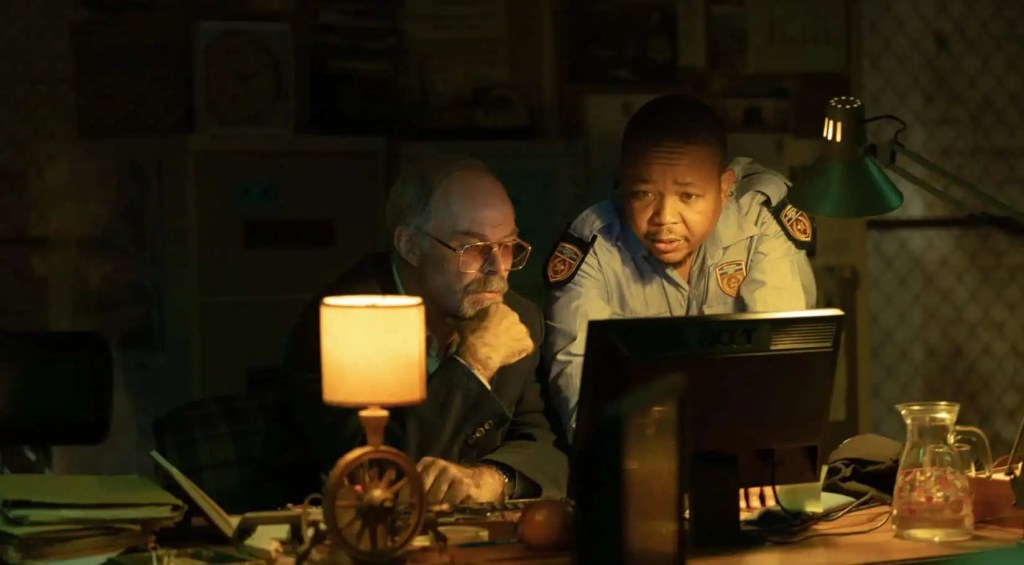



“iNumber Number” began life as a South African cop thriller ten years ago, morphed into a single-season cop series and now returns to the screen via Netflix with “iNumber Number: Jozi Gold.”
This genre thriller from Donovan Marsh, who directed by the original film (titled “Avenged” in some countries) manages a few twists and a couple of lighter touches amidst the chases, killings, corrupt cops and CGI hyena scenes. Not enough to wholly recommend it, but it’s not an utter waste of an action fan’s time.
Our Black cop team here is consists of gonzo undercover idealist Chili (S’Dumo Mtshali) who is in his element, all pimped-out in wig (complete with an Afro-pick pistol), garish suit and vintage Dodge Monaco convertible, and his trigger-shy family man partner, Lt. Shoes (Presley Chweneyagae).
We meet them as they fail to bust The Hyena Man, a smuggler of “conflict gold” into the country, a way for Africa’s mineral-backed dictators to launder their blood loot and sell it to unscrupulous jewelers around the world.
It’s all “Jozi Gold” once its been refined in Johannesburg.
The Hyena Man got his nickname because he’s kept a savage hyena as his pet/interrogation tool for years.
“When a hyena laughs, it means the ancestors are not happy!”
Chili and Shoes were paired-up way back in an orphanage, and the frustration of missing that bust (“fool’s gold”) and the fact that their orphanage is running out of money, coupled with the corrupt taunting of their “kickback” prone Brigadier (Brenda Ngxoli) has Chili ready to quit.
But no, they’ll take the demotion to “the basement,” where a 100 percent-success rate all white “Afrikanner graveyard” run by the ancient Van Slys (Deon Lotz) isn’t keen on taking them on.
If the “light skinned” enclave ever wants to catch The Hyena Man and whoever else is mixed up in a big gold smuggling/smelting and trading conspiracy, the streetwise Black guys will have to be a part of it.
Imagine Chili’s conflicted emotions when he stumbles into a family-run gang of Zulu Robin Hoods, stealing ill-gotten gold and spreading cash in the Townships. When push comes to shove, which side will Chili be on?
Marsh stages an epic gasping and Dodge Monaco’ing chase in the opening act, and takes a couple of shots at topping it later. He never does.
The brawls and shoot-outs would pass muster in Britain, Korea, China, Hollywood or Bollywood.
The acting is sharp and more subtle than what you’d see in most African films — Nigeria’s Nollywood fare, for instance. Ngxoli’s brigadier is the most over-the-top character, and she makes this swaggering bully kind of fun.
While I tend to watch films in their original language (Zulu and Tswana here), there’s no reason not to catch the South African-dubbed English tracked onto this import.
But the story is kind of slapdash, with our writer-director not knowing the geological/chemical properties of “fool’s gold” and the whole Robin Hood gand of thieves, gold smelters and activists redistributing wealth is just too on the nose to be plausible or much fun.
Marsh has conjured up a formula action film that could be set anywhere and made it distinctly South African and authentically African, which makes it worth your time even if it isn’t a new touchstone take on the genre.

Rating: TV-MA, violence and oodles of profanity
Cast: S’Dumo Mtshali, Presley Chweneyagae, Noxolo Dlamini, Brenda Ngxoli and Deon Lotz.
Credits: Scripted and directed by Donovan Marsh. A Netflix release.
Running time: 1:53




Writer-director Kaveh Nabatian’s debut solo feature is a sensual and mystical love triangle tale of self-centered dreams, narcissistic agendas, sex, salsa and Santeria set among the immigrant communities of Montréal.
“Sin La Habana” (Without Havana) is compact and completely immersive, a film that takes us from the impoverished lives and hopes of escape among the accomplished working poor of lovely Old Havana to the limited opportunities and dreams-deferred of French Canadian Montréal.
Thanks to its classical dance subtext and superbly sympathetic performances, it passes before the eyes as a balletic elegy bathed in Santeria ritual and the human foibles that foil the best laid plans.
Leonardo (Yoneh Acosta) is a talented dancer, “the best in the company” in Havana, and damned irked that he didn’t get the lead in his ensemble’s “Romeo & Juliet.” When he’s told “Your lack of humility” and “lack of respect” kept him from the role by the arrogant company director, Leo may be on the money in his translation of that.
“You just want a Romeo who’s white like you,” (in Spanish, with English subtitles).
That gets him fired. And that gets in the way of “our dream,” girlfriend Sara (Evelyn Castroda O’Farrill) lectures him. Hustling salsa lessons and dance tours of the city to tourists won’t get them “out of here.” That’s the “dream.”
Sara is a lawyer, he’s a great dancer and they’re living in a hovel that loses its electricity every time it rains. She’s young and beautiful, and he’s runway gorgeous and accomplished, and Cuban racism and the general poverty of the country will never let them have the lives they feel they deserve.
Sara’s adamant about seducing and marrying a tourist, getting that visa and getting them out — first one and then the other — that way. And if Leo won’t do it, she will.
So he puts the moves on Canadian divorcee Nasim (Aki Yaghoubi). When she flies home to Montréal, Sara coaches Leo on how to email her, what to say that will close the deal.
Yes, that’s every bit as predatory as it sounds.
Leo’s secret edge in all of this is “luck,” something he figures he’s gathering every time he consults with his Santeria shaman. A few beheaded chickens, offered into a jungle river, and a gift of a crystal marble should send him to dance glory, a passport and the money to summon Sara to the capital of French Canada.
But Nasim isn’t just a mark here, someone to be played. She is a Jewish-Iranian immigrant to Canada who fled an abusive marriage over the objections of her “traditional” father. She’s 40ish, her sister has a baby. Nasim is trying her “luck” with a long shot, too.
Nabatian brilliantly bites off just enough of each city to get across its flavor, contrasting the vibrance and sensual pleasures of socialist/impoverished Havana with the chill and haughtiness of classist Montréal, where immigrant communities import their aspirations and their prejudices — racism included — with them.
The story enfolds traditional-jobs-immigrants-take (meat processing, service sector) as they struggle to find a way practice what they’ve trained to do and expect to be able to do in a Land of Opportunity.
Leo rehearses and auditions and puzzles with First World dance ensemble expectations — “improvise.” Nasim is an artist, working in stained glass, house-sitting for a friend and getting handouts from her family to get by.
Every character we meet is looking out for Number One, and nobody is living their dream. Even that’s a common trope of immigrant narratives, lending the entire film a hint of “we’ve seen this before.”
But Nabatian gets an engrossing, involving story out of these familiar themes with artistic interludes via dance, surrealistic flourishes as Santeria flashbacks and en pointe performances.

Rating: unrated, sex
Cast: Yoneh Acosta, Aki Yaghoubi and Evelyn Castroda O’Farrill
Credits: Scripted and directed by Kaveh Nabatian. A Breaking Glass release.
Running time: 1:34
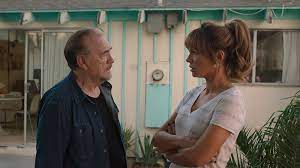

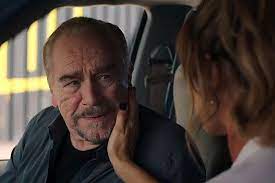

Perhaps the biggest bonus to come from Brian Cox‘s lauded turn in the hit HBO series “Succession” is that it made him just viable enough to get a few indie feature films made, little grace notes added to a career worth celebrating.
One was “Mending the Line,” letting him play a grizzled vet who teaches fly fishing as a way of coping with PTSD in younger men just stepping away from the military. Another is “Prisoner’s Daughter.”
He plays a man of violence who says “I’m not that guy any more,” but who will end his life in detention, sent “home” to live with his estranged daughter when a cancer diagnosis gives him months to live. She’s broke, a struggling single mom with a smart-but-bullied tween and an abusive addict for an ex.
And that simple description tells you everything that’s going to happen in this simple story. But with sensitive direction from “Twilight” survivor Catherine Hardwicke, sympathetic casting and some very good performances, this becomes a poignant tale with bitterness turned into forgiveness, mistakes and misdeeds rendered into redemption.
Max is the old man of the yard, moving among the population with weariness not wariness at his age. There may be others in the Nevada state prison who still carry grudges. But years of surviving, “getting clean” and sober and helping others do the same have made him almost beloved.
So when he gets that pancreatic cancer death sentence, the warden gives him a shot at spending his last months under house arrest, in his old house with the daughter (Kate Beckinsale) who has it now.
And even though he knows “we’re blood, not family,” not any more anyway, he reaches out.
“I’m getting out soon,” he tells her. “Like I give a s—,” isn’t exactly a welcome response. Not that he didn’t expect it.
But Maxine — and yes, the name’s on her list of grievances — is a 40ish ex-Vegas dancer who has to hustle waitress and strip club custodial work to keep herself and son Ezra (Christopher Convery) housed and fed. When we meet her, her stoned and scary ex Tyler (Tyson Ritter) storms into one work place, demands to see his son, punches her boss and gets her fired.
Yeah, he’s a drummer. And an addict.
If Max has money, he can come stay. But don’t expect a reunion. Don’t expect pity. “I don’t want you bringing your past in my house.” And don’t tell her son you’re his grandfather.
“I’m not interested in making you feel better before you die.”
Ezra’s a mouthy kid with a lot of questions for this new “uncle” he never knew existed. He’s unduly attached to his no-good Dad and facing trouble at school, where it doesn’t matter that a whole gang is bullying and beating him up. He gets suspended, too.
Well, not really. The screenplay, the punishment we see and hear doled out and the editing don’t reflect that.
But maybe the “uncle” who “used to be a fighter” can help the kid with the fresh black eye. Maybe he has favors from “inside” that he can call in “outside.” Maybe he can, you know, have a word with the ex.
Producer and screenwriter Mark Bacci’s script is undemanding redemption story comfort food. But this cast redeems that.
Cox conveys guilt, a desire to “square things” with everyone — old foes and daughterly grudges — in this character and this understatted performance. He makes us believe he’s every inch a guy “who could write the book on ‘sh—y fathers.”
Beckinsale adds “earthy” to her repertoire, a 50ish actress who lets the years denote the hard mileage life the 40ish Maxine has lived.
Young Convery does solid work in support of these two, convincing as a kid with a medical condition, an increasingly dire bullying situation at school and a desperate need for a father figure.
And Ernie Hudson drops in as another of Max’s old friends from his old life, bringing dignity and a modest resolve to do right by his fellow inmate via the boxing gym he runs, started “outside” by Max’s seed money from “inside.”
There aren’t a lot of surprises when characters behave the way a thousand screenplays have ordained they must, but the little moments of indulging their better angels, and their worst, give “Prisoner’s Daughter” a gritty, B-movie authenticity that is intensely satisfying.
And this gives Brian Cox another way to remind us that even though he “died” in “Succession” and that series ended, that’s not all he can do and that’s not all she wrote as far as his lauded career is concerned.

Rating: R for language and some violence
Cast: Brian Cox, Kate Beckinsale, Christopher Convery, Tyson Ritter and Ernie Hudson.
Credits: Directed by Catherine Hardwicke, scripted by Mark Bacci. A Vertical release.
Running time: 1:40

The Academy of Motion Picture Arts & Sciences has announced the Governor’s Awards for the next Oscars, and a screen queen, a comic king and a celebrated editor will take home honors.
Angela Bassett has two Golden Globes, and she was the favorite for best supporting actress this past Oscars. But the voters elected to not honor her for good work in a mediocre comic book sequel.
This is better. Let’s celebrate her entire career.
Mel Brooks could have copped a best Original Song Oscar at some point. His writing, acting and directing never managed it. But he’s worth celebrating for hilarious, shticky comedies that cut a wide swath through the’70s.
Editor Carol Littleton cut “E.T.” and “Body Heat,” and has been one of the stars of an under appreciated corner of the filmmaking art for half a century.
Ok
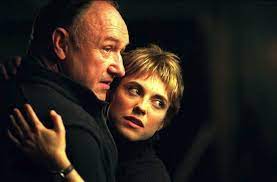
Film fanatics don’t need an excuse to re-watch classic films, some of them over and over again across the decades from when we first encountered them. But if you’re a critic, one reason you do it is to check back on the touchstone films of a genre, the movies you consider benchmark Westerns, film noirs, romances, rom-coms, combat pictures and the like, the movies you measure every film against.
“Heist,” “The Score” and “Heat” have long been the yardsticks I’ve measured “heist” thrillers against. I have particular affection for 2001’s “Heist” because it’s David Mamet‘s take on the genre.
It’s as Mamet-esque as anything the celebrated playwright ever concocted for the screen — convoluted, complex, biting, bitter and layered with the repetitive, poetic and profane tough-guy/tough-gal dialogue that became Mamet’s trademark.
“Everybody needs money. That’s why they call it money.“
“Is he going to be cool?” “My motherf—-r is so cool, when he goes to bed, sheep count him.“
“She could talk her way out of a sunburn.”
The Mamet machismo, the blunt Mamet Darwinian “truth” telling, the Mamet sexism and misogny, the Mamet love of the sound of his own deep (ish) words — all the stuff that got this increasingly unhinged “thinker” canceled, is in the dialogue in this ornate thriller, a late career highlight for the great Gene Hackman and an early jewel in Sam Rockwell‘s acting crown.
Hackman plays Joe Moore, grizzled leader of a small but skilled crew that includes Bobby (Delroy Lindo), Pinky (Mamet regular, the magician/actor Ricky Jay) and Mrs. Moore, Fran (Rebecca Pidgeon, Mrs. Mamet), aka “The girl.”
“What’s the girl do?”
“The girl gets us in the door.”
“Gets us in the door ‘How?'”
She “gets us in the door.”
A “perfect” jewelry store heist goes just wrong enough when one employee doesn’t drink the coffee that Fran — as a waitress — drugged, and forces Joe to enter the premises without a mask. He can’t get to the CCTV system and swipe the tape.
So much for “one last job” before sailing south into the Caribbean. Their mob go-between (Danny DeVito in RARE form) figures that gives him an excuse to screw them over.
“You screw me on Wednesday, you screw me on Friday,” Joe barks. “I gotta go, I got my picture on a cereal box.”
That leverage forces the crew to do “the Swiss job” that mob-made Bergman has in mind. And take along “my boy” (Rockwell), sort of as security.
So now Jimmy, a mouthy, careless and dangerous punk, is in “the crew,” asking questions, keeping an eye on his uncle’s investment, pitching in to steal Swiss gold. His favorite questions are about one person in particular.
How do you spell trouble? “G.I.R.L.”
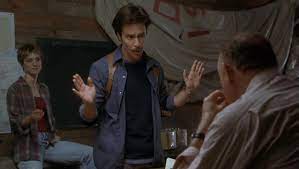
Mamet mocks the “plan the heist” conventions via Jimmy, the punk. Try to illustrate the moves they makd with toy cars on a makeshift map? Mamet wants to know who, outside of heist movies, ever does that? Crooks are rarely smart and generally not all that meticulous.
Steps in the process are under-explained. How’s the uniformed airport security guard (Patti Lupone) figure into this? This “tow-truck” they keep calling and timing?
The characters are straight-up “types,” with little twists. Joe is “old,” we’re constantly-reminded. And “smart.” But so is Bobby, who might ordinarily be cast as “the muscle.” Pinky would seem to be a tech whiz, conjurerer of misdirections and distractions.
“The girl” is ruthless, mercenary, more than ready to “suit up” (short dresses, cleavage) for her much-older husband when he asks her to. What that might entail is anybody’s guess.
The plot leans on that hoariest of heist picture tropes — the omnipotent, all-seeing, all-knowing leader. Joe is so many moves ahead in this chess game of double and triple crosses that even when he seems to have misjudged his rivals and taken a beating or a bullet, we wonder if he anticipated even that.
The “professionalism” of almost one and all is admired, the hypocrisy and cognitive dissonance of criminal goons trotted out and skated over.
Why do creeps who wrong you figure they get to play the offended party when you fight back?
And the dialogue gets to be a bit much, florid and feral, even though that’s what we come to Mamet plays and Mamet pictures for, the iambic pentameter of the profane.
“Never liked the Swiss. They make them little clocks, these two c–ksuckers come out of ’em with these little hammers, hit each other on the head. What kind of sick mentality is that?”
But as heist pictures go, “Heist” is still a benchmark — tough, unsentimental, stacatto and satisfying.
Its problematic creator was always controversial, with little red flags littering his theatrical outspokenness long before his works were turned into movies. He’s long flirted with contrarian conservative extremist, so nobody should be shocked at how he curdled into a Dennis Prager-quoting fascist in his dotage, with only Fox News anchors and a Jewish apologist sticking up for him.
He was mostly forgotten by Hollywood after the ill-considered “Redbelt” 15 years ago.
But “Heist” still stings and still ticks over like a fine-you-know-what watch, a genre defining work of art even if we have to hold the artist at a sort of Woody Allen-arms length in his last years.

Rating: R, violence, profanity
Cast: Gene Hackman, Delroy Lindo, Sam Rockwell, Rebecca Pidgeon, Ricky Jay, Patti Lupone and Danny DeVito.
Credits: Scripted and directed by David Mamet. A Warner Bros.
Running time: 1:49

Two grannies try to throw together their good-looking-but-still-single grandkids in “Make Me Believe,” a seriously bland, barely comic rom-com from Turkey.
It’s a formula film that stumbles badly when it strays from the formula. But it has three stand-out features working in its favor. The 30ish leads — Ayça Aysin Turan and Ekin Koç — are simply beautiful . In the case of TV actress Turan, “unutterably gorgeous” almost covers it. They’re filmed in front of some striking vistas on the vacation-friendly coast near Istanbul.

But the “grandmothers” who set the plot in motion are more or less forgotten, and rather clumsily so, by the filmmakers, who never seem to grasp “The reason we make rom-coms according to formula is that the formula works.”
Sahra and Deniz find themselves summoned to the the Çanakkale coastal homes of their respective grandmothers’ homes (Zerrin Sümer, Yildiz Kültür), ostensibly because of some emergency — “Palpitations!” — or other.
But the upshot is, “You never have time for us any more, unless we say we’re dying!” (in Turkish with subtitles, or dubbed into English).
It’s pretty obvious pretty early on that they’re trying to throw these two, who sort of grew up together, into each other’s arms. Well, it’s obvious to everybody else, but not the two hotties.
They haven’t seen each other “since we were 15,” and judging from the brusque way Deniz speaks to, disdains and ignores Sahra, there’s bad blood, perhaps a failed romance in their past.
He’s irked that she doesn’t remember his name, annoyed at calamities that seem to hit every time he’s in her presence and seriously judgmental about every word out of her mouth or flip of her too-perfect hair.
Sahra starts out with “jerk” and works her way up to “asshole” and finishes with “I hope the likes of you die out.”
Can these two crazy cover models ever make it work?
She’s a fashion mag journalist hoping for a promotion and in need of a Big Win to get it. Landing the elusive photographer who just turned down a big international prize for a cover story might do it. He’s world famous but apparently...never photographed.
His name is “Deniz,” and yet Sahra takes a good, long time to figure out it’s the same guy. Huh.
Sahra launches “Operation Trojan Horse” with her subordinate and bestie (Cagla Imak). Let’s use Deniz’s man-bun bartender pal (Çagri Çitanak) to inveigle our way into Deniz’s good graces and talk him into the gig.
Co-directors Evren Karabiyik Günaydin and Murat Saraçoglu have no flair for staging “Impulsive Romantic Gestures” or making “My Big Secret” scenes pay off.
But they make our stars look stunning, and serve up just enough scenery to remind us of this lovely, underfilmed tourist magnet filming location.
Oddly, not every scenic shot is all that scenic. If you’ve seen one functional, rocks-and-concrete seawall to a working port you’ve seen them all.
The “meet cute” is kind of cute here. But whatever potential our cute couple has in acting cute is nothing compared to what was possible with the abandoned grannies.
As lame as a “Come over and get my kitten out of the tree” scene is, there’s more potential in that than in the many boring arguments contrived and shoved in here to keep our future lovers apart.

Rating: TV-14, a little profanity
Cast: Ayça Aysin Turan, Ekin Koç, Zerrin Sümer, Yildiz Kültür, Çagri Çitanak and Cagla Irmak
Credits: Directed by Evren Karabiyik Günaydin and Murat Saraçoglu, scripted by Selen Bagci. A Netflix release.
Running time: 1:44

We were prepped for Robert Duvall’s Big Moment for a decade before it happened.
From “The Godfather” (1972) through “Network” (1976), “The Great Santini” (1979), “Apocalypse Now” (1979) and “True Confessions” (1981), people who knew acting and film scholars with an eye for the long game were in lockstep.
“WATCH” this guy, they all said. This is how it’s done.
Then “Tender Mercies,” the validation of an Academy Award, and everything that came to DeNiro in a blinding blur — the acclaim, the Oscars and Oscar nominations, “legend” status — finally came to Robert Duvall just as he entered his 50s.
Glory and the decades of acclaim-as-his-due that followed arrived on the back of a small, intimate film from the Aussie director of “Breaker Morant” and the playwright and screenwriting legend who adapted “To Kill a Mockingbird” and wrote all versions of “The Trip to Bountiful” — play and screenplay.
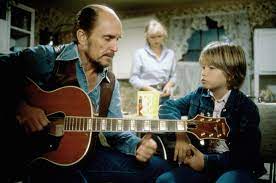
The memory has been conditioned to recall only what became the signature scene of this film, the clip that ran when Siskel & Ebert praised it on their view show, wherever Duvall showed up on TV to promote it and which remains its iconic moment to this day.
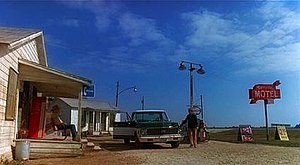
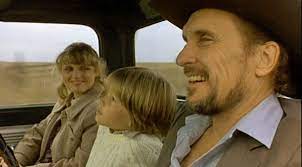
He plays Mac Sledge, a country music has-been, a Willie Nelson singer/songwriter type who let the bottle and heartbreak get the better of him, but who sobers up for a good woman (Tess Harper), a widow, and her little boy. Duvall as Sledge gets across the gift, art and craft of songwriting as he strums out the bones of a tune to the kid, Sonny (Allan Hubbard) as Mom watches on, a homey scene set in a rural Texas kitchen with just actors, a simple melody and heart.
Two-time Oscar winner Horton Foote’s screenplay has a few grace notes like that, and some hard-won Texas working class country music suffering simmering beneath the surface as Sledge begins his unlikely path to redemption. He gets left behind by a friend, post-bender, at the tiny Texas filling station/store and motor hotel run by Rosa Lee (Harper), widowed by the Vietnam War some ten years before.
Foote, who also had a Pulitzer Prize attached to his reverent obituaries back in 2009, gets at the heart of Texas, rural folks of a certain generation, and at the despairing working class soul of country music with this simple redemption story.
Mac finds himself singing in church, watching over Sonny as Rosa Lee sings in the choir, trusted to run errands and expected to do the right thing — stop drinking — without her having to ask.
That he does, with no judgement coming from her, is as country music as it gets, “Good hearted woman lovin’ a good timin’ man” and all.
Betty Buckley plays the bitter country star ex that Mac finds himself trying to reconnect with, if only to get her manager (the great Wilford Brimley) to show his new songs around Nashville.
Mac isn’t looking for notoriety, a “comeback.” Otherwise he wouldn’t blow off the reporter (Paul Gleason of “The Breakfast Club”) twisting his arm for a “star now pumping gas” story. Whatever he’s doing — sobering up, walking the line, trying to make some real cash — is for “her” and “the boy.”
Ellen Barkin was just a babe in the biz playing the sad, needy daughter Mac never got to know. Buckley brings her Broadway voice to a country chanteuse who has started to feel the miles.
And Harper, making her big screen splash in this 1983 classic, dazzles by doing as little as possible — an understated performance of dignity, pragmatism and love that isn’t gushed or even admitted out loud.
The film’s quiet authenticity made it something of a watershed, and most everybody in it went on to do great work — Foote turning his play “The Trip to Bountiful” into an Oscar winning movie, Beresford helming “Driving Miss Daisy,” Harper enjoying a long, widely-admired career than included “No Country for Old Men,” “Crimes of the Heart” and indie films and more episodic TV than a body can recall.
Duvall? He took his new status and made indie films with Oscar potential (“The Apostle”), showy turns in the odd blockbuster, and work that ensured Billy Bob Thorton’s “Sling Blade” was Oscar worthy, that Jeff Bridges (“Crazy Heart”) got an Oscar, too, and that Bill Murray (“Get Low”) at least had a shot at one.
“Tender Mercies” became something of a landmark in all their careers, and you can see Duvall’s considered introspection in every film he’s done since, from TV’s “Lonesome Dove” to “Open Range,” to films he’s directed himself — “Wild Horses,” “Assassination Tango” and “The Apostle” among them.
But the best thing about this classic is you can watch it now and wonder, even all these years later, what took Hollywood so long to realize that the best among them was the one player who never called attention to himself. He let you find him, and feel all the richer for it.
Rating: PG
Cast: Robert Duvall, Tess Harper, Ellen Barkin, Wilford Brimley, Allan Hubbard, Paul Gleason and Betty Buckley
Credits: Directed by Bruce Beresford, scripted by Horton Foote. A Universal (EMI) release on Youtube, PosiTV, etc.
Running time: 1:32


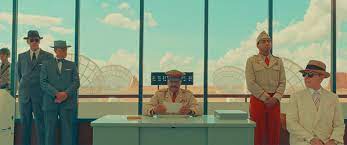

If a “twee” falls in the woods, would anyone hear it?
“Asteroid City” is the latest from the Tsar of Twee, Wes Anderson. It’s an all-star, pull-out-all-the-stops “comedy” that wrestles existentialism, Group Theatre, “The Twilight Zone,” 1950s paranoia and 1950s sci-fi, Theatre of the Absurd, Scarlett Johansson and uh, “The Big Bang Theory” into one movie.
Love Wes Anderson movies? This is as Wes Anderson as they get. Well, if Wes Anderson was outsourcing his screenwriting, production design and casting to AI.
It is all style over substance, casting over acting, immaculate screen compositions with the odd strained sight gag and the occasional flash of wit over heart.
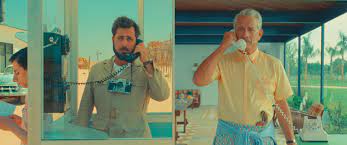
A newly-widowed photographer (Jason Schwartzman) with the surname of the editing table used back when movies were made on celluloid (Steenbeck) breaks down midway between Arid Plains and Parched Gulch.
It’s 1955, and Asteroid City — pop. 87 — is host to a teen “brainiacs” science honors ceremony. Fittingly enough, the mesas and flatlands there are within sight of the explosions of an atomic bomb testing grounds.
Asteroid City and its science fair is where Augie Steenbeck was taking teen son Woodrow (Jake Ryan), anyway. Maybe Augie will work up the guts to tell Woodrow and his three tiny-terror little sisters, Pandora, Andromeda and Cassiopia, that their mother died...three weeks ago.
He’d better get that out of the way before his pistol-packing father-in-law (Tom Hanks) Cadillacs over to take them to his golf-community-in-the-desert home.
Other parents here for their kids to show off their science wizardry include the glamorous actress with the stage-makeup black eye (Johansson), a no-nonsense, patent-protecting dad (Liev Schreiber) and a supportive mom (Hope Davis) and a similarly supportive dad (Steve Park).
A Christian elementary school teacher (Maya Hawke) will show up with her field-tripping, prayerful brood, who will deliver the picture’s biggest laugh.
A posse of cowboys (including Rupert Friend and Jarvis Cocker) are sidetracked there and act folksy and play a little music.
A general (Jeffrey Wright) and his aide (Tony Revolori) will present the prizes. An astronomer at the local observatory (Tilda Swinton) is also present for Asteroid Day, a celebration of the meteorite that crashed and created the crater there.
The kids will bond over nerdy science and nerdy wordplay, and maybe flirt. The newly-widowed Augie will unemotionally flirt with the actress, who won’t break character to acknowledge the flirtation.
An alien will show up to snatch the town’s coveted asteroid, forcing everybody to stay there under quarantine.
And none of it is real because none of it is meant to be real. The opening scene is a framing device in which a Rod Serlingesque TV show host (Bryan Cranston) introduces us to the artifice, and the artificialist who created it — the playwright (Edward Norton).
A celebrated stage director (Adrien Brody) bucks up the performers.
A famous acting teacher (Willem Dafoe) will instruct the actors who later appear in the (tele) play. Augie and the actor cast to play him deconstruct the character he’s about to play, and makes out with the playwright.
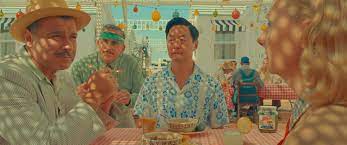
Yes, we have all the characteristics of a Wes Anderson film, and then some — eccentrics played by a Who’s Who of Hollywood, everybody speaking in a staccato deadpan.
“If you wanted to live a quiet, peaceful life, you picked the wrong time to get born.”
Characters like the motel clerk (Steve Carell) and others pointlessly say “I understand,” a lot, another Anderson trope.
But here’s the thing. It’s so airless no oxygen gets in. The laughs are few, and as dry as the fake desert this is meant to be.
Anderson serves up so many stars he barely uses some (Dafoe, Matt Dillon) and ill-uses others. The great character actor Bob Balaban is reduced to a simple silent sight gag. Not a funny one.
Some viewers will get the many cultural references, the Anderson rep company cameos, and maybe grin. Some will enthuse over the rigidly-enforced style, the totality of WesWorld.
Yet there’s no getting around that two tiered canon of Anderson’s filmography. There are films like “The Royal Tennenbaums” and “The Grand Budapest Hotel” and maybe his breakout cult film, “Rushmore,” that you can watch and revel in over and over, and that list includes his two animated hits “Fantastic Mr. Fox” and “Isle of Dogs.” And then there’s “Darjeeling Limited, “Life Aquatic with Steve Zissou,” “Moonrise Kingdom,” maybe “The French Dispatch” and almost certainly “Asteroid City,” movies that don’t beckon one to “enjoy” them again.
“Asteroid City” is like a stop-motion animated Anderson film, in which he uses real actors in stop-motion. How is indulging oneself in that reductive, self-defeating cleverness a good idea?
Whatever the twee-tempted target audience hopes to get out of Anderson’s latest, this Easter-egg-packed still-life doesn’t play.

Rating: PG-13 on appeal for brief graphic nudity, smoking and some suggestive material
Cast: Jason Schwartzman, Scarlett Johansson, Tom Hanks, Jeffrey Wright, Edward Norton, Hope Davis, Liev Schreiber, Adrien Brody, Matt Dillon, Sophia Lillis, Jake Ryan, Maya Hawke, Grace Edwards, Steve Park, Steve Carell, Willem Dafoe and Bryan Cranston.
Credits: Directed by Wes Anderson, scripted by Wes Anderson and Roman Coppola. A Focus Features release.
Running time:

 Movie Nation