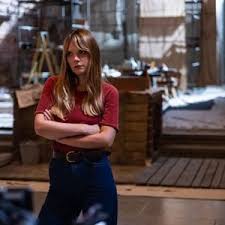
Netflixable? Dakota Johnson’s brand of “Persuasion”

I’m not positive it’s the definitive version of the Jane Austen novel, but for me, the benchmark adaptation of “Persuasion” was made for British TV and played in US cinemas back in 1995.

Casting newcomer Amanda Root as Anne Elliott, the woman who gave in to family “persuasion” and brushed-off poor Naval officer Wentworth, played by then-little known Ciaran Hinds, lent the story a bittersweet air of “last chance at love” that no other version has matched. Root, character-actress “plain,” and Hinds, then tall, awkward and hangdog-looking, were perfect as a headed-to-spinsterhood middle sister and the sort of second-choice man she’d attract.

Guess what my problem with building a winking, cutesy and anachronistic “Persuasion” around Dakota Johnson might be? Anyone wondering if one of the great beauties of her era, often cast in sexy roles, can pass for the “passed-over” and ignored middle sister in any family?

It’s not that the character is supposed to be unattractive, with limited options. Mousey, yes. But it’s damned near impossible to figure Johnson’s Anne wouldn’t have prospects the minute someone nearby threw one of those Jane Austen balls.

That said, this take on starchy, reserved, comedy-of-manners Austen isn’t awful. It may be peppered with anachronisms, from to “like I said…quite the upgrade” to “He’s a ten. I never trust a ten.”

And this Anne narrates her story, with an ironic, jokey Johnson smirk, right to the camera.

“My father — he’s never met a reflective surface he didn’t like.”

The wit seems a bit forced, the big romantic moment somewhat muted and the anachronisms just jolting enough to make us notice and think, “Wot wot? No one utters such stuff and nonsense in Austenland!”

Oscar winning screenwriter Ron Bass (“My Best Friend’s Wedding”) and actress-turned-screenwriter Alice Victoria Winslow had the unenviable task of modernizing and livening up Austen for National Theatre director Carrie Cracknell’s stumbling adaptation. They don’t wholly succeed.

They are aided by the usual Austen adaptation virtues — striking Great Houses, historic Bath, seascapes — and a good cast. Johnson’s coquettish whisper, with just a hint of period accident, goes down easily, and Cosmo Jarvis (“Peaky Blinders,” “Hunter Killer”) brilliantly conveys now-wealthy Captain Wentworth’s seven year-old romantic wound that will not heal.

Jarvis makes Johnson’s years of pining credible, and gives us everything a guy who lost a love who looks like Dakota Johnson might feel. The man seems gutted.

The wit comes from Anne’s delusional, self-absorbed sisters (a droll Yolanda Kettle and hilariously narcissistic Mia McKenna-Bruce) and primping, spendthrift father, played to perfection by Richard E. Grant, as we’d expect no less.

“Quick! Break out your finest frocks! We are about to touch…GREATness!”

And the complications, built around Anne’s forced reacquaintance with richer Captain Wentworth thanks to his Navy colleagues, her relatives and his friends, are given a brisk brush up by the arrival of the suave Henry Golding (“Crazy Rich Asians”) as a distant-enough-to-date relative who aims to inherit Anne’s father’s baronetcy, come heck or high water.

Individual scenes play better than the whole, just as some performances shine — McKenna-Bruce, Jarvis, Grant and even Ms. Johnson — and get the hang of dry Austen wit and its sometimes clumsy “try to keep up” updatings better than others.

But that mixed-bag feeling spills over to the central romance, which as I said at the outset, needs higher stakes and the desperation of “last chance at marrying for love” that the best version of this novel boasted.

The two of the three best looking people on the screen finally get together for the finale? Where’s the heartfelt relief and glorious release of that?

Rating: PG, mild innuendo

Cast: Dakota Johnson, Cosmo Jarvis, Henry Golding, Mia McKenna-Bruce, Nikki Amuka-Bird, Nia Towle, Ben Bailey Smith and Richard E. Grant

Credits: Directed by Carrie Cracknell, scripted by Ron Bass and Alice Victoria Winslow, based on the novel by Jane Austin. A Netflix release.

Running time:

Posted in Reviews, previews, profiles and movie news | Comments Off on Netflixable? Dakota Johnson’s brand of “Persuasion”

Netflixable? “For Jojo” is for the toxic co-dependent in all of us

Snippets of home movies reveal that they’ve been friends since childhood, BFFs forever growing up on a German island in the Baltic.

Now pushing 30 and living in Berlin, Paula (Cara Cult) and Jojo (Nina Gummich) still do everything together. Everything. Paula sees to that.

If she’s bored with whoever she’s hooked up with on a given night, she makes sure hers isn’t the only coitus she interrupts. Does she even know “grenzen,” the German word for “boundaries?”

Headstrong, rash and living in an almost permanent impulsive hissy fit, we wonder, as the Bee Gees sang, “How Deep is Your Love?” Because this isn’t a crush, isn’t an actual romance at all. It’s some sort of clingy toxic dependency that Paul has “For Jojo.”

Barbara Ott’s intimate, edgy film, based on a Stefanie Ren script, takes us inside a lopsided co-dependency as, we guess, it runs its course.

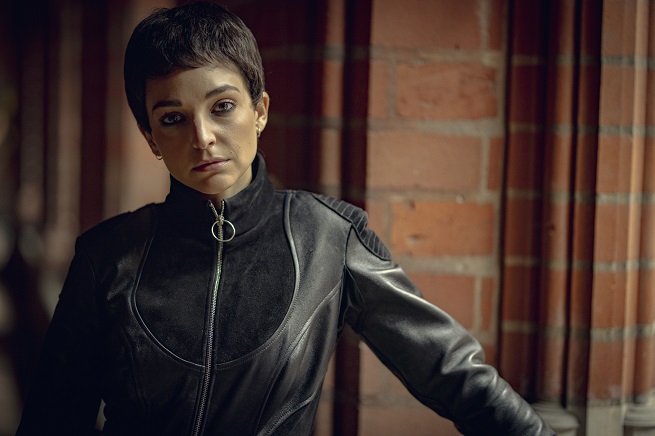
Cult, in that German shag haircut, leather, jewelry and sneer that’s become a Berlin Slacker Stereotype, ably turns Paula into a personal nuisance and a public menace.

Jojo leaves town for a stint of work in Mexico and Paula won’t leave her in peace to get her ticket to board. She spies a guy they grew up with in “Sh–sville,” on the island, and insults him repeatedly to his face. He’s flying to surf in Tulum, and Paula’s many, many calls to Jojo reveal that they’re hanging out and maybe falling in love.

Paula won’t stand for it. When they abruptly return together, Paula flips out at what they’re not telling her, stopping the shared car mid-bridge/mid-tantrum until they fess up.

When they drive Daniel (Steven Sowah) home with them, Jojo can’t stop insulting him and ignoring her doesn’t help. News that they’re already talking marriage reheats the ongoing meltdown. Jojo says she’s going back “home” with Daniel and Paula turns it up a few more notches.

“I give you guys two days,” she hisses (in German with subtitles, or dubbed into English). “Maybe until the weekend.”

So Paula is going “home” WITH them.

“I’m not letting you marry Daniel,” she declares.

Jojo ignores Maya Angelou’s advice — “When people show you who they are, believe them.” Bad move.

“For Jojo” isn’t some “Fatal Attraction” thriller. But for a non-violent drama it’s kind of brutal. The screenplay cooks up all sorts of ways for Paula — a narcissist who never thinks anything through — to sabotage this relationship that could cost her the best friend she’s been mooching off, leaning on and clinging to forever.

As Jojo is likely to say “Enough is enough” at some point, this is plainly a zero-sum game Paula is playing. We see it. She doesn’t.

Cult and Gummich plays these closer-than-sisters two in a way that makes every wedge Paula finds and every Jojo reaction to what she can see is happening in-the-moment believable.

The reasons for their deep bond are sketched in as Paula becomes completely unmoored in what is essentially a long tantrum of a movie. She uses people left and right, storms out of arguments and goes so far as sleeping on the beach to show her outrage.

Can this wedding be saved? What kind of a friend do you have to be to put up with that? We can only guess at the final straw, only speculate on the collateral damage.

And Cult, sullen and furious, manipulative and demanding, gives us as vivid a picture of toxic interpersonal dependency as we can stomach, never giving ground, crossing one line after the other until we’re screaming at her, Jojo, Daniel and the TV in indignation.

Rating: TV-MA, sex, nudity, profanity

Cast: Cara Cult, Nina Gummich, Steven Sowah, Louis Nitsche and Anne Zander.

Credits: Directed by Barbara Ott, scripted by Stefanie Ren. A Netflix release.

Running time: 1:35

Posted in Reviews, previews, profiles and movie news | Comments Off on Netflixable? “For Jojo” is for the toxic co-dependent in all of us

Movie Review: “Where the Crawdads Sing,” the audience naps

Whatever the virtues of the popular Delia Owens novel it’s based on, the film adaptation of “Where the Crawdads Sing” makes it “a beach book,” a simple, pulpy page-turner to take on vacation with you and nothing more.

A clumsily-plotted murder mystery tucked into a geographically-inept/historically-dubious period piece wrapped up in a “surviving abuse” bow, it’s so corny, slow and dull that one barely notices how colorless and uninteresting the cast is.

Set in a sort of “Sleepy Time Down South” North Carolina that would make Andy Griffith’s teeth ache, with an illiterate and never-tanned or dirty character who raises herself without adults, electricity or running water and yet somehow starts each day in the mucky, muddy swamps and marshes looking like she just got out of the production’s hair and makeup trailer, it’s a drama overwhelmed by the ways it gives anybody with a low tolerance for romance novels or Hallmark movies to mentally check out.

English rose Daisy Edgar-Jones of TV’s “War of the Worlds” stars as Kya, “the Marsh Girl,” shunned by sleepy Barkley Cove, N.C., a Low Country backwater that cruelly nicknamed this abandoned child who raised herself from the age of 10 onward as “the Missing Link.”

She’s 24 in 1969, the fictive present. Kya is a solitary swamp creature who collects feathers, nests and shells, sketches the flora and fauna around her and stands accused of murder after the hunky one-time quarterback of the high school team is found dead at the bottom of an abandoned mid-swamp fire tower.

Her tale is told in flashbacks, floridly-narrated by our heroine, as her old country lawyer (David Strathairn, classing up his scenes if not improving his tepid dialogue) tries to get her to open up as he prepares to defend her in court.

The word pictures of the novel become flatly-spoken monologues about how Catherine Danielle “Kya” Clark was taught as a child to “hide deep in the marsh, where the crawdads sing” when danger approaches. “Whenever I stumbled, the marsh’d catch me.”

Perhaps it’s the florid nature of that narration that convinced producer, Oscar-winner and Nashville native Reese Witherspoon that nobody in this story should have a Southern accent. A moment of relief that “Well, at least we don’t have another Brit attempting a drawl” is quickly replaced with, “Wait, NOBODY has one? Nobody even tried?”

The frame of the story is Kya narrating, ostensibly to her lawyer but mainly to some future reader of her diary/memoir, how she came to be in this murder rap fix, the childhood abuse of her drunken father (Garrett Dillahunt gives the most credible performance in the film) that caused her mother (Ahna O’Reilly) to just pack up and walk away in resigned shock, followed later by Kya’s siblings, one after the other.

Kya wakes up one day to find her father gone, too. So she takes the skiff and starts digging up mussels, selling them to the kindly Black couple, Mabel and Jumpin’ (Michael Hyatt and Sterling Macer, Jr.) who run the swampside general store and literarily-convenient seafood distribution operation. They become Kya’s protectors, with Mabel finding her clothes and shoes via her church charity and encouraging the child to take a stab at school. Barefoot and dirty (for the last time in the movie), little Kya (Jojo Regina) is teased right out of that idea.

But a local fisherman’s son, Tate (Taylor John Smith) takes a shine to her in their teens, befriends Kya and teaches her to read as they swap shells and feathers and such. Theirs is a storybook swamp romance until he goes off to Chapel Hill (UNC). Abandoned, Kya falls for the first hunk to show up with a shiny new boat, Chase (Harris Dickinson). That’s when things go from idealized hand-to-mouth living to a murder charge.

Scenic as Coastal Carolina is, as lyrical as Kya’s appreciation for marsh and swamp can be, one never runs out of ways this female wish fulfillment/living-happily-is-the-best revenge fantasy goes wrong.

The “To Kill a Mockingbird Rewritten by a High School Dropout” trial scenes, and the absurdly thorough-and-yet-comically-wrong-headed 1960s rural NC police investigation scenes that precede it play like the only homework anybody did was watching “Matlock/In the Heat of the Night” re-runs.

Producer Reese Witherspoon’s choice as director, Olivia Newman (“First Match”), can’t wring much pathos out of this lost-mother/abusive father/abused in love story, or get out of her own way most of the time.

And it’s not like the screenwriter or cast had any feel for the place, the people and the story. Whatever Delia Owens, a Georgia native, zoologist and under a cloud for being a possible accessory to murder in Zambia in the 90’s knows about the place, the people and the era is erased by the third time a character refers to going to “Asheville” for this, that or the other thing.

Asheville has long been a mountain vacation enclave, and is hundreds of miles from the Carolina coast, the sort of place you reach by passing through big cities like Charlotte, Raleigh or Winston-Salem. Owens screwed this up, but did the screenwriter look at a map? Or check the frequency of 1960s bus service to sleepy towns down South in before scripting multiple stops, all day and into the wee hours of the AM, every day for Barkley’s Cove?

The racism of the era is glimpsed just enough to give us a few other possible suspects in the death of the ex-quarterback. But one gets the feeling that this molasses-slow narrative is fixated on the “fantasy” side of the spectrum, with magical and insanely improbable solutions to money problems, education shortcomings, property deeds and Kya’s wardrobe and beauty regimen.

As with memoirs like “The Glass Castle,” “This Boy’s Life” and “The Prize-Winner of Defiance, Ohio,” “Crawdads” uses abuse, enduring it and escaping it in its many forms, as a literary hook. Here that’s reduced to just a couple of scenes of childhood beatings (and seeing their mother hit) and the suggestion that Kya’s got to be on her guard lest she repeat the cycle. Almost lost in the narrative, it can feel like cynical virtue signaling, just something the author thought she’d throw in to sell the book, just another deflection to hide the fact that she’s no mystery writer. Or geographer.

And while the cast is pretty far down the list of reasons “Crawdads” doesn’t come off, the lack of charisma or chemistry in the young leads and the cheapskate casting among the supporting players shows in every instantly-forgotten court or police investigation scene.

Sorry to beat the hell out of a book millions have bought and presumably adored. But “Where the Crawdads Sing” doesn’t sing a note in film form, and plays more like Nicholas Sparks than Harper Lee, more a Lifetime Original Movie than anything worth the price of a cinema ticket.

Rating: PG-13 for sexual content and some violence including a sexual assault.

Cast: Daisy Edgar-Jones, Taylor John Smith, Harris Dickinson, Michael Hyatt, Ahna O’Reilly, Garrett Dillahunt and David Strathairn.

Credits: Directed by Olivia Newman, scripted by Lucy Alibar, based on the novel by Delia Owens. A Sony Pictures release.

Running time: 2:05

Posted in Reviews, previews, profiles and movie news | 2 Comments

Movie Review: Even Mel Brooks and “Blazing Saddles,” can’t save “Paws of Fury: The Legend of Hank”

Turning the rude and shticky “Blazing Saddles” into a samurai Western cartoon starring cats and a hapless dog isn’t the dumbest idea anybody in Hollywood ever had.

Mel Brooks’ classic comedy is 50 years old, and while it was racy for its day, about the only thing about it that whispers “Oh, they could never do that now” is the way it goes straight at racism in ways that racists found and continue to find amusing.

But when the racist culture lampooned is Japanese and feline, well, that’s kind of cute. “Paws of Fury: The Legend of Hank” isn’t all that funny, and bears the hallmarks of “We’re worried about this not playing, so let’s hire a LOT of ‘names’ for the cast,” an age-old band-aid for lesser animated comedies. It’s a decently-animated, dialogue-heavy comedy that manages a few laughs from the age-old sight gags of “Blazing Saddles” and a lot of groaners that pass for one-liners.

A scheming nobleman (Ricky Gervais) from a time when Hello Kitties owned Japan wants his palace to dazzle the shogun (Mel Brooks) enough to be named his successor. But there’s this village that clutters up the view. When bandits chase off the samurai in charge of protecting it, he decides to find an incompetent replacement that will run the rest of the villagers off, and makes this decision over the objections of his faithful samurai toady (George Takei).

A joke about the palace’s new bathroom sets the tone of the humor. It’s a giant lavatory.

“I call it The Super Bowl. Because it’s a SUPER bowl!”

I doubt Gervais will be quoting from this at the next Golden Globes.

As a hapless lap dog, Hank (Michael Cera) has been arrested and scheduled for execution…because he’s a dog who wants to become a samurai, but mostly because he’s a dog in a land that doesn’t tolerate the different — Helloooo xenophobic/monoethnic Japan — Hank is who Prince Ika Chu (Gervais) sends to tiny Takamucho.

There, he’s shunned, “Blazing Saddles” style, by the anti-canine locals. He takes up with a tipsy old samurai (Samuel L. Jackson) who reluctantly “trains” him. And he confronts and converts a gigantic tabby villain named Somo (Djimon Hounsou) who was named Mongo and played by retired footballer Alex Karras in “Blazing Saddles.”

And so it goes.

Unless you and your kids are tickled at the thought of Mel Brooks joking “There’s no business like shogun business,” unless you can tolerate anything with Michelle Yeoh in it, no matter how lame, unless you find “Guns don’t kill cats…cars and CURIOSITY kills cats” and “Maybe I should start out as a ‘mall samurai'” hilarious, “Paws of Fury” may not be the comedy for you.

Hank’s a dog. So’s the “Blazing Saddles” homage cartoon comedy about him.

Rating: PG for action, violence, rude and suggestive humor, some profanity

Cast: The voices of Michael Cera, Ricky Gervais, Michelle Yeoh, George Takei, Djimon Hounsou, Gabriel Iglesias, Kylie Kuioka, Mel Brooks and Samuel L. Jackson

Credits: Directed by Chris Bailey, Mark Koetsier and Rob Minkoff, scripted by Ed Stone, Nate Hopper and Mel Brooks. A Nickelodeon/Paramount release.

Running time: 1:37

Posted in Reviews, previews, profiles and movie news | Comments Off on Movie Review: Even Mel Brooks and “Blazing Saddles,” can’t save “Paws of Fury: The Legend of Hank”

Netflixable? Italian 20 year-olds reach for romance among the rich “Under the Amalfi Sun”

It wouldn’t be summer without an insipid Netflix summer romance set somewhere in scenic, sunny Italia. This year’s entry, “Under the Amalfi Sun” hangs on a couple of youth romances that are pretty hard to invest in, and an adult one that’s strictly a non-starter.

But the scenery’s stunning, an idyllic Amalfi Coast backdrop for the rich and the pretending to be rich swimming, cliff diving, scuba diving, boating, biking, clubbing and dining out.

Camilla (Ludovica Martino) is home from college in Canada. Vincenzo (Lorenzo Zurzolo) isn’t. But as his dad has a seaside luxury apartment he’s letting them stay in, maybe he doesn’t need to go and learn a trade. They’re 20 years old, have been apart for a year and he’s ready for them to move in together. But Camilla might have other plans.

Irene (Isabella Ferrari) is Vincenzo’s doting/hovering mom. She’s been divorced for a while, and has been dating Lucio (Luca Ward) for long enough that he’s angling to ask her to marry him. Not that she’s quite ready for that.

A big obstacle to everybody’s happily-ever-after? Vincenzo is blind, reasonably self-sufficient in environments he has memorized. We kind of understand his anxiety over closing the deal with his first great love. Where is going to meet her equal?

His mother worries about him incessantly. Everybody else is wondering if Camilla’s ready for a lifetime commitment, and understands what that means with a blind mate. “Everybody,” in this case, includes Camilla.

Complications include Vincenzo’s on-the-make BFF Furio (Davide Calgaro), who pines for the stunning, designer-dressed/runway-ready Rebecca (Elena Funari), who doesn’t know he’s alive, and has no interest in changing that, and Cami’s British roomie Natalie (Kyshan Wilson), a beauty with body image issues that keep her from falling for Vincenzo’s hunky “playa” pal, Hans.

The posh setting might have been a source of stress for the young folks. Furio’s trying to come off as rich to impress Rebecca, but nobody else talks about that financial elephant in the room.

La di dah, la di dah. Let’s hop on Dad’s boat for a bit, visit Hans’ mother’s waterfront views afterward, maybe do some diving off Lucio’s boat. Not a cheap place to do any of that, and as the film has so little conflict in it, you’d think a little class friction or fretting over finances and the future would be in order.

But no.

There isn’t much to this aside from an attractive but bland and colorless cast parked in front of seaside vistas, stunning coves to swim or dive in and the like.

We don’t get much of a picture of the place, although there is a sense that it’s not really meant for young people. Not much night life, etc.

The parallel “couples in trouble” plot doesn’t play out in the most predictable ways. But it comes damned close. And even the “twists” can’t break the serenity, the calm and the boredom always present “Under the Amalfi Sun.”

Rating: TV-MA? Why? Oh, a little profanity

Cast: Lorenzo Zurzolo, Ludovica Martino, Kyshan Wilson, Davide Calgaro, Isabella Ferrari and Luca Ward.

Credits: Martina Pastori, scripted by Caterina Salvadori, Enrico Vanzina and Ciro Zecca. A Netflix release.

Running time: 1:35

Posted in Reviews, previews, profiles and movie news | Comments Off on Netflixable? Italian 20 year-olds reach for romance among the rich “Under the Amalfi Sun”

Movie Review: Let’s make a Brazilian “Barton Fink” — “Jesus Kid”

You can’t go far wrong when you decide that your “wholly original” film should be based-on, stolen-from and slavishly devoted to a famous movie by the Coen Brothers.

That’s the premise of “Jesus Kid,” a daft satire from Brazil that zings the country’s fascist-fringe government, the class wars and the delusional ditziness of a star TV commercials director who wants to turn this hack author of paperback Westerns into his “Barton Fink.”

A hapless 50something novelist, Eugenio (Pablo Miklos) has built a comfortably miserable, lonely life out of a long series of just-successful-enough Westerns. The hero of his books? The Jesus Kid, an omnipotent gunfighter with the looks and swagger of a matinee idol.

Writing as “Paul Gentleman” — because really, who’d want to put his real name on this trash, or waste even a good nom de plume on it — Eugenio has another, ready for his publisher, when he agrees to take a meeting with this pie-in-the-sky movie producer.

But fast -alking Max (Fábio Silvestre) doesn’t want the rights to Eugenio’s latest book. No, he’s indulging this director of commercials named Fabio (Gabriel Gorosito), a fabulist who wants to tell the story of “a writer in crisis...a mediocre writer who wants to be a famous writer…like ‘Barton Fink.'”

Fabio talks a good — ok INSULTING — game.

“Western is a DEAD genre,” he declares (in Portuguese with English subtitles). “Especially after what Tarantino did with ‘Django Unchained.'”

Fabio wants to lock Eugenio up in a swank hotel to write a script about a writer who is cracking up in search of that next big idea. The gobsmacked Eugenio considers the cash offer, decides “I have no idea” how to do that, and turns them down.

That’s before he takes his latest “Jesus Kid” manuscript to his publisher. That’s before he meets the hulking new chief (Helio Barbosa) of the government’s Ideological Integrity Control Council. That’s before Eugenio is told “You can no longer write books with offensive characters.”

“Offensive to…me?”

“Offensive to our Lord Jesus.”

What this mountainous Olavo fellow would prefer is that this popular (enough) writer, a “favorite” of the president, write a biography of Dear Leader, Mr. MAGA of Manaus.

OK, a stunned Eugenio figures. Maybe the movie offer isn’t so bad after all.

But he can’t even check into the hotel without believing he’s being followed by some mug in a black coat, black hat and black gloves. He can’t pack a bag without coming home to an apartment that’s been busted into, his pet fish murdered.

And even after checking in, getting past the snarky, rude desk clerk (Leandro Daniel, hilarious), Eugenio is sure he’s about to meet with some accident at the hands of this (assumed) government thug who’s shadowing him.

That’s when Jesus — the cowboy version (Sergio Marone, quite amusing) — manifests himself and starts dealing with Eugenio’s problems with his handy six-shooter.

“I exist so that you can bear your mediocrity,” his greatest creation tells Eugenio.

Director and co-writer Aly Muritiba (“Rust,” “Deserto Particular”) takes us straight down the “Barton Fink/Adaptation” rabbit hole from here on out, telling a tale of a stressed writer probably losing his marbles trapped in a posh hotel, tormented by “Chet,” as Eugenio disdainfully nicknames his desk clerk (the name of Steve Buscemi’s desk clerk in “Barton Fink”), nagged by Max and Fabio and insulted by this shapely nurse (Maureen Miranda) he meets in the hotel bar.

Writer’s block? Let Jesus tap tap away at the laptop. Maybe the nurse will proofread. She seems down for anything (after-sex-scenes show us THREE nudes in the bed, Eugenio and the nurse being two of them). Scared to death of this brute, Olavo? SOMEbody will think of something.

“Jesus Kid” is peopled with characters ranging from odd to downright bizarre, conversations that bite, cut and draw blood and a breakdown any movie-lover will recognize, as will more than a few writers.

“But it’s NOT ‘the story,'” Eugenio protests, as his director and producer confuse his complaints about what’s happening to him for his screenplay in progress. “It’s MY LIFE!”

Miklos, a well-known musician who took up acting with “The Trespasser” (“Smoke Gets in Your Eyes” might be a little more famous in North America), is adorably irritable as a character out of his depth and alarmed at his fate, no matter how miserable his old life was.

Miranda is a sassy, dismissive broad mean far beyond what her ordinary looks suggest. I thought she was playing a hooker, at first.

And Marone, who played Pontius Pilate in a Brazilian version of “Jesus of Nazareth” a couple of years back, is a smoldering hoot — funny from the moment we first glimpse him in his cowboy hat, kerchief and holstered pistol.

The movie, like the movie within the movie, hangs up on “the ending.” But a droll, comically sparkling cast make “Jesus Kid” a near bullseye among gunslinger Savior Westerns adapted into “Baton Fink” writer-in-crisis dark comedies, which when you think about it, should become a genre all its own.

Rating: unrated, violence, lots of nudity, profanity

Cast: Paolo Miklos, Sergio Marone, Maureen Miranda, Leandro Daniel, Gabriel Gorosito, Fábio Silvestre and Helio Barbosa

Credits: Directed by Aly Muritiba, scripted by Laura Malin and Aly Muritiba. An IndiePix release.

Running time: 1:28

Posted in Reviews, previews, profiles and movie news | Comments Off on Movie Review: Let’s make a Brazilian “Barton Fink” — “Jesus Kid”

Movie Review: “The Deer King” rides a doe in this anime quest fantasy

A “chosen one” and a “chosen child” ride a doe to their destiny among the Lone Antlers and Fire Horse People in “The Deer King,” a lovely if somewhat cluttered anime fantasy from GKIDS.

It begins with a mountain of back-story and piles exposition — new characters, new locales — almost all the way through the third act, which tends to make this simple quest tale drag as it lumbers towards its finish.

In a time of Black Wolf Fever, the uneasy dominion of the conquering Zolians and the subjugated Aquafa is upset when a prisoner of the salt mines, Van, battles an onslaught of wolves about to kill an orphaned toddler named Yuna. Van survives the bite, which spreads Black Wolf Fever, and develops super strength. He rescues the babe, whom he raises as his own in a peaceful nomadic village in Aquafa country.

But this plague has brought the court physician of the Zols, Hohsalle Yuguraul, to visit the infected Aquafa and their “priest doctors.” He is sure there’s a reason this disease only used to infect the Zols, and that it’s not some superstitious curse. To “transcend history and dispel fear” he must find, observe and test Van’s blood to see if it offers a cure.

The female tracker, Sae, is sent to find Van and the child so that the physician can explain his theory and perhaps save all who are swept up in the plague, which manifests itself in a purple tsunami of wolves, spreading the contagion far and wide.

“Saving the body saves the soul,” the physician explains.

Van just wants to get the child to safety and this quest lets him accidentally discover the breadth and depth of his various new superstrengths.

This is a pretty and pretty violent film directed by animators who worked on “Paprika” and “Spirited Away” and a screenwriter who has specialized in anime TV series. That explains why the story is almost overwhelmed with plot flourishes, characters and agendas. There’s a TV season’s worth of exposition jammed into this thing.

The violence takes the form of bloody wolf attacks, arrow impalings and knife and sword fights, with Van enduring many a bandage thanks to the brutal assaults.

It’s not the easiest tale to follow. Perhaps more explanations and discussion of competing agendas, treachery and old grudges would have helped. The “emperor” keeps track of this Medieval Japanese world via magical balloons called “The Emperor’s Eyes,” but we never see this chase unfolding in a way that the emperor sees. Considering all the ideas cribbed from Tolkien, it seems a shame the “seeing stones” were forgotten.

I saw the Japanese (subtitled) version of “Deer King,” which made viewing a bit of a grind, I must say — A J.K. Rowling sea of names of foods, characters, places, legends, illnesses, ridable (and milkable) magical deer and the like — rather like the Old Testament-endless pages of creatures, names and what-not that that give a kind of tortuous texture to Tolkien

“The Deer King” isn’t on a visual par with the best anime, most of it generated by Studio Ghibli. But it’s head and shoulders above the TV mass-production look of “Dragonball” and its ilk. I’d say the same for its story, but that could have used some serious editing before production began.

Genre fans may eat this up, but it’s not anything I’d call a “must see” film, despite its obvious ambition.

Rating: R, for some violence

Cast: The voices of Shin’ichi Tsutsumi or Ray Chase, Anne Watanabe or Erica Schroeder

Credits: Directed by Masashi Ando and Masayuki Miyaji, scripted by Taku Kishimoto. A GKIDS release.

Running time: 1:53

Posted in Reviews, previews, profiles and movie news | Comments Off on Movie Review: “The Deer King” rides a doe in this anime quest fantasy

Today’s DVD donation? The “Jesus Kid” comes to Oviedo

I am writing the review of this Brazilian satire shortly, but suffice it to say, it’s a hoot. A riff on politics, writers and writing and a movie maker who insists on getting this nom de plumed hack who writes paperback Westerns under the name Paul Gentleman to become his “Barton Fink.”

Eugenio, our 50something novelist, has been threatened by the Bolsinaro regime for being blasphemous — his novels always feature the amoral gunfighter, The Jesus Kid. That same regime is willing to resort to violence to get Eugenio to write the president’s biography.

Paranoid, hallucinatory, subtitled fun. I hope the residents of Seminole County Florida are ready for it!

MovieNation, spreading international cinema to the southeast, one DVD, one library at a time.

Posted in Reviews, previews, profiles and movie news | Comments Off on Today’s DVD donation? The “Jesus Kid” comes to Oviedo

Documentary Review: Courtney Barnett invites us on tour, into her “Anonymous Club”

Australian “slacker rock” star Courtney Barnett and her longtime music video collaborator Danny Cohen team up for a Courtney-and-nothing-but documentary, “Anonymous Club.” It’s not so much an invitation into her world as a peek at it from an almost safe, emotionally-muted distance.

She shows us something of her process, but little of “the Real Courtney” comes through as she and Cohen keep things at a personal arm’s length, if not an emotional one.

Barnett talks about her “feeling sad days,” which produce such self-deprecating singles as “Depreston,” “Anonymous Club,” “Pedestrian at Best” and “Nameless Faceless.” This raw confessional style is her brand. She’s noticed that people “never look up,” they’re always staring at the ground or ahead, or at their cell phones.

“Well time is money and money is no man’s friend. And all eyes on the pavement, I’m not gonna touch ya don’t worry so much about it.”

Cohen gives her a recorder to make an audio diary, where she talks about what she’s doing, the tour she’s on, often just before bedtime. She reads comments from her blog, where she invites fans to talk about rough emotional times they’re going through. And she reads one suggestion about how she should never do another interview again.

It’s only when we see her interviewed — awkward, bored and boring, evading faux complex questions and doing it in the same flat voice (“deadpan,” her fan-critics call it) we hear her sing in that we get it. She’s pretty bad at this part of the career-making exposure.

There are little glimpses of her personal life (she’s gay) and lots of short cuts from her concerts, large venues and small, sing-alongs with fans and one or two actual interactions with them.

There’s little about that screams “rock star,” with her unruly Chrissie Hynde mop and obscure, Ani DiFranco-meets-Chrissie songs-as-therapy songbook. I dare say she could walk most city streets and not earn a second glance — no hint of glam to her.

Honestly, I didn’t get enough of the music and the “process” — picking out tunes to go from long, closely-typed pages of lyrics and phrases in the studio — to come to a conclusion about her as an artist, other than the voice is nothing special squared.

The film’s aesthetic mistake is in limiting the movie just to her, denying us any vocal or visual variety, not letting the folks who made her an AIR (Australian Independent Records) awards maintstay, onetime Grammy nominee and global touring hit tell us why she’s special.

Kurt Vile is her fellow “slacker rock” star and has written for her and performed with her. She doesn’t need his validation, but one monotonous voice makes for a monotonous movie.

At one point, she covers “I’m So Lonesome I Could Cry” — an apt choice, considering her self-confessed malaise — so plaintively and emotionally flat I almost cried.

One gets a hint that maybe her inspiring backstory — a ballerina’s daughter, self-produced and distributed debut LP (five years before a “Best New Artist” Grammy nod), “born in Sydney, raised in Hobart (Tasmania), based in Melbourne” rise to stardom — makes better copy than hard analysis of why the work speaks to so many.

The audio diary is something of a non-starter, in which Barnett sounds weary, references “Nico, the singer” and suggests “I was an EMO kid before I knew what “EMO” was,” as if we hadn’t figured that out.

All of which circles round to my original point. “Anonymous Club” isn’t an invitation. Don’t know the lyrics? Kind of hard to make them out. Underwhelmed by this guitar snippet or that one? Well, she does like the label “slacker garage rock.”

Leave this one to the fans.

Rating: unrated

Cast: Courtney Barnett

Credits: Scripted and directed by Danny Cohen. An Oscilloscope Laboratories release.

Running time: 1:23

Posted in Reviews, previews, profiles and movie news | Comments Off on Documentary Review: Courtney Barnett invites us on tour, into her “Anonymous Club”

Movie Review: A Marriage takes maybe its final turn, “The Wheel”

At certain points, relationships can develop their own momentum, careening headlong towards affirmation or collapse. And heaven help anybody trying to stall the inevitable, put the brakes on or turn “The Wheel.”

Albee and Walker are hurtling towards the abyss when we meet them in Steve Pink and screenwriter Trent Aktinson’s intimate indie dramedy. Or rather she is. Walker (Taylor Gray) is grasping at straws, dragging Albee (Amber Midthunder) out for a romantic weekend getaway at an AirBnB. Albee is resigned to “this sh—y thing” she’s agreed to do, and she never lets him or us forget it.

Walker has this plan, consult a self-help book he picked up for little or nothing — “Seven Questions to Save Your Marriage.” They’ll spend a weekend, “four questions today, three on Sunday,” and sort things out.

Question one? “What was the first thing that drew you to me?”

They’re very young, their hostess Carly (Bethany Anne Lind) notices. And yet they’ve been married eight years.

“We were 16,” Walker blurts. “It was Texas.”

Maybe they’ll hit that Ferris wheel they drove by on the way up, Albee tells Carly, “if we’re not divorced.”

They’re both given to blurting.

“The Wheel” is about that marriage about to break up, and co-owners Carly and Ben (Nelson Lee), who are about to marry, trying to intervene. Well, she wants to intervene. He’s picked up on toxic Albee acting like “a monster.”

“Maybe they’re not supposed to be together,” he reasons. “She doesn’t need help. She needs an exorcist!”

“Bad relationships are contagious,” he adds as a warning.

Over the course of the weekend, both couples will be tested. Revelations will explain characters — some more than others — the marriage and the desperate way it began. And we watch and shake our heads and wonder if this plunge over a cliff can be averted, or even should be.

The intimacy of this movie seems to raise the personal stakes among the four. Aussie TV writer Atkinson makes up our minds for us about this character or that one, and then upends those formed opinions.

Midthunder (TV’s “Roswell”), affecting a sort of cruel-cloying Aubrey Plaza vibe, is perfectly believable as a 24 year-old aspiring actress out to sabotage this marriage, come hell or high water. Gray (“Walt Before Mickey”) comes off as that all-in very young guy who can’t imagine life without Albee, mainly because he has no perspective.

Prospects don’t look good, and seeing the waves Albee makes in the about-to-marry couple, we don’t dare hope for any sort of happy ending for “The Wheel.” With this cleverly unassuming script, anything could happen, no matter where the momentum is taking them and us.

Rating: unrated, profanity

Cast: Amber Midthunder, Taylor Gray, Bethany Anne Lind and Nelson Lee.

Credits: Directed by Steve Pink, scripted by Trent Atkinson. A Quiver release.

Running time: 1:23

Posted in Reviews, previews, profiles and movie news | Comments Off on Movie Review: A Marriage takes maybe its final turn, “The Wheel”