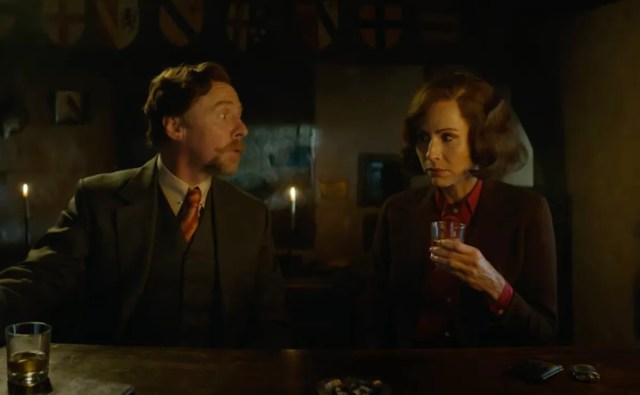
There’s a “Nefarious” vibe to this Sept. 22 release, with a murderous chuch shooter (McCord) telling her interrogator (Cain), with a “Hell is real” and “deal with the Devil” message.
Sept. 22 in theaters, streaming shortly thereafter.
There’s a “Nefarious” vibe to this Sept. 22 release, with a murderous chuch shooter (McCord) telling her interrogator (Cain), with a “Hell is real” and “deal with the Devil” message.
Sept. 22 in theaters, streaming shortly thereafter.


“Friday Night Plan” is a genial but utterly generic “get-to-the-big-party” teen comedy, a slow-footed Indian version of a universal formula that was never limited to just Hollywood, which has taken many a swipe at it over the decades (“Can’t Hardly Wait,””Booksmart,” “House Party”).
“Plan” is set among private school kids in Mumbai, in particular two mismatched siblings, played by Babil Khan (son of famed Indian actor Irfan Khan) and screen newcomer Amrith Jayan.
Sid, short for Sidhartha (Khan) is a studious senior at the International School of Mumbai, fretting over where to go to college, worried about grades and condemned to sit the bench on the school soccer team. He is tentative about life, and timid around classmates, a bit of a wallflower.
Sixteen year-old Adi (Jayan) is his irritating, overreaching little brother, forever “embarassing” Sid, pretty much since birth, a fact we see verified in flashbacks. Adi thinks he’s figured out how to live and thrive in school, by hanging out with Sid, his teammates and the “cool” kids.
Only Sid isn’t “cool.” Until that is, he scores the only goal that beats archrival Global School of Mumbai. A flash of notoriety, amplified by Adi’s hype, and the next thing Sid knows, he’s invited to the weekly “Friday Night Plan,” a cool kids cut-loose party. Adi will tag along, despite Sid’s best efforts. And Adi will nag Sid into asking “the prettiest girl in school” (Medha Rana) to the prom.
It wouldn’t be a teen party movie without single (widowed) mom (Juhi Chawla) being “out of town” on business. She’s told Sid to keep an eye on his brother, and stay away from her Skoda Superb sedan.
Also part of the formula, Adi’s cool super-smart and cute classmate Nitsy (Aadhya Anand) is hot-girl Natasha’s little sister Nitsy. She will be Adi’s conscience, as we know the smarmy kiss-up is about to get himself and Sid into a night of trouble.
The few laughs come from one Goth classmate’s reaction to Sid’s new “stardom” — “You’re metal!” (in Hindi, or dubbed into accented English) and the idea that the junior member of the family has to instruct his older brother in beer pong, or whatever it’s called by the cool kids of Mumbai.
Director and co-writer Vatsal Neelakantan (“Inside Edge”) dawdles through the predictable waypoints of this day-and-a-night-and-morning-after tale of partying, pranking and growing up. He wastes screen time showing us how irritated a local cop is to be caught in the soccer teams’ prank battle, shifting attention away from the kids, who at least get to turn a karaoke moment into a production number.
This genre story, almost always told with a “Ferris Bueller” flush of affluence, has a universality that kids from many cultures can connect with, and a warm familiarity that its many prior incarnations turn into expectations among adults watching it.
It’s a shame that the tale, like its hero, is so tentative, timid and slow in getting us where we know he and the film are taking us.
Rating: TV-14, teen partying, profanity
Cast: Babil Khan, Amrith Jayan, Aadhya Anand, Medha Rana and Juhi Chawla
Credits: Directed by Vatsal Neelakantan, scripted by Vatsal Neelakantan and Sapan Verma. A Netflix release.
Running time: 1:49

“Borderline” is an awful, amateurish “psychosexual thriller” that lurches between straight-up sexual exploitation and heavy-handed downward-spiral-of-drug-addiction cliches.
There have been good pictures with this common title, so don’t confuse them. Rich Mallery is the writer-director of this leering “let no starlet be un-ogled, let no young woman in the cast keep her top on” trash, a picture that somehow manages to wallow and stumble at the same time.
Charli, our heroine, is introduced with a flourish — a screeching, threatening, pleading and name-calling tirade through her mother’s locked bedroom door. Charli has problems, debts, mental disorders and addictions. Right now, he needs $300 or she’ll go out and sell her body for the cash.
She gets it and promptly blows it on more pills, causing her to “hook up” with her roomie and best-friend Zee (Kylee Michael, let’s hope that’s a stage name).
Charli is credited as Emma Jade in the film, with IMDb saying the actress is Kate Lý Johnston (this is an…interesting filmography). Seeing the film, one totally understands the name change.
Charli, we quickly figure out, is manic and prone to self-injury. She is delusional, fleeing her escalating problems and debts with more drugs. “Bipolar Disorder” is the official diagnosis. Her treatment meds for that make her sick, so she won’t take them. Instead, she’s self-medicating, stumbling from pill to pill, lashing out in paranoid rages and using Zee, her “boyfriend” (Irmon Hill) and anyone else she can think of to score more Oxy, Molly or what have you.
Oh, and she’s a nurse. Her kinkiest drug connection might be the doctor (Quentin Boyer) who trades drugs for fetishist favors at the office, with the promise of more to come if she joins him for “dinner.”
It’s the sort of no-budget film where background sound effects, a table with two beer bottles on it and a wall passes for “a bar,” and similar tricks are used to avoid showing us “the club” or “the mother.”
The acting isn’t anything to single out as a positive or negative. But the plot and inattention to details are straight out of low budget porn. Charli shows up for a dealer who doesn’t know her, is made to strip (of course) to prove she’s “not a cop,” is photographed and gets her drugs. But no money changes hands. Whoops. The foreshadowing “Lemme borrow your taser” pays off with a medically-indefensible reaction by one character to being tased.
Another scene has the shapely drug dealer (uncredited) strip for reasons only the leering film crew can explain. Maybe.
The “serious” scene has Charli try to describe her illness to her roomie/bestie-with-benefits.
“I don’t know what’s real, sometimes.” She always thinks “people are lying to me.” “What I think doesn’t line up with reality.”
Everything else in this movie from the writer-director of “Felines” and “Maid Droid” is just icky exploitation. Watch the camera track down to bare or near bare bottoms or up to naked breasts, because the script has so many “reasons” for its attractive young cast to um, change clothes or just strip.
Rating: unrated, violence, drug abuse, nudity, profanity
Cast: Kate Lý Johnston, Kylee Michael and Irmon Hill.
Credits: Scripted and directed by Rich Mallery. A Cinema Epoch release.
Running time: 1:41


“Rotting in the Sun” is the most sexually explicit gay missing person hunt in the history of cinema.
It’s a dark, deadpan comedy that isn’t really funny, but whose premise is the the quintessence of “permission to laugh.”
A suicidal filmmaker desperate for a comeback or a quick, painless death, goes missing in Mexico City. And the only person concerned about what might have happened to him is this vapid American Instagram influencer who desperately wanted to A) team up with him on a project and B) get in his pants, although they meet on a Mexican same-sex vacation mecca that’s basically one long nude bacchanal.
Pants? Optional. Frowned upon.
An added twist is that the missing filmmaker is the this film’s director and co-writer, Chilean Sebastián Silva (“The Maid (La nana),” “Crystal Fairy & the Magical Cactus”) playing a thoroughly unlikable exaggeration of himself.
The influencer is comic Jordan Firstman, who had an Instagram moment during the pandemic. Firstman’s parody-version-of-himself is a relentlessly upbeat hedonist without a deep thought in his head or a sexual inhibition in his over-exposed body.
They meet, by accident and by coincidence, in the waters off Playa Zicatela. Jordan’s a guy who is drowning, yanked along by the rip tide while a vast audience of nude gay men shout at him from the beach, that someone should save him, and who shout directions at Sebastian, already in the water, to do what they won’t.
But Sebastian is a brooding ketamine addict, buried in reading and (voice over) quoting E. M. Cioran’s “The Trouble with Being Born” and who has come to this beach to either talk himself out of suicide, or do something about it.
Jordan, not really “saved” by Seba, bowls him over with fanboyish enthusiasm for his work, happily crediting Sebastian with his salvation and ready, on the spot, to pitch this inane “‘Curb Your Enthusiasm,’ but positive” show concept — “You Are Me” — to the filmmaker, who isn’t having it.
“You’re not funny at all,” is Sebastian’s opening salvo. But Jordan’s relentless invitations, come hithers and the like wear on him. At least he doesn’t end it all on vacation, although Jordan videos Sebastian snorting Ketamine and posts it on Instagram. “That’s what I do,” the empty-headed icon bubbles.
When Sebastian is sober and focused enough to have his Zoom pitch meeting with HBO, the only show idea they go for is “You Are Me,” a plot point ripped off from “Seinfeld” and plenty of other showbiz stories.
But when Jordan shows up at Sebastian’s arist’s studio/apartment, the guy is nowhere to be found. Seba’s “friend,” who owns the building, isn’t concerned. His maid (Catalina Saavedra, who starred in Silva’s breakout film, “The Maid”) is evasive, using the language barrier to avoid the annoying gay gringo.
Can this hedonistic dim bulb ever sober up enough and get his mind off sex long enough to Google Translate his way to figuring out what happened to this filmmaker, whom he’s calling “My husband” on social media?
Director of photography Gabriel Díaz uses a lot of hand-held sequences to accentuate the social media vibe of this story, which is basically a “Columbo” episode for the influencer era. We know what’s happened. We’re just wondering if the shallowest American south of the border can figure it out.
The tale, acted-out in Spanish and English, unfolds ever-so-slowly. Truth be told, the Anal Sex Beach Party goes on and on as if to test the audience, and revisiting that carnal chaos for a “party” Jordan throws in his missing “husband’s” flat just underscores how out of his TV friendly twink is, picking up clues and “lighting up” Sebastian on social media for the perceived slight of “ghosting me.”
Silva manages little suspense, and the slack pacing and odd “Why would he/she do that?” moment had me on the fence with this one.
But a bravura finish seals the deal. So if you watch only one sexually-explict gay sex romp/missing person mystery this year…
Rating: unrated, drug abuse, suicide is discussed at length, explicit sex, full frontal nudity, profanity
Cast: Sebastián Silva, Jordan Firstman, Catalina Saavedra
Credits: Directed by Sebastián Silva, scripted by Pedro Peirano and Sebastián Silva. A Mubi release.
Running time: 1:51



A rich and powerful patriarch faces the end with a household full of women scheming against him in “The Origin of Evil,” a clever and twisty French thriller that’s a little bit “King Lear” and a little bit more “Sucession.”
Sébastien Marnier’s film invites us to root for this or that character amongst the schemers depicted here — old man Serge (Jacques Weber) being out-manuevered by his vindictive daughter George (Doria Tillier), being bled dry by his hatefully-spendthrift wife Louise (Dominique Blanc), being robbed by their adored but sneaky cook and housekeeper Agnes (Véronique Ruggia), the granddaughter (Céleste Brunnquell) who may be a mere observer, but one prone to taking sides.
And then there’s the struggling fish-packing plant worker, the long lost illegitimate child given a man’s name, like his other daughter. Stephane (Laure Calamy) has just tracked Serge down.
“No no, I don’t want anything,” she insists to him. But we’ve seen her parlous, messy life, the room she’s renting being taken away, the calls she keeps making to Toulon Prison.
Just when you start to figure out one character is worth pulling for, their greed, their sketchy past, their anti-semitism, homophobia or what-have-you bubbles up.
Louise suffers from “syllogomania” and their Porqueralles villa is stuffed with junk, the phone constantly in her hands, the TV constantly tuned to whatever French home shopping network has her attention today.
“I know she does it to piss me off,” Serge tells his newfound daughter (in French with English subtitles).
Agnes the maid avails herself of whatever prizes Louise can’t keep track of as she stores it all.
George runs her father’s businesses “American style,” and loathes every breath he takes.
“Stop, you’re breaking my heart,” he cracks at some feigned slight.
“We can rip it out, too,” she threatens. George is obviously the one most afraid of new “sister” Stephane’s arrival, telling her “Don’t come back.”
But Stephane has seen the opulence, the comfortable life. And we know she’s lied about her job to her father, and she won’t produce ID for George.
Director Marnier (“School’s Out”) and co-writer Fanny Burdino give us motives and give away character flaws that throw us off the scent as they direct, re-direct and misdirect our loyalties.
Calamy, of the recent “Two Tickets to Greece” and “My Donkey, My Lover and I,” makes our central character smiling yet mysterious, just polished and performative enough to wonder about and just cunning enough to root for, no matter what we find out about her.
She can’t be worse than anybody else, right? Her “new family” ranges from dizzy and rude to treacherous and downright dangerous.
Weber gives Serge shades of “a man in full,” hints of entitlement mixed with aged regrets he claims he does not harbor because “we all make mistakes.” Failing health or not, we cannot underestimate him.
That’s true of everything in this confection of a mystery. We’re forever being shown how we don’t really know what cruelty this character is capable of, the kindness of another, the extremes each will go to cultivate her or his self-interest.
It’s not “Lear” or “Knives Out” or “Succession,” but “The Origin of Evil” works, a thriller that keeps you guessing as it keeps time like a pretty good French knockoff Swiss watch.
Rating: R, violence, nudity, sex
Cast: Laure Calamy, Jacques Weber, Dominique Blanc, Doria Tillier, Véronique Ruggia, Céleste Brunnquell and Suzanne Clément.
Credits: Directed by Sébastien Marnier, scripted by Fanny Burdino and Sébastien Marnier. An IFC release.
Running time: 2:02



“Outlaw Johnny Black” takes its title from “The Outlaw Josey Wales,” its first gag from “A Fistful of Dollars,” its hero’s wardrobe from “Django Unchained,” its plot from “Buck and the Preacher” (sort of) and its cast from a pool of folks who knows how cool Michael Jai White’s “Black Dynamite” was.
This parody of blaxploitation Westerns starts funny, hits the sweet spot a few times and finishes reasonably well. But the long middles acts? Like the cowboy who recognized the tall green man made of rubber said about his horse, “That there’s a little Pokey, pardner.”
White plays a lone gunman on the range, hunting down the curr (Chris Browning) who killed his preacher daddy (Glynn Turman, seen in eyepatch flashbacks). Johnny Black figures the murderer has a bullet with his name on it. Because that’s in Johnny’s pocket, a Colt round with “Brett Clayton” etched on the casing.
Johnny himself is wanted, as we learn when he busts up a street assault on a Native American (not really) couple. The good folks in “Cheyanne” (note the spelling) recollect he’s up for “bank robbery, train robbery, improper white woman eye contact,” the works. They recognize him from his wanted poster.
Actually, that’s a photo of ever-smiling Scatman Crothers, “The Shining” star who died during the Reagan administration.
Our tone is set, a jokey Western with quick gunplay and Johnny dropping bad guys with his quick kicks “upside your head.” The plot is put in motion when Johnny takes the place of a preacher (Byron Minns, co-writer) he figures hostile natives have killed, and tries to pass himself off as a Man of God at sleepy, intregrated Hope Springs.
Barry Bostwick plays the town boss who wants to get the church’s land (oil). Two sisters (Anika Noni Rose and Erika Ash) vie for the can’t-recall-his-daddy’s-sermons reverand’s romantic attention. And the saloon singer (Jill Scott) regales the yokels, cow-punchers and gunmen with her bluesy rendition of that Old West standard “You Ain’t S–t!” between barroom brawls.
There’s funny stuff here, and gags as lame as having Johnny’s horse literally “kick the bucket.” White’s fighting skills aren’t put on display often enough. But the pacing is funereal. . There’s no giddyap or get-up-and-go to a 132 minute movie with 75 minutes of plot and jokes. Not even Michael Jai White’s cool enough to cover for that.
The long cast list on IMDb suggests this has to be cut down a bit just to get it this “short.” It wasn’t enough.
Rating: PG-13, violence, sexual situations, profanity
Cast: Michael Jai White, Anika Noni Rose, Erica Ash, Barry Bostwick, Jill Scott, Chris Browning, Tommy Davidson and Glynn Turman.
Credits: Directed by, scripted by Michael Jai White. A Samuel Goldwyn release.
Running time: 2:12



I was attending my first New York Film Festival in 1990 when the Chinese Cinema Revolution reached America’s shores.
The film was Zhang Yimou and Yang Fengliang’s overwrought, elegaic and allegorial “Ju Dou,” and it gave much of the world its first taste of the great Chinese filmmakers about to break out of the confines of the People’s Republic, the force of film nature that was actress Gong Li and the glories of Chinese color cinematography.
“Chinese Technicolor” was the whisper around Alice Tully Hall. Hollywood and European movies just didn’t look like this. Not any more.
Titles like “Life on a String,” Raise the Red Lantern,” “To Live,” “The Story of Qiu Ji” and other “Fifth Generation” Chinese cinema poured out, a red tide of gorgeously-shot films that sometimes battled past censors, sometimes made their points obliquely and metaphorically, and bowled over the movie world.
The masterpiece among those masterpieces has to be “Farewell My Concubine,” a true epic, a Chinese “Doctor Zhivago” that takes a Chinese opera relationship between “stage brothers” from the 1920s and an “Oliver Twist” youth with beatings and a suicide in opera school, through the Sino-Japanese War (WWII), the Communist takeover, the denunciations of the Cultural Revolution all the way to 1990.
And its central relationship is notable for being an (apparently unrequited) same sex love story, two stars of China’s stylized all-male opera, mentoring and supporting each other, feuding in jealousy when one gets married, struggling to save each other from the Japanese, the Nationalist government, the Communists and each other over the decades.
Chen Kaige’s film was banned in China for its homosexuality, suicide and perhaps for the unflattering depiction of the uglier aspects of Chinese Communist history, and that only made it more tempting to Western audiences.
For its 30th anniversary, “Farewell My Concubine” has been restored for re-release by Film Movement. Well done. This is a movie lover’s bucket-list film, so you have your orders.
Two aged stars are seen in silhouette, rehearsing in in the fictive present. They’ve been apart for decades, they tell a facilities manager. A lot of things kept them apart.
It was “the Gang of Four’s” doing, one jokes. “Isn’t everything,” the other cracks?
Decades before, a child was given up by his prostitute mother to the almost Medieval — in more ways than one — Peking Opera. He is rejected for his bent back and having an extra finger on one hand. His mother gets him off her hands by lopping off that extra finger. The opera’s Dickensian leadership straps little Douzi to a rack to straighten his back. But the canings doled-out to one and all as their “training” could kill the slight shild.
The rebellious Shitou sticks up for him, turns back the bullies and even takes a caning of two on the frail child’s behalf. They bond for life.
The film is a nearly three hour saga of their relationship as it spins around their most famous roles, as the concubine and the king in a popular Chinese opera. Life onstage mimics life offstage, with the feminine and demure Douzi, aka Cheng Dieyi (Leslie Cheung) pitching his voice in its highest register and his bluff, breaks-bricks-with-his-forehead co-star and protector Shitou, using his given name Duan Xiaolou (Zhang Fengyi) as an adult, playing the masculine, belicose but romantic king onstage and off.
They study, face years of corporal punishment and are discovered by an impressario, a moment of triumph with a brutal bloody edge. Dieyi is pursued by a rich “patron” (You Ge) with a thing for opera and the most feminine opera star of them all. And Xiaolou carries on with a local prostitute (Gong Li) until she is pursued by a few too many suitors and he rashly tells this “damsel in distress” and her cruder customers that they’re engaged.
Dieyi doesn’t take this well. Their testy menage a trois is pulled this way and that by the fortunes of World War II, Japanese threats followed by denunciations by Nationalists topped by dogmatic and judgmental Communists who kick out the Nationalists.
Gong Li’s turn as Xuxian shows vulnerability, insecurity and on a couple of occasions when the chips are down, a steely resolve and eye for leverage against this new “official” threat or that one. We never question her love for her savior, or her grudging acceptance of his connection with his co-star.
The “stage brothers” act and fight and struggle to get along and face one moment of truth after another as they surf the currents of turbulent 20th century Chinese history. And every so often, a tableaux of that history intrudes on their insular world.
They live their whole lives by the ethos of their cruel taskmaster of a teacher (Qi Lü).
“If you belong to the human race,” he barks (in Mandarin with English subtitles), “you go to the opera.” It is what marks someone’s “civilized” “humanity.”
The scope of the script, based on a Lillian Lee novel (she co-adapted it) became a template for Chinese “Fifth Generation” cinema, a way of relating modern Chinese history and rationalising the excesses of this leader or that era through a personal story.
The peformances are startling in the stylized gestures and almost musical sing-song of the stage work and the unspoken bond and love, jealousies battling loyalties, offstage. The echoes of their childhood “training” and trauma spill over onto a baby that take into the company as children, whom they later try to train the same way as an adult (Lei Han) — lots of canings and worse.
But it is the colors, the life contained in those vivid those tableux, the theaters, street scenes of this or that army marching by, the shadows and fog of “reality” intruding on the rigidly constrained theatrical performances that stick in the memory from this masterpiece.
“Farewell My Concubine” captures a moment in cinematic time when artistic freedom of expression first publicly chafed at the restraints of a totalitarian state. Here was a government that was no longer in sync with the vibrant, long repressed culture all but exploding off the screen thanks to a generation of artists ready to show the world masterpieces, even if their leaders weren’t sure they should allow them to.
Rating: R, violence, sex, profanity
Cast:Leslie Cheung, Zhang Fengyi, You Ge, Ying Da, Lü Qi, Lei Han and Gong Li.
Credits: Directed by Chen Kaige, scripted by Lillian Lee and Lue Wei, based on Lee’s novel. A Film Movement release.
Running time: 2:51


Like astronauts Neil Armstrong and Guion Bluford, former New York Mayor Michael Bloomberg and movie directors Steven Spielberg and David Lynch, I am an Eagle Scout. In Lynch’s case, he used to approve only one biographical sentence in press notes delivered to movie critics whenever he had a film coming out.
“David Lynch, Eagle Scout, Missoula, Montana.”
I always thought that was cool. But any Scouting recognition lost a lot of its lustre in the early ’90s, when a century of sexual abuse and its cover-up came to light in Patrick Boyle’s damning expose, “Scouts Honor.” My father was a Scoutmaster, and I remember talking with him about the book and the TV coverage that erupted when the many “local” stories turned into a national scandal.
He and I encountered scores of Scouts and Scout leaders over the years. Neither of us had a clue, which tells you…nothing. Because that’s the way the Boy Scouts of America “handled” this “problem” for decades. It was covered up. Kids generally are afraid and ashamed to talk of abuse while its happening, and there weren’t any whispers either of us heard about Scout leaders and troops in our corner of rural America.
But as the new documentary “Scouts Honor” makes clear, it was going on from the beginning of the Scouting movement in England. The Boy Scouts of America would publish “Red Flag” lists of pedophiles whod been caught and might try to “volunteer” with a new troop in a new town way back in the 1920s.
“Scouts Honor: The Secret Files of the Boy Scouts of America,” delivers just what its title promises, apalling accounts of decade after decade of minimizing horrific abuse by serial boy-rapists, a scandal so big it “dwarfs” the “Catholic Church and Baptist Church” scandals, as one expert testifies in the film.
Brian Knappenberger’s film is built around testimonials of many men who have come forward to sign onto the lawsuits that pushed the Boy Scouts of America into bankruptcy, and interviews with Boyle, who blew the lid off this national “corporate” scandal, with BSA insider and whistleblower Michael Johnson, Scouting’s first “Youth Protection” officer, a veteran child abuse investigator with the Plano, Texas, PD, and former Scouting legal counsel Steven McGowan, who correctly states that “We’re a microcosm of entire society. If we had a problem, our society had a problem.”
Most of what McGowan says on camera comes off as “deflection,” blame-shifting and in Johnson’s words, “lying.” Johnson, who came on board long after the national scandal blew up, complains that the culture hasn’t changed and that too little has been done to prevent pedophiles from pursuing a Boy Scout association to aid their predations.
“Why did you choose the Boy Scouts,” one convicted sex offender (in prison) is asked? “Because they made it so easy.”
The victims’ testimonies can be heartbreaking and infuriating — a brother remembering his younger sibling who killed himself, as a teen, after being molested by a Catholic priest/schoolteacher and Scout leader in New Jersey in the ’70s, and most chilling of all, the “sex ring” that suspiciously “single men” set up with New Orleans Troop 137, creating and running child prostitution with poor boys in the city and “clients” passed off as “visiting Scout leaders” flying in from Europe, as if jetting in to a Third World “anything goes” brothel in Bangkok.
Knappenberger digs into the “secret files,” and the takes his film into the “after this became public knowledge” years. The “problem” continued largely thanks to the pigheaded homophobia of the Catholic Church and the Mormon Church, which played a larger and larger role in Scouting — basically running it in recent decades — until the LDS Church dropped the BSA (in 2019) after the organization lifted its ban on gay Scoutmasters in 2015.
Homosexuality and pedophilia are not related, one is not a predictor factor in the other, with no scientific correlation found.
Experts in the field of child abuse, survivors and lawyers involved in the class action suit liken this to every “boarding school,” “Catholic Church” and “Baptist” scandal writ larger mostly thanks to the long records the non-profit corporation has kept, its “Perversion Files,” recognizing a “problem” and treating it as a PR issue, something they needed to keep quiet lest the “brand” become impossible to market to new generations.
When victims were asked to come forward to tell their stories for the class action lawsuit, over 80,000 did.
After this damning indictment of a film, Scouting’s “Norman Rockwell,” “patriotic” and “American values” image will never be the same. The life skills those of us lucky enoug And any cachet Spielberg, George W. Bush or me and my Eagle Scout friends could claim from that is forever tarnished, even if the organization avoids being put out of business in bankruptcy court and its ordained payouts.
Rating: TV-MA, accounts of sexual abuse
Credits: Directed by Brian Knappenberger. A Netflix release.
Running time: 1:35


As we enter the fifth decade of gay coming-of-age screen romances, the biggest challenge for filmmakers seems to be finding something new to say on the subject. To be fair, the straight version of such tales of “first love” has been similarly trapped for a lot longer.
“Aristotle and Dante Discover the Secrets of the Universe” is a sweet period piece about middle class Mexican American teens figuring out their same sex attraction over a couple of El Paso summers in the late ’80s.
Based on a novel by Benjamin Alire Sáenz, it’s safe, unchallenging, PG-13 and just bougie enough to fit in that “Love, Simon” formula. English, Spanish or Spanglish, this love affair isn’t going to be “Amores Perros.” But handled with great sensitivity by all involved, it comes off in all the most predictable ways.
Max Pelayo, also in the new drama “Marisol,” is our hero and narrator, a kid given the lofty name “Aristostle” by his mailman father.
It took me six scenes to figure out that white haired, bearded patriarch was Eugenio Derbez.
“Ari” is a loner lost in his thoughts who has figured out, at 16, that “alone is better.” But he’s no sooner narrated “one more summer without learning to swim” when a stranger offers to help. That’s Dante (Reese Gonzales), a freer spirit, son of college educated parents (Kevin Alejandro and Eva Longoria), a lover of art (his dad’s a professor) and still teen enough to debate the merits of various comic books.
They strike up a friendship, hang out with each other’s families, dabble in astronomy and ignore the nattering of the school gossup (Isabella Gomez) and the sympathetic winks of Ari’s “she’s different” aunt (Marlene Forte).
Dante’s dad takes a research sabbatical and they’re separated a year, and the tone of his letters suggests sexual coming of age and makes Ari uncomfortable in ways such narratives always lead us into.
And then Dante comes home.
Everything above is something of a genre cliche, and the film’s later second and entire third act is no different. But “sweet” does a lot of heavy lifting. The performances are sensitive, and the soft-sale of the story arc doesn’t hammer home its points. Writer-director Aitch Alberto just lets them happen.
The leads are attractive, nicely immersed in their roles. And the presence of Longoria and Derbez in the cast got the film financed and distributed.
It’s a gentle as well as generic take on this subject, with some gay bashing (1987, El Paso, Latino community) to remind us how far the culture has come in terms of tolerance, and make one wonder how far it has to go.
Movies like “Aristotle and Dante” aren’t for the jaded or worldly, as Longoria and Derbez might agree. The whole idea here is to show teens that this “There’s something wrong with me” speech (another genre cliche) isn’t accurate, that they aren’t the first to feel that way and that loving parents — especially today — are better equipped to handle that.
That messaging, the engaging leading men and the picture’s inherent charm put it over, despite its many “on-the-nose” situations and despite the comically symbolic names “Aristotle” and “Dante,” something only a writer dazzling in Young Adult fiction would concoct.
Rating: PG-13, one violent scene, some profanity
Cast: Max Pelayo, Reese Gonzales, Veronica Falcón,
Marlene Forte, Kevin Alejandro, Isabella Gomez, Eugenio Derbez and Eva Longoria.
Credits: Scripted by Aitch Alberto, based on the novel by Benjamin Alire Sáenz. A Blue Fox release.
Running time: 1:37

Taking “Godzilla” out of its post-war Japan setting, a country and culture struggling to take on the mantle of victimhood but silently knowing they deserved to be punished, kind of ruined most of the recent iterations of the monster for me.
A warning against technology, nuclear proliferation and heedless “progress” that awakens the dark side of nature only goes so far. What’s been missing is the knowledge that this awful thing is something they brought down on themselves, through brutal aggression, crimes against humanity, racism and barbarism.
Veteran Japanese director Takashi Yamazaki gives us that setting, and perhaps some of that original terror and guilt back in this version of “Oh no, there goes Tokyo.”
“Godzilla Minus One” opens Dec. 1.