Movie Review: Denzel’s Robert McCall takes a last bow — “The Equalizer 3”

Something about the way Denzel Washington‘s Robert McCall lays his cane across his shoulders and drapes both hands over it tells us that he’s sized up a new threat, that he’s recovered from the Sicilian bullet wound that has him laying low in a postcard-perfect Italian seaside/cliffside town and that the bad guys are about to learn that old English expression, “rue the day.”

“The Equalizer 3,” pitched as the final film in this one-and-only Denzel franchise, is the most violent film in the series, with Washington making the character — his “government” trained man of violence — the most idiosyncratic, guilt-ridden and prone to tics, we’ve ever seen him.

And it’s the best-crafted film in this Antoine Fuqua trilogy, with Washington’s “Training Day/Equalizer” director making stunning use of Ravello, Italy locations and giving this TV-created character and franchise a finale that’s an homage to John Woo’s hitman thrillers.

That little gesture with the cane gives our hero a hint of the exhausted Christ on the Cross, just for a second, one of many religious images and nods to Woo’s trademark Christian iconography that Washington, Fuqua and screenwriter Richard Wenk give to the character.

“Equalizer 3” opens on a scene of terrible violence. Some 15 armed goons are bleeding out in various corners of a winemaking villa in the Sicilian countryside. Our meticulous “equalizer” is there to recover “something that doesn’t belong to you,” he tells the mob boss who stares down the barrel of a pistol at him.

How did he get to this unreachable mafioso? How did he kill so many thugs? Why is he here, really?

“We’re all where we’re supposed to be,” the unnamed McCall intones, quoting an old Italian saying. And then he adds to the body count.

He gets out of there alive, which is more than we can say for the made men he’s taken down. But McCall is found on a roadside with a grievous bullet wound, and the caribineri (Italian cop) who finds him, doesn’t report him.

The cop (Eugenio Mastrandrea) takes the bleeding, bald Black American to a doctor friend (Remo Girone). When McCall wakes up, he’s facing the troubling question, “Are you a good or a bad man?”. And he’s in scenic Altamonte. As he recovers and is befriended by one and all, he starts to feel “at home” and “at peace” here. He even buys a hat.

But the Neopolitan mob’s two most reckless brothers (Andrea Scarduzio, Andrea Dodero) are leaning on the local merchants and the property owners. McCall may still be using that cane, but when it goes on his shoulders, this man of violence, feeling his years and his guilt, is about the “equalize” the odds in this little corner of George Clooney’s Italy.

The script loses some of its lean, well-crafted vengeance thriller edge when McCall phones a CIA analyst, played by Washington’s “Man on Fire” co-star, Dakota Fanning, 19 years older than when they co-starred in that one. She’s adequate in this part, playing “young” and trying too hard to look “seasoned” in the field, taking tips from this stranger, wondering just what he’s up to and who he’s killing.

Take a gander at her in Raybans. Those sunglasses are wearing her, not the other way around.

Screenwriter Wenk hits the religious redemption allegory a tad too hard, and the picture doesn’t so much finish as peter out, with an anti-climax or two.

But Fuqua and “Kill Bill,” “Aviator” and “Once Upon a Time…in Hollywood” cinematographer Robert Richardson give us one gorgeously-composed shot after another.

Forget the Alfa-Romeo product placement in this one. “Coastal Italy” is the real sale.

And Washington still makes a very scary dude with a threat, most of them involving measures of time for his foe to “prepare yourself,” still a convincing enough man-of-action that his late-period Steven Segal wardrobe (black and billowy) isn’t hiding a body that’s gone completely to pot.

This “Equalizer” is older, more eccentric because he knows how much blood he has on his hands, mostly because there’s a lot more of it in this, his carnage-covered curtain call.

Rating: R for strong bloody violence and some language.

Cast: Denzel Washington, Eugenio Mastrandrea, Gaia Scodellaro, Andrea Scarduzio, Andrea Dodero, Remo Girone and Dakota Fanning

Credits: Directed by Antoine Fuqua, scripted by Richard Wenk, based on the TV series created by Michael Sloan and Richard Lindheim. A Sony/Columbia release.

Running time: 1:49

Posted in Reviews, previews, profiles and movie news | 1 Comment

Movie Preview: Michael Jai White IS “Outlaw Johnny Black”

Didya love “Black Dynamite?” Didya MISS it? Get on that, wouldya?

I loved it. And this has “Black Dynamite” blaxploitation Western energy, and we know Mr. White’s gift for deadly deadpan.

Michael Jai White wrote, directed and stars in “Outlaw Johnny Black.” September 15, from Samuel Goldwyn.

Posted in Reviews, previews, profiles and movie news | Comments Off on Movie Preview: Michael Jai White IS “Outlaw Johnny Black”

Netflixable? A Mexican version of “The Great Seduction (La Gran Seducción)”

Every ten years, like clockwork, we get a new version of “La grande séduction.” And every ten years, I review it and find something charming in this “Northern Exposure” tale of a dying village lying, cheating and manipulating its way into “seducing” a doctor to move there to help save the place.

The charms are always “slight,” and the first two versions of the film — a variation on the oft-repeated “small town comical conspiracy” formula perfected by “Whisky Galore!” — dragged a bit, and were 15 and 20 minutes longer than the latest.

But there’s something so resonant, so right about making this a Mexican tale, a tiny island fishing village that has lost its business to fish-packing plant competitors and its population to “The City” and the lure of Los Estados Unidos.

“The Great Seduction (La Gran Seducción)” is set on Santa Maria, a fishing island down to 120 residents and shrinking, a village so small and remote that an early scene has even the mayor moving his family to the mainland.

Everybody there is on government relief. Germán is cashing his check, his wife Maria’s and that of his late mother. And even cheating, they’re barely getting by.

Germán (Guillermo Villegas of “Where the Tracks End/El Último Vagón”) is our narrator, and as we meet him, his wife is moving to the mainland for a nursing job. But he won’t leave “our little slice of paradise” (in Spanish with subtitles, or dubbed into English).

Their long shot chance at saving the place is landing a fish-packing plant. No, their population isn’t big enough to run it, but they’ll worry about that later. Their biggest obstacle is that corporate won’t open a plant in a town without medical care. They need a doctor.

Events conspire to push Dr. Mateo Suarez (Pierre Louis) out of his job in a city hospital, “sentenced” to a month of looking after Santa Maria, which has been sending recruiting letters to every doctor in every major Mexican city’s phonebook.

The village, with Germán as ring leader and post-mistress Ana (Oscar nominee Yalitza Aparicio of “Roma”) as researcher, dives into tidying up, social-media “investigating” the doctor and plotting their strategy.

He’s into Los Cowboys, so they scramble to carve a ball, cut up watermelons to use as helmets and fake a game for him.

They talk gauche banker Benjamin (Julio Casado) into letting the doctor stay in his gaudy purple castillo of a mansion.

And they tap his phone. That’s how they learn about his fickle girlfriend, his disdain for a place with no cell service and his yen for Indian cuisine, prompting a quick Google search and a mad dash to whip up some facsimile of “Chicken Tika Masala!”

The lies pile up as bonding over fishing, “futbol Americano” and the like ties them to the doctor. And the many untreated illnesses touch him and make him feel needed.

The colorful cast of supporting players is a bit thin. The obnoxious nature of the manipulation is somewhat watered-down. And this version doesn’t get much at all out of the biggest lie of all, talking the most fetching single woman in town (Ana) into batting her eyes at the medico.

Director Celso R. García gets giggles out of efforts to troop the entire village from the cantina to the church and back again as they must convince the fish packer that they’re a bigger village than they are. Villegas mugs and narrates and amuses as a polished liar and cheat trying to pull off that one big score so that he won’t have to leave “our little slice of paradise” and can lure his wife back.

The third act’s turn towards “stop and watch the sunset” sentimentality works better in this film than I remember it playing in the first two.

But a small problem with the earlier versions becomes a bigger one here. Too many laughs or potential laughs are left on the table. The locals need to be larger-than-life colorful, the stunt-lies more outlandish, the doctor more cynical before he softens.

You want to retell this story with a little edge? Make Dr. Suarez a woman. Introduce a priest who’s not in on all the lying. Show more of the village’s “transformation” into a place worth living in instead of a ghost town in the making.

Maybe somebody’ll try that in 2033, the next time this “seduction” comes up for renewal.

Rating: TV-14, drinking, some profanity

Cast: Guillermo Villegas, Pierre Louis, Yalitza Aparicio, Eligio Meléndez and Julio Casado

Credits: Directed by Celso R. García, scripted by Luciana Herrara Caso and Celso R. García, based on the French-Canadian of the same title, scripted by Ken Scott. A Netflix release.

Running time: 1:34

Posted in Reviews, previews, profiles and movie news | 3 Comments

Movie Review: An animated Oddity from China — “Goodbye Monster”

In the spirit of “It’s animated, let’s dub it with English-speaking voices and see if it’ll sell” comes “Goodbye Monster,” a cross-cultural curiosity from China that loses something in translation.

The director and co-writer of “Bobby the Hedgehog,” Huang Jianming, conjures up an animist fantasy about a world of vaguely recognizable creatures obsessed with medicine and health care.

Seems like a natural for the U.S. market, if not the Canadian one, right?

There are these two islands, famed for their hospitals. Their creed is “There is no sickness that cannot be cured.” And in that spirit, “removing” the “Dark Spirit” from those infected by it is an ongoing quest.

The great and cocky Bai Ze (sorry, the studio didn’t provide any English language voice cast names) is sure he’s conjured up a spell that will banish this “dark spirit” from all who suffer from it.

But he’s reckless and loses the chance to demonstrate this in front of the Four Elders. A rival gets his hands on the incantation, and the banished Bai Ze, forced to take on an orphaned unicorn boy Yi whose horn stopped growing, as a sidekick, sets off on a quest to clear his name and find a real cure, dodging an Owl-headed hunter and his fishy-soldier minions along the way.

Perhaps The Heavenly Thunder Mentor will have a clue?

There’s a three-headed god, Ku-Shan, who needs the cure, and bull creatures, gazelle women and others who somehow figure into all this, none of them all that clearly.

The CGI animation is of decent quality, the color palette is impressive and there’s just enough Taoism to at least ground this unfathomably strange concoction in that culture. But I had a very hard time making much sense of any of this, and remember, I watch thousands of movies and I take lots of notes.

The Dark Spirit, mentioned roughly 11,400 times by characters in the screenplay (there’s a stunning amount of repitition), appears to be the curse of self-doubt, manifested in a black, swirling cloud that consumes characters until Bai Ze finds a cure.

And that’s all I’ve got. Good luck to you or your kids decoding this exotic Mystery of the East.

Rating: PG, animated fantasy violence

Credits: Directed by Huang Jianming, scripted by Li Liang, Wu Xiaoyu, Zheng Xuejia and Huang Jianming. A Well Go USA release.

Running time: 1:39

Posted in Reviews, previews, profiles and movie news | Comments Off on Movie Review: An animated Oddity from China — “Goodbye Monster”

Movie Preview: Lakeith Stanfield goes a Bit Biblical – “The Book of Clarence”

This A24 release is a sort of Jesus-adjacent/not quite Pythonesque account of the revolutionary ferment of 1st century Jerusalem.

Omar Sy, Alfred Woodard, Benedict Cumberbatch, David Oyelowo and James McAvoy are in this January release.

Posted in Reviews, previews, profiles and movie news | Comments Off on Movie Preview: Lakeith Stanfield goes a Bit Biblical – “The Book of Clarence”

Movie Preview: Mel Gibson plays Garrett Hedlund’s daddy, Carjacked by Willa Fitzgerald on “Desperation Road”

An Oct 6 release from Lionsgate, et al.

Mel Gibson is Mississippi Mel in this one, which is based on a Michael Farris Smith novel.

Sort of Stockholm Syndromish involvement between the son and an accused cop killer?

Hard to tell from this, but the familial casting seems rock solid.

Posted in Reviews, previews, profiles and movie news | Comments Off on Movie Preview: Mel Gibson plays Garrett Hedlund’s daddy, Carjacked by Willa Fitzgerald on “Desperation Road”

Classic Film Review: Early Nicholson, Early Harry Dean — “Ride in the Whirlwind” (1966)

I was never much of a fan of B-movie maker Monte Hellman, who had a long if not exactly prolific career — 23 directing jobs between 1959 and the 2010s. “Two-Lane Blacktop” is a solid genre picture, and I’m hard pressed to think of another of his films I got much out of.

But Hellman was long associated with King of the Bs, producer, director and impressario Roger Corman, and that put him into business with the pre-fame Jack Nicholson and Harry Dean Stanton and here we are.

Hellman made a handful of films with those two future icons, and the Nicholson Western “The Shooting” might be the best known of his Jack team-ups. But a film they made concurrently with that one — same locations, some of the same cast and crew — is worth a look, as Nicholson turned out the script and concocted himself a starring role.

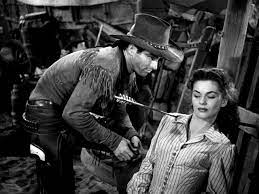
In “Ride in the Whirlwind,” Jack co-stars with Cameron Mitchell. But Stanton, billed as “Dean Stanton” and a dozen years into a not-yet-remarkable career, has his first chewy big screen role as an outlaw named Blind Dick.

Corman financed the two Westerns, Hellman directed both and neither, truth be told, is all that to look at. The minimal settings are properly dusty and rustic in “Whirlwind,” with arid Yanab, Utah serving as an iconic “The Way the West Looked in Most Westerns” location.

But Hellman’s experiment in trying to film inside or on top of a rolling stagecoach is “Blair Witch Project” shaky. The shoot-outs are competently-handled, and that’s as much praise as they warrant. Technically and artistically, “Whirlwind” is exactly what it looks like — an under-budgeted horse opera.

Nicholson conceived a spare story of three range-riding cowhands “headin’ South” for “Waco” from their last job up along the Snake River.

Vern, Wes and Otis (Mitchell, Nicholson and Tom Filer) are “just passin’ through,” rattlign off names of ranches where they’ve worked or might work, unaware that a gang of five led by Blind Dick (Stanton) but including Injun Joe (future Oscar nominee Rupert Crosse) just robbed a stagecoach, shot the shotgun rider and had one of their number gut-shot in the process.

Nothing is made of their “haul,” but they’re holed up in a range rider’s cabin when the trio ride up to regard them warily, share their whisky and figure out the quintet is lying about why they’re there.

“They don’t want no trouble, we don’t want no trouble” is about a far as that goes. The three will ride out at dawn, they figure. Only the sheriff and posse show up and lay seige to the cabin, trapping the three innocents in the process.

“We waren’t doin’ NOTHING, dammit,” Wes complains, to no avail. He and Vern are the only two to make it out of their encampment and up the canyon walls, struggling for safety on foot even though “This ain’t no country to be set afoot.”

They’re just climbing.

THEN where’ll we be?” “Someplace ELSE.”

Their struggle to escape doesn’t end as the posse “burns out” the cabin. They’ve already had one of their number gunned-down by shoot-first/ask-no-questions lawmen. And they’ve seen a lone hanging victim along the trail, another reminder of the brutal, unjust summary justice of the frontier.

They need horses from the first ranch they get to, and there’s no explaining “We waren’t doin’ nothin’, dammit” to the owner (veteran character player George Mitchell), his wife (Katherine Squire) or their fetching daughter (Millie Perkins, also in “The Shooting”).

The suspense of the hostage situation in the ranch house isn’t handled any better than the desperate shootout in that range cabin. But the players give us a sense of the stakes, even as they pause — at one point — to play checkers.

The script’s parameters are agreeably narrow, but Hellman’s ability to direct and edit into this a sense of urgency leaves a lot to be desired.

What’s fascinating is Nicholson’s reach for a kind of “True Grit” era authenticity in the speech, the slang and the nature of conversations amongst a trio of itenerant cowpokes. Wes remarks, when they stop to take hostages, a meal and hopefully horses, how laid back they’re being about their getaway.

“This is the ‘less work I done on a weekday since I was 4, ‘less’ I was sick.”

Cameron Mitchell, who’d go on to TV stardom via “The High Chaparral” a year later, notes how every crossroads, village and full fledged town in the West has a “Gold Nugget” saloon or hotel or what have you, “every place between here and Rosa’s Cantina,” a nod to Marty Robbins’ 1959 Country & Western hit, “El Paso.”

Stanton is all costume and stubble and screen presence. And the still boyish Nicholson, who’d take a few more stabs at the genre after becoming famous, looks as at home in the saddle and the sagebrush here as he’d later look in shades, sitting courtside at Lakers’ games or in the front row of the Oscars.

I’m still no Monte Hellman fan. But Nicholson, in front of and behind the camera, makes at least two of Hellman’s films intriguing sidetracks for any film buff who considers him-or-herself a Jack completist.

Rating: G, violence

Cast: Cameron Mitchell, Jack Nicholson, Millie Perkins, George Mitchell, Rupert Crosse, Katherine Squire and (Harry) Dean Stanton

Credits: Direted by Monte Hellman, scripted by Jack Nicholson. A Continental Distributing release, streaming on Shout! Factory, Roku TV, Youtube, Amazon, etc.

Running time: 1:22

Posted in Reviews, previews, profiles and movie news | Comments Off on Classic Film Review: Early Nicholson, Early Harry Dean — “Ride in the Whirlwind” (1966)

Netflixable? Those lovesick Poles take another shot at “Squared Love: Everlasting”

Well, thank God that “Squared Love” romance is settled and done with. Again.

Those crazy lovebirds, teacher Monika (Adrianna Chlebicka) and high-living influencer Enzo (Mateusz Banasiuk) have had not one but TWO Polish rom-coms to fall hard and tie the knot. And yet here we are again.

How DID they manage to avoid the altar this long?

“Sometimes life has other plans for you,” we learn, in voice over under a parade of botched Big Proposal moments.

The third film — “Squared Love: Everlasting” — is a tad exhausted and a bit of “deja vu all over again,” but at least the “obstacles” to true love are more interesting this time out.

Monika’s about to take over as principal at her elementary school. Enzo’s social media presence is maturing.

Now yes NOW the time is FINALLY right to tie the knot. No, they haven’t worked out that whole “I want a son!”/”I’m not ready to start a family” thing. But surely the stars are aligning…

Except for some problems with Enzo’s birth certificate, which will require him and his brother Andrejz (Krzysztof Czeczot) to revisit Uncle Wiktor, the parish priest in their hometown, and a guy who keeps score and kept receipts.

Enzo has “unfinished business,” he is told. It involves something he did to Ewa (Eva), one of his exes.

Ah, but which Ewa? This one, or that one (met in a montage)? When he finally finds the “right” Ewa (Ina Sobala), the complications grow more complicated. She’s an impulsive, flaky artist and single-mom. Might the little boy be Enzo’s?

In a flash, Ewa has taken over his schedule, derailed his wedding plans and imposed fatherhood on Enzo, with poor Monika facing sabotage in her new job from the jerk principal who just retired, with no support from the baffled and overwhelmed Enzo.

Meanwhile, Monika’s garage-owning Dad (Miroslaw Baka) is finding that courting a wealthy widow isn’t easy when her greedy adult son is involved.

Sobala’s Ewa has a hint of manic-pixie-dream-girl about her, a 30something dervish of irritating impositions, bad decisions, bad mothering, use and throw-herself-at-Enzo irritations.

The messiness piling onto the plot here doesn’t add up to much amusing, just fresh challenges for the drifting-apart couple to try and cope with (in Polish with subtitles, or dubbed into English).

I laughed once, at a church scene, when an organist forced to fill time before a ceremony starts turning to the Scott Joplin songbook.

For just a couple of bars, he is “The Entertainer.”

As for the movie? It’s no better or worse than the first two films, PG-rated pablum at best, a pointless time-suck at worst.

Rating: TV-14

Cast: Adrianna Chlebicka, Mateusz Banasiuk, Ina Sobala and Miroslaw Baka

Credits: Directed by Filip Zylber, scripted by Natalia Matuszek and Wiktor Piatkowski. A Netflix release.

Running time: 1:42

Posted in Reviews, previews, profiles and movie news | Comments Off on Netflixable? Those lovesick Poles take another shot at “Squared Love: Everlasting”

Movie Review: Iranian Swimmer Fights Abuse and Oppression with an “Orca” as her Spirit Animal

Elham was beaten, almost to death, by her abusive husband. When she gets out of the hospital, the only place she feels at peace — normal — is in the sea, swimming. As the daughter of a famous freestyle wrestler, she’s an athlete with great stamina and endurance, and if she swims long enough, she loses herself in the watery moment.

But Elham lives in Iran, and “in an Islamic country, women don’t swim.” And yet, she persists.

“Orca” is a tale of one woman’s resistance to a violently cruel patriarchy, and that patriarchy’s fiercest defender — an officious female martinet appointed head of Iranian women’s athletics. Beautifully shot and well-acted, with Taraneh Alidoosti (“The Salesman”) as Elham and a marveloulsly villainous Mahtab Keramati (“Staging”) as her governmental tormentor, Nazar Abadi, this “true story” is banned in Iran, which might be its best endorsement.

The opening scenes show the frantic efforts to save Elham’s life after the worst beating of a marriage that ends with divorce and an apparently short prison sentence for her never-seen husband. Her mother (Armik Gharabian) suspected, but her ex-wrestler father (Arash Aghabeik) never knew.

Elham struggles with the trauma, and even attempts suicide. But that attempt takes her into the sea, and heavy, elaborate swimming costume or not, she is at home there. She finds her purpose in endurance/distance swimming. She could set records.

But that officious showboat Nazar Abadi, the one we see hosting press conferences unveiling Iran’s many Muslim-modest uniforms for its female athletes, is more than happy to shut that ambition down.

She is the one to dismiss Elham with a curt “in an Islamic country, women don’t swim” (in Persian with subtitles).

“Orca” is about Elham’s years-long struggle to find a work-around, find allies in a repressive state with sexist, violent religious/cultural enforcers of male dominance, The Revolutionary Guards, intolerant goons are willing to call Elham every dirty name in the book, to hurt her and threaten her life if she doesn’t abandon her quest.

In a beach town, she finds a friend in the motherly hotel proprietor (Mahtab Nasirpour) and a spirit animal that might be her inspiration — the Orca. In a flowing, full-body-covering black and white costume mimicking the orca’s coloring, she will swim and batter herself against an intractible theocracy.

Director Sahar Mosayebi (“Platform”) gives this saga, scripted by Tala Motazedi, a stately pace that allows room for Elham’s underwater reveries. The script gives us vivid villains — The Revolutionary Guards try to drown Elham as she swims far offshore — she makes her attempts in the Caspian Sea and the Persian Gulf — and stubborn, plucky allies.

While we don’t see Elham as a devoutly religious woman, the film provides overwhelming evidence that she was always a reasonable one, seeking permission, offering compromises and solutions, polite until she’s finally had enough.

The character and Alidoosti’s moving performance of her make Elham a metaphor for EveryWoman’s struggle in a country hellbent on controlling and repressing women, where even a moment of triumph can be denied by another woman, who uses controlling Elham to express the power of fanatical, all-powerful state.

“Orca” may be a variation on the classic “succeed against the odds” sports drama formula. But Alidoosti, Keramati, Mosayebi and Motazedi leave no doubt what the stakes of “winning” are here. They should wear their “banned in Iran” badge with pride.

Rating: unrated, graphic violence

Cast:Taraneh Alidoosti, Mahtab Keramati, Ayoub Afshar, Mahtab Nasirpour and Arash Aghabeik

Credits: Directed by Sahar Mosayebi, scripted by Tala Motazedi, A Blue Fox release.

Running time: 1:47

Posted in Reviews, previews, profiles and movie news | Comments Off on Movie Review: Iranian Swimmer Fights Abuse and Oppression with an “Orca” as her Spirit Animal

Movie Review: Time Stands Still in this Time-Travel Western — “Showdown in Yesteryear”

“Showdown in Yesteryear” is an exceptionally-pokey indie Old West fantasy about an aged John Wayne-worshipping stable boy who finds himself transported back to @1880, Dogwood Pass.

It’s ambitious enough, making use of an Ohio “Old West” town attraction, but clumsily slow, formulaically-obvious and amateurishly-acted, with many of the players performers from that attraction — apparently.

Darryl (Jeff Grennell) is a just-lost-his-gal (Michelle Snyder), just-laid-off hand at Steve Callahan’s (Mike Montgomery) ranch hand who never finishes that noose he’s a’tyin’ when he spies this old doorway in the middle of a pasture. He walks through it, and danged if he isn’t in Dogwood Pass, sometime after “Dr. Bell” invented the telephone.

It takes him a while to figure out he hasn’t stumbled into a theme park, to see a man gunned down by a no-good hombre (Jesse Marciniak) in a poker game dispute, to intervene and keep “The Beast” from shooting anybody else.

It takes the sheriff (Steve Graf) a while to figure out this fellow calling himself John Wayne or just “Duke” has a laminated driver’s licence with the name “Daryl Dumwoody” on it, that he’s got this cell phone in his pocket “from the FUTURE,” he insists.

“No service.”

Daryl may frantically hunt for “the door” because “I don’t belong here,” but we know he’s going to kit himself out in gunfighter-gear, court the shopkeeper (Debra Lamb) and start manning up to the troubles facing this town, thanks to its murderous Boss Orson (Vernon Wells).

Director Aaron Bratcher (“Pawn’s Volition”) takes forever to get this picture underway, wasting scene after scene with drone shots establishing the windmill-covered “modern” West, never letting a single shot of Daryl’s first tumble on his first-ever horseback-riding lesson suffice when he can cover it from three angles.

Once we finally get to the Old West, “Showdown” slips straight into “stranger in town sets things right” formula, and becomes more of an actor’s picture. And no, that doesn’t improve matters.

Rating: unrated, violence, some profanity

Cast: Jeff Grennell, Vernon Wells, Debra Lamb, Jesse Marciniak, Steve Graff, Michelle Snyder and Mike Montgomery.

Credits: Directed by Aaron Bratcher, scripted by Gregory Lamberson. A Lion Heart release.

Running time: 1:53

Posted in Reviews, previews, profiles and movie news | Comments Off on Movie Review: Time Stands Still in this Time-Travel Western — “Showdown in Yesteryear”