
She tried to get away, they shot her.
Now Mel and his daughter are mixed up in their “business.”
She tried to get away, they shot her.
Now Mel and his daughter are mixed up in their “business.”



Pristine, sleek and stylish, “The Day of the Jackal” is a period piece that’s aged into a period piece about a period piece.
Director Fred Zinnemann’s film of Frederick Forsythe’s thriller novel recreates chic early ’60s Euro-travel, wining and dining as the well-heeled managed it. And it does so from the gritty confines of early ’70s cinema.
It’s a brutally efficient assasination story with a “Thomas Crown Affair”/Sean Connery Bond years sheen. Virtually every hired killer tale that’s followed has leaned on it, borrowed from it or just plain stolen plot elements, character traits and the ticking clock formula of the professional-who-must-be-stopped-by-other-professionals narrative.
Edward Fox became the template for assassins from “The Killer” (Chow Yun-Fat) to “The American” (George Clooney), “The Professional” (Jean Reno) and “John Wick” (Keanu Reeves) to “Grosse Pointe Blank” (John Cusack).
Our hunter/killer is a lone wolf, meticulous in his work and perfectly turned-out in a succession of tan suits, ascots ’60s and beltless, polyester pants — “Continentals” they were called. He knows the underworld, where forged passports and custom-built, easily-disassembled and concealed sniper rifles can be commissioned. But he travels in style, with leather luggage that tucks into his just-acquired Alfa Romeo Giulietta Spider, perfectly coifed and notably dashing, the sort who of eye candy who can seduce seducable women or gay men at the local Turkish bath, when the need arises.
Zinnemann parks Forsythe’s cold-blooded killer in a lean narrative that takes us from the hire to the prep to the hunt for a man the French have figured out has been hired by traitors to shoot President Charles de Gaulle.
Some French military men turned on de Gaulle for conceding rebellious Algeria’s independence. We see their first attempt to kill him via an ambush of his convoy of black Citroens. The plotters flee, and decide to hire a non-Frenchman, a “professional,” perhaps the man rumored to have gotten away with shooting Trujillo just a couple of years before.
The man (Fox) meets the leaders in Vienna, names his price (“half a million U.S. dollars”), makes a point of fretting over how one kills a highly-protected, high-profile leader in a foreign country and gets away afterwards, and sets protocols for contacting them.
We follow the killer as awaits the Swiss bank deposit and plunges into his prep, from finding an English grave that will give him a new identity to contacting a Genoese forger (Ronald Pickup) and gunsmith (Cyril Cusack) to provide him with the ways and the means.
The French, fretting about what this cell of disgruntled military men might be plotting next, resort to kidnapping and torture to get the barest clues about what’s in the works.
A foreign killer has been hired. “Jackal” appears to be his code name. The interior minister (Alan Badel) puts whole departments of government on this case, including the foreign service. As clues point to an Englishman, assorted Brits (Tony Britton et al) are reluctantly dragged into the hunt.
The French finally call in their best investigator, Lebel (future Bond villain and “Ronin” scene-stealer Michael Lonsdale). The chase is on to catch this guy abroad, trying to sneak into France or already in France if there’s evidence somebody matching his “English” and “fair haired” description has already crossed the border.
Continue reading
Callum Turner, Tim Blake Nelson and Jane Levy also star this is goof on a nation atrophying in a forever war, training its troops in a pricey simulation Iraqi town in the California desert.
Might have had promise, but Tim Heidecker’s in it. Dead give away only Vertical would release it.
Based on a memoir and thus a “true story,” this Jan. 23. release punches a lot of feel-good buttons, if the trailer’s any indication.




Title to subject matter, casting to setting, “Die Like a Man” is a by-the-numbers LA-gangland tale that takes its best shot at leaving no “number” out.
Latin teen who celebrates his 17th birthday by “becoming a man” with a gang initiation shooting? Mentor who “knew your dad” in Chino or some such? Latin teen who has to choose between his mother, his girlfriend and a gang?
What writer-director Eric Nazarian’s debut feature lacks in originality it somewhat compensates for with grit.
But it’s a pokey affair, a slow saunter down a path many movies have walked before. There’s little urgency to the action of the character’s “decision” or the over-familiar arc of story that this few-days-in-the-life story tells. It’s uncertain grasp of ages and timeline make it feel out of its date, or just plain dated.
Miguel Angel Garcia of “The Long Game” stars as Freddy, a kid who narrates that he’s nicknamed “Casper, like the ghost” by his friends, even if we never hear anybody call him by that name. “Ghost” or not, he’s growing up fast on the mean streets of “the Four Corners, Venice Beach, Santa Monica, Culver City and Sawtelle” and the concrete canyon of the LA River.
His working mom (Berenice Valle) may wonder what he wants for his 17th birthday, but she hasn’t a clue. Today’s the day he gets wings tattooed on his back. Today’s a day girlfriend Luna (Mariel Moreno) has ordained that he get lucky. And today’s the day his dreadlocked mentor, Solo (Cory Hardrict) has set aside for him to “be a man” and learn the rule of “the threes and fours.”
Those are the caliber bullets you use if you’re trying to kill someone. Solo has the target picked out and the snub-nosed .38 ready. All Freddy needs to do is show up and pull the trigger.
The kid voice-over narrates like the hardcase he longs to be, even after his latest bloody beating.
“Only two kinds of people out there. Those who lost and those who lose.”
He inherits his father’s prison crucifix necklace and a legacy. “Everything (his father) schooled me on I’m a’teach you,” Solo sermonizes.
But will his mother, Luna and others be able to intervene so that he can break the cycle?
Pacing is a real problem with this picture as it’s the main reason we notice a screen story has no “urgency.” Nobody ever breaks their slow stride. The choices that show up are stark and abruptly introduced. The moment his mom sees his tattoo she lays down her cards.
Choose. “You Mom or your friends.”
As for Solo?
“Why don’t you stop hangin’ around him?”
She’s not very convincing, nor are pleas from Luna or man-to-man chats with Mom’s latest beau (Frankie Loyal).
Leads Garcia, Moreno and Hardrict are sharp, and Cesar Garcia brings gravitas to the role of the intended shooting victim. The supporting players mostly have one note to hit — angry and “hard.” Curiously, no Spanish and almost no Spanglish is spoken by the locals, young and old, or the gang-bangers.
But the film’s primarcy shortcoming is that “Die Like a Man” meanders when it should stomp. It’s a day-in-the-life story that should march towards deathly inevitability or the inevitable it avoids. It doesn’t.
With a story, setting, characters and even dialogue this over-familiar, the best favor you can do your movie is to plow through these paint-by-number touches at speed, giving our hero barely a moment to catch his breath and reconsider his choices.
“Die Like a Man” takes entirely too long to bleed out.

Rating: Unrated, violence, sexual situations, profanity
Cast: Miguel Angel Garcia, Mariel Moreno, Cory Hardrict, Cesar Garcia, Frankie Loyal and Berenice Valle
Credits: Scripted and directed by Eric Nazarian. A Gravitas Ventures release on Amazon Prime.
Running time: 1:59



“Off the Record” is a drab little “cautionary tale” of the music business about how a whirlwind courtship could cost you your publishing rights.
The low-stakes, with mostly forgettable tunes and a meandering narrative make it a film that doesn’t need showy, “Isn’t that Billy Gibbons/Peyton Manning?” cameos to feel half-assed.
Throw in a nepo baby star of the “Too pretty to bother with acting lessons” school and you’ve just wasted 95 minutes of your life on a “Star is Born” where nobody drinks himself to death. Dammit.
Rainey Qualley, Margaret’s older sister and Andie MacDowell’s other daughter, is Astor Grey, a Los Angelina with dreams of pop stardom. She’s 25 (Qualley was born in 1990) and living on a boat, making ends meet with gigs at the Silverlake Lounge and the odd bit of acting in TV commercials.
And then this big but never quite “huge” big-timer Brandon Verge (LOL), played by Ryan Hansen of the rebooted “Night Court,” takes notice of her and gives her a little social media boost.
He shows up in his Porsche to sweep her off her feet, take her to “the weirdest place on Earth” (the Salton Sea), boost her ego, sex up her love life (kinda icky) and open doors for her.
Red flags? He drinks. A lot. He’s clingy. He’s older and bossy and plays the “I kinda need to know if you don’t wanna have an adult relationship” card awfully quikcly.
He has a reputation, an ex to point out how toxic he is and fans that Astor might not want to cross.
The needy drunk dialing begging for her rescue, the flashes of temper, the record deal he bum rushes her into all scream “Run girl RUN.”
But la di dah, Astor’s not hearing it. Until she can’t NOT hear it.
Stuntwoman turned writer-director Kirsten Foe’s narrative doesn’t so much pass by as stagger, with the cliched plot points joined by random ones.
Let’s have the rock star with the top end Porsche “run out of gas,” only to be picked up by a local Salton Sea beardo (Gibbons, of ZZ Top). In case there’s any doubt who that sage of the Salton Sea, let’s needle-drop “La Grange” in there.
Rebecca DeMornay’s the older agent who tries to bring Astor to her senses. Olivia Sui is her gay Asian BFF. Montanna Gillis is the vamping pop starlet Mr. Verge would like to give Astor’s songs to. And Julia Campbell is Astor’s mom, who figures everything that ails her can be fixed with the right dose of lavender.
It’s inane, innocuous and random enough to feel as if it was scripted on the fly. And while it’s almost never the star’s fault when a picture stiffs like this one, one has to think back to all the not-wholly-justified abuse Qualley’s mom went through during her peak years to find a comparable leading lady turn as flat and free from sparks.
The message, about the predatory nature of the music business — stars-preying on wannabes — has been sent via letter, telegraph, film, TV and a few songs over the decades, a couple by Loudon Wainright III (“Ingenue” and “Aphrodisiac”) come to mind.
It’s as valid as a critique of creepy/clingy older men as it ever was. But you need a film less half-assed than “Off the Record” if you want to bring new insights to singing Svengalis in the cinema.

Rating: R, sex, substance abuse, profanity
Cast: Rainey Qualley, Ryan Hansen, Olivia Sui, Rebecca DeMornay, Montanna Gillis, Billy Gibbons and Peyton Manning.
Credits: Scripted and directed by Kirsten Foe. A Quiver release on Amazon Prime.
Running time: 1:35

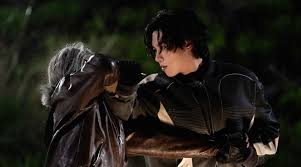

“The Old Woman with the Knife” is a Korean variation on the World of Assassins tale, where killing for hire is a business with professionals assigned out of offices and following “rules.” It’s another story of an aged killer competing with a younger one to see who gets whom first.
And yes, we’ve seen versions of this where all the killing is done with knifes, poison and garrotes until somebody — usually mobster victims — figures out that pistols are a decent defense against such cutlery “artists.” The third act becomes bullet-riddled just as arbitrarily as the first two acts were sliced and diced.
Veteran Korean actress Lee Hye-yeong (“The Devil’s Game”) stars as the assassin her employer calls “Godmother” in her advanced years, but who used to be nicknamed “Nails” and took on the name “Hornclaw” because that’s how she rolls.
But way back in ’75, she was a battered young woman (Shin Si-ah) taken in by a mop-topped diner owner, Ryu (Kim Mu-yeol) and his wife. His work takes him away from home for days at a time. One homecoming, he arrives to find that their new dishwasher has fought off and killed a rape-minded thug of a U.S. G.I.
It turns out Ryu’s “pest control” work is killing human pests. He treats it as a calling. But as crime victims and the bullied start paying for “pest” removal, the Sinseong Agency goes professional, “eliminating malignant vermin” from society. Hornclaw has found her destiny.
Decades later, Ryu’s long gone but Godmother Hornclaw is still the best if you need a brutal bookie poisoned on the subway or some other “pest” out of your life. But she’s going soft. That injured, abandoned and aged dog she finds demands her pity.
“It’s awful to be abandoned when you’re old and sick,” the kind veterinarian (Yeon Woo-jin) tells her, in Korean with English subtitles. So she takes in the dog.
The punk who goes by Bullfight (Kim Sung-cheol) is a freelancer who has to be talked into joining an agency where he’ll get paid for the killing that seems to come naturally to him. “Nails” isn’t as hard as she used to be, with joint pains and eye problems and the agency’s doctor refusing to hide that from her boss. Bullfight will act as “backup” on her tougher jobs.
We’ve all seen “The Mechanic,” “John Wick” and a DVR full of old-killer/young killer tales. We know how this “relationship” will play out. And we fear for the dog.
Director and co-writer Min Kyo-dong goes back to 1999’s “Memento Mori,” so he does what he can to make this formulaic script (based on Gu Byeong-mo’s novel) surprising. There are several twists to hold our interest over 125 minutes. OK, maybe for 90 minutes of that.
Lee is a somber presence at the center of this, handling the fight choreography (as if anybody believes a 65 year-old woman could kick this much ass) and rarely betraying emotions, an unsentimental killer who gets sentimental over a dog and the veterinarian who talks her into adopting it. Kim makes a properly belligerent smart-assed “brat with a death wish” foil, someone who has absorbed the “you’re killing a bug” ethos of their line of work.
But the cluttered backstory meant to flesh out the present day relationship dilemma just serves up more mayhem — one woman or punk with a knife slashing through mobs of minions and the like. The ingredients of an over-familiar formula are right there, letting us know more or less exactly where all this is going, lowering the stakes along the way.
There’s a grace note, here and there. One victim from their profession talks of how one knows the end is nigh — ghosts appear while they’re doing the work.
“Those who miss you come to greet you” upon death. Even hitmen and hitwomen, apparently.
Still, the film never quite transcends the “mixed bag” treatment of a weary genre that it is. We know who she is and how she got this way, but the lack of interior life leaves the character cold as a corpse, with little chance for the viewer to warm up to her.

Rating: unrated, bloody violence
Cast: Lee Hye-yoeng, Kim Sung-cheol, Kim Mu-yeol and Yeon Woo-jin
Credits: Directed by Min Kyo-dong, scripted by Kim Dong-wan and Min Kyo-dong, based on the books by Gu Byeong-mo. A Well Go USA release.
Running time: 2:05




“Due process” has been much on the minds and even in the news in North America, as ordinary citizens grapple with the shock of a rights-trampling regime killing people in boats it can’t identify much less charge with a crime and with citizens and immigrants alike being snatched from the streets by masked, armed and brutish unofficial “police” in name only.
That’s what the Argentine drama “The Woman in the Line” is about, a country with a history of making people “disappear” leaving too much of the oppression apparatus of the state in place to ensure it never happens again.
Co-writer and director Benjamin Ávila’s generally gripping and engrossing drama never misses a step when we see a mother assaulted in a police raid that arrests her teen son — with no charges named and no tolerance for debate or questioning what the authorities can and cannot do.
“It’s a mistake! My kid’s a SAINT!” (in Spanish with English subtitles) is almost sure to be an overstatement. But where’s the due process when masked, armed goons bust in your house and slap you when you dare to protest this home invasion?
The film, “inspired by a true story,” takes liberties with that story, something bluntly acknowledged in the closing credits. We viewers are entitled to think the co-writers did their subject and their movie wrong by taking the tale in a much more conventional inside-and-outside prison melodramatic direction.
Natalia Oreiro of “I’m Gilda” and “Today We Fix the World” plays Andrea, a widowed mother of three shocked and seriously put-out when her tall, teen son Gustavo (Federico Heinrich) is dragged away, right in front of her eyes.
Andrea has a temper, which is not mollified by getting punched during the arrest, nor rebuffed by an efficious and cruel “system” that gives her no answers and insists on locking her kid up without so much as a word with him or a listing of charges.
She rages at internment functionaries and roars at guards and the other women in similar circumstances who complain when she cuts line or tosses a tantrum.
Her lawyer (Luis Campos) isn’t spared her fury.
Her mother, whom she asks to pick up her younger kids and take them home and her employer both get lies about what’s going on. She won’t tell friends, either. We suspect her embarrassed silence does her no favors.
The kid, when he finally calls, is more stoic. He hastily gives her a list of what he needs and hangs up.
Andrea finds her world upended and her rights circumscribed as she frantically cooks and packs for the kid and endures food-rummaging and strip searches from the guards. She’s in over her head, and this widowed real estate agent can’t help but notice that most everyone in line at this prison is a woman, and that they’re at best tolerant of each other when they aren’t elbowing their way past one another to get what they need or want.
Andrea snaps more than once. A fellow inmate steals her kid’s new shoes? She’s going after that guy’s mother.
An older woman (Amparo Noguera) whose nickname is “’22,’ like the madman,” tries to calm her and show her the rules and roles everyone must play. This 22 has lots of experience with this system and this visitation process and all the ways the state gets back at women in line who get out of line.
And another client of her lawyer, Alejo (Alberto Ammann) is also a calming influence, an inmate who knows this world and Gustavo’s risks and who calls her — repeatedly — just to reassure her about her son, and just to hear a friendly woman’s voice.
The way this story sets up, we figure these women will get over their stand offishness and organize either to demand due process and civil rights for their loved ones, or plot an escape. Suffice it to say the story turns more melodramatic than Hollywood far-fetched and violent.
Not every “turn” is accurate or as dramatically satisfying as this film promises. The more we learn about this case, the more conventional and less truthful the story becomes.
But Oreiro is a fierce presence at its heart, making Andrea an uncompromising hotheadwho fumes and pokes around, finds herself taking extraordinary risks and unable to control her temper even as she’s doing that.
And the story can’t help but move us, even as we wonder if would have been more moving had it hewed more closely to the facts.

Rating: TV-MA, violence, smoking, profanity
Cast: Natalia Oreiro, Federico Heinrich, Amparo Noguera and Alberto Ammann.
Credits: Directed by Benjamín Ávila, scripted by Benjamín Ávila and Marcelo Müller. A Netflix release.
Running time: 1:45



“Gunslingers” is an early 20th century Western set in Kentucky — nobody’s idea of the West — starring B-and-C movie icons Stephen Dorff, Heather Graham, Costas Mandylor and Nicolas Cage.
And if that doesn’t lower your expectations for it, it should.
It was written and directed by the “prolific” C-and-D movie filmmaker Brian Skiba, who has but two online “Master Classes” he could teach for aspiring filmmakers. How’d he convince this cast, including Tzi Ma (“The Farewell” and TV’s “Kung Fu”), to show up with a “This time I’ll be BETTER, I PROMISE” and how he convinces anybody to finance his cascading career of cluster-you-know-what embarrassments.
This is basically Dorff, who always takes things seriously, surrounded by a few big names rolling their eyes and having a laugh with a lot of no-names and/or amateurs who never let us forget they’re just playing dress-up for the camera.
It’s about a robbery gone wrong that gets a young Rockefeller killed in the Northeast, with the man who killed him (Dorff) fleeing South by Southwest to rural Kentucky and the town of Redemption.
Skiba loves that word. He even titled a film “Guns of Redemption.” Here, the town is filled with “wanted” men and women, with a whole infrastructure built to protect them, from fake hangings, fake graves and funerals presided over by “preacher” Jericho (Mandylor) photographed by Halloween costumed photographer/madman Ben (Cage).
Cage dons designer sunglasses and affects a hoarse whinny of a voice for this role, which has neither foot planted in reality.
Graham plays a wounded mother fleeing a murderous husband, come to warn Thomas (Dorff) that a “100 man” masked posse led by his grudge-carrying brother (Jeremy Kent Jackson) is coming for him.
One-eyed brother Robert sees Redemption for what it is, “a buncha wanted criminals playin’ possum.”
The plot is a couple of shootouts leading to a long if never remotely epic standoff/shootout in and around the Domus de Sallust saloon.
As the mayhem, six shooters and bad-acting go off all around him, Dorff stands above it all, reminding us that this might have been taken seriously instead of all this vamped bad makeup, acting and screenwriting ineptitude and goofing around by players who figure they’re better than this.
But maybe Dorff’s the real fool here for not realizing what everybody else did.

Rating: R, lots of violence and profanity
Cast: Stephen Dorff, Heather Graham, Tzi Ma, Costas Mandylor, Scarlett Rose Stallone, Laurie Love, Jeremy Kent Jackson and Nicolas Cage
Credits: Scripted and directed by Brian Skiba. A Lionsgate release on Netflix.
Running time: 1:43
Palestine’s hopes for an Oscar — Best International Feature — ride on this historical drama starring Hiam
Abbas and Jeremy Irons.
Land buys/land grabs, displacement by mass immigration, statehood and the long march towards apartheid and then genocide of an increasingly desperate and militant minority, not just a product of the Balfour Declaration or the Zionist movement that preceded it.
If it gets nominated — a long shot — we’ll find this one in theaters early in 2026.

 Movie Nation