Classic Film Review: Cooper, Hayes and Menjou in Hemingway’s “A Farewell to Arms” (1932)

Ernest Hemingway was famously grumpy about film adaptations of his novels, and the mere brevity of the first screen version of “A Farewell to Arms” must have raised his ire.

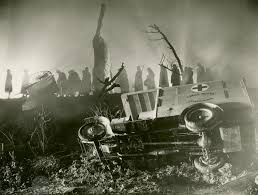
But Frank Borzage, the first two-time Best Director Oscar winner, gives us an Expressionist montage for the ages in the film’s third act, five solid minutes of Lt. Frederic Henry’s AWOL escape through the northern Italian combat zone.

The newly-restored film serves up smoke and fog, wounded men in close-up and silhouette stumbling towards through the dark towards the rear, armored cars and wrecked ambulances and bodies and stylized horrors, air raids and the like. This black and white nightmare has a chilling immediacy and it adds credibility and an artistic touch to what feels, from the very start, like one of the most adult, uncluttered and spare Hemingway adaptations.

Borzage, an actor’s director who did “Bad Girl,” “Seventh Heaven,” the terrific anti-Nazi thriller “The Mortal Storm” and the jolly stars entertaining the troops “Stage Door Canteen,” doesn’t do much to keep the incongruous pairing of the towering Gary Cooper with the petite, 15 inches shorter Helen Hayes from looking like a sight gag in a couple of walking and talking scenes.

But we don’t mind because Borzage and the screenwriters give us a streamlined plot that zeroes in on the characters. The film was also based on an uncredited 1930 stage adaptation that narrowed the tale’s focus. Building on that, Borzage lets the cast give this romance set against the epic tableaux of war an intimacy that allows Cooper and Hayes to just break your heart.

The story has a pre-Production Code edge to it, with pregnancy out of wedlock, an English nurse (Hayes) who “gets in trouble” thanks to a handsome young American ambulance officer (Cooper) who impulsively seduces her, impulsively tells her he loves her, impulsively turns his ambulance around on the way to the Front to come back to reassure her it wasn’t just a “conquest,” and impulsively goes AWOL from a combat zone to track her down after she’s gone to Switzerland to have their baby.

There’s a live-for-the-moment immediacy and resignation to the story and the performances that gets at the fatalism of life and love in a war, where promises that “I’ll never get hurt” ring hollow, where Catherine’s jaded friend Fergy (Mary Philips) has a better grasp of what’s happening here, this nurse’s creed that “we must bring solace to the men who fight” that’s perhaps gotten out of hand.

“You’ll never get married. Fight or die, that’s what people do” in places like this.

Taking its inspiration from Hemingway’s own experiences driving ambulances in the Italian/Austrian campaign, the film gives us just enough combat sequences — barrages and bombardments, hospitals, advances and retreats — to be credible. The story’s really about a young man’s first real love and a (slightly) older woman’s touching, reluctant acceptance of that at face value, because of the combat crucible this romance comes to life in.

Hayes makes us believe Catherine’s leeriness of Lt. Henry, her sad love-in-wartime recognition of what’s happening and her grim embrace of this man and this affair, because losing a fiance at the Somme taught her that life is as impermanent as it gets in war.

Cooper, very young (just a year younger than Hayes) and not yet settled into his relaxed, folky persona or the stoic hero he became in his 40s, was never more vulnerable than he comes off here. The smitten earnestness feels real, the irresponsibility that has him abandon his duty seems almost heroice.

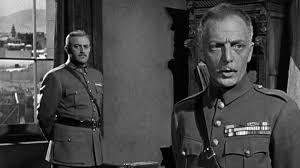
Adolphe Menjou, who’d make his greatest mark on screen in another World War I film, Kubrick’s “Paths of Glory” twenty-five years later, plays Capitano Rinaldo, a rakish Italian surgeon who loves having the American along as his wingman, comically calling himself “your best friend and your war brother” right up to the moment Henry steals the fetching Catherine away from him.

Rinaldi’s reaction to their love affair is masked in nobility, looking out for his cannot-afford-to-be-distracted “war brother,” but has a sinister romantic sabotage feel.

The film’s simplified plot and cast of characters, coupled with all the information, symbolism and emotion Borzage gets across in that epic combat zone montage allowed the director to manage something few other filmmakers did — make a movie as spare, stark and moving as Hemingway’s prose, not so much the definitive “A Farewell to Arms” as a movie that “gets” the novel and delivers it without a single minute of screen clutter getting in the way.

Rating: unrated, fairly adult for its time

Cast: Gary Cooper, Helen Hayes, Mary Philips, Jack La Rue and Adolfe Menjou

Credits: Directed by Frank Borzage, scripted by Benjamin Glazer and Oliver H.P. Garrett, based on the novel by Ernest Hemingway. A Paramount release on Roku, Tubi, Plex, etc.

Running time: 1:28

Posted in Reviews, previews, profiles and movie news | Comments Off on Classic Film Review: Cooper, Hayes and Menjou in Hemingway’s “A Farewell to Arms” (1932)

Movie Preview: Alice Eve and Antonio Banderas, “Cult Killer”

Eve plays the protege of a famous private eye who is murdered in this Jan. 19 release.

Strictly B-movie, from the looks of it. But we all love B-movies, right? And Banderas? And Ms. Eve?

Posted in Reviews, previews, profiles and movie news | Comments Off on Movie Preview: Alice Eve and Antonio Banderas, “Cult Killer”

Merry Christmas! So, what movie are we watching today?

I’m not sure when the Big Holiday Movie Event became a thing, although “To Kill a Mockingbird” made its bow on today’s date, and “The Godfather” certainly claimed that Christmas Day opening “event” in its time.

“Les Miserables,” the Downey/Jude Law “Sherlock Holmes,” “Dream Girls,” “Django Unchained,” “Ali” and “Catch Me If You Can” were some recent blockbusters or would-be hits that hit screens on the holiday.

This year, I’m planning on catching “Ferrari,” as Neon wasn’t so confident in another Adam Driver slinging-an-Italian-accent drama that they screened it for critics everywhere.

The girlfriend would love to see “The Color Purple,” and I heartily endorse that. So we’ll be immersing ourselves in the wonder that is Taraji, And Fantasia. And Jon Batiste, Colman Domingo and David Alan Grier, by golly.

Are you going out to see one of those, or “The Boys in the Boat” (ugh), or are you staying home to stream “Maestro” with Bradley Cooper as Leonard Bernstein?

The holidays are about a lot of things. After you’ve over-eaten at the table, be sure to drag the kids to “Wonka,” if they haven’t seen it. And if “the kids” are adults, you can’t go far wrong with a Christmas musical version of “The Color Purple.”

Posted in Reviews, previews, profiles and movie news | 1 Comment

Classic Film Review: In Like Technicolor Flynn — “The Adventures of Robin Hood” (1938)

What a wonder “The Adventures of Robin Hood” must have been to the Depression Era moviegoers who first saw it.

A jaunty Errol Flynn swashbuckler splashed across the screen in the still-new and rare Technicolor, capturing glorious locatations, with Oscar winning art direction, editing and an Erich Wolfgang Korngold score that just sings, it must have been every bit as overwhelming as “Gone With the Wind” and “The Wizard of Oz” were a year and a half later.

It’s a touchstone film for any cinephile, and I’ve seen it on TV, video, and at university film societies over the years. But the most recent Museum of Modern Art restoration of this National Film Registry classic really takes one back to what it must have been like to bowled-over by this masterpiece, directed by Michael Curtiz and William Keighley but nursed to life by producer Hal B. Wallis.

The English folk legend has been committed to film more times than one can count, but this is the version with that ineffable something that makes every other take on the tale pale in comparison.

It’s more fun, sure. There are comic moments in the Kevin Costner “Hood,” even fewer that come to mind in the Russell Crowe version. It’s gorgeous, built around an impressive, soon-to-be-regarded as “all star” cast, and epic in scale. But other renditions of the story have been just as big. Yet nothing else over the decades come even as close as those two recent “Hoods” to matching this 1938 classic.

Watching Flynn in it, we can see the Aussie expat chisel his screen reputation in stone, the true heir to the jolly, grinning Douglas Fairbanks action hero throne. The athletic, charismatic Fairbanks filmed the definitive silent “Robin Hood” 15 years before. That film’s plot has been more of a template for all the “Robin Hoods” to follow. Like the Costner and Crowe versions, Fairbanks & Co. went for something more drawn out, and all those versions of the story were over two hours and 20 minutes long.

The Flynn film zips by in 100 breathless, endlessly-quotable minutes.

“Ho, varlets, bring Sir Robin food! Such insolence must support a healthy appetite!”

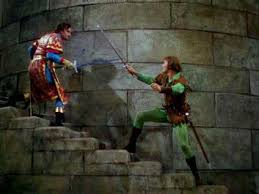
Pairing Flynn with Olivia de Havilland, his “Captain Blood” co-star, and reconnecting him with his “Prince and the Pauper” sidekick Alan Hale, Sr., as the iconic rendition of “Little John,” giving the film two delicious villains — not just the delicious “Captain Blood” alumnus Basil Rathbone as Guy of Gisbourne, but Claude Rains at his snootiest as the scheming Prince John, it seems as if every move producer Wallis made paid off.

The story’s waypoints had been long codified before the first scene was shot. A young member of the landed gentry is radicalized by the tyranny that sets in whilst “Good King Richard” the Lionheart was off crusading and getting himself held for ransom by the crown princes of Europe.

Robin Hood is a rabid royalist, of a rank that he has access to confront Guy of Gisbourne, the cowardly Terry Jones look-alike Sheriff of Nottingham (Melville Cooper, hilarious) and cruel, scheming Prince John.

“By my faith, but you’re a bold rascal!”

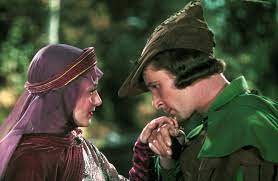
He instantly gets under the skin of Lady Marian Fitzwalter (de Havilland).

“Why, you speak treason?”

“FLUENTLY!”

The script firmly sets the story in 1191 — just over 100 years after the Norman Conquest, and sets up the conflict between plucky, industrious Saxon Britons and the effete Norman French who rule them at the point of a sword, with a compliant high Catholic clergy (Montagu Love) assisting.

But the French haven’t reckoned on English revulsion at taxation, English notions of liberty or English longbows, made of yew wood and lethal in battle for 250 years.

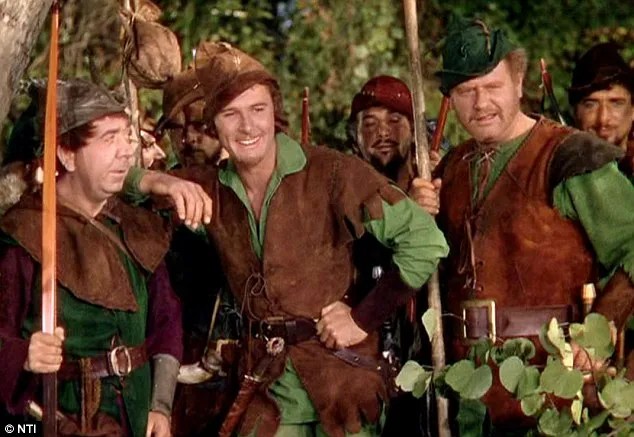
Robin of Locksley evades capture, and starting with his dandy, lute-playing make Will Scarlett (Patric Knowles) and then Little John and later Friar Tuck (Eugene Pallette), he gets the merry band together and takes over Sherwood Forest. They’ll rob from the Norman rich and give to the English poor.

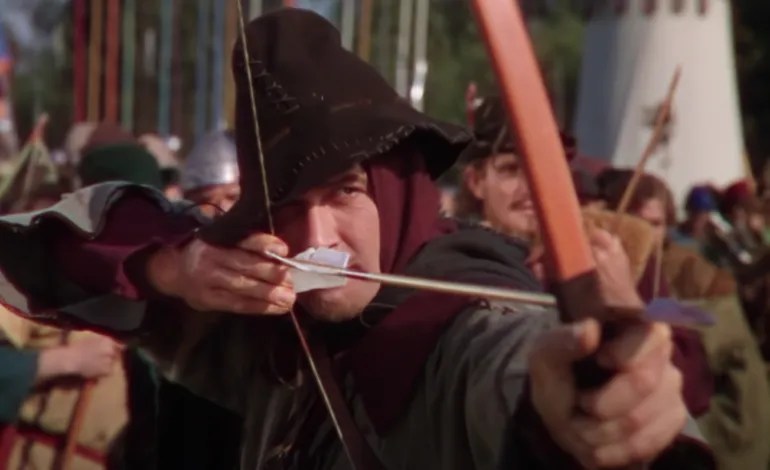
And Robin, a sporting chap, will not only eschew several chances to kill the venal Sir Guy. He’ll risk his neck to compete in an archery competition, in disguise, just to impress Lady Marian.

So many happy accidents led to this film that they themselves became the stuff of legend. James Cagney was slated to play the Prince of Thieves, but he sued to get out of his contract with the stingy brothers Warner.

That went on for years. And that delay didn’t just allow Flynn to emerge as a star, but made the production’s last minute decision to film in Technicolor possible. Every three-strip color camera in Hollywood was brought to Warners’ soundstages and to Chico and Pasadena and Calabasas for location shooting.

Those years also allowed Wallis to convince Viennese composer Erich Wolfgang Korngold to come to Hollywood and compose his “opera without singing” score and change the way films sounded from that moment on.

Without that playful score, we wouldn’t have that lovely moment where Robin confronts Little John with quarterstaffs on a log bridge, Scarlett strums along on his lute as entertainment, and Little John barks at him to pick up the tempo to something more suited to a fight scene. Will obliges.

The archery stunts involve a real archer shooting real arrows into assorted extras, stunt doubles and cast members. Howard Hill was that archer entrusted with that dangerous task, and you can see him playing Elwyn the Welshman in the archery contest scenes.

“The Adventures of Robin Hood” is quite old fashioned, simplistic morality and politics, corny speeches and trash talk, rear-projection chases on horseback, cuts between Robin swinging from a forest tree to land on a fat tree branch on a soundstage for his signature line, “Welcome to Sherwood, milady!”

Edits like that are a lot less jarring and more seamless in this latest restoration.

Critics back then and the still-young Academy of Motion Picture Aats & Sciences had an easier time acknowledging what they knew to be a classic the moment they saw it. It might not have won any acting honors, and Best Picture went to the stage adaptation of the Pultizer Prize-winning Kaufman and Hart play, “You Can’t Take It With You.” Even then, the “academy” liked to be seen as honoring “art.”

But “Robin Hood,” a dazzling smash when it came out, has endured, aging better than any of its contemporaries, a classic worth restoring and worth revisiting any time you crave a little escape to a legendary time, iconic characters and a sporting cast more than perfect at playing them.

star

Rating: “approved,” PG

Cast: Errol Flynn, Olivia de Havilland, Claude Rains, Basil Rathbone, Alan Hale, Patric Knowles, Eugene Pallette, Herbert Mundi, Montagu Love, Una O’Conner, Melville Cooper and Ian Hunter

Credits: Directed by Michael Curtiz and William Keighley, scripted by Norman Reilly Raine and Steon I. Miller. A Warner Bros. release on Tubi, Amazon, etc.

Running time: 1:42

Posted in Reviews, previews, profiles and movie news | Comments Off on Classic Film Review: In Like Technicolor Flynn — “The Adventures of Robin Hood” (1938)

Libation in the Holidays like Aquaman

Best product placement in “Aquaman and the Lost Kingdom?”

The brew of choice our King Arthur sips with his lighthouse keeper Dad.

I didn’t care for the movie. But Momoa always does his best to deliver fair value. And drink a Guinness like he knows what he’s doing.

Don’t mind if I do, Kid King Curry.

Posted in Reviews, previews, profiles and movie news | Comments Off on Libation in the Holidays like Aquaman

Netflixable? A Simple, Soapy Primer on Trans Acceptance — “Mutt”

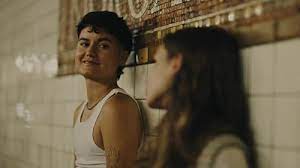
The transitioning transgender man has a moment at the pharmacy. He’s finished up his purchase with a request for “Plan B,” the “morning after” birth control pills.

And the pharmacist is a bit confused, which the still-female Feña disarms with a flippant fib.

“I’m gay,” Feña says. He’s just being a good friend, buying this for somebody else. So he says.

“Before more careful, young man,” the unseen pharmacist scolds.

If there’s a moment that sums up the “confused” 2023 state of sexuality and most confused people’s response to it better than this single scene in “Mutt,” I haven’t seen it.

Writer-director Vuk Lungulov-Klotz packs a lot into his 87 minute primer on Being Transgender Now in mostly-tolerant New York City.

“Confused” comes up, and often. “It’s complicated” is trotted out a time or two. Or three. The phrase “a phase” turns up and is addressed, head-on at a personal if not a cultural, teens-trying-something-on-for-size level.

But any way you look at it, Feña, played by transgender actor Lio Mehiel, goes through a soap opera season’s worth of drama, trauma, romance and pain in this “single day in the life” character sketch.

Feña doesn’t go by Fernanda any more. The adjustment, like her transition to “him,” is ongoing.

Consider, he needs to borrow a car to pick up his semi-estranged Chilean dad at the airport. He’s still dealing with hassles at the bank as his boss keeps writing his birth name on his paychecks.

He may have a supportive group of friends and a sympathetic transgender roommate (Jari Jones). But today of all days, he sees his ex, John (Cole Dolman) in the city, and then in their favorite bar. Today of all days, old feelings and urges pop up.

Even though, as Feña’s kid sister Zoe (MiMi Ryder) notes, he’s had the “top” surgery (breast reduction), when “old feelings and urges pop up,” one sometimes has to have an awkward conversation with a pharmacist.

And “today of all days” is the day Feña’s 14 year-old sister has chosen to skip school, flee the “broken” and raging mother who kicked Feña out of the house, and that sister proceeds to carelessly make everything just a little worse.

But the kid’s hip enough to snap at the explanation Feña and every Feña out there feels the need to use with those who don’t “get it.”

“I’m still me.” As if saying that’s necessary.

But the kid and the ex-boyfriend and later the long-absent father (Alejandro Goic) serve a vital function in Lungulov-Klotz’s film. They’re the surrogates for the less hip, asking for clarification, explanation, asking to “see” the scars.

“Mutt” overreaches in the ways it folds all this drama into a single day. And maybe you can’t “have it both ways” in a movie on this touchiest of current hot-button subjects.

Feña is vocally adamant about being way past the point where anybody can use the word “phase” in his presence. But to the uninitiated, those struggling to walk a mile in “their” shoes, sleeping with a guy and having to go buy Plan B muddies the waters and fuzzies up that “phase” argument.

There’s a pause, and something like a raised-eyebrow from Feña when his mouthy sister insists she’s down with all this because “I have a trans friend.” Maybe Feña, like the casual viewer, wonders how anybody a 14 year-old would call a “friend” could be emotionally and intellectually prepared to realize that about themselves, or make that “choice.”

The best thing about “Mutt” is its implicit plea for “sit this one out” if you don’t know what the hell you’re talking about. And there’s also a plea for patience and sympathy for parents, family and friends wrestling with what appears to most to be a “new” thing, an utterly “modern” problem and concern, and for those actually going through this “confusion” and determined to wrestle it into something that resembles a stable, balanced and happy life.

Rating: TV-MA, sexual situations, smoking, profanity

Cast: Lio Mehiel, Cole Doman, MiMi Ryder, Jari Jones and
Alejandro Goic

Credits: Scripted and directed by Vuk Lungulov-Klotz. A Strand Releasing film on Netflix.

Running time: 1:27

Posted in Reviews, previews, profiles and movie news | Comments Off on Netflixable? A Simple, Soapy Primer on Trans Acceptance — “Mutt”

Movie Preview: Russell Crowe and Liam Hemsworth in the “Land of Bad”

A modern day “mission gone wrong” combat thriller, also starring Milo Ventigmilia and Luke Hemsworth, this one makes it to screens right around Valentine’s Day.

Looks generic, and feels Aussie. Let’s see what we see.

Posted in Reviews, previews, profiles and movie news | Comments Off on Movie Preview: Russell Crowe and Liam Hemsworth in the “Land of Bad”

Movie Preview: One Last Trailer to “Dune 2”

This one really closes the deal, right? Might even erase memories of David Lynch’s more twisted and truncated “Dune.”

Posted in Reviews, previews, profiles and movie news | Comments Off on Movie Preview: One Last Trailer to “Dune 2”

Classic Film Review: Trench coats and Fezes, Back to the Desert with Bogie — “Sirocco” (1951)

What a curiosity Bogart’s “Sirocco” is, a “bizarro” “Casablanca” that mirrors Humphrey Bogart’s definitive romantic lead performance, but sees this American meddling in the Middle East as an amoral cad, precisely the way noble cafe owner Rick Blaine described himself in covering up his past and not “getting involved” back at the Cafe Americain.

It’s so much like “Casablanca” that it could be a prequel to it — it’s set in 1925 Damascus, not Occupied Morocco on the cusp of Pearl Harbor — or a sequel, with an older, even more jaded Rick smoking through his bitter years, running guns to the Arab revolutionaries in French colonial Syria.

“Conspicuously lacking in charm,” a critic of the day called it.

But German-expat Curtis Bernhardt directed it and “All the King’s Men” and “A Lonely Place (later “From Here to Eternity” and “Bonnie and Clyde”) cinematographer Burnett Guffrey bathed the casbah, clubs and catacombs of Damascus in “Third Man” gloom and shadows.

And the cast, the mere fact that Bogart is in it just before his “African Queen” triumph, make this not-quite-a-classic worth a look.

After “The Great War,” the European Powers and Japan gobbled up German colonies and divvied up the former Ottoman Empire. That’s how France came to control Lebanon and Syria, with its ancient capital of Damascus not just a destination of the prophet Paul, but of Lawrence of Arabia.

But the Arabs who fought alongside Lawrence to free themselves from Turkish domination weren’t having this “mandate.” They fought it.

Everett Sloane of “Citizen Kane” plays Gen. LaSalle, the embattled officer in charge, struggling to keep the city under curfew — restricting goods from getting in or out, including guns.

Lee J. Cobb is Col Feroud, his intelligence chief, who summons the major traders — above and below board — to his office for a little persuasion. That’s how we meet such “businessmen” as Balukjiaan (a very young Zero Mostel) and this name-changed American, Harry Smith, a doughboy who went AWOL, went wrong and went underground after The Great War.

Harry (Bogart) is “an American in Damascus with no morals, no political commitments,” Feroud notes. Harry won’t give him any trouble.

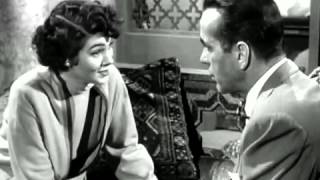
But there’s this dame, see? Feroud’s “girl” (Märta Torén) was brought here from Cairo with him, and we’d assume she’s his wife, except well, they are French. Violette wants out, and in the worst way. Harry, being a chancer, spies that in an instant.

“How can a man so ugly be so handsome,” Miss Half his Age wants to know?

When he “saves” her after a terror bombing at the hot club in town, Moulin Rouge, she remembers. And he takes liberties. He’ll get her and himself out, no matter what her “ceasefire” preaching, high-minded negotiator, woman-slapping beau says.

“I’ll KILL you if you try to leave me!”

Harry finds himself making bribes, dodging the French and scrambling underground, trying to play all the angles between the revolutionary Emir (Onslow Stevens) and those “murdering” French.

Bogart had just turned 52 when the film came out and he and his Santana production company produced “Sirocco.” As the new biography “Bogie & Bacall” lays out, he was straddling the tail end of his romantic lead years, trying to cash in before character leads (“Treasure of the Sierra Madre” was a triumph a couple of years before) were all that was left to him.

He needed an easy hit, but no matter how redolent of “Casablanca” this was, this wasn’t it.

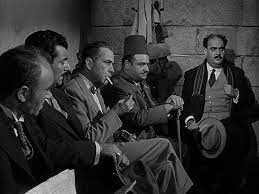
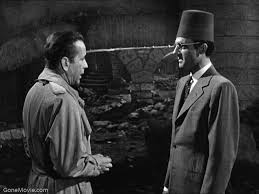
With every cigarette, every time he dons a trench coat, every exchange with shifty characters in fezes, Bogart leaned into what was already his iconic image — shaped by “Casablanca.”

The whole playing against Rick turn of the plot remains fascinating. Rick is noble, sacrificing love for doing the right thing. Harry is Rick’s cynicism cut loose, his opportunism mirroring America’s in the Korean years of the Cold War. He’ll do what he pleases, whatever is expedient. He’s take the Frenchman’s “girl” in a heartbeat, cash in when he can and flee, leaving the Middle East a bigger mess than he found it.

I got a kick out of Mostel’s kvetching and kvelling his way out of a jam, of reliable Greek-American character actor Nick Dennis as Harry’s rough and tumble partner and out of soon-to-be-veteran character actor Jeff Corey (“True Grit” decades later) showing up as an Arab middle man pricing out safe passage for Harry and “the girl.”

Yuma, Arizona, and some convincing Columbia Pictures soundstage “Roman catacombs” give the picture a whiff of authenticity, but only a whiff.

The film’s darkness and fence-straddling cynicism make it an interesting companion piece to “Casablanca,” whose villains were clear cut, whose desperation was palpable and whose romance was one for the ages. A lighter touch may have been called for here. But nobody involved, especially not Bogart, just past his peak and starting to notice it, was in the mood.

Rating: “approved”

Cast: Humphrey Bogart, Lee J. Cobb, Märta Torén, Nick Dennis, Zero Mostel and Everett Sloane

Credits: Directed by Curtis Bernhardt, scripted by A.I. Bezzerides and Hans Jacoby, based on a novel by Joseph Kessel. A Columbia Pictures release on Tubi, Youtube, Amazon etc.

Running time: 1:38

Posted in Reviews, previews, profiles and movie news | Comments Off on Classic Film Review: Trench coats and Fezes, Back to the Desert with Bogie — “Sirocco” (1951)

Movie Review: “Aquaman and the Lost Kingdom” feels like the beginning of the End

Make it stop. Because at this point, we’ve kind of given up on “make it better.”

Warner Brothers and DC finish the job of wasting the great casting coup of their “Justice League” era comic book film adaptations in a dead fish of an Aquaman sequel, “Aquaman and the Lost City.”

It’s a lifeless patchwork of comic book movie “world building” and tropes, pieced together by four credited “story” authors, shot and re-shot, surrounded by rumors that Amber Heard has been edited out of it (She isn’t, but haters gon’hate.) and almost zero buzz.

Even bad buzz might have been better than that.

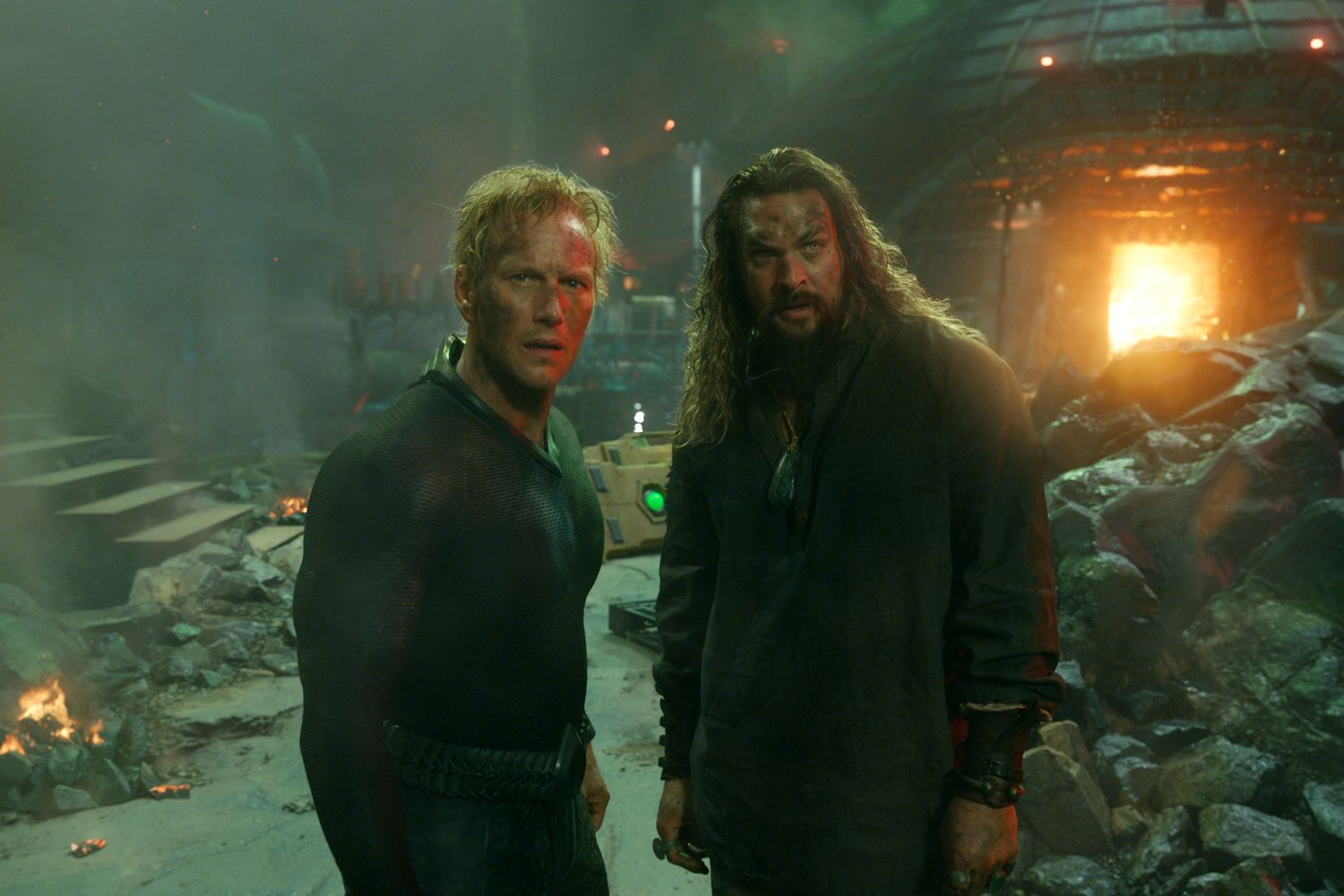
Earnest efforts to make it jokier, probably at the behest of humorous he-man star Jason Momoa, come to naught. Trying to turn Aquaman’s (somewhat) evil brother (Patrick Wilson) into a sort of Loki figure/foil and object of Aquaman’s fun fail.

And the story is just a “payback” tale from the first “Aquaman” outing, the one where Manta (Yahya Abdul-Mateen II ) was a villain foiled, and now he’s back to find ancient undersea tech that will end life on Earth and while he’s at it, “take from him what he took from you.”

Because Aquaman’s got a baby boy, now.

Aquaman’s dad (Temuera Morrison, the original Boba Fett) has little useful advice for his man-mountain son.

“Sometimes not giving up is the most heroic thing you can do.”

James Wan & Co. give us CGI sea-creatures voiced by Martin Short and fanboy favorite John Rhys-Davies, to little avail.

Randall Park plays the scientist no one believes in as he looks high and low for proof of Atlantis.At some point, there’s a scene in which he must have been given a bloody nose. Blood turns up in his beard in insert shots later in this edit.

But the people you kind of feel sorry for are Heard, given enough scenes to justify a paycheck, and Nicole Kidman. It’s been years and years since our favorite redheaded Aussie Oscar winner has been in a movie this bad.

There is some environmental messaging in here, which will annoy the same folks who’re made whenever Amber Heard gets work. Aquaman notes the state of the seas and the environment at large and mutters “I’m tired of nothing ever getting done.”

Yes, even Aquaman hates Joe Manchin.

But Momoa flexes, hops on a bike (his first, best destiny is anything with motorcycles in it) and does his damnedest to carry or will this picture into something worth watching — big laughs, macho joking around — “I’m gonna go start a fight.” – all of it looks like he’s trying too hard, and almost none of it works.

At this point, with Marvel over-saturating the “content” marketplace and out of ideas and DC almost never getting it right, make it stop, make it go away or maybe take a break and a breather on this over-exposed genre seem like the best options.

The technology to make these movies eye candy of the first order is here. But the people making them are at a loss for a decent story to put these superheroes in, much less a movie that matters.

“Aquaman and the Lost Kingdom” fails to answer, in any meaningful way divorced from corporate accounting, the question “Why does this exist?”

Rating: PG-13, violence, some profanity

Cast: Jason Momoa, Nicole Kidman, Yahya Abdul-Mateen II, Temuera Morrison, Randall Park, Dolph Lundgren, Martin Short, Indya Moore, Jani Zhao and Patrick Wilson

Credits: Directed by James Wan, scripted by David Leslie McGoldrick, based on the DC comics. A Warner Brothers release.

Running time: 2:04

Posted in Reviews, previews, profiles and movie news | Comments Off on Movie Review: “Aquaman and the Lost Kingdom” feels like the beginning of the End