
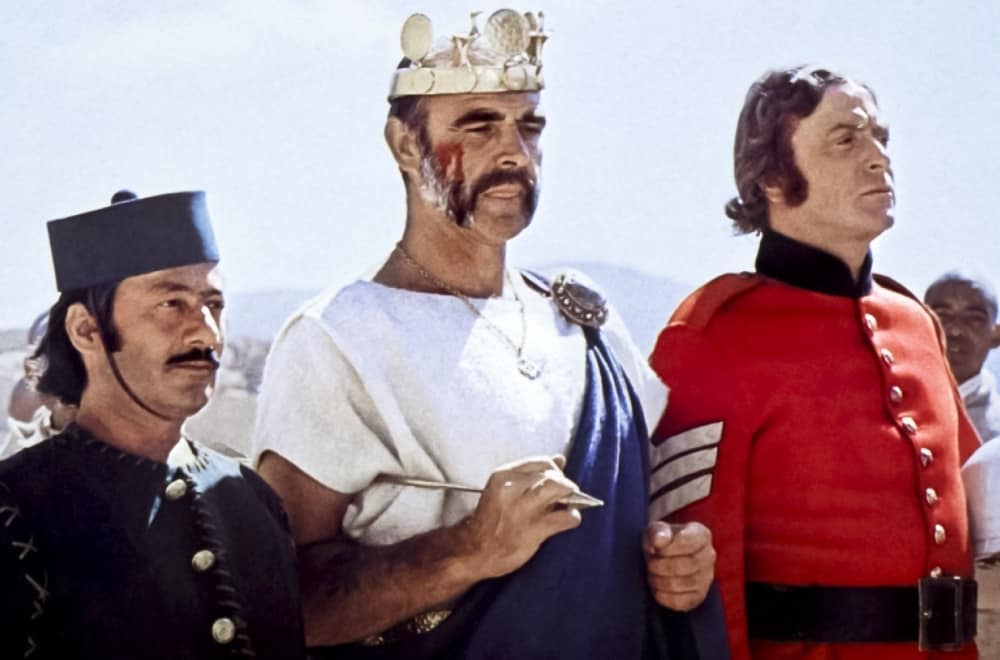
John Huston’s adaptation of Rudyard Kipling’s story “The Man Who Would be King” would have been a vastly different enterprise had he made it when he first had the idea — in his post “African Queen” 1950s.
Huston wanted his muse, Humphrey Bogart (“The Maltese Falcon,” “Across the Pacific,” “Key Largo,” “Beat the Devil,” “The African Queen”) to co-star with the then-fading “King of Hollywood,” Clark Gable in a film not that far removed from the racially patronizing classic “Gunga Din,” also based on Kipling’s writing.
Conversely, a modern day take on this story would be worlds away from Huston’s old-fashioned but faintly anti-imperialist post-Civil Rights Movement/post-Vietnam War 1975 “The Man Who Would Be King.”
When he finally got the money to film this misadventure about two former British soldiers staging a coup in a remote land beyond Afghanistan, it still came off as of another era. Some attitudes expressed and tacitly embraced seem dated. And the three stars were future Oscar winners, and already a bit long in the tooth to be tackling the material.
Christopher Plummer put “The Sound of Music” behind him to play a young reporter hearing and writing down the tale, a 20something Kipling. Plummer was well over 40, and Huston had signed Richard Burton for the role, who looked decades older.
But Sean Connery and Michael Caine could easily pass for robust, years-mustered-out sergeants, making a go at being chancers of the pick-pocketing, extorting and adventuring variety, Daniel Dravot and Peachy Carnehan.
Using Morocco to substitute for India under the British Raj, Huston immerses us in the an exotic alien world of teeming street bazaars and epic mountain ranges, the perfect setting for a racially-patronizing boyish adventure about two “rascals” who set out to take over and then rob a backward, unconquered corner of the Hindu Kush, northern Afghanistan’s Kafiristan.
Our seasoned reporter and editor, Kipling, is a curious and sympathetic “Anglo-Indian” of the Subcontinent, his superiority coming from his white skin, white linen suits and connection to the occupying white Western power. But we don’t see how “enlightened” he is until he crosses paths with the combat veteran Peachy.
Peachy, we quickly learn, is a hustler who picks Kipling’s pocket, only to discover he’s stolen from a fellow follower of “The Widow’s Son.” His suit may be clean enough, but he’s common and broke and yet not at all shy about expressing his grievances at a government that’s treating him as no more privileged than the locals. He thus exercises his racial superiority over the natives as he returns Kipling’s stolen watch, blaming it on a stereotypically obsequious Indian he’s just hurled out of the moving train.
As gags go, that can make a modern viewer wince.
Peachy leans on Kipling for a favor, passing a message on to a mate he’s supposed to meet. The big and bluff and sideburned Daniel also speaks the language of their shared secret society, Freemasonry.
“We met on the level, and we’re parting on the square!”
Kipling intervenes in a blackmail scheme the two have lined-up, but keeps them out of prison, They decide their best bet for fame and fortune is to cross the mountains with rifles, their scarlet Army tunics and military knowhow, throw-in with a local ruler in his conflicts with rivals, change the power balance of the region, and then seize power themselves, looting a bit as they do, before fleeing.
They’re mad, Kipling insists. They’ll be killed.
“Peachy and me, we don’t kill easy!”
But to accomplish their goal, these two rowdies must foreswear strong drink and women, which they do, ceremoniously, with a “contract” which they sign before Kipling, using him as their notarized witness.
Donning darker-skin and turbaned disguises, they’re off to a place “where no white man has ever been and come out since Alexander (the Great).”
The two provide us of evidence of their serious intent and their qualifications for “the job” as they battle bandits and tribesmen, a raging river and snowy peaks on their way.
And once they get there, it’s simpler-than-simple to identify a hapless leader (Largbi Doghmi) and a conflict they can intervene in to set their scheme in motion.
Continue reading













 Movie Nation