


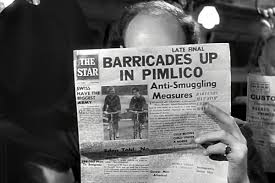


There’s something to the notion that bomb-battered and nearly bled-out Britain had more to celebrate than most after the end of World War II. That explains the time-delayed explosion of wry, giddy comedies that poured out before they’d ended rationing or even begun to clean up the rubble from six years of world war.
“Kind Hearts and Coronets,” “Passport to Pimlico” and “Whisky Galore!” all came out the same year, every mother’s son of them a bonafide classic, and all of them heralding more classic farces to come.
“Whisky Galore!” is the most eccentric and hilarious of the lot. But its 1949 competition, “Passport to Pimlico” gives it a very nice run for the money, a romp that folds in pent-up privation, anarchic capitalism, “We’re all in this together” socialism and a Who’s Who of Great British character players to make funny characters stick and Cockney-flavored punchlines sting.
It’s about a corner of London — hemmed-in by the city and pinned-down by national and local austerity — where everyone is resigned to their limited diet and still putting things on layaway for that sunny day when they have the ration points to buy a car or a dress or what have you because little was available as the country was as broke as could be.
Then one day, the “19 families” of Miramont Place, Pimlico, learn that they’re still under the domain of the French Duchy of Burgundy. “British” austerity “rules” don’t apply. That martinet bank official has “no jursidiction” over his put-upon but independent-minded local manager (Raymond Huntley). The dress shop owner (Hermione Baddeley) can sell whatever she wants as “imports.”
Even the local bobby (Philip Stainton) no longer has the power to close any business on Sundays, or close the pub at “Last orders, ladies and gents.”
Right. “I’ll have a pint, too” then.
Director Henry Cornelius (“Genevieve,” “I Am a Camera”) had the budget to fill the streets and Ealing Studios sets with extras and the cast with famously funny faces for this farce. They treat us to the giddiness of “freedom” from a rigidly-controlled wartime economy. And one and all serve up the sour aftertaste as unregulated “freedom” leads to cheating, inequity and (British) government crackdowns, a “siege” of this little bit of Burgundy in Olde Britannia.
T.E.B. “Tibby” Clarke was a big reason we call “Ealing comedies” a genre and a writer largely responsible for the “Golden Age” of British screen farces. He won an Oscar for scripting “The Lavender Hill Mob,” and “The Titfield Thunderbolt” and “Passport to Pimlico” decorate his classic-strewn resume.
Here, he deftly sets us up for the fun with a “Dedicated To the Memory” image of a wreath with ration books “buried” inside it. The bobby walks the streets, warning residents of what the viewer can hear on the radio, that the area’s “last unexploded bomb,” nicknamed “Pamela,” is due to be removed.
Is there anything more WWII “British” than nicknaming a long-unexploded German bomb?
As we meet various locals — fishmonger Frank (John Slater), Baddeley’s dress shopkeeper, etc. — we get the news that the bomb won’t be removed at all. It’s to be inconveniently blown up in that crater in the middle of a ruined city block that nobody wants to build on.
Pranks-prone schoolboys solve that problem by rolling an old factory flywheel into the crater.
One “ka-BOOM” later, and what’s beneath that crater reveals itself — a treasure trove from a former lord of the region’s stash. One coroner’s inquest later, an expert royalist (Dame Margaret Rutherford) is consulted, and damned if it doesn’t appear that this 15th century Duke of Burgundy didn’t die on a battlefield and lose his lands that way. He lived on, and this parcel still belongs to his descendents — in France — and its people aren’t exactly English or British.
“You mean that these Londoners are…Burgundian?!”
“Indubitably!”
Continue reading


















 Movie Nation