Classic Film Review: Kipling and Huston, Caine and Connery, “The Man Who Would be King” (1975)

John Huston’s adaptation of Rudyard Kipling’s story “The Man Who Would be King” would have been a vastly different enterprise had he made it when he first had the idea — in his post “African Queen” 1950s.

Huston wanted his muse, Humphrey Bogart (“The Maltese Falcon,” “Across the Pacific,” “Key Largo,” “Beat the Devil,” “The African Queen”) to co-star with the then-fading “King of Hollywood,” Clark Gable in a film not that far removed from the racially patronizing classic “Gunga Din,” also based on Kipling’s writing.

Conversely, a modern day take on this story would be worlds away from Huston’s old-fashioned but faintly anti-imperialist post-Civil Rights Movement/post-Vietnam War 1975 “The Man Who Would Be King.”

When he finally got the money to film this misadventure about two former British soldiers staging a coup in a remote land beyond Afghanistan, it still came off as of another era. Some attitudes expressed and tacitly embraced seem dated. And the three stars were future Oscar winners, and already a bit long in the tooth to be tackling the material.

Christopher Plummer put “The Sound of Music” behind him to play a young reporter hearing and writing down the tale, a 20something Kipling. Plummer was well over 40, and Huston had signed Richard Burton for the role, who looked decades older.

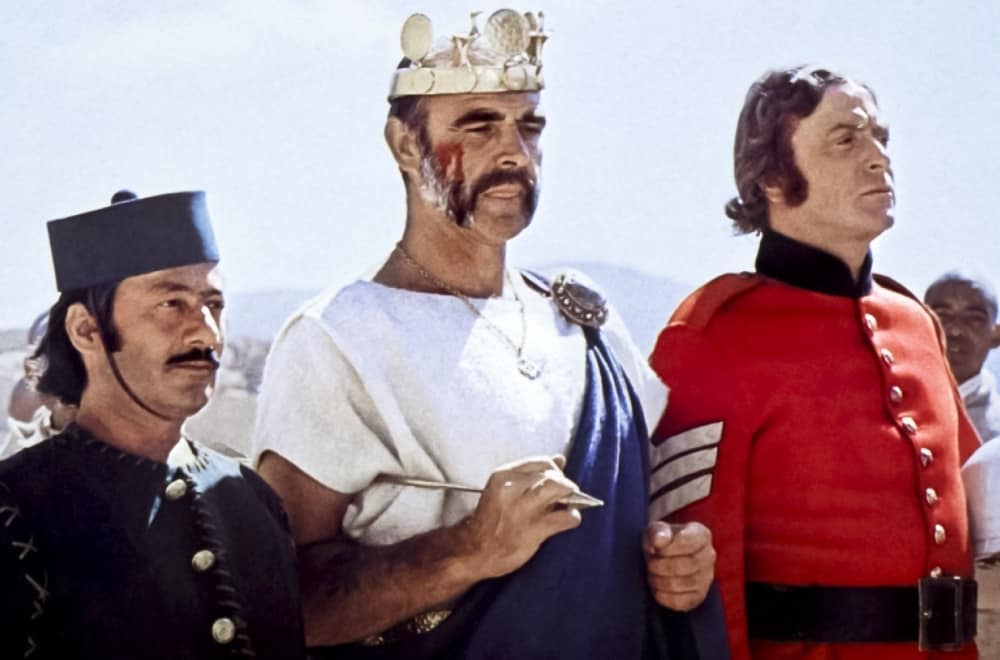
But Sean Connery and Michael Caine could easily pass for robust, years-mustered-out sergeants, making a go at being chancers of the pick-pocketing, extorting and adventuring variety, Daniel Dravot and Peachy Carnehan.

Using Morocco to substitute for India under the British Raj, Huston immerses us in the an exotic alien world of teeming street bazaars and epic mountain ranges, the perfect setting for a racially-patronizing boyish adventure about two “rascals” who set out to take over and then rob a backward, unconquered corner of the Hindu Kush, northern Afghanistan’s Kafiristan.

Our seasoned reporter and editor, Kipling, is a curious and sympathetic “Anglo-Indian” of the Subcontinent, his superiority coming from his white skin, white linen suits and connection to the occupying white Western power. But we don’t see how “enlightened” he is until he crosses paths with the combat veteran Peachy.

Peachy, we quickly learn, is a hustler who picks Kipling’s pocket, only to discover he’s stolen from a fellow follower of “The Widow’s Son.” His suit may be clean enough, but he’s common and broke and yet not at all shy about expressing his grievances at a government that’s treating him as no more privileged than the locals. He thus exercises his racial superiority over the natives as he returns Kipling’s stolen watch, blaming it on a stereotypically obsequious Indian he’s just hurled out of the moving train.

As gags go, that can make a modern viewer wince.

Peachy leans on Kipling for a favor, passing a message on to a mate he’s supposed to meet. The big and bluff and sideburned Daniel also speaks the language of their shared secret society, Freemasonry.

“We met on the level, and we’re parting on the square!”

Kipling intervenes in a blackmail scheme the two have lined-up, but keeps them out of prison, They decide their best bet for fame and fortune is to cross the mountains with rifles, their scarlet Army tunics and military knowhow, throw-in with a local ruler in his conflicts with rivals, change the power balance of the region, and then seize power themselves, looting a bit as they do, before fleeing.

They’re mad, Kipling insists. They’ll be killed.

“Peachy and me, we don’t kill easy!”

But to accomplish their goal, these two rowdies must foreswear strong drink and women, which they do, ceremoniously, with a “contract” which they sign before Kipling, using him as their notarized witness.

Donning darker-skin and turbaned disguises, they’re off to a place “where no white man has ever been and come out since Alexander (the Great).”

The two provide us of evidence of their serious intent and their qualifications for “the job” as they battle bandits and tribesmen, a raging river and snowy peaks on their way.

And once they get there, it’s simpler-than-simple to identify a hapless leader (Largbi Doghmi) and a conflict they can intervene in to set their scheme in motion.

Continue reading


Posted in Reviews, previews, profiles and movie news | Comments Off on Classic Film Review: Kipling and Huston, Caine and Connery, “The Man Who Would be King” (1975)

Movie Preview: Well, it’s got a Chevy Nova in it. I guess “Roadkill” it is

Think I’ll review this? Given my obsession with movies featuring a vintage (butt ugly) Chevy Nova as a “car with character?”

You bet your life. Other vintage cars feature in this “road” picture.

“Roadkill,” a straight-up thrill-kill B-movie thriller, opens Friday.

Posted in Reviews, previews, profiles and movie news | Comments Off on Movie Preview: Well, it’s got a Chevy Nova in it. I guess “Roadkill” it is

Movie Preview: Mickey Mouse’s copyright expires, “Mickey’s Mouse Trap” of horror is coming

Here’s the trailer to the first film to make use of Disney’s insanely-overextended copyright of the character the company founder created nearly a century ago.

As horror movies set in amusement parks go, “Mickey’s Mouse Trap” doesn’t seem to offer much.

But as intellectual property rights go, it’s kind of reassuring the Disney’s heirs, familial and corporate, don’t get yet more special treatment of the mouse that led to The Mouse.

Disney has, at long last, moved on from Mickey and Minnie and their peers. Mickey video games and the like may still have value for those who now have access to the creation. But if Disney was willing to let him and others go, believe me, they know better.

Posted in Reviews, previews, profiles and movie news | Comments Off on Movie Preview: Mickey Mouse’s copyright expires, “Mickey’s Mouse Trap” of horror is coming

Netflixable? Sniper Chad, Haysbert and a B-C movie crew try to make “Sniper: G.R.I.T.” cool

You hate to start the year reviewing a bad C-movie aiming for B-status, but that’s the state of the cinema between Christmas and that first weekend after New Year’s.

“Sniper: G.R.I,T.” is the latest in a series of glib, violent and dumb “Sniper” action pictures starring Chad Michael Collins and built on a tsunami of sniper “head shots” as action beats.

This time, his crew, named “G.R.I.T.” for Global Rescue & Intellegence Team, is in the spotlight for a matter of some mayhem in Malta.

I’ll bet the financing, incentive cash, etc. that got this picture made is more interesting than anything on the screen.

A blast of exposition introduces that “team,” led by Gabriel Stone (Dennis Haysbert) and their quarry — rescuing a missing comrade, Yuki, a.k.a. “Lady Death” (Luna Fujimoto) from the clutches of the cultish State of Aragon that Malta has become.

It’s led by a plumb, guru-ish Bond villain named Bubalo (Paul Kissaun, as menacing as a stoner department store Santa). He and his minions must be murdered so that Yuki can be brought back into the fold at G.R.I.T.

Ryan Robbins is here as the shooter’s local language-learning (just a single phrase, a running gag) wiseguy/sidekick.

“Who are you,” a future-target asks?

“The Piper! And your balance is long overdue!”

A lot of the dialogue is an attempt to manage that level of wit, and failing.

There are I.T. guys (Josh Brener is one), necessary in any modern picture of this genre. And that Lady Death is a badass martial artist who looks good doing sweep-kicks in her leather pants, boots and long, billowing red overcoast. That’s usually a plus.

But the fights and action beats seldom rise to “adequate,” the stunt-work lets us see how hard it is to get stunt fights right.

And by the end, we’ve figured out why the violence of choice is a gun-shot to the head. A simple, singular effect, repeated dozens of times, never cleverly, is a lot less trouble than working out fight choreography and doing the takes to make it sting.

When your plot is crap and your location may be your biggest selling point, that’s what you do.

Collins makes a bland lead, with Robbins’ never letting us forget that he’s the “tries too hard” sidekick and none of them have even a shadow of the presence Haysbert does. And he must be asking himself what he’s doing in anything this junky.

But Malta still looks like a bucket-list vacation.

Rating: R, violence, sexual innuendo, profanity

Cast: Chad Michael Collins, Luna Fujimoto, Ryan Robbins, Josh Brener,
Toshiji Takeshima, Paul Kissaun and Dennis Haysbert

Credits: Scripted and directed by Oliver Thompson, a Sony film, a Netflix release.

Running time: 1:31

Posted in Reviews, previews, profiles and movie news | Comments Off on Netflixable? Sniper Chad, Haysbert and a B-C movie crew try to make “Sniper: G.R.I.T.” cool

Movie Preview: Lithgow and Morse and Giannini boost new drama that remembers a crusading nun, Francesca “Cabrini”

Cristiana Dell’Anna has the title role in this Italian Catholic immigrant who made opening a humane orphanage in New York her life’s work.

Giancarlo Giannini plays Pope Leo XIII, with John Lithgow the New York mayor she had to contend with and David Morse as an American archbishop who reminds her of the long odds of her 1880s-90s success.

This Angel Studios release comes our way March 8.

Posted in Reviews, previews, profiles and movie news | Comments Off on Movie Preview: Lithgow and Morse and Giannini boost new drama that remembers a crusading nun, Francesca “Cabrini”

Billy Graham, DeMille and “The Ten Commandments”

Steven Spielberg mentioned in interviews over the years how a Cecil B. DeMille epic from the early 1950s changed his life. The spectacle, the larger-than-life presentation and the special effects of “The Greatest Show on Earth” turned little Steven into a kid who wanted to do his own effects and make his own epics, something recounted in his autobiographical drama “The Fabelmans.”

I was reminded of that this Sunday morning as I caught a rural Southern Baptist church’s pastor relate how DeMille’s “The Ten Commandments” was his idea of “The Greatest Show on Earth,” the greatest film of his youth, never challenged or “topped,” in his mind since.

These church services are the Sunday AM background noise on my monthly visits to my aged mother in North Carolina’s piedmont, which used to be tobacco farming and textile manufacturing country, and hasn’t entirely emptied out despite that cash crop and that factory work shrinking or disappearing, sending ensuing generations away to find work, college and different lives in cities near and far.

Shrunken towns all over this corner of the South point to how rural America has aged and in many cases curdled politically as the best, brightest and youngest moved away.

A college job I had was working Sundays at a college town radio station that broadcast a collection of (paid promotion) church services, and I learned way back then that not all “fundamentalist” rural Southern pastors are the same. One that sticks out in my mind was an Apartheid-backing racist, who made me cringe Sunday after Sunday. Another was a young, passionate “spirit-filled” lay preacher who’d come into the studios with a few of his flock, who’d be moved to tears by his sincere exhortatations.

I’ve been moved a couple of times to post on Pastor G. Barry Chambers’ Mount Harmony Baptist Church of Rougement, N.C. Facebook page about some obvious lie or propagandistic nonsense he was spouting on a given Sunday. “Conservative” doesn’t quite do justice to his politics.

But this Sunday, he moved me to fact-check him. Here.

In his “Ten Commandments” recommendation, Pastor Chambers tossed in an aside about the Southern Protestant saint, Billy Graham.

“Billy Graham was offered the part of Moses,” Chambers said. “Blank check,” name his price to play the part, Chambers added. “Turned’em down, flat.”

I apologize to my elderly mother, who may have overheard my epithet in response to that load of codswallop.

But considering the politics of Graham — an anti-communist zealot, “fluffed” into prominence by reactionary newspaper publisher William Randolph Hearst — and those of ultra-right-wing DeMille, whose 1956 “Ten Commandments” is laced with anti-communist messaging, it is within the realm of possibility.

Graham, as those who covered him most closely (newspapers in Charlotte, near his birthplace) noted, kept his nose clean and his ministry above reproach financially and morally (Mike Pence got his “never be alone in a room with a woman not your wife” thing from a Graham ministry edict). But he was, as the late columnist Frye Galliard noted in a profile, a “star-f—-r” of the first magnitude. He loved rubbing shoulders with the powerful, most of them reactionary, one of the most infamous of whom was Richard Nixon.

I interviewed several folks from a famous protest of a Graham/Nixon joint appearance at the University of Tennessee when that notorious event’s anniversary came up while working at a Knoxville newspaper some years back. Graham, to his credit, seemed to learn from that experience, when an amoral politician used him to legitimize his crimes with “the silent majority.” He kept most politicians, save for Reagan,at arm’s length after that.

More recently, I had to study up on Graham before interviewing Armie Hammer, who before he got famous as an actor played young Billy as a student at Bob Jones U. or whatever the school was called back in the ’40s. Hammer later got a shot at “The Lone Ranger,” “The Man from U.N.C.L. E.” and “Call Me by your Name” before his kinkiness got him “canceled.”

DeMille, you might remember from John Ford biographies and the memoirs of Hollywood editor turned director Robert Parrish, famously pushed loyalty oaths and efforts to blacklist Hollywood stars and filmmakers, aiming for some sort of right wing “coup” overturning the Hollywood heirarchy, which rarely gave him his due. His zeal to back up the infamous U.S. House of Representatives’ “Unamerican Activities Committee” efforts to censor, silence and render unemployable pretty much all of Progressive Hollywood was petty and personal in that regard. John Wayne and his lacky/sidekick Ward Bond were in on this, a form of “revenge” against their Hollywood “betters” reminiscent of a certain treasonous ex-president and his cult.

Ford, Wayne’s favorite director and mentor, famously stood up to DeMille’s “anti-American” witch hunt in a 1950 meeting of Director’s Guild of America members.

But was DeMille interested in casting Graham as Moses the Lawgiver? DeMille allegedly considered a lot of people, Burt Lancaster among them. He wanted William Boyd, who had acted in the DeMille silent epic “King of Kings” decades before he became Saturday morning movie serial and later TV cowboy (when those serial films were televised) Hopalong Cassidy.

Billy Graham’s name never came up.

But Pastor G. Barry Chambers didn’t invent this out of whole cloth. What he appears to have exaggerated was related to this reference in Graham’s autobiography, as reported in the L.A. Times in the 1990s. DeMille DID meet with Graham, but to suggest some sort of business collaboration, as Graham was starting up his own film production company at the same time.

Graham was a pioneer in faith-based movies in the ’50s into (at least) the ’80s. There were times that my rural Virginia Boy Scout troop was called in to act as voluntary ushers for these “crusade” based films. The stories were often modern parables of a struggling life made better by answering an altar call at a Billy Graham crusade (in the third act).

The Graham-as-Moses notion could be a simple mistake, but feels like “lore” and a fact-based message muddying over time, conveniently bent to fit a small town pastor’s agenda.

As no movie-lover in the good reverend’s flock was able to fact-check him in real time (a LOT of preachers could use that, from my experience), the least a film fan can do is provide that service, with links — “receipts,” as the kids say — here on the Internet.

Posted in Reviews, previews, profiles and movie news | Comments Off on Billy Graham, DeMille and “The Ten Commandments”

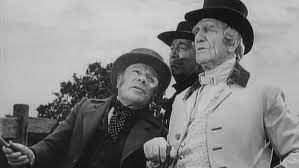
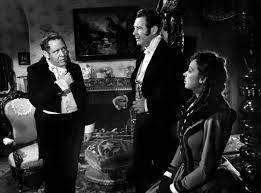
Classic Film Review: Hollywood Brits and Others rally for WWII England, “Forever and a Day” (1943)

Almost every Hollywood movie of “the war years” was an embarrasment of riches when it came to European expats decorating the cast. “Casablanca” was practically a make-work project for conflict refugees. British films with a patriotic bent — “The 49th Parallel,” for instance — were often filled with famous faces in small roles, getting across the idea that everyone was “doing our bit” to fight fascism.

But none of them, not even “Stage Door Canteen,” surpassed “Forever and a Day” for “Hey, isn’t that?” character actor delights. For a film buff, it’s a must-see movie, just for the parlor game pleasures it provides.

A cast of dozens and dozens, with seven directors, twenty-one credited screenwriters (Hitchcock allegedly wrote some of it, uncredited) make this must-see-cinema for anybody still playing “Six Degrees of Kevin Bacon.”

The story is simple enough, but downright soap operatic in all its characters and complications. An American with the poncy name of Gates Trimble Pomfret (Kent Smith) in London during The Blitz of 1940-41 has to deal with some old family property before rushing home.

“If I’m going to have to eat shells and shrapnel, I’m going to do it on my own country’s dime,” he says, cynically leaning into his homeland’s neutrality.

The property is an historic house in a city of such houses, this one built in 1804. A British woman renting it, Lesley Trimble (Ruth Warrick) wants to buy it,”for sentimental reasons,” she says. And for cheap. As he’s of a mind that this place isn’t long for this world, given all the bombing, he’ll hear her out.

The basement is an air raid shelter, filled with make-a-brave-face sing-alongs, led by a priest played by Herbert Marshall. Future TV icon June Lockhart appears as a teen in the air raid shelter, the last surviving member of the cast (as of this writing).

Upstairs, “serving tea in the middle of an air raid,” Miss Trimble tells the flirtatous Yank, whose middle name suggests “We might be related,” the story of this great house, which was built, a bronze plaque tells us, by Sir Eustace Trimble in 1804.

In four chapters, we’re taken back to the Napoleonic Wars, the early reign and last years of Queen Victoria and World War I, showing us Britain and the house under threat from Napoleon and external enemies, and changing times within.

C. Aubrey Smith plays the elderly Admiral Trimble who built the place, out in the country on the edge of London as “the Corsican” (Bonaparte) threatened Britain with invasion. He quotes this “young” poet, that “Wordsworth” fellow, about the need to defend this house and this land from authoritarian invasion.

“We must be free or die, who speak the tongue. That Shakespeare spake!”

The admiral’s son (Ray Milland), a Lieutenant, gets mixed up in efforts to marry a young woman (Anna Neagle) off to some rich older man (Claud Allister) by her guardian, the oily Ambrose Pomfret (Claude Rains, a grand villain). For the first time, the house must literally be defended from invading ruffians.

And the Pomfret family and Trimble family are thus forever bound by the house. A member can marry a brassy Cockney maid (Ida Lupino) and run off to America, but the connection remains.

We’ll see fortunes made as a family member is talked into manufacturing cast iron bathtubs (Buster Keaton is a silent plumber doing the installing). Snide servants (Charles Laughton) and monied aristocrats (Edward Everett Horton) will reside there, celebrating Queen Victoria, attempting to master the horseless carriage (early motorcars), hosting American servicemen (Robert Cummings) during The Great War (WWI).

Warrick’s Miss Trimble, as she narrates, notes that these were “all people I should like to have known,” these generations who sat in gardens (long gone) and note “Our gardens are worth fighting for.”

Continue reading
Posted in Reviews, previews, profiles and movie news | Comments Off on Classic Film Review: Hollywood Brits and Others rally for WWII England, “Forever and a Day” (1943)

Movie Review: “Something’s Brewing,” but not romance in this bore

For everybody who figures The Hallmark Channel is too “edgy” and The Christian Channel too preachy, there’s UpTV, whose fare one hopes isn’t represented by “Something Brewing,” a bland, lifeless romance parked on Amazon Prime for the curious.

Suffice it to say I’m feeling a bit feline after sampling this drab, Kentucky-filmed misfire.

The performances have no spark, the situations are insipid and desexualized, the “plot” never more than plodding.

Kristi Murdock is Jane, a VP with a marketing firm who comes home on the day she’s laid off to find her boyfriend hooking up with another woman. It’s implied, as this movie wouldn’t care to take us into the bedroom.

Jane’s had it with this business world, “men” and “the city.” She’s ready to escape to the country.

But that would be a Hallmark movie, wouldn’t it? Here, a friendly barrista (Jason Cook) makes her day, flirts, and despite being a BARRISTA, she gives him a chance.

After all, she’s about to move away — turned in her notice on her apartment, the works.

“Things can’t get any worse, right?” her real-estate agent bestie (Tammy-Anne Fortuin) insists.

They do, just as soon as Jane pokes around into the background of Mr. Knows All About Coffee David.

There’s no spark between the attractive leads, and no surprise in this modest blunders’s “twists.”

The message isn’t faith-based, but more of a “to being happy where we are” kind of acceptance of the hard breaks life doles out and the laughable good luck that intervenes for those who like their romantic entertainment to have a dose of magical thinking ladled on top.

It’s not hatefully bad. But story to acting to settings to direction to sentimental Muzak score, nothing’s “brewing” here. Nothing at all.

Rating: TV-13up

Cast: Kristi Murdock, Jason Cook and Tammy-Anne Fortuin

Credits: Directed by Nadeem Soumah, scripted by Adam Rockoff. An UpTV film on Amazon Prime.

Runing time: 1:29

Posted in Reviews, previews, profiles and movie news | Comments Off on Movie Review: “Something’s Brewing,” but not romance in this bore

Movie Preview: “Garfield” the cartoon cat returns, CGI animated

This version of “The Garfield Movie” is an origin story, with a discovery. “Garfield Doesn’t Like Burgers” once he discovers the wonders of lasagna.

Chris Pratt voices the cat, with the voices of Samuel L. Jackson, Ving Rhames, Bowen Yang and Hannah Waddington also in the cast.

The brand seems dated, with comic strips extinct and the earlier movies and TV series a distant nostalgic memory for today’s parents. But a cute smart alec cat could be just the ticket for tiny tykes.

May 24.

Posted in Reviews, previews, profiles and movie news | Comments Off on Movie Preview: “Garfield” the cartoon cat returns, CGI animated

Netflixable? Polite Swedish Sisters try to overcome saying “Thank You, I’m Sorry”

The lady priest tells the support group that “Grief is love that has become lost.” But Sara doesn’t want to hear it.

Her last conversation with her husband, Daniel, was him telling her — by phone — that “This isn’t working” and that he’s taking a few weeks off with a friend. She slept on the sofa, he slept in their bed.

And that’s where she found him, dead the next morning.

She has a five year-old, Eliot, whom she didn’t know how to give the news. She has an overbearing mother-in-law that she threw her phone at (“Two stitches.”), which is why she’s in this support group. Mother-in-law Helen is a psychologist, minoring in manipulation.

Sara had a hasty funeral to plan, telling the priest about her life with her husband, and it doesn’t sound like he was any piece of cake to live with. And she told that same priest that she has no family, that her parents are dead.

Sara’s Dad isn’t dead. Her estranged sister Linda, is the one who checks in on him at the nursing home.

Oh, and Sara’s eight months pregnant. Throwing a phone was all she could manage.

“Thank You, I’m Sorry” is a downcast and dark Swedish comedy about grief, the victims our parents sometimes turn us into, the lies we grew up with replaced by lies we live with, and healing. It’s amusing, touching and downright therapeutic, parked as it is on Netflix right in the middle of The Holidays.

Sara (Sanna Sundqvist, terrific) is a scabbed-over wound of a woman, in shock and not helped at all by her over-helpful mother-in-law Helen (Ia Langhammer, never lapsing into caricature), whose shock manifests itself by insisting on recording their meeting with the coroner. Helen’s practically accusing Sara of having something to do with her boy’s death.

But she doesn’t. That’s the theme here, the running gag and the meaning of the title, “Thank You, I’m Sorry.” Everybody’s too polite to be direct. Unpleasantness is brushed over, covered with a lie or what have you.

Sara’s emotionally shut-down. Older sister Linda (Charlotta Björck, subtle and earthy), the one left checking on their disabled, alcoholic, cheating father, has her own “politeness” issues. She can’t shake her controlling, clingy and mooching live-in lover Jasse (Pershang Rad, quite funny).

“We’re on a break” means nothing to him. He simply won’t be chased out of their flat and her life. Every problem of hers somehow wrongs him. And everything we need to know about him is in how he takes the news that Linda’s brother-in-law died and left her sister with a child and a baby on the way.

“It’s just that you haven’t asked me how I’M doing!”

The sisters reconnect, reluctantly. They reveal the secrets of their distant past and the unfamiliarity of the recent events of their lives. They clash and run afoul of Helen, each in her own way. Linda has a big dog, but no clue how to deal with a five-year-old boy. Sara has unresolved rage about their childhood, their estrangement, her manipulative mother-in-law and the husband who died just as he was about to ditch her with two kids.

Director Lisa Aschan (“Call Mom!”) and screenwriter Marie Østerbye (“Almost Perfect”) find a lot of sweet spots amidst the melancholy laughs. Five-year-old Eliot (Amaël Blomgren Alcaide) meets Linda’s dog “Zlatan” and keeps pronouncing his name “SATAN” (in Swedish with subtitles, or dubbed into English). At the funeral.

And Sundquist and Björck mesh in a wonderfully arms-length, sisterly way. No hugs, just a shoving match and kick-fight or two, “bonding” without overt “forgiveness.” Almost everything is left unsaid.

It’s entirely too predictable some of the time, but this film has some warm things to say about sisters, the lies families live with and the scars those lies, and decisions made to tell them, leave years later.

Sometimes, good manners and delicate denial just make everything worse, especially in Sweden.

Rating: TV-MA, death, childbirth, profanity

Cast: Sanna Sundqvist, Charlotta Björck, Ia Langhammer, Amaël Blomgren Alcaide and Peshang Rad.

Credits: Directed by Lisa Aschan, scripted by Marie Østerbye. A Netflix release.

Running time: 1:31

Posted in Reviews, previews, profiles and movie news | Comments Off on Netflixable? Polite Swedish Sisters try to overcome saying “Thank You, I’m Sorry”