Movie Preview: Zendaya is the heart of a Tennis Love Triangle — A New Trailer for “Challengers”

This looks like a step away from the blockbusters she’s typically associated with on the big screen (“Greatest Showman,” “Spider-Man,” “Dune”).

Let’s see how a pixie-pretty leading lady holds the picture together in a dramedy about tennis and love matches and what not.

Funny “white boy” joke, a phrase that almost always lands a laugh.

April 26.

Posted in Reviews, previews, profiles and movie news | Comments Off on Movie Preview: Zendaya is the heart of a Tennis Love Triangle — A New Trailer for “Challengers”

Movie Review: A Nobel Prize-winning classic rendered in paint — “The Peasants”

“The Peasants” is a film based on a village life melodrama of the same title written by the Pole Wladyslaw Stanislaw Reymont in four massive volumes in the 1920s.

Even the fact that Reymont won the Nobel Prize for literature for it isn’t much of a justification for giving it a second thought, as in those early years, the Nobel literary prizes were doled out to a string of forgotten figures, while giants such as Tolstoy, Conrad, Chekhov, Edith Wharton, Conrad and Ibsen went to their graves without such honors. Maxim Gorky, Thomas Mann and Thomas Hardy were Reymont’s esteemed competition in 1924.

But this potboiler of a book has been filmed and then those film frames painted to life in the same rotoscoping animating style deployed by the filmmakers who made the gorgeous Van Gogh biography “Loving Vincent” a few years back. After casting, rehearsing, acting and shooting the film, another five years were needed for 100 painters to get Poland’s official entry as Best International Feature for this year’s Oscars painted and ready for the public.

And even though it didn’t make that Oscar cut, this detailed look at the life in Lipce, the struggles, ambitions, greed, jealousies and transgressions of its often venaly inhabitants, is too beautiful to pass over.

Jagna (Kamila Urzedowska) is the most beautiful teen in the village, 19 and blonde and pony-tailed, she is indulged by her widowed mother (Ewa Kasprzyk), who spares her heavy labor so that she has time to be pretty, make artful cutouts and necklaces and such. All the men and boys notice her, and when she’s quizzed about her prospects, this or that “wealthy widower,” she lets one and all know that she won’t be “rocking someone else’s cradle.”

When the richest farmer in town, Maciej Boryna (Miroslav Baka of the “Squared Love” movies) is talked into taking this prize and clumsily flirts, she lets him know just how much trouble she’d be.

“I wouldn’t work in the fields,” she tells him (in Polish with English subtitles). She might not do much around the house, either. I mean, just look at her.

Unknown to the miserly patriarch, his resentful oldest son Antek ( Robert Gulaczyk of “Loving Vincent”) has noticed Jagna, too. Handsome and rugged and headstrong, his attentions are reciprocated.

The fact that he has a wife (Sonia Mietielica) and child doesn’t deter Jagna. When you’re that pretty, you get used to getting what you want.

But their trysts can’t stop the wheels of tradition, as matchmaking is underway. One courtship ritual in this place at this time (late 19th century) holds that when a man sends vodka over, things are about to turn serious and legally so. Boryna sends the vodka through a proxie.

A bit of haggling over acreage between Jagna’s mother and Boryna sets Jagna on the path to matrimony, and multiple families on the road to collision. Jagna practically weeps through her seranaded, danced-to-death wedding. This is destined to end badly.

Animated gimmick or no gimmick,”The Peasants” is gorgeous to look at, with almost every frame its own work of art.

This technique is put to great use on scenes of festive dancing and lurid moments of passion, with our trysting couple caught in a haystack and almost burned to death over their transgressions.

One doesn’t have to know the recent history of Polish art to appreciate the images even if we can’t place the direct influences on this scene or sequence, or that one. We see peasants harvesting cabbages, herding sheep, slaughtering a cow and at every turn, we hear them gossiping about the girl, the old husband, the lover, money and the land.

The melodramatic story touches on familiar themes, situations, conflicts and resolutions of conflict as we follow the rivals for old Boryna’s fortune and land.

But there’s no escaping the realization that melodrama is a perjorative description of any narrative, that many situations seem contrived, that characters act unnaturally, driven by passions or simple plot necessities as they do.

This isn’t the masterpiece that “Loving Vincent” was and remains, the definitive Van Gogh biography told by painters honoring his works, visual subject matter and style. But “The Peasants” is an engaging way of taking us back to a simpler time when the people are just as petty, inconsiderate and greedy as people have always been and always will be.

Rating: R, violence, sex, nudity, profanity

Cast: Kamila Urzedowska, Robert Gulaczyk, Miroslaw Baka, Mateusz Rusin, Ewa Kasprzyk and Sonia Mietielica

Credits: Scripted and directed by DK Welchman and Hugh Welchman, based on the novel by Wladyslaw Stanislaw Reymont. A Sony Pictures Classics release.

Running time: 1:55

Posted in Reviews, previews, profiles and movie news | Comments Off on Movie Review: A Nobel Prize-winning classic rendered in paint — “The Peasants”

Classic Film Review: Heavy-Handed Fascism Allegory — “Ship of Fools” Sails On (1965

The cinema of Stanley Kramer is marked by movies that touched, directly or indirectly, matters of great social import and social justice.

Race and racism messages were carried in “The Defiant Ones” and “Guess Who’s Coming to Dinner.” The perils of the nuclear arms were laid out in the forlorn “On the Beach,” anti-science conservative no-nothingism sent-up in “Inherit the Wind” and World War II’s most important subtext — The Holocaust — informed “Judgement at Nuremberg,” “The Juggler” (which he produced) and perhaps his weakest “message” movie, 1965’s “Ship of Fools.”

An all-star melodrama in the “Grand Hotel/Airport” model, it’s a slow-moving disaster about a slow-moving disaster. The film is set in 1933. The “ship” in question is German, heading home to its newly-fascist German home port . And the characters, one by one, answer the question posed by a complacent German Jew (played by Heinz Rühmann) in their midst.

“Do you zink zis boat is a cross-section of ze German people?”

Yes it is.

Based on a Katherine Anne Porter best-seller, this sailing-into-fascism allegory is heavy-handed, even if you ignore the opening and closing remarks to the camera made by the canny dwarf passenger (Michael Dunn, most famous for his turn on TV’s “The Wild Wild West”).

“Oh I can just hear you saying, ‘What has all this to do with us?'” he chuckles to the viewer as the passengers disembark in Swastika-bedecked Deutschland. “Nothing.”

But audiences, who even-then needed reminding that the great sacrifice of World War II was worth it, that totalitarianism, racism and eugenics were evils to constantly be on guard against, ate it up. Kramer made many a movie contrived to make the viewer feel good about standing up, buying a ticket and being counted, that one was considering the issues tackled in that film in their daily and public lives.

No, you don’t tolerate, support or vote for racists, militarists, the willfully ignorant or the nationalist. Nazis are Nazis, Communists are Communists and human rights, like human life, aren’t just :liberal” values, they are to be supported and preached by one and all.

The message took priority over the narrative, in this case. But as soundstage-bound as this Oscar-nominated sea voyage was, as clumsily-unsubtle as it could be, there are riches in its sometimes tedious two and a half hours.

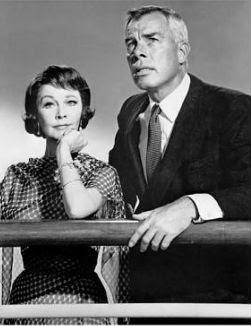
Vivien Leigh gives one last haughty, faded-rose turn as an aged American divorcee trying to pass for 46 and keep some dignity in her bitter loneliness.

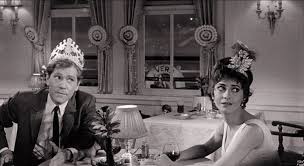
Elizabeth Ashley, the last surviving member of the cast, is utterly captivating as an American artist trapped in a love-lust-hate relationship with leftist fellow artist George Segal. She dances the flamenco, flirts, fights and falls back into her beloved’s arms.

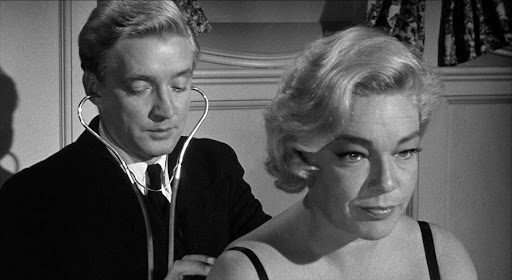
Oskar Werner, a draft-dodging WWII veteran, gives one of his best “conscience of a nation” performances as a ship’s doctor miserable about his lot in life and the country he must return to.

Simone Signoret (“Les Diaboliques”) underplays an addict who falls for the doctor.

For all his hamminess and showboating bluster, José Ferrer is never less than fascinating to watch as Rieber, a eugenics-preaching Nazi sympathizer, disturbing many with his anti-Semitism, but ardent in his pursuit of a golddigging German blonde (Christiane Schmidtmer), who dances with him and duets with him in German song.

And Dunn, deftly playing the self-aware conscience of the piece, delivers plain truths about who the inhumane hate — dwarves, Gypsies and Jews, etc. — and where that hate is headed.

“Fifty percent of the people who produced a Goethe, a Beethoven, and a Bach voted for Rieber’s party last week!

The narrative follows the unnamed passenger liner from Veracruz, where Lee Marvin’s failed baseball player turned coach was “trying to teach the greasers how to play ball.” Why he should be taking a slow boat to Germany is anybody’s guess.

The captain (Charles Korvin) is disappointed that his ship’s doctor (Werner) has abruptly announced this is his last voyage. The charming but racist purser (Werner Klemperer, most infamous for TV’s “Hogan’s Heroes”) won’t be quitting. Like the skipper, he’s a “Good German,” going along to get along. The captain denies admission to the captain’s dinner table to the lone dwarf on board and the Jewish “religious trinkets” salesman (Rühmann).

The young painters (Ashley and Segal) paint and bicker. The aged “Condesa” (Signoret) is an addict facing prison in Tenerife, another stop on the long voyage home, for her drug abuse.

For 26 days, Rieber (Ferrer), the ardent German Nationalist, has a captive audience for his sermons on all things grand and German.

The troupe of Spanish dancers returning home are headed by Pepe (the flamenco legend José Greco), who leads them in formal and informal dances all through the voyage. And after the dancing, he pimps out the women in his ensemble.

Characters discuss their worries, their ennui and their wants in promenades along the (soundstage) upper decks on in private in their staterooms. A lad is under the thumb of a stingy rich relative. A German couple let their English bulldog dine at the table with them. Some deny their bigotry. Some are in denial over it.

And when the ship stops in Cuba, it takes on some 600 Spanish laborers freshly-deported back to Spain. The deck and steerage are crowded with bodies which the purser sniffs over but whom the doctor treats and insists get hose-downs in lieu of baths.

Continue reading
Posted in Reviews, previews, profiles and movie news | Comments Off on Classic Film Review: Heavy-Handed Fascism Allegory — “Ship of Fools” Sails On (1965

BOX OFFICE: “Bob Marley” still “Jammin,” “Ordinary Angels” a slow starter, “Dolls” another Focus Features Bomb

This weekend at the movies is the calm before the “Dune” sandstorm. “Dune: Part 2” is coming March 1, and will bury every film released this year in a sandstorm of ticket sales.

Pre-release reviews have been raptorous, even (up to a point), mine. Don’t TELL me Warner Bros. will leave this tale at just the first book in Frank Herbert’s quintology.

But Paramount will continue cash-in on their compromised but warm and just inspiring and heroic enough, and very well-acted “Bob Marley: One Love.” No, it’s not good enough to have been a serious awards contender, save for Kingsley Ben-Adir’s turn in the title role. But Deadline.com projects it will add another $13-14 million this weekend, pushing it over $70 million in North America.

It will be near $80 by the time “Dune” storms in. It might not make $100 million, but it’ll come close. It will clear the $100 million mark worldwide by weekend’s end,.

The newcomer making this weekend’s movie box office noise is an anime action “episode” (the 11th) of  “Demon Slayer,” “Kimetsu no Yaiba -To the Hashira Training.” It’s on track for a $10-10.5 million weekend, and as it is probably pointless to drop in on this eleven episodes in, and judging from the for-fans-only snippets I’ve seen, I’ll be giving this a hard pass. But thanks for your service to the local cinema, fans. They could use the ticket sales.

“Ordinary Angels” has Lionsgate behind it, and probably not the church-pulpit/Fox News/OAN backing of a “Sound of Fury” or “God’s Not Dead.” This sweet drama, based on a true story, shows people of faith making their own “miracles” with good deeds aimed at saving a dying child. The film had a middling Thursday night and a decent Friday, pointing it towards a $6.5 million opening. I hope its audience finds it. Hilary Swank may be the most under-rated Oscar winner of them all.

“Madame Web,” an ill-advised, badly-cast superhero movie on the wrong side of that superhero movie curve (they’re finally losing their cachet with fans) is on track to lose 65-70% of its underwhelming opening weekend audience on its second weekend, adding only $5 to 5.5 million, only good enough for fourth place.

And the middling animated hit “Migration” has two more weekends all to itself before “Kung Fu Panda 4” comes along to give parents a choice in animated fare to take the kiddies to. It’s coming in fifth place, another $3-3.5 million, and will have cleared the $120 million mark by midnight Sunday.

For those wondering, the one-Coen-brother-not-two action comedy “Drive-Away Dolls,” which earned middling to negative reviews (barely a laugh in it) is bombing. Focus Features follows up its bomb “Lisa Frankenstein” with a vulgar flop about two lesbians from the 1999 model year stumbling into mob beheadings and blackmail on their rhymes-with-bike bar-tour way to Tallahassee.

It will only open at $2.5 million, Thursday to Sunday night. Ouch. Focus has lost focus on the sorts of fare that was their bread and butter, and their marketing department treats their product as if this is a money-losing/money laundering operation. Time to clean house and repent, kids. Dogs like this make it easy to understand why they’re not screening most of their wares for critics pre-release these days.

I will update these figures as the weekend progresses and more data comes in.

Posted in Reviews, previews, profiles and movie news | Comments Off on BOX OFFICE: “Bob Marley” still “Jammin,” “Ordinary Angels” a slow starter, “Dolls” another Focus Features Bomb

Movie Review: An American Saint earns a stately screen biography — “Cabrini”

Mother Frances Cabrini was an Italian born nun whose advocacy of charity through her Missionary Sisters of the Sacred Heart of Jesus, which built schools, hospitals and orphanages all over the world and led to her being canonized as the “First American Saint.”

In “Cabrini,” she earns a stately, somewhat stodgy screen biography from the filmmakers who gave us the controversial human trafficking blockbuster “Sound of Freedom” last summer. So as you might expect, they’ve made a faith-based film with a conservative agenda.

But while “Freedom” has fallen into discredit because of all that the filmmakers didn’t know or chose to ignore about their dodgy “hero,” Mother Cabrini was vetted by the Catholic Church in the 1940s. Granted, that nature of their research might not wholly pass modern muster, and a many-decades-long -pedophile scandal has stripped the institution of the benefit of the doubt on such matters. Still, Cabrini’s story suggests a life of purpose, ambition and faith pretty much beyond reproach.

It’s a handsomely-mounted period piece with some impressive talent in the cast. And if it’s a bit vague about the passage of time, fictionalized incidents and the mission creeping “real estate” focus of her work, it tells her story with few embellishments.

Cristiana Dell’Anna of “Toscana” and “The King of Laughter” has the title role, a gaunt 19th century nun whom we meet as an adult with a tubercular cough and a determination to build “an empire of hope” out of orphanages, missions and hospitals the world over.

But in 1889, Mother Cabrini is finishing up an orphanage and school in Lombardy, just a pest to a pope (Giancarlo Giannini) whose lieutenants wish she would “stay in her place.”

Pope Leo XIII won’t grant her wish to become the first woman to head a Catholic mission abroad in China. But with Catholics struggling and children living on the streets in New York’s slums, she’s welcome to take over an orphanage there and do what she — still a “first woman to head a mission abroad” — can with it.

Cabrini and half a dozen sisters show up, disembark and hear their first ethnic slurs. With the help of a former street child turned prostitute (Romana Maggiora Vergano), they’ll learn the ropes and do battle with Five Points poverty, a cynical priest whose orphanage they’re taking over, the local archbishop (David Morse) and an anti-immigrant Mayor Gould (John Lithgow).

People on the street call and her sisters “dagos” and “guineas.” The mayor himself labels the entire 19th century Italian diaspora “brown-skinned filth.” Their Irish Catholic archbishop tries to prevent their fundraising. The police are used to oppress and harass their efforts and Italians goons and pimps menace their orphans and recruited help.

Mother Cabrini resorts to shaming “the greatest nation on Earth” for allowing the newest wave of immigrants to live worse than “rats.” And when mobsters threaten her, she’s not shy about playing the “wrath of God” card.

Continue reading
Posted in Reviews, previews, profiles and movie news | 1 Comment

Netflixable? Tyler Perry did WHAT?” “Mea Culpa”

“Mea Culpa” is the most over-the-top, lurid and hyper-sexualized soap opera Tyler Perry has ever served up.

Sure, it’s a thriller, and by the pull-out-all-the-stops finale, it acts like it. But soapy, turgid trash is one of the guy’s brands — when he isn’t playing Madea. And this eye-roller is on-brand, first scene to last.

It’s another tale set amid African American affluence, this time in Chicago. The cast is populated by beautiful people in beautiful clothes in striking, upscale settings, another Perry trademark.

And it’s got laughably clear-cut villains, ludicrous situations and a season’s worth of daytime TV soap “twists” that have to be seen to be believed. But “seeing” doesn’t really help.

Singer/actress Kelly Rowland (“Think Like a Man”) stars as Mea Harper, an in-demand Chicago criminal defense attorney pursued by an artist (Trevante Rhodes of “Moonlight” and “Bird Box”) accused of killing his girlfriend and splattering her blood and skull fragmants all over a painting.

Zyair Malloy has a James Harden beard and a 50cent menace about him. He’s smooth, a womanizer and one “arrogant mutha” shut your mouth.

Could he be guilty? He’s too touchy to answer tough questions, too picky about where he lets her intereview him, as if the court will let him testify from his artist’s loft and sex den. And he’s too intent on bedding Mea to take all of this seriously.

Mea’s tempted because her loser husband (Sean Sagar) has substance-abused himself out of a career, cheated with another woman and found a new addiction — online video games.

The ADA prosecuting the case (Nick Sagar) is husband Kal’s brother. And their tyrannical, sickly mother (Kerry O’Malley) “forbids” Mea from taking the case. ADA Ray is running for higher office. That’s the play. When ADA Ray joins Mom in “I FORBID it” that just seals the deal. Defiant Mea is on-board and all-in for the defense, no “culpas” about it.

Perry makes Mea laughably passive for a high powered attorney. He scripts some odd scenes in which Mea allows her trusty, all-seeing/all-knowing private eye (RonReaco Lee) to do the name-calling and harsh questioning, and plunges Mea into a covered-in-paint sexual dalliance after her “arrogant” client lets her watch him getting felatio from a compliant neighbor.

Quite the turn on. As I said, “Lurid.” Some will take guilty pleasure out of watching that. The dears.

Continue reading
Posted in Reviews, previews, profiles and movie news | Comments Off on Netflixable? Tyler Perry did WHAT?” “Mea Culpa”

Movie Review: Coarse, Crude, “Out” and proud, and not funny…at all — “Drive-Away Dolls”

One Coen Brother is either not enough, or one too many. If it’s the wrong Coen. Oh brother.

That’s “Drive-Away Dolls,” a crude, clunky and carnal romp that runs bits and pieces of “Raising Arizona,” “Fargo” and “Burn Before Reading” through a lesbian bar tour of the southeast, and can manage barely a laugh in the process.

Left to his own devices, Ethan Coen — sans brother Joel — is just a generic vulgarian grasping for laughs out of an ill-considered cartoon of a cultural commentary comedy.

Margaret Qualley of “Once Upon a Time…in Hollywood” and Geraldine Viswanathan of “The Beanie Bubble” and the best of the COVID lockdown rom-coms “7 Days” co-star as gay women of 1999 Philly who take on a one-way drive car delivert to Tallahassee just to get out of town.

Cocky womanizer Jamie (Qualley) just got caught cheating, and buttoned-down and uptight Marian (Viswanathan) was going to the corner of Florida aptly nicknamed “Florabama,” and not because of its enlightenment and tolerance.

“Why would anybody go to Tallahassee, Florida?”

“My Aunt lives there!”

“Can’t she MOVE?”

Good one. No. Seriously. Sentencing DeSantis there seems like fitting punishment.

But the guy who arranges such drive-and-deliveries, Curlie (deadpan Bill Camp) has these mobsters shipping a 1980s drug dealer (aluminum case) briefcase there he’s working for. He mistakenly assigns the Sapphic sisters to that beat-up Dodge Aries by mistake.

We know what our travelers don’t, that the guy who owned the case (Pedro Pascal) was murdered by corkscrew to acquire that case. And whatever is in it, somebody wants it real bad.

Jamie doesn’t know, and taking out an old-fashioned fold-out map and marking up the Southeast’s finest selection of lesbian (rhymes with “bike”) bars, she plots their trek. They’re in no rush. “Dismantling the patriarchy” takes time. And Marian...has needs.

The disappointed mob lieutenant (Colman Domingo) and his goons (Joey Slotnick and C.J. Wilson) will just have to find a way to track them in this pre-cellular phone (almost) era. Questioning Jamie’s ex (Beanie Feldstein) is just the beginning of their problems.

Marian’s planned ahead. She’s got a copy of Henry James’ “The Europeans” to polish off. The head mobster is reading James’ “The Golden Bowl.” To which the viewer can sigh and titter, “Better them than me.”

Qualley trots out Mama Andie Macdowell’s drawl, Viswanathan does her best tight-ass turn, Feldstein goes tough-broad to limited effect, and none of the big names in glorified cameos can stop the bleeding.

Bar pick-ups and a spirited encounter with the “very committed lesbians” of a woman’s college soccer team, what passes for a resort hotel in Tallahassee, intrigues involving a certain “family values” Senator (Matt Damon) and a hump-anything chihuahua give one an appreciation of how low this Coen will go, letting us figure that the Coen married to Frances McDormand is the classy one, the guy who got Denzel to make “Macbeth.”

Maybe. Maybe not. But suffice it to say, Ethan’s movie-making without Joel is lacking the sounding board that made even their worst excesses (“Hail, Caesar!”) marginally better than this.

Rating: R,  R, Full Nudity, Crude Sexual Content, violence and profanity

Cast: Margaret Qualley, Geraldine Viswanathan, Colman Domingo, Bill Camp, Beanie Feldstein, Pedro Pascal and Matt Damon

Credits: Directed by Ethan Coen, scripted by Ethan Coen and Tricia Cooke. A Focus Features release.

Running time: 1:24

Posted in Reviews, previews, profiles and movie news | Comments Off on Movie Review: Coarse, Crude, “Out” and proud, and not funny…at all — “Drive-Away Dolls”

Movie Review: Hilary Swank reminds us what “Ordinary Angels” can do

“Ordinary Angels” is a kind-hearted weeper that gets by on good vibes and the talents of the Unsinkable Hilary Swank.

Based on a true story, it’s a faith-based film about what people can do when they act out of compassion, not self-interest or hate, and a reminder that “miracles” aren’t supernatural. They’re the work of good people doing good deeds, out of character and against the odds.

Swank plays a blowsy, honky-tonkin’ Louisville hairdresser who isn’t shy about giving her denim skirts and fringed leather jackets a twirl from the top of the bar, drinking until she can “make just one’a these guys look my age.”

Sharon Stevens has a problem, but it’s only obvious the morning after. That’s when he colleague Rose (Tamala Jones, quite good) tries to intervene and get this drunk to a meeting. Whatever Sharon’s drinking to forget, her problems pale compared to some folks.

Take the Schmitt family. Ed (Alan Ritchson, terrific) is a roofer barely scraping by, a guy who buries his wife and doesn’t know how he’s going to pay for a liver transplant for his five year old daughter, Michelle (Emily Mitchell, adorable).

Because Ed’s buried under the bills he couldn’t pay when medical science failed to save his wife. Sharon reads about their problems in the newspaper, shows up at the funeral and makes that “If there’s ever anything I can do” offer.

She’s muttered what a “stupid” idea it is of her to just show up, a long time between “meetings,” a six pack in the car. But whatever her failings, she’s got a big heart and the pluck to turn her focus from addiction to “saving” this one little girl.

It begins with an unbidden “Shear-a-Thon” hair-cutting fundraiser. Next thing Ed and his mother (Nancy Travis) know, Sharon’s dressing up his work portfolio, diving into his stack of unpaid bills and strategizing, fundraising and “negotiating” her way through them.

“I’m good at plenty’o things,” she drawls. “Takin’ ‘No’ for an answer ain’t one of’em.”

Obstacles will arise, and Sharon’s “Say yes” until “you can figure things out” ethos comes in handy. But it can only take one so far. Tornados and blizzards will intervene. They’ll face the impossible odds of the national liver transplant registry. Sharon’s personal demons and a lot of phone calls and legwork dominate this 1990s story of Ms. “Can Do” trying to gin up a miracle.

Continue reading
Posted in Reviews, previews, profiles and movie news | Comments Off on Movie Review: Hilary Swank reminds us what “Ordinary Angels” can do

Movie Review: A Diet Fad points inducts indulged kids into “Club Zero”

Talk about your cinematic hot potatoes.

“Club Zero” is a drama played out in the soft-spoken tones of self-help speak, a satire on the indulged habits of indulged children of the indulgent rich. It’s about food and the swirl of modern issues surrounding our consumption of it.

Director and co-writer Jessica Hausner’s tale takes in the eating disorders of our “You can never be too rich or too thin” era, the cultural obsession with “health,” and dietary environmentalism as we visit a tony private school that dives into the “conscious eating” fad a tad too seriously.

The film folds “saving the planet” by eating less, anti-consumerism and survivalism into a story of “mindful eating” (the other name for it) run amok.

Mia Wasikowska plays an expert in the field — She has a website! — hired to be a teacher and coach to the first kids at this Euro-prep boarding school that is run, as such schools often are, by rich parents who serve on a board.

Being in tune with the latest “thing” and hearing their fad-hunting kids tell them “Vegan is so OUT” has them track down Miss Novak (Wasikowska) and put her on the faculty. The half-dozen teens who sign up for her first course of meditation, mindfulness and chewing very very slowly mention “weight” issues and health concerns, along with “saving the planet” and the like as their reasons for enrolling.

Miss Novak will be their spirit guide, helping them retrain their bodies to eat less, consider what they eat more and sharpen their minds with practices that she promises will prolong their lives, letting them outlive those outside their circle who are eating themselves into oblivion.

Fred (Luke Barker) is a ballet dance student and a diabetic whose distracted parents are running a help-the-natives project in far-off Ghana. He’s not well enough to endure life there, but he is convinced he can eat or fast his way out of his insulin shots.

Ragna (Florence Baker) is a trampoline gymnast who likes the weight control and mind-“sharpening” virtues of eating less. A lot less. Her weight-obsessed mother (Keeley Forsyth) seems on board with this program, but her impatient father (Lukas Turtur) rages at his perhaps bulemic wife and a daughter who seems determined to go down the same path, sanctioned by her school.

And Ben (Samuel D Anderson) is a “brilliant” student, son of a single mom (Amanda Lawrence) who cooks and feeds him in ways that belie his skinny frame. He will be a hard one to sell on this business of reducing your diet to a single potato wedge, carefully carved and consumed from one’s otherwise empty cafeteria plate.

Continue reading
Posted in Reviews, previews, profiles and movie news | Comments Off on Movie Review: A Diet Fad points inducts indulged kids into “Club Zero”

Classic Film Review: Fainty Surreal Italian noir — “The Possessed”

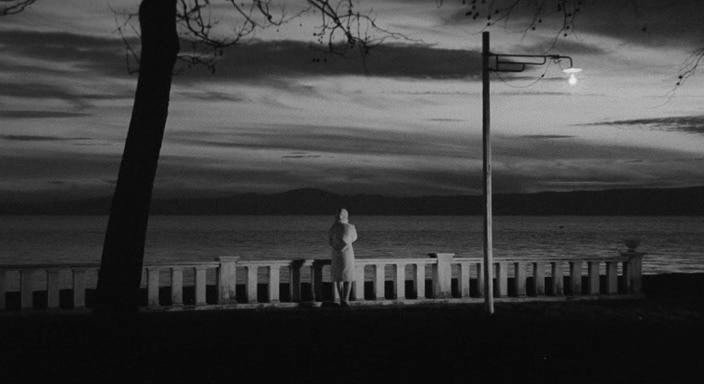
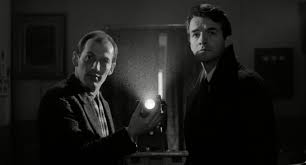
Enigmatic and obscurant, a film noir bathed in gloom and dreams within dreams, its “story” carried by voice-over narration, “The Possessed” is an Italian murder mystery all but conceived as a “cult picture.”

It had multiple titles — “La donna del lago (The Lady of the Lake)” in Italy, “Love, Hate and Dishonor” on U.S. TV, and “The Possessed,” as it is titled today. It was title-checked in Quentin Tarantino’s 1960s pop-culture Easter egg basket “Once Upon a Time…in Hollywood.”

Co-directors Luigi Bazzoni and Franceso Rossellini are largely forgotten figures now. The sound appears to be all post-production looped, and the star — Peter Baldwin — had bit parts in films and American TV, but a few starring roles in Italian films in the ’60s, before coming home and working steadily as a director of TV sitcoms for decades.

The film is basically an attempt at art house Hitchcock, something tried in a few Italian films of the era. This obscurant and somewhat mesmerizing film grabs and holds one’s interest, and not just the racier bits sometimes edited out for American TV.

Baldwin plays Bernard, an award-winning novelist who is fresh off a break-up, needing an off-season vacation. He’s a regular at a hotel by a lake which his family used to visit when he was young.

There was this blonde there, Tilde, a housekeeper at the hotel. Bernard must have been infatuated with her. Why else would he ring for her, only to get a different housekeeper? He sees a coat he recognizes and knows she is near. He fantasizes or perhaps remembers spying on her lovemaking through a crack in a door. Or perhaps he was her lover.

In any event, he is determined to track down this beauty (played by Virna Lisi). And then, after others have avoided his questions about her, he gets the news. She died.

“Suicide,” the hotelier (Salvo Randone) sighs. “Poison.”

But the poison in her mouth and her stomach didn’t kill her, the conspiracy-minded local photographer (Pier Giovanni Anchisi) tells Bernard. Her throat was cut!

That sends Bernard on a downward spiral of “investigation,” perhaps for a new book, and dreams in which he imagines a couple of men as Tilde’s lover — the hotelier, and his butcher son (Philippe Leroy).

The hotelier’s daughter (Valentina Cortese) has a shifty way about her. The butcher’s wife (Pia Lindström) is hidden from public view, mysteriously driven to walk the lake shore late at night.

What’s going on here? Why are so many “clues” and suspects introduced in dreams? Is the guy who runs the hotel in town really “powerful” and capable of covering up a crime?

Asking questions, however obliquely, doesn’t so much provide Bernard with answers as allow him to dream out many scenarios, with none of them provable in court, not that the police are all that interested in re-opening this “banal suicide.”

Co-directors Bazzoni and Rossellini (the nephew of legendary director Roberto Rossellini) prioritize mood over mystery, but one reinforces the other in this puzzling narrative. The film is often mentioned as belonging in the genre of lurid “Giallo” murder mysteries and violent tales of ’60s Italian cinema. But it’s rarely anything more than a film noir that struggles to make sense.

The hoary voice-over device is novelistic, better at telling us Bernard’s state of mind than at helping him solve this mystery.

“The Possessed” is designed to frustrate, to make us wonder if Bernard feels responsible for this death and if this ties into his break-up, by phone, with another woman before making the trip.

It may make more sense in its slightly longer version, and Lisi is a fiery, beguiling screen presence, even in this. But this is a limp thriller that reminds us that sometimes a “cult film” is less interesting than the reasons a cult formed around it in the first place.

Rating: unrated, violence, sexual situations

Cast: Peter Baldwin, Salvo Randone, Pia Lindström,
Philippe Leroy, Pier Giovanni Anchisi, Valentina Cortese and Virna Lisi

Credits: Directed by Luigi Bazzoni and Franceso Rossellini, scripted by Giulio Questi, Luigi Bazzoni, Franceso Rossellini and Ernesto Gastaldi, based on a novel by Giovanni Comisso. An American International release now on Tubi

Running time: 1:25 on some prints, 1:35 on others

Posted in Reviews, previews, profiles and movie news | Comments Off on Classic Film Review: Fainty Surreal Italian noir — “The Possessed”