Classic Film Review: Schrader, George C. Scott, Calvinism and “Midwestern Values” are confronted with “Hardcore” (1979)

Some of its power to shock and repel still clings to “Hardcore,” the debut feature by “Taxi Driver” writer turned writer-director Paul Schrader.

But as it travels from the conservative Rust Belt just before Reagan and the “Rust” set in, into the strip clubs, sex shops, lap dance “arcades” and porn film industry of the Southern California of 1979, it can feel almost quaint as it exposes a mostly-naive Middle America to variations of “The World’s Oldest Profession.”

It’s a quest thriller, loosely based on the classic John Wayne/John Ford Western “The Searchers,” about a Grand Rapids, Michigan father hunting for a teen daughter when went missing on a trip to church camp in California, and somehow wound up in the sordid, dangerous porn film/sex-worker underworld of Van Nuys and environs, a landscape later surveyed in Paul Thomas Anderson’s epic “Boogie Nights.”

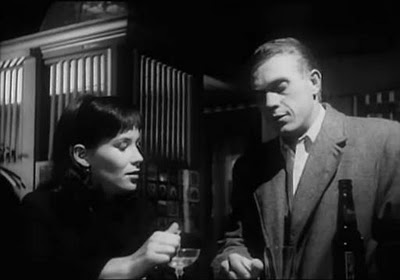
George C. Scott gives us shades of guilt-ridden concern, shock and his trademark enraged histrionics as Jake VanDorn, owner of his family’s venerated furniture manufacturing concern. We’re immersed in their world, first, a snowy Christmas with the whole clan gathered, singing carols, dutifully attending their Dutch Reformed (Calvinist) Church and enjoying the bountiful fruits of lives their belief system tells them they were predestined to receive.

Writer-director Schrader’s religion has long informed his cinema, something he made even more obvious with his 2017 “comeback” movie, “First Reformed.”

When Jake says grace before the whole family that evening, he finishes with “keep up safe from harm and danger, if it be thy will.” Remember that.

In “Hardcore,” that faith is discussed and those values are tested when Jake gets a call that his daughter disappeared on a field trip from California church camp to the Knotts Berry Farm theme park. His support system is such that his brother-in-law (Dick Sargent of “Bewitched”) thinks nothing of saying he’ll book the flights and go with him out West to find Kristen (Ilah Davis) or at least get some answers.

Sitting with a not-particularly comforting cop (Larry Block), seeing a wall of teen girls and boys “missing persons” posters and fliers around him makes Jake despair. But on the cop’s recommendation, he hires “the best” private investigator for this sort of case in that corner of Southern California.

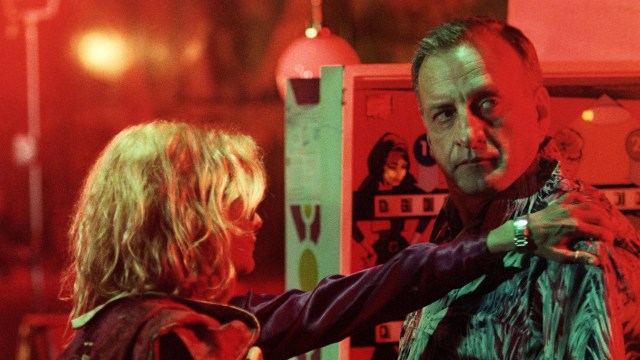
Peter Boyle has one of his best roles and runs with it as Andy Mast, a sleazy guy in a sleazy business doing a sleazy job of hunting through a world of sleaze. Mast’s bluntly sexual questions about the missing teen and his salty language offend VanDorn.

“You wanna hire a choir boy, go back to Grand Rapids.” But he assures Jake he’ll find her in “a week or two, a month at the most.” He doesn’t.

But as seasons change Mast shows up in Grand Rapids, takes Jake to a seedy 8mm peep show porn theater where he shows what he did find. Kristen is working in “Hardcore” porn.

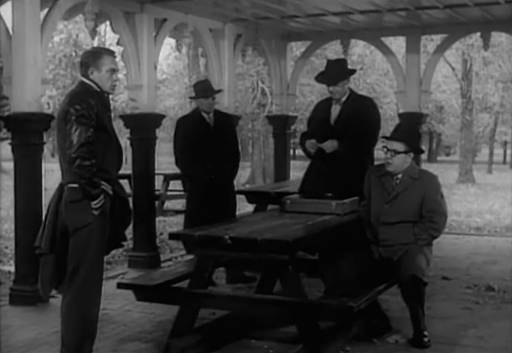
That and rising impatience with how long this is taking launches Jake’s odyssey, a conservative man in conservative suits wandering the mean and sordid streets, showing pictures of his daughter in that dirty movie to sex workers and porn shop operators (Tracey Walter plays one, naturally), roughing up Mast in his righteous wrath over his child’s fate and the private eye’s “methods,” which include bedding porn actresses on VanDorn’s dime “for information.”

Eventually, our hero will have to descend to everyone else’s level, pose as an “investor” with a porn producer (Leonard Gaines, in a definitive portrayal of a “type”) in order to trace his child’s journey, determine her fate and perhaps accept his role in it.

Continue reading
Posted in Reviews, previews, profiles and movie news | Comments Off on Classic Film Review: Schrader, George C. Scott, Calvinism and “Midwestern Values” are confronted with “Hardcore” (1979)

Netflixable? Neighbors consider “Love, Divided” by a shared load-bearing wall

“Love, Divided” is a pleasant-enough love-without-first-sight rom-com about two quarelling neighbors who find a connection through a shared wall, one that’s entirely too thin to get the sound muffling job done.

He, played by Fernando Guallar, is borderline agoraphobic, a tinkerer/game-builder who hasn’t left his apartment in three years. Something set David off, and he’s been obsessing over getting his next game just right, any excuse to not go out.

The new neighbor (Spanish pop star Aitana) “won’t make it through the day,” David predicts to his pal, Nacho (Adam Jezieriski). David has his ways — sound effects gear, noisy machinery, etc. — to chase off anyone who might disturb his peace by moving into the place next door.

He doesn’t need that other neighbor Valentina asks about “the noise” (in Spanish, or dubbed into English) telling her it’s a “ghost.” Couldn’t hurt, though.

She’s a pianist rehearsing for a big audition. Mr. “I require absolute silence” and “Challenge, accepted” and his metallic racket may be getting into an escalation he’s not mentally prepared for.

But a truce is quickly reached, conversations grow more pleasant and her Beethoven audition piece muddles along. Her overbearing ex Oscar (Miguel Ángel Muñoz) may still be in the picture, but she takes a stab at figuring out who the sensitive stranger next door is. That requires conferring with her cousin/bestie Carmen (Natalia Rodríguez) while David copes with the “get out of the house” efforts of Nacho.

Can love be in the offing, or is an old non-soundproofed wall enough to stand in their way? Not having to face or get too close to someone could be “perfect, just the way it is.” Or is it?

Continue reading
Posted in Reviews, previews, profiles and movie news | Comments Off on Netflixable? Neighbors consider “Love, Divided” by a shared load-bearing wall

Documentary Review: Sounding the alarm , “Bad Faith: Christian Nationalism’s Unholy War on Democracy”

It’s a little dispiriting to watch Alex Garland’s idea of what America’s next “Civil War” will look like, and the documentary “Bad Faith” on the same weekend.

The first is about effect, and the second, subtitled “Christian Nationalism’s Unholy War on Democracy,” a point-by-point examination of the steps and the people who schemed, fund-raised, wrote-manifestos and enflamed and misled a fanatical minority to put us there.

Like other films covering similar ground (last winter’s doc “God & Country”), filmmakers Stephen Ujlaki and Christopher Jacob Jones — they collaborated on the “Hollywood Masters” interview series — set out to define “Christian Nationalism,” the political movement that “privileges Christianity” “over all other faiths” and seeks power to impose that view on others.

And they trace the modern version of this KKK-born movement’s birth back to the days when activist/zealot Paul Weyrich found, in abortion, the proper smokescreen issue to enlist ardent Protestant segregationists like Jerry Falwell, Pat Robertson and whichever Bob Jones was presiding over the founder of Bob Jones U.’s white supremacist preacher’s college into Republican politics in the 1970s.

“Bad Faith” features academics, pastors, authors and Russell Moore, the courageously outspoken editor of “Christianity Today,” in detailing the history, agenda and assorted manifestos of billionaire-funded right-wing “think tanks,” data banks and “rage baiting” organizations, from the Council for National Policy and Koch Foundation to the Faith and Freedom Coalition, Turning Point USA, ALEC and The Heritage Foundation.

Their latest manifesto could be their Final Solution for ending American democracy and majority rule — Project 2025.

A “Calvinist” view of Christianity is at the heart of it, some suggest, the idea that the wealthy pastors of the Falwell, Robertson, Kenneth Copeland and Joel Osteen variety were “chosen” to be made rich by the Almighty, and thus worthy of being donated to and followed right to the ballot box.

Enlist and coopt them, and you’ve got a virulent one-issue voting bloc.

But who do a lot of those preachers follow? “Bad Faith” takes us back to the way Weyrich and others figured out that connecting this manipulated minority to Big Money and the issues Big Money people support — cutting or eliminating corporate tax rates, attacking estate taxes and lowering taxation on the rich.

The fact that the Hunts, the Kochs and many others were oil and coal barons isn’t even played up. But who denies climate change and who benefits from their electoral denial of scientific fact?

The film’s most troubling footage is of the violence of the January 6 insurrection, with grim images of the assault on police, the nation’s capital and democracy itself interspersed with images of the combatants, urged into “war” by thousands of conservative pastors and others, carrying Jesus wearing a MAGA hat posters, wearing crucifixes and waving Trump flags.

Continue reading
Posted in Reviews, previews, profiles and movie news | Comments Off on Documentary Review: Sounding the alarm , “Bad Faith: Christian Nationalism’s Unholy War on Democracy”

Movie Preview: Rachel Sennott has NO business claiming “I Used to be Funny”

This indie dramedy puts a would-be stand-up in crisis over a girl she used to nanny. PTSD, Sennott (“Shiva Baby,” “Bottoms,””Bodies Bodies Bodies”) and stand-up comedy.

Sure, Samantha Bee’s husband is the most recognizable face in the supporting cast. But what’s not to (potentially) love?

Posted in Reviews, previews, profiles and movie news | Comments Off on Movie Preview: Rachel Sennott has NO business claiming “I Used to be Funny”

Movie Preview: Eckhart, Olga and Pettyfer — Espionage meets Revenge with this “Chief of Station”

If one is being perfectly candid, “good” thrillers don’t often wind up down the food chain at Vertical Releasing. But some movies are a hard sell. Many, many actors aren’t “box office,” even if they once were.

This looks good. Money was spent and it’s on the screen.

Posted in Reviews, previews, profiles and movie news | Comments Off on Movie Preview: Eckhart, Olga and Pettyfer — Espionage meets Revenge with this “Chief of Station”

Classic Film Review: Early McQueen, the “punk” in “The Great St. Louis Bank Robbery”

Steve McQueen got his big break in landing the lead in the late ’50s bounty hunter Western “Wanted: Dead or Alive.” And that translated into his first quality, name-recognition movie roles.

He is the ostensible lead in the ensemble thriller “The Great St. Louis Bank Robbery,” a by-the-numbers heist picture co-directed by Oscar-winning documentary filmmaker Charles Guggenheim, father of Oscar-winning documentarian Davis Guggenheim.

That explains the natural light, almost made-for-TV black and white look of this genre picture, a tale told with competent lighting, uncomplicated camera set-ups and a story that was a tad old hat, even for its day.

But McQueen shimmers with real star power, working that contemplative, let-us-see-the-wheels turn style that set him apart from most of his peers (not Newman) and set him up for stardom.

The whole icon of cool thing would come later, after “Magnificent Seven,” “The Great Escape,” “The Thomas Crown Affair” and “Bullitt.”

McQueen plays a college kid who shows up for the gang meet-up in his letter jacket. But George isn’t in college any more. Something to do with a woman. And that woman’s brother, Gino (David Clarke) is the one who set him up for this job.

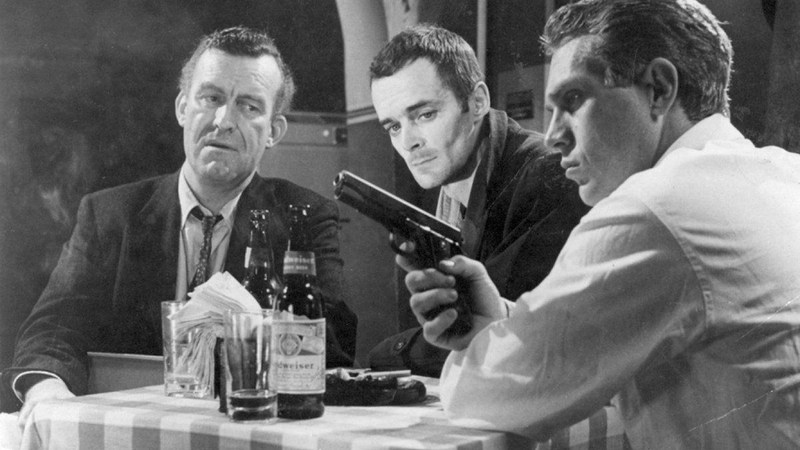
He’s to be the driver in a bank heist, with 60something John (Craham Denton) the brains of the outfit, always pushing around his demoted wheelman Willie (James Dukas), with Gino an antsy gunman anxious to make a score so’s he can pay off his lawyer.

Twenty thousand bucks? Each? Or to split? They’re “not messing with the vault,” just “the cash drawers,” John growls. They’ll spend five days casing the joint. They’ve already got the three cars they’ll need for the robbery and the get away.

George? He’s new, “green,” and insistent that driving is “all I’m gonna do.” As his abrupt hiring, on Gino’s word, creates friction, John tests him by making him steal license plates for a getaway car.

“I ain’t no petty thief” protests be damned, that’s what he ends up doing — haplessly.

When Gino insists George hit up his ex, Gino’s sister (Molly McCarthy), for spending money, the “punk” kid draws the line again, and again to no avail.

“Look George, this ain’t the university. You’ve got to do some things you don’t like.”

But Ann, invited out, sizes George and the situation up pretty quickly. As John barked to the other three “No WOMEN,” right from the start, George has got problems. With the day of the bank rob closing in, those problems put the whole heist in jeopardy.

Continue reading
Posted in Reviews, previews, profiles and movie news | Comments Off on Classic Film Review: Early McQueen, the “punk” in “The Great St. Louis Bank Robbery”

Movie Preview: Daisy Ridley’s gonna show those Brits and swim The Channel — “Young Woman and the Sea”

There’s always a first. It’s often someone like American Gertude “Trudy” Ederle, someone willing to ignore “No woman can swim that far,” to fend off jellyfish and sniping Brits.

“Young Woman and the Sea” Stars Ms. Daisy and co-stars Stephen Graham and Christopher Eccleston and will come to the big screen May 31 before moving to Disney+.

Posted in Reviews, previews, profiles and movie news | Comments Off on Movie Preview: Daisy Ridley’s gonna show those Brits and swim The Channel — “Young Woman and the Sea”

Movie Preview: A TV show that was “more” than a show — “I Saw the TV Glow”

The strangeness and “festival darling” nature of this mystery/coming-of-age drama gets across in this dark and magical trailer for the latest film from “We’re Going to the World’s Fair” director Jane Schoenbrun.

May 3.

Posted in Reviews, previews, profiles and movie news | Comments Off on Movie Preview: A TV show that was “more” than a show — “I Saw the TV Glow”

Netflixable? Reindeer herders face a “Stolen” way of life in this Swedish thriller

Today’s “Around the World with Netflix” outing takes us to snowy, remote region we outsiders used to call Lapland (Sápmi, is preferred by the locals), that treeline on the edge of the tundra in northern Norway, Sweden, Finland and a bit of Russia. It is the home of the Sámi peoples, traditional reindeer herders who have lived in this cold place for thousands of years.

That makes for a striking setting for “Stolen,” a seriously basic, if satisfying, thriller about the challenges this “outsider” group faces in the modern world. Adapted from a novel by  Sámi journalist and novelist Ann-Helen Laestadius, it comes to the screen as a somewhat violent melodrama in the “Witness” mold.

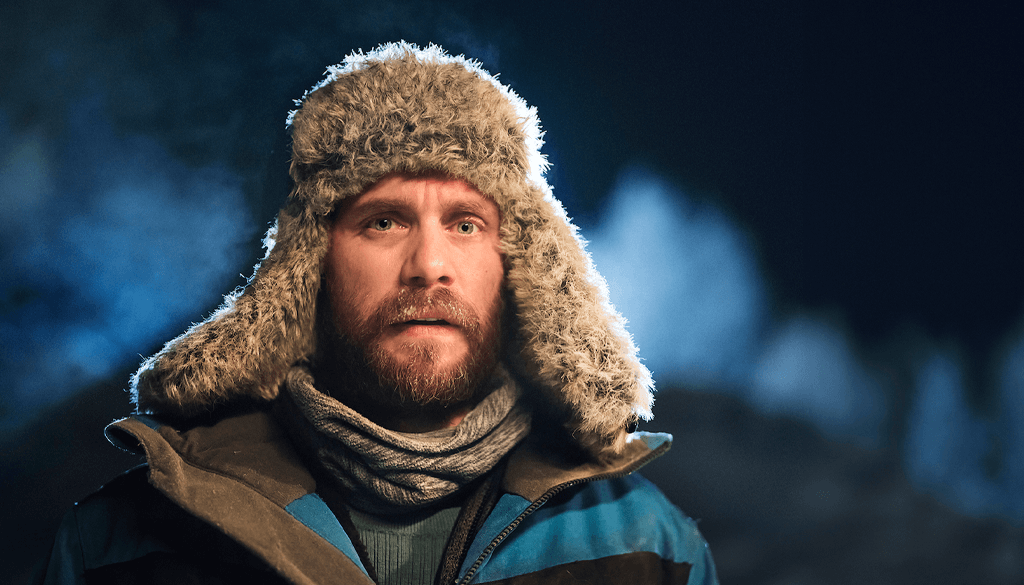
We meet the Sámi, a tiny population clinging to an almost prehistoric lifestyle in their traditional homeland. We see the beauty of the reindeer herds, galloping through the snow, meet a family from a small village, herding them with snowmobiles and griping about “changes” in the climate that make their lives harder.

And now there’s somebody killing reindeer and burning their feed.

An enthusiastic little girl, Elsa (Risten-Alida Siri Skum) gets her first reindeer, which she names and ear-marks and whispers the traditional Sámi incantation into that ear, “I don’t own you. I only have you on loan.” But shortly after that, she sees it have its throat slit by a local goon with a grudge against the Sámi. He makes a throat-slashing gesture to Elsa to keep her mouth shut. Which she does, even when she sees this creep in the station as her father (Magnus Kuhmunen) files yet another pointless police report.

No wonder the cops won’t do anything. Anybody who isn’t Sámi resents them, their government protections, their say over what happens to “their” grazing land.

So you’ve got a misunderstood and shunned outsider culture under deadly threat from a guy cozy with the cops. And a child is the only “Witness.”

But the Laestadius novel and the film adapted from it quickly shakes off any resemblence to the 1985 Peter Weir film as Elsa grows up to become a teacher ((Elin Oskal) in the village school. With her culture and family facing even more pressures — more attacks on their herds, more threats to their land, which may have iron ore beneath it — Elsa has grown up to be outspoken, unusual for a woman in this tradiational patriarchy.

Elsa has kept her secret about the animal-torturing and butchering Robert (Martin Wallström). Speaking out, badgering the cops, with her family seeing the threat and their own people shunning her warnings about it, something’s got to give.

Continue reading
Posted in Reviews, previews, profiles and movie news | Comments Off on Netflixable? Reindeer herders face a “Stolen” way of life in this Swedish thriller

Movie Review: The “Civil War” so many have been asking for, but here on The Big Screen

Alex Garland’s “Civil War” is brutal, unblinking and myopic, a sour taste of what a “real” civil war in the industrialized, armed-to-the-teeth United States might look like.

Garland, the thoughtful and thought-provoking auteur behind “Ex Machina,” “Annihilation” and “Men,” makes a smart and sobering political thriller that brushes past “how we got here” — because we’re seeing that literally every day in these Disunited States. He makes an attempt at playing this civil war tale as “apolitical,” but clues are there if you watch and listen.

He lightly touches on the Big Picture and instead shows us the brutality of war the way most of those caught in the middle of a conflict experience it — personal, limited to what we can see on the horizon and what we’re facing close at hand. The firefights are either just down the road, or just across the parking lot.

Nobody wants to be on the receiving end of a visit from a tank, an armored Humvee or a helicopter gunship. “Bad guys” and “good guys” fall, battle lines are blurred along with everything else shrouded in “the fog of war.” All noncombatants are, when the smoke clears, is “collateral damage.

It’s sometimes riveting, almost wrenching at others and kind of depressing. And it generally succeeds in its main mission, de-romanticizing “civil war” and “secession,” words that the glib, the rural, old-enough-to-know-better low-information voter types and their leaders throw around.

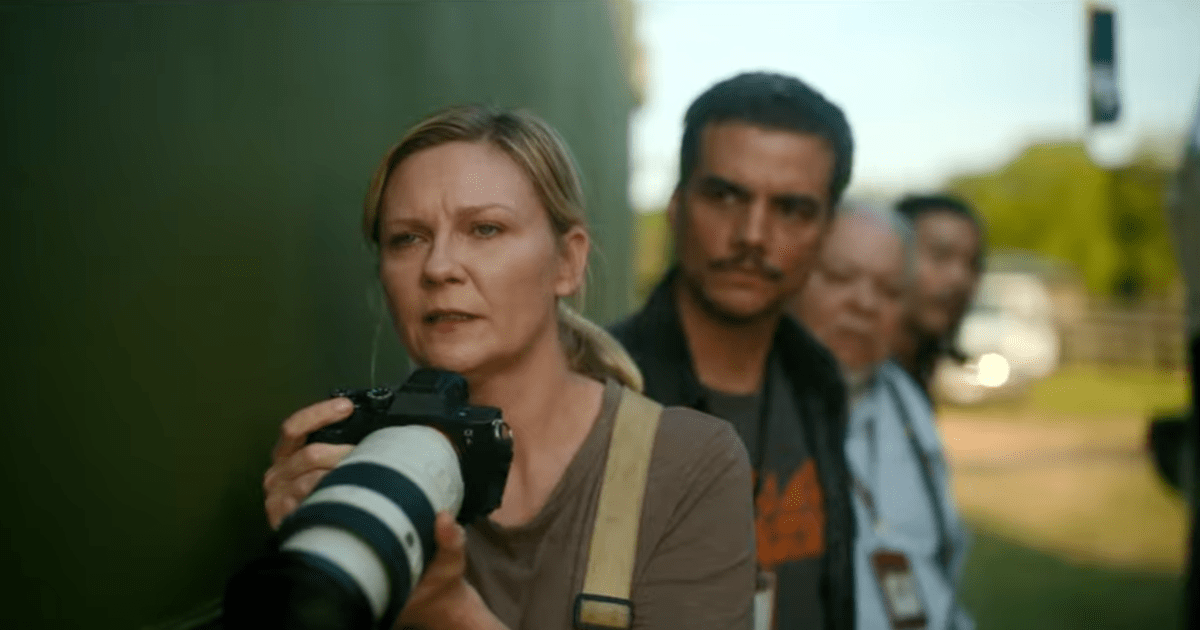
Kirsten Dunst grimly plays a veteran conflict photographer wearing the “thousand yard stare” of someone who’s seen it all, and a tad too often to let it impact her.

“Every time I survived a war zone — and got the photo — I thought I was sending a warning home. ‘Don’t DO this.’ But here we are.”

Photographer Lee works with reporter Joel (Wagner Maura of “The Gray Man” and TV’s “Narcos”), and they’re about to embark on a trip to Washington, D.C., crossing through lines where “We work for Reuters” is just another way they could get killed. It “don’t sound American.”

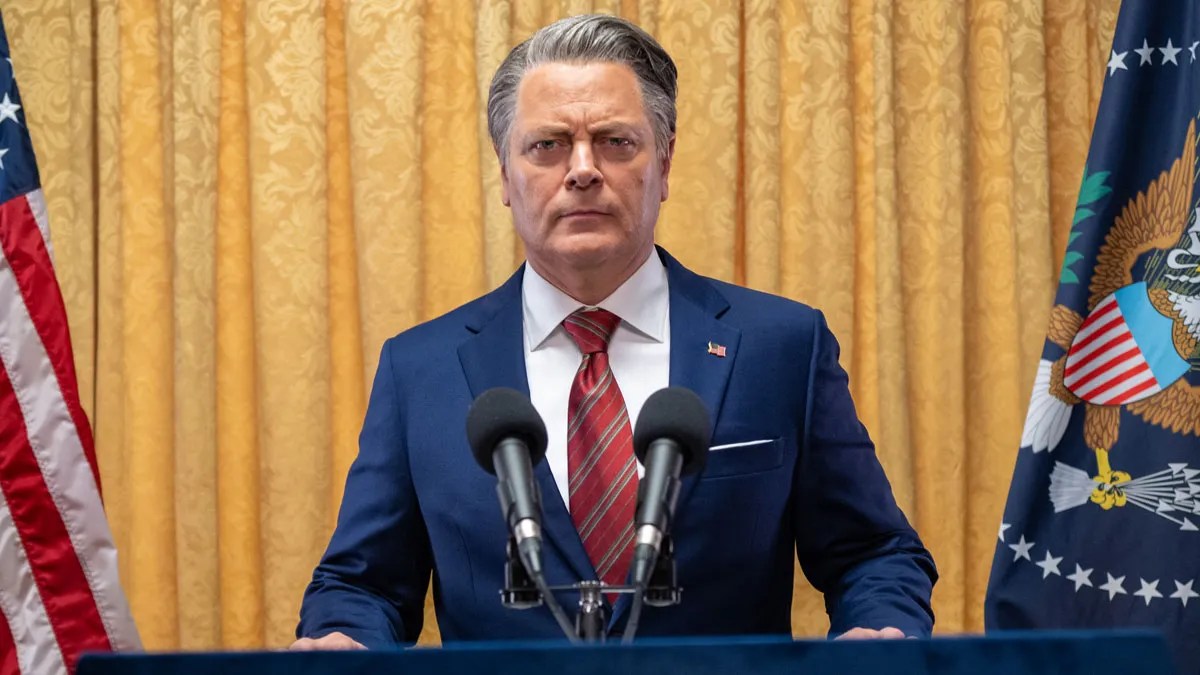
But that’s where they’re headed, hoping for a chance to interview and photograph the “third term” president (Nick Offerman, playing it straight) whom we’ve seen rehearsing his spin on a “great victory” announcement and the hyperbole that accompanied it.

All his talk about offering the “secession states” of the “Florida Alliance” and “Western Forces” (Texas and California) a chance to cease hostilities, we gather, was propaganda. Joel and Lee want to get to D.C. before the rebel forces close in on the United States Army and Secret Service et al defending that city and this sitting president.

We’ve seen the way these reporters and photographers hurl themselves into danger, walking into a New York riot as it begins, getting entirely too close to firefights when they break out. Lee must have some notion of the bullets that don’t have her name on them. Yellow vests and “press” helmets and passes aren’t bullet proof.

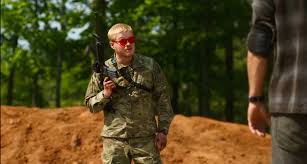
A kid (Cailee Spaeney) who calls herself 23 and could pass for 15, who shoots on celluloid film because her dad did, fangirls over Lee. But Joel is the one she talks into letting her ride along to Washington, by way of Western Pennsylvania and Charlottesville (“the front lines”). As Lee has allowed aged, hobbled New York Times reporter Stephen (the regal Stephen McKinley Henderson) to ride in their “Press” marked Ford Excursion, fair is fair.

Lee’s motherly-without-being-a-mother objections set up the back-and-forth with Jessie the kid about how hard-nosed you have to be to do this job.  Heartless enough to photograph “me if I get shot,” Jessie wants to know?

In a dozen other movies, a line like that counts as foreshadowing.

On their trek they will stumble into a sniper situation, a mass grave and the scary soldiers (Jesse Plemons, aka Mr. Kirsten Dunst plays the scariest) filling it. They will banter with other press, grit their teeth over those “embedded” with one side or the other and face combat between regular and irregular forces, grimly documented by black and white still shots by our photographers.

Torture and summary executions long ago returned to warfare of the “civil war” variety. Hating “the other,” obsessing about guns, violence and the death penalty will do that to a people.

Little details enrich their odyssey. “Canadian” money is more valuable when you’re trying to score gas from assault-rifle-armed convenience store commandos. Rural folks, near and far, have found an excuse to “keep away” from all that and carry on some semblence of normal life.

Is Garland making an ironic comment on the “rural white rage” that is driving much of this Trumpist rhetoric? Big talkers want to start a civil war, and then sit it out?

Continue reading
Posted in Reviews, previews, profiles and movie news | Comments Off on Movie Review: The “Civil War” so many have been asking for, but here on The Big Screen