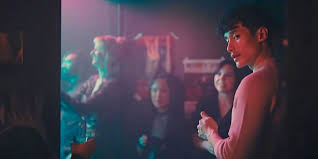
Movie Preview: Kieran Culkin and Jesse Eisenberg are Cousins taking a Holocaust Tour of the Old Country — Poland — “A Real Pain”

A bitchy, kvetchy, edgy comedy about paying tribute to a beloved granny, traveling and bickering over family history. Eisenberg wrote and directed this Oct. 18 Searchlight release.

Posted in Reviews, previews, profiles and movie news | Comments Off on Movie Preview: Kieran Culkin and Jesse Eisenberg are Cousins taking a Holocaust Tour of the Old Country — Poland — “A Real Pain”

Movie Preview: “A Man of Reason,” and violence

It’s getting so a Korean mobster can’t get out of prison and go about his business any more.

The directing debut from actor Jung Woo-sung (“Steel Rain”) opens July 5.

Posted in Reviews, previews, profiles and movie news | Comments Off on Movie Preview: “A Man of Reason,” and violence

Netflixable? “Remembering Gene Wilder” scratches the surface of a Famous Funnyman

“Remembering Gene Wilder” is an affectionate and sentimental biographical tribute to the beloved star of “Willy Wonka & the Chocolate Factory,” “The Producers” and “Young Frankenstein.”

Director Ron Frank uses archival interviews, Gene Wilder reading from his autobiography, and interviews with producers, a couple of co-stars and Mel Brooks to recreate the Milwaukee native’s comical career, focusing on the key collaborations which became the films Wilder is rememembered for.

But it’s never much more than a surface gloss of the man’s life, a quick-and-dirty doc of the sort A& E perfected with its “Biography” series and Biography Channel — superficial, ignoring anything resembling an edge, never letting us know the guy, who died in 2016 at age 83.

There are glimpses of the benchmark moments in the acting career, a telling anecdote Wilder repeated about a doctor telling him to “never argue” with his sickly mother, but to make her laugh, a brief overview of his ill-fated marriage to Gilda Radner, and moving recollections of his final days via his widow, Karen Boyer.

We get a step-by-step genesis of “Young Frankenstein,” and a year-by-year account of how long it took Brooks to get “Springtime for Hitler,” aka “The Producers,” into production, with his wife’s Broadway co-star in “Mother Courage and Her Children” set to launch his screen career as co-star.

But the film career has few value judgments, celebrating the “comic” touch he brought to “Bonnie & Clyde,” his first film, his barely-controlled hysteria in “The Producers,” his brilliance in conceiving, co-scripting and starring with Mel Brooks in “Young Frankenstein.

There’s no academic or critic to speak with any authority to the work as an actor, and then later writer and director and star. Nepo baby TV host Ben Mankiewicz’s empty platitudes notwithstanding, somebody needs to talk about how badly-received and poorly-remembered almost all of his later films were, and why.

Richard Pryor’s daughter speaks knowingly of the on-camera — and on-camera-only — chemistry between her dad and Wilder in “Silver Streak,” “Stir Crazy” and the lamentable, late-life groaner “See No Evil, Hear No Evil.”

By the late ’70s, when Wilder was at his peak, he was already passe — making lumbering, clumsy and dated comedies like “The Adventures of Sherlock Holmes’ Smarter Brother,” “Haunted Honeymoon” and “Lady in Red,” all of which showcased Wilder’s weary style, and his limited bag of comic tricks.

Dwelling on a staggering disappointment like “The Frisco Kid,” which paired him awkwardly with Harrison Ford, is a huge mistake. Leaving out the romp “Start the Revolution Without Me” seems ill-advised. The enduringly funny films are few and far between.

Mercurial outbursts, a quiet side that could suggest “sinister,” good timing that eventually failed him, he was a complicated performer and more complicated, some would say damaged person. And little of that darkness or complexity is suggested here.

“Remembering Gene Wilder” isn’t bad. But it’s incomplete enough to call attention to its shallowness. It never overcomes that “Coming up next on ‘Biography'” superficiality.

Rating: unrated

Cast: Gene Wilder, Mel Brooks, Carol Kane, Alan Alda, Rain Pryor, Harry Connick, Jr., Ben Mankiewicz, Alan Zweibel and Karen Boyer

Credits: Directed by Ron Frank, scripted by Glenn KirschbaumA Netflix release.

Running time: 1:32

Posted in Reviews, previews, profiles and movie news | Comments Off on Netflixable? “Remembering Gene Wilder” scratches the surface of a Famous Funnyman

Documentary Review: Stand-ups reveal comedy as “Group Therapy”

It’s been pretty widely accepted and understood that stand up comedy can be a sort of talking therapy to those who practice it.

Richard Pryor to Robin Williams, Richard Lewis to Tig Notaro, a lot of performers have taken to the stage to air their personal issues and find laughs in deeper, darker places than the standard “D’ja ever notice?” shtick.

“Group Therapy” is a documentary that taps into that undercurrent in stand-up, a film that gathers half a dozen stand-ups for a chat with Neil Patrick Harris, who isn’t a therapist, doctor or medical professional, but who has played versions of those professions on film and TV.

We see bits of the on-stage acts of Nicole Byer, Mike Birbiglia and Notaro, hear them talk about therapy and mental health issues and crises they or members of their family have faced in confessional moments of “sharing.”

Cute, sweet and slight, the film has stand-ups talk in the language of self-help speak, quoting everybody from Mark Twain to Oprah, reveal the way they came to talk about their struggles on stage and talk about how that’s helped them.

“There has never been a better time to be mentally ill,” depressed, successful and funny 50something Gary Gulman jokes. And he’s right.

If nothing else, society has become more accepting of talking about such problems, post-Oprah. When Notaro, battling a break-up, the loss of her mother, a deadly illness and then a more deadly cancer diagnosis, rebuilt her deadpan act around that in 2012, it made her famous and made her fortune.

Japanese-American Atsuko Okasuka is revealed to be the only comic in this group — Harris included — not in therapy, she takes in everything all of the others have gotten out of “seeing somebody.” When we sample her family’s troubled history, we appreciate what she’s dealing with without a therapist.

Much of the film is standard-issue “stand up special biographical background” in nature — growing up Black and funny and female in Britain (London Hughes), a jock who couldn’t handle the depression of losing the one thing that was “exceptional” about him at 19 (Gulman) or finding the funny in leaning into “fat” (Byer).

“Group Therapy” doesn’t reinvent the “revealing” profile of comedians documentary. But it’s a novel approach to having performers talk about themselves, those who pursued the work, lifestyle and “sharing” until it killed them (Mitch Hedburg is mentioned, Richard Jeni and generations of others are not), and those for whom therapy — onstage and off — has helped and make happier, or at least a lot better adjusted than they once were.

Rating: unrated, adult subject matter

Cast: Neil Patrick Harris, Tig Notaro, Atsuko Okatsuka, Gary Gulman, Nicole Byer, Mike Birbiglia and London Hughes.

Credits: Directed by Neil Berkeley. A Hartbeat release.

Running time: 1:27

Posted in Reviews, previews, profiles and movie news | Comments Off on Documentary Review: Stand-ups reveal comedy as “Group Therapy”

Netflixable? “Ultraman: Rising,” awww, isn’t that cute?

You’d have to go out of your way to have avoided the many on-screen, large and small, incarnations of that Japanese superhero Ultraman that have traveled abroad since the mid-60s.

Action sci-fi involving a guy in a beetle-eyed space suit fighting the monsters that bedevil life in post-“Godzilla” Japan, I seem to recall reviewing a film or two imported to the U.S. And some of the many TV series might have crossed one’s field of vision, although the similarity of the suit and the villains to the Power Rangers and other variations on a theme muddy the memory.

Netflix gives Ultraman a slick, beautifully-animated updating, reboot, re-launch with “Ultraman: Rising,” a parable about workaholic Japanese looking for “balance” in life between work, child-rearing and enjoying the fruits of one’s labor.

The “balance” messaging is pounded home, time and again as our baseball superstar Kenji (Christopher Sean) returns to Japan, a U.S. Major League baseball superstar who comes back to play for the Tokyo Giants, but whose real summoning was to take over as Ultraman for his aged fighter father (veteran character actor Gedde Watanabe).

As Ultraman’s personal directive is now to “save” kaiju — those flying, swimming, crawling, city-smashing monsters — from themselves and the “wipe them out” Kaiju Defense Force (KDF), he finds himself stuck with an orphaned kaiju baby to raise in his “base,” his secrete underwater fortress of solitude.

Awww. Isn’t that cute? Even when the gigantic, flying, cooing and gurgling baby has “acid reflux?”

Kenji must tame his Westerinized ego, his “bro bro BRO” cockiness, to contribute meaningfully to his new team, impress the single mom reporter (Tamlyn Tomita) who asks him the hardest “life” questions in intereviews and keep the wandering, mischief-prone baby kaiju Emi in line.

At least he has a helpful hovering AI assistant to TCB.

As for the whole Ultraman thing, he’s got Spider-Man issues in terms of public perception. Nothing he does is ever good enough. “It’s like he doesn’t care,” the public whines.

“I didn’t even WANT this gig” is no get-out-of-Japan-free card. Kenji must man-up, take the hits, do what’s right and find that “balance.”

The narrative veers between the action-packed and the insipid often enough to give one whiplash. The messaging is so shallow as to simply invite shrugging off. And the jokes are few and far between.

The many Up Baby Kaiju and recapturing baseball skills montages are scored to the alcoholic anthem “There Stands the Glass” and the punk classic “Pretty Vacant,” which may be the most radically random needle drops in the history of animated features.

Other than that, there isn’t a lot here for an adult to chew on, much less to mull over or take delight in. “Ultraman: Rising” is more polished than the old movies and TV series with guys in rubber suits wrestling amidst the primitive effects all around them. But that’s all the praise this new iteration deserves.

Rating: PG, animated violence

Cast: The voices of Christopher Sean, Gedde Watanabe, Tamlyn Tomita and Keone Young.

Credits: Directed by Shannon Tindle and John Aoshima, scripted by Shannon Tindle and Marc Haimes. A Netflix release.

Running time: 2:01

Posted in Reviews, previews, profiles and movie news | Comments Off on Netflixable? “Ultraman: Rising,” awww, isn’t that cute?

Classic Film Review: You can’t “Fiddle dee dee” away The Great Depression — “Dinner at Eight” (1933)

“Dinner at Eight” (1933) is a fascinating snapshot of a moment in time.

An early “talkie,” a mid-Great Depression adaptation of a then still fresh and edgy Broadway dramedy, we can look at this ancient George Cukor film and appreciate the topicality, the wit and the many cinematic shortcomings evident in it, stylistic traditions that would fall by the wayside as Hollywood sprinted towards its Golden Age.

It’s stodgy and stagey, a movie burdened by the limitations of sound gear and the dull, lock-the-camera-down technique that inspired. But the dialogue is pre-“Screwball” quick and funny . Well, at times.

It’s “Pre Production Code,” a movie made just as Hollywood was about to morally police its pictures lest governments and censorious church organizations take that job for themselves.

That makes this a showcase for sex symbol Jean Harlow at her peak, a scantily clad “bombshell” who could be hilarious as a dizzy blonde, or a blonde not as dizzy as you might think.

It was the pentultimate film of stage and Oscar-winning screen comedienne Marie Dressler.

No less than two Barrymores, John Barrymore and Lionel Barrymore, would grace the screen.

And through them, and the machinations of a George S. Kaufman/Edna Ferber comical melodrama, we see the seas about to change in the theater and in acting, and in the genre that come to define Depression Era Hollwood — the Screwball Comedy.

It’s 1933, and business is bad, but the well-traveled are still the well-traveled, keeping up appearances.

Oliver Jordan (Lionel Barrymore), owner to the hundred-year-old Jordan (shipping) Line is having to keep ships in port for lack of exports. But dithering, chirping wife Millicent (Billie Burke) all atwitter at the social coup she’s managed, wrangling a couple of wealthy members of the visiting British aristocracy for a dinner party.

She buzzes about the staff and plants invitations with an old family friend, the ancient, well-traveled and well-connected actress Carlotta Vance (Dressler), their society doctor (Edmund Lowe) and his wife (Karen Morley), with the Jordans’ daughter Paul (Madge Evans) and her just-back-from-a-Grand-Tour fiance (Philip Holmes).

As her husband needs business from the rough, new-money Montana tycoon Max Packard (Wallace Beery), he’s invited, along with the gauche lower class young beauty (Harlow) he’s married to.

“You’re joking! Ask that common little woman to my house and that noisy, vulgar man? He smells Oklahoma!”

A late addition? Another actor, struggling, aging matinee idol Larry Renault (John “The Profile” Barrymore).

The twists in all this are that Oliver is deathly ill and is reluctant to tell his family. His doctor (Lowe) is carring on an affair with the platinum blonde Kitty Packard (Harlow). Her cutthroat husband is planning on buying The Jordan Line out from under Oliver behind his back.

Oliver’s daughter Paula is having an affair with the actor Renault, who is a hopeless drunk whose big stage show may not come together for him after all.

And “everybody’s broke,” bitching about the social requirements that translate to the great expense of keeping houses in New York, Florida, the Riviera, London and the like.

Dressler gives us a taste of the grande comedienne of the stage she was and how that translated to screen presence, best appreciated in silent comedies with Chaplin and Marion Davies. But she had a late career talkie revival in popularity that won her an Oscar and put her back in demand. She gives us moments of subtlety and broad gestures straight out of 19th century melodrama — a lot of facial mugging that had her over-made-up eyebrows bouncing along to a performance that had little to do with the dialogue coming out of her mouth.

“I belong to the Delmonico period. A table at the window, looking out on Fifth Avenue. Boxes with flowers in. Pink lampshades. String orchestra. And, I don’t know, yes, yes, willow blooms. Inverness capes. Dry champagne. And snow on the ground.”

Burke, aka Mrs. Florenz Zeigfeld, reminds us why her turn as Glenda the Good Witch in “The Wizard of Oz” made her high-pitched, upper class chirp one of the era-defining voices on the screen. Every time she opens her mouth it’s worth a giggle.

Lionel Barrymore was a few years from taking the turn toward the grumpy old men character roles (“It’s a Wonderful Life,” “Key Largo”) that we remember him for.

His brother Barrymore, a great Edwardian actor and great drunk great at playing a drunk, registers. Beery is all bluster, self-importance and the threat of violence as Packard.

But Harlow just pops, and not just because of Cukor’s gooey, gauzy soft-focus closeups. She’s got a louche look, a sexually self-confident air and a sass that she turns on the minute her lout of a husband gives her cause, such as suggesting Roosevelt might put him in the cabinet in Washington.

“Nertz! You’re not going to drag me down to that graveyard. I seen their pictures in the papers, those girlies. A lot of sour-faced frumps with last year’s clothes on. Pinning medals on girl scouts and pouring tea for the DARs and rolling Easter eggs on the White House lawn.”

The film’s theatricality, built out of a series of intimate, serio-comic scenes, and some of its dialogue date it firmly in the “before talking picture cameras moved” and “before dialogue got snappy” era. It’s static, and its turns towards the melodramatic are daring only in that the coming Production Code would frown upon alcoholism, infidelity, suicide, bare-backed bra-lessness and dialogue leaning towards “son of a…”

But it’s a classic of its type and its era, a fine moment-in-time look at the theater in the fourth year of the Depression, the first year under Roosevelt and the cinema just as it was about to get a lot quicker, punchier and wittier.

“You know, my skin’s terribly delicate and I don’t dare expose it.”

Rating: TV-PG, today, pre-code in 1933

Cast: Lionel Barrymore, Billie Burke, Jean Harlowe, Wallace Beery, Marie Dressler, Edmund Lowe, Jean Herscholt, Lee Tracy and John Barrymore

Credits: Directed by George Cukor, scripted by Frances Marion and Herman J. Mankiewicz, based on the play by George. S. Kaufman and Edna Ferber. An MGM release.

Running time: 1:51

Posted in Reviews, previews, profiles and movie news | Comments Off on Classic Film Review: You can’t “Fiddle dee dee” away The Great Depression — “Dinner at Eight” (1933)

A Classic Film is restored, along with its Trailer, for a re-release — “The Story of G.I. Joe”

World War II movies made during the war were rarely as bluff and blunt as this Robert Mitchum, Burgess Meredith star vehicle.

William Wellman’s film celebrated the infantryman’s champion, celebrated journalist Ernie Pyle. Meredith plays the Scripps New Service grunts-eye-view reporter, covering the liberation of Italy. Mitchum, in his first role of real stature, plays the lieutenant Pyle deals with on what would turn out to be his last assignment.

“G.I. Joe” has been restored for a late June re-issue by Ignite, and they even found the damaged and almost lost nitrate trailer for the film and restored that, too.

Interesting suggestion of what a “wolf” might be seen as today, in terms of a lecherous soldier in a foreign land.

Posted in Reviews, previews, profiles and movie news | Comments Off on A Classic Film is restored, along with its Trailer, for a re-release — “The Story of G.I. Joe”

BOX OFFICE: “Inside Out 2” sweeps away the summer — for now — a $155 million bow

Thank heavens for little girls!

A good Thursday afternoon and evening was swept away by a huge Friday as Pixar’s latest sequel, “Inside Out 2,” managed a $60 million opening “day,” setting up a $145 million or so opening weekend.

That number fell by the boards Sat night and now $155 million is what Disney is reporting as its Sunday estimate.

While “Incredibles 2″ will hang onto to the all time record opening for an animated film at over $180,”Inside Out 2” sprinted past “Super Mario Brothers” for second place.  A “Less joyous” but still emotional”Inside Out” sequel about what it takes to “grow up” into a decent person surpassed that “Mario” crap by Sunday afternoon.

Reviews have been glowing, even if it isn’t as entertaining as the 2015 hit that spawned it.

This sequel takes our girl Riley into puberty, as seen through the emotions she learns from and learns to master in forming her core values, so you’ve got to figure Disney will insist on a third film, introducing romance, etc., into her trip to adulthood.

“Bad Boys: Ride or Die”  is holding interest and will sell another $33 million in tickets, according to deadline.com.

Kingdom of the Planet of the Apes”  is still puzzlingly in the top five, clearing another $4.4 or so. People flocking to this warmed over hash over “Fall Guy” and “Furiosa” remains a puzzlement of summer.

Garfield” finally has some competition and is winding down its run with a $4 million weekend.

IF” has proven to have legs clearing another $3.4 million, taking it over the $100 million mark, sticking around the top five thanks to weaker than expected competition

Speculation is that the upcoming Deadpool/Wolverine action romp will own the rest of the summer, perhaps grabbing $200 million on its opening holiday week/weekend bow.

But for now, Pixar and Disney are celebrating the family audience and the little girls who drive ticket buying to animated hits like “Inside Out 2.”

Posted in Reviews, previews, profiles and movie news | Comments Off on BOX OFFICE: “Inside Out 2” sweeps away the summer — for now — a $155 million bow

Movie Preview: Old West Horror on a Budget — “Thine Ears Shall Bleed”

Nicely evocative of the period, a little promise in the set up.

Good looking trailer, Great Title.

Posted in Reviews, previews, profiles and movie news | Comments Off on Movie Preview: Old West Horror on a Budget — “Thine Ears Shall Bleed”

Movie Review: Who Needs Louise? “Thelma” has this caper comedy well in hand

Write a good script. Keep costs low by focusing on characters, situations and witty dialogue, not effects, lots of settings and stunts. Look for a world to show us that the movies don’t often visit.

With a little luck, good actors will come to you and your indie film is as good as made.

“Thelma” is an indie comedy that proves a lot of the truisms of “How to make your debut feature film.” The most adorable “action” pic of the summer is a senior citizen’s caper comedy that’s novel enough and clever enough that the fact that it also has something to say is merely the cherry on top of the cinematic sundae.

The further it putters along, maintaining forward-motion at senior citizen speed, the cuter and more surprising it becomes, and the more we understand why Oscar nominee June Squibb and five other “names” signed on, why the money to make it came together and why its headed to a theater near you.

We’re all going to get old. We’re all going to be victimized, probably online. And we all want our revenge.

Squibb has the title role, an LA 90something who has been widowed a couple of years and is still keeping her apartment. She’s active and mobile enough, even if she can’t drive. But her world has shrunk. Her peers have mostly passed on.

She has that habit of the extremely elderly, blurting “I think I KNOW her!” about most every person of advanced years she sees. That always starts a conversation, almost always with someone it turns out she doesn’t know.

“If I fall, I’m lost,” she knows, passing on that mantra of everyone’s dotage. “It’s why I don’t fall.”

She seems savvy enough with her iPhone, but needs doting grandson Danny (Fred Hechinger of “News of the World”) to help her get her laptop going and email operating. That’s probably how she’s exposed to the scam.

“Danny” calls, in a rush. Says he’s been in an accident, he’s in jail and a lawyer’s about to call. The “lawyer” calls, demands $10,000, gives her an address and the bum’s rush and hangs up.

And with Danny, his mom (Parker Posey) and Dad (Clark Gregg) not answering their phones — only seniors answer calls from strangers these days — next thing we know, she’s raided her cash-stashes around the house, stuffed it into an envelope, addressed it and waddled down to the post office.

Oh well. At least she’s OK, they tell her. “Nothing you can do at this point,” they say to her face.

“These things happen to people her age,” they say behind her back, but within earshot.

With the police yawning about her crime, her family just relieved she’s safe and no peers she can call for help, Thelma takes inspiration from the action star of a movie her grandson just watched with her. Like Tom Cruise, she’ll do her “own stunts.”

First-time feature writer-director Josh Margolin sets up problems, builds comical (and serious) suspense in, and foreshadows solutions. No car? That widower whose calls she doesn’t return mentions his new “scooter.” Ben is in a nursing home, lonely, and realistic.

“We’re old. Diminished. A liability to the ones we love.”

It’s not like Thelma’s enlisting his help. Getting Ben’s scooter is merely another obstacle on her quest.
But Ben is played by the late Richard Roundtree, in a fitting and fun final performance. That’s an accomplice well worth enlisting.

“Thelma” has our heroine visit an old friend who’s become a shut-in, and stumble into more than one “I think I KNOW her!” The indignities of great age, outliving your peers, coping with an ever-changing world via a shorter and shorter attention span and helplessness in climate where preying on the elderly is tolerated are commented on with resignation and wit.

“How can Zuck-uh-Berg let this happen?”

The narrative grinds almost to a halt in the middle acts, and there are head-scratching lapses in logic that hang over many a twist.

But Posey’s presence turns the family-squabbles about “Mom/Gran dma’s MISSING!” into ’80s indie kvetch-offs and the running gags pile on and everything — EVERYthing — we see coming we see coming for an amusingly excruitiatng long time.

Roundtree introduces pathos and gravitas to the proceedings. And a little muscle. Hechinger sparkles as a hapless, directionless and indulged 24-year-old racked by guilt, but the guy who gives granny the most credit for being able to get what she wants.

And Squibb holds it all together as a nurturing (smothering) mom turned doting granny, but transformed into a stubborn old cuss, simply by being preyed upon the way many of her peers are.

Her revenge is their revenge and their revenge is played out, at walker-scooter speed, to our delight in this winning, against-the-grain codger caper comedy.

Rating: PG-13, gunplay, profanity

Cast: June Squibb, Richard Roundtree, Fred Hechinger, Parker Posey, Clark Gregg and Malcolm McDowell.

Credits: Scripted and directed by Josh Margolin. A Magnolia Pictures release.

Running time: 1:38

Posted in Reviews, previews, profiles and movie news | Comments Off on Movie Review: Who Needs Louise? “Thelma” has this caper comedy well in hand