
Takes a pair of plastic unicorn testicles to make a movie like this, title it like that, and release it Aug. 16.
Just saying…mate.
Kelly Slater and some surfer dudes and Luke Hemsworth provide the voices.
Takes a pair of plastic unicorn testicles to make a movie like this, title it like that, and release it Aug. 16.
Just saying…mate.
Kelly Slater and some surfer dudes and Luke Hemsworth provide the voices.



“MaXXXine” is horror auteur Ti West’s Big Statement on horror, censorship, the hypocrisy in American conservatism and the dog-devour-dog ethos of the struggling classes in Hollywood.
A lurid send-up of exploitation cinema of the ’70s (split screens, neon-tinted lighting and blood blood blood), the third film in West’s Mia Goth Gore is the New Shock horror franchise is a scary movie that forgot the scares. Among other things.
The sequel to “X” is a sort of “The Stunt Man” riff on Maxine Minx’s (Goth) final push to become “a f—–g movie star” so that “the whole world’s gonna know my name!”
Maxine, we remember from “X,” was brought up on the ethos “I will not accept a life I do not deserve.” She’s shed her fundamentalist roots, fled west and plunged into porn.
But thanks to a take-no-prisoners agent (Giancarlo Esposito) and a mercenary director (Elizabeth Debicki) who needs a fresh face for her horror sequel, “The Puritan II,” Maxine, now driving a Mercedes convertible with “MAXXXINE” vanity plates, is about to land her big break.
But L.A. is being terrorized by the butchering serial killer called “The Night Stalker,” who decorates corpses with zodiac carvings. People associated with Maxine in her prior line of work (porn) are dying, and the cops (Michelle Monaghan and Bobby Cannavale) want to know what Maxine might know about this, and what she’s doing to protect herself.
Hollywood is roiled by anti-porn, anti-horror and anti Hollywood protests by Reagan-Falwell emboldened fanatics, and Maxine could be in their sights.
And Maxine’s bloodstained “X” past has caught up with her through menacing, blackmailing sleazeball detective from New Orleans, overplayed with ketchup, mustard AND relish by Kevin Bacon.
Maxine’s monomaniacal “Stunt Man” lite director Liz Bender (Debicki, of “The Great Gatsby,” “Tenet” and “Widows”) won’t have a tardy, distracted and harassed wannabe star as her leading lady.
“Whatever’s going on in your life that’s interfering with this picture… Squash it.“
We know better than to think Maxine won’t take this advice to heart, to her agent, and to extremes.
The first thing that leaps out off the screen here is that after three movies, pretty much back-to-back-to-back with West, one of which (the prequel “Pearl”) she co-wrote, is that Mia Goth has become a worse actress and less interesting screen presence in the process.
A consequence of her limited palette of roles, the need to be constantly pandering to horror fanboys, or the limitations of working with the same director — who is no Alfred Hitchcock — too much?
West is still taking shots at the people who started and fan the flames of “the culture wars.” But he’s never used a sniper-rifle on his targets. Here, he’s resorted to a blunderbuss. The shots are indiscriminate and the targets are broad lampoons of the real villains.
The pastiche of ’70s cinema styles comes off as Ti West imitating Tarantino imitating the real thing.
The murders seem more random and the gore less shocking.
Bacon and Esposito stand out in the cast, with Debicki — a tall, model-beautiful/model-thin dominatrix towering over poor Goth in their scenes together — rewriting her screen persona with this turn.
Cannavale’s a cop with that ex-pretty boy’s Hollywood mantra, “I wanted to be an actor” never far from his lips. The singer Halsey is merely a very good looking murder victim here.
And the finale’s over-the-top and underwhelming and set pretty much exactly where you’d expect, given the film’s focus on Hollywood as the root of all evil, at least in the minds of the narrow-minded.
The shock has worn off and the transition to slasher porn to “thriller” proves to be a bit of a stretch for West. But maybe, now that all this “Pearl,” “Maxine” period piece business is out of his system, he’ll try something fresh.
Goth? She’s moved on to Del Toro (“Frankenstein”) and a “Blade” reboot, and none too soon, from the looks of things.

Rating: R for strong violence, gore, sexual content, graphic nudity, language and drug use.
Cast: Mia Goth, Kevin Bacon, Elizabeth Debicki, Giancarlo Esposito, Halsey, Bobby Cannavale and Michelle Monaghan.
Credits: Scripted and directed by Ti West. An A24 release
Running time: 1:43



“Touch” is a lovely, patient romantic melodrama about remembering and pursuing that woman whose gentle caress a man remembers from the first time they met, long ago.
This search will take Kristófer from Iceland to London and beyond. Kristófer is in his 70s, with hints of failing health and “unfinished business” in his quest.
He undertakes this task just as COVID lockdowns are spreading, like the virus, across the globe, a time when human contact turned fraught, sharpening the connection of that most memorable “Touch” from long ago.
This Icelandic saga, spoen in English, Icelandic and Japanese, will be told by the Icelandic action producer and director best known for the Mark Wahlberg smuggling thriller “Contraband” and “Two Guns,” with Denzel and Wahlberg, and “Everest,” of all people. And it will co-star that director’s son.
How do they say “Nepo Baby” in Icelandic?
Amazingly, Baltasar Kormákur’s film comes together in a tale told with great sensitivity and patience, probably owing to the novelist who wrote this story participating in the adaptation.
Kristófer, played with quiet sensitivity by veteran Icelandic actor Egill Ólafsson, lives in a small town, sings in the local men’s choir and runs a restaurant, which keeps him focused on the present. But he’s a widower facing an MRI over signs of some brain malady and is keenly aware time is running out.
Even with COVID just rearing its head around the world, he gets on a plane for London. That “unfinished business” his doctor suggested he settle is on his mind.
In the tumultuous late ’60s, Kristófer (played as a young man by Palmi Kormákur) was a leftist/anarchist, in step with his generation and out of place as a student at the London School of Economics. One day, after a protest, he shocks his friends with the rash decision to apply for a job at the Nippon Japanese restaurant.
The owner (Masahiro Motoki, terrific) is a little put-out at the applicant. His eatery caters largely to Japanese expats seeking an “authentic” taste of home, and the entire staff is Japanese. But he’s open-minded enough to stop fathering the kid (no dad, Japanese or otherwise, would endorse a kid giving up a prestigious education) and bring him on.
He might want to do something with all that stringy, greasy ’60s hair the 20something keeps running his fingers to.
What closes the deal for future-dishwasher Kristófer is encountering the young woman (model, songwriter and novice actress Kôki) who turns out to be the owner’s daughter, a student and a waitress at Nippon. The mere touch by Miko, gently making her way past him, seals their fate.
They work together, and even though she is a student herself, involved with a more ambitious Japanese classmate, even though her father is stern about her love life, as he studies Japanese language and Japanese cooking and she studies him with curiosity mixed with growing infatuation, they fall in love.
Something tore them apart, and our sense of the elderly Kristófer, who revisits this romantic past in flashbacks, is that he wants answers for what split them apart almost as much as he craves one last caress from his first great love.
“Touch” enfolds memories of a great love lost, learning Japanese history and cuisine, travel, the COVID crisis and old age in telling this slow-moving, emotionally-muted romance.
Young Kristófer learns from Miko that Hiroshima brought her and her father to London. The rest of the colorful restaurant staff (Meg Kubota, Charles Nishikawa and Tatsuya Tagawa) teaches him the seriousness of the business of welcoming, feeding and serving people and helps him with his Japanese.
Through him, we learn about the culture that would go on to produce “Iron Chef,” its history and the Japanese word “hibakusha” in all its darker shadings.
Ólafsson makes a mild-mannered lead, just avuncular enough to charm, worldly but still a fish-out-of-water on this quest. The younger leads show their inexperience in performances that are very much skin-deep. If we don’t feel a great passion emerging between Miko and Kristófer, that’s on them and the director for casting a relative and somebody more cute than experienced.
But emotional shortcomings aside, “Touch” still pulls you in, an immersive story of alien worlds — the 1960s, Iceland and Japan — sympathetically and patiently told, a lovely two hour break from the world and the fresh waves of bad news that stain even the best of times.

Rating: R, sex, gruesome images of Hiroshima, smoking
Cast: Egill Ólafsson, Kôki, Masahiro Motoki, Palmi Kormákur, Yôko Narahashi, Meg Kubota, Charles Nishikawa, Tatsuya Tagawa and Ruth Sheen
Credits: Directed by Baltasar Kormákur, scripted by Olaf Olafsson and Baltasar Kormákur, based on a novel by Olaf Olafsson. A Focus Features release.
Running time: 2:02


So what the hell is THIS supposed to be about?
“Fly Me to the Moon” is a pointless, humorless goof on the old “They faked the moon landings” conspiracy theory treasured by the Flat Earthers among us.
Ill-timed for an America fighting and losing its endless battle with reality and “facts,” “Moon” is glib, dull and ahistorical.
Not a romance, kind of comic and too stupid to be satire, it wastes leads Scarlett Johansson and Channing Tatum on a screenplay by Rose Gilroy, whose sole qualification for getting the assignment seems to have been that she’s the daughter of screenwriter Dan Gilroy and actress Rene Russo.
Nepo babies can be a menace to society. Or cinema.
Johansson plays a cracker jack Madison Ave. Mad-woman summoned by shady a Nixon administration operator (Woody Harrelson, not quite funny) to burnish NASA’s image, popularity with the public and Congressional budget through a little good, old-fashioned salesmanship.
What she winds up doing — per the movie’s fantasy take on the Apollo program — is teaming up with Tang and Omega watches as sponsors, “casting” actors to play NASA officials who’ll be more telegenic and skilled at interviews, and conspiring to “fake” a moon landing in a warehouse just in case America and accident-prone NASA seem to be on the verge of failing.
Tatum plays the launch director presiding over the flights leading up to and including Apollo 11, furious at this fakery and hapless in the face of resisting it. Because Kelly Jones is played by Scarlett Johansson, I guess.
It’s “The Right Stuff” without the swagger, wit or myth-making, “Apollo 13 without the gravitas, “I Dream of Jeannie” without the punchlines or bare bellies.
Kelly Jones is trying to sell the “magic” of the first-ever image of “Earthrise,” the Earth photographed by an astronaut circling the moon in Apollo 8 and the romance of the odyssey in the divided country and planet of 1968-69.
“Nobody disagrees about the moon,” is the ethos there. And all the NASA nerds with pocket protectors and slide rules led by Cole Davis (Tatum) and Henry Smalls (Ray Romano) will just have to embrace the message.
The faked moon landing and walk? They won’t know about that. Kelly hires “the Stanley Kubrick of commercials” (Jim Rash at his swishiest) to do the casting and filming and Tab drinking.
Time stands still as this inane and charmless codswollop unfolds for two hours and 12 minutes. As it is being shuttled over to Apple TV, and quickly, they figure nobody’ll mind what an endless drag it is.
Director Greg Berlanti directed “Love, Simon,” which was a way of living down producing “The Green Lantern,” and his production team here manages a tepid recreation of rowdy Space Race Era Cocoa Beach, Florida that, like almost everything else in this, is less interesting than the real history they’re bastardizing.
Space Coast filming locations have been used by “Transformers” movies, but damned if I can figure out why NASA let somebody on property to make a movie mocking Apollo and giving oxygen to “faked” moon landings, lumping all the many “comical” accidents of the first decade of space flight in with the tragic Apollo 1 launchpad fire.
What tin-eared hack thought that would play? Oh. Right.

Rating: PG-13 (Some Strong Language|Smoking
Cast: Scarlett Johansson, Channing Tatum, Ray Romano, Anna Garcia and Woody Harrelson
Credits: Directed by Greg Berlanti, scripted by Rose Gilroy. A Columbia/Apple Films release.
Running time: 2:12




The plot points, characters and situations of the Korean thriller “A Man of Reason” are so familiar that I had to check many times to ensure I haven’t reviewed this before.
Seems to me I’ve seen versions of this ex-con tries to live “a peaceful life” after prison story in multiple languages, from several different gang cultures. The Korean ex-con/boxer thriller “The Wild” is a recent example.
Over-familiarity is probably the chief shortcoming of director, star and co-writer Jung Woo-sung‘s simple push-a-violent-man-to-vengeance thriller. The action beats are superb, the supporting cast properly colorful and mostly hateful. It’s the story and the drab archetypal lead character which let it down.
Jung, of “Hunt,” “Beasts Clawing at Straws” and the “Steel Rain” movies, makes his directing debut an Eastwood-ish star vehicle, playing a man-of-violence and very few words.
But all Choi Soo-hyeok wants, on getting out of the joint, is his old BMW M5 and to be left in peace to maybe re-connect with an old flame (Elijah Lee). Fat chance.
First, the punk aide to the big boss, Kang (Kim Jun-han) gives him grief, and threats. And when Choi finally talks to The Chairman himself (Park Sung-woong), a payoff and brusque dismissal is all his soft-spoken “You won’t have to worry about me any more” assurances (in Korean with subtitles) earn him.
The mob is now Kaiser Development Group. As they’re still a tad rough with the folks whose land they want to redevelop, the last thing they need is an ex-con, on the loose and loosely affiliated with their doings, a big crooked part of their history.
Choi has just enough time to try and renew things with Min-seo (Lee), who is raising their daughter, when we figure out she’s sick and he can’t save her or their child from Kang’s minions.
Here’s a place where this formulaic “Why won’t you DIE already?” tale goes very right. Kim Nam-gi and Park Yoo-na are perfect as a loving couple of punkish hired killers, pitiless — deranged bomb-throwing, nailgun-shooting motorcycle sociopaths, determined to collect that bounty on Choi.
They end up holding his daughter hostage, so you can almost guess the rest.
There’s chase or two, some parkour, a beast of a mob minion who must be bested, savage brawls and a bit of business involving one 2001 BMW and a lot of gangsters masquerading as businessmen and thus having no gun to stop the car that trashes their business HQ’s lobby and kills or injures most of their ranks doing donuts.
Jung stoically-underplays his anti-hero, but doesn’t wholly make the sale as a man of violence reluctant to return to it. The character’s world-weariness and cynicism about the business he left has to be simply accepted at face value.
But the violence is cleverly-staged and brutally-played, with Kim landing laughs with his Joker-like cackle.
If this script had found just one surprise to serve up as a plot twist, it’d be a better or at least different movie, which is all one can reasonably hope for when the story’s as timeworn as “A Man of Reason.”

Rating: unrated, violence, profanity
Cast: Jung Woo-sung, Kim Nam-gil, Elijah Lee, Park Yoo-na, Park Sung-woong and Kim Jun-han
Credits: Directed by Jung Woo-sung, scripted by Jung Hae-sin and Jung Woo-sung. An Epic release.
Running time: 1:39


“A Part of You” is a solidly sentimental teen melodrama about a girl who dons her late sibling’s clothes, takes up with her friends and boyfriend and even engages in the behavior that led to her sister’s death.
Swedish filmmaker Sigge Eklund’s feature directing debut visits all the waypoints of teen grief, and Michaela Hamilton’s script rarely fails to miss a cliche on that journey.
Yes, there’s a song that older sis Julia used to love to karaoke after knocking back a few drinks. Yes, little sis Agnes is sure to take her turn at trying to channel Avicii at pretty much the exact moment you expect her to. But that predictability only occasionally lapses into the maudlin in this mixed-bag of a weeper.
Julia (Zara Larsson) is baby sis Agnes’ (Felicia Maxime Truedsson) idol and her biggest cheerleader, urging her to go for it and audition for the school play.
Julia is a vivacious and popular life force, and Agnes isn’t the only one who seems to be in her shadow whenever Julia is present. Julia’s boyfriend, Noel (Edvin Ryding) shrinks and retreats. And Julia’s bestie Esther (Alva Bratt) defers to her more outgoing — sometimes manic — friend at school lunch gatherings, posse parties and the like.
Single mom Carina (Ida Ingvall) makes Agnes a birthday cake and lets Julia bring Noel over for the festivities, which Julia takes over with an argument about whether she’s going out tonight.
“You live in my house,” Mom declares.
“And you should be thankful,” the wild child spits back (in Swedish, or dubbed into English).
That’s how Agnes is dragged to a rowdy party with tipsy older teens. Julia promised she wouldn’t be drinking, but Julia does what she wants, when she wants and with whom she wants. So give her the karaoke mike, and get out of my spotlight!
That’s the night of the accident, the one that takes Julia’s life. Mom runs off to grieve with her own mother. Noel feels guilty, and wants to “talk about it” with Agnes. But the surviving sister, newly cast as the lead in the play, is in shock, numbed and tuned-out.
She’s anxious to get back to school. She’s scrolled through Julia’s phone, and starts wearing her clothes, hanging with her friends, flashing her fake-ID and when she finally agrees to “talk” with Noel, it isn’t just talking that she has in mind.
Maxime, who went by Truedsson when she was in last year’s disaster thriller “The Abyss,” is very good at conveying the inadequate responses to grief many a teen experiences when facing loss at that age. We buy the shock and the calculation that makes her “become” a version of her sister as a coping mechanism.
Singer/actress Larsson is perfectly cast as the vivacious and mercurial Julia, whom no one says “No” to, even when her life is at stake.
The story and plot points of grief on display here offers few surprises. Aiming your film at a teen target audience lowers expectations with regards to showing us something new.
But “A Part of You” is meant to be a movie you feel more than you follow, anxiously awaiting the next twist. And one does feel something, here and there and in the finale. If you’re young enough, that will suffice.

Rating: TV-MA, teen drinking, sexual situations, profanity
Cast: Felicia Maxime Trueddson, Edvin Ryding, Zara Larsson, Ida Ingvall and Alva Bratt.
Credits: Directed by Sigge Eklund, scripted by Michaela Hamilton. A Netflix release.
Running time: 1:40
A mid-“Spanish Flu” class war comedy about an insurrectionist chef (Peter Sarsgaard) who clashes with his rich, famous and entitled vegetarian essayist boss (Billy Magnussen), with the Master of the Estate’s wife (Sarah Gadon) and their children trapped in the middle.
This film festival darling looks…delicious.
A24 has this Toronto bound fall romance, which goes into limited release Oct. 11.
Looks sweet and melancholy, from a Mini Cooper pedestrian accident “meet cute” to the looming threat of things “getting real.”
Sanaa Lathan, Uzu Abada and Aunjanue Ellis-Taylor are joined by Mekhi Pfifer, Vondie Curtis Hall and Tony Winters in this feel-good dramedy, based on the novel by Edward Kelsey Moore.
Hulu has this one slated for Aug. 23 release.


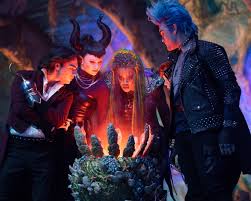

Disney has gotten a lot of mileage and scads of TV viewers out of the “Descendants” franchise, made-for-TV fairy tale musicals with a sort of “‘High School Musical’ meets ‘Wicked'” ‘vibe.
The series of films started with Broadway queen Kristen Chenoweth in the cast and “High School Musical” veteran Kenny Ortega directing, lots of fantasy fashion forward costumes and music-video-style production numbers to showcase pleasant-enough pop tunes to help tell the story, set up each principal character and lay out their intentions.
Now we’re up to the fourth film, “Descendants: The Rise of Red,” with Brandy Norwood and Rita Ora among the stars and veteran TV director Jennifer Phang behind the camera. It’s on a par with the earlier films — in other words, pretty forgettable for adults if not for the tweens who eat this cotton candy up.
The conceit is that fairy tales all exist in the same Disney universe, and that whatever went on with Sleeping Beauty, Cinderella, Peter Pan, Aladdin or Alice’s “friends” in Wonderland, their children have their own stigmas and agendas for overcoming them.
Red, played by Kylie Cantrall of TV’s “Gabby Duran and the Unsittables,” is a rebellious teen trapped in Wonderland under the thumb of her ruthless mom, The Queen of Hearts (Rita Ora). Red stays sane by playing pranks and being generally uncooperative. Her “escape” might be a letter of invitation to enroll at Auradon Prep, the big high school for privileged kids from assorted fairyale kingdoms.
It’s usually where heroines and heroes are educated. But new headmistress Uma (China Anne McClain), the pirate leader of assorted Lost Boys and daughter of Ursula, the Little Mermaid sea witch, is here to institute a “villains, too” policy.
But mean ol’Queen Mom, freed from fending off the accidental challenges Alice might have presented her in Wonderland, drops Red off and promptly stages a coup.
Mom has a grudge against Cinderella (Brandy Norwood), something to do with a prank back when they were at Merlin Prep. Cinderella’s handsome prince-turn-King Charming husband (Paolo Montalban) can’t save her. Can her sweet daughter, Chloe (Malia Baker) and bratty Red put aside their differences long enough to change Mrs. Glass Slippers’ fate at the hands of Queen “Off With their Heads?”
Red’s one ally back in Wonderland, Maddox aka “Mad” Hatter (Leonardo Nam) loaned her his “time machine” pocket watch. The girls find themselves hurled back to when their parents were in school. Red and Chloe must stop Red’s then-sweet-and-innocent-teen Bridget (Ruby Rose Turner) from being pranked by “Ella” (Morgan Dudley) or whoever it was that traumatized her, way back when.
The message, that “Hurt People Hurt People,” could not be clearer. “Privilege” is poked any time poor “Ella” aka Cinderella reminds Red and others that “You are a girl, but your princess is showing!”
The references to fairytale characters in their school days — Aladdin and Jasmine, etc — are too clumsily handled and obvious to be cute, with or without the “Bippidy, boppedy Boo.” The “plot,” such as it is, labors along towards its inevitable big “Castlecoming (homecoming) Dance” payof, which isn’t anything of the sort.
But grand Medieval steam punk clubwear costumes and faaaabulous wigs adorn the players as they sing and bounce through Ashley Wallen’s choreography for eight or so tunes by Torin Borrowdale, songs with forgettable if amusingly insipid lyrics like “The sun shines a little more brightly when you’re taking things a little more lightly.”
That’s how to take these childish but almost wry fantasies — “lightly.”
That next big stage or screen musical is going to need an audience, and Disney has spent decades growing it, from “The Little Mermaid” through “High School Musical” to “Descendants I-IV.”
Such entertainments have historically been stuffed with forgettable filler, plot-advancing tunes that few remember outside of those who performed “Camelot” in community theater or joined the “Les Mis” cult at some point.
There’s little to “The Rise of Red” meant to stick in the memory, and no “devil on my shoulder and it won’t be quiet” tune is going to create an earworm, even for kids watching it over and over again. It’s all just (almost) good, clean and forgettable “fun,” for those young enough to be delighted by it.
Rating: G
Cast: Kylie Cantrall, Malia Baker, Brandy Norwood, China Anne McClain, Dara Reneé, Ruby Rose Turner, Jeremy Swift, Leonardo Nam and Rita Ora.
Credits” Directed by Jennifer Phang, scripted by Dan Frey and Ru Sommer. A Disney+ release.
Running time: 1:32


