
Movie Review: “Coriolanus”

“Oh yes, he is wounded,” the war hero’s mother exults at the news her son is returning home. “I thank the gods for it!”
Volumnia (Vanessa Redgrave, fierce and feral) proceeds to list her offspring’s many cuts and injuries gained in battle. She keeps track of Martius’s wounds, because she is sure they will bring him glory and power.
But in “Coriolanus,” power and popularity are fleeting things. And nobody knows this more than that anti-heroic hero, Martius. Even after the Senate has offered him the consulship, he resists the need to curry favor with the masses, whom he holds in contempt. Honored and flush with new victory, he knows that mob has hated him in the past and will again, soon enough.
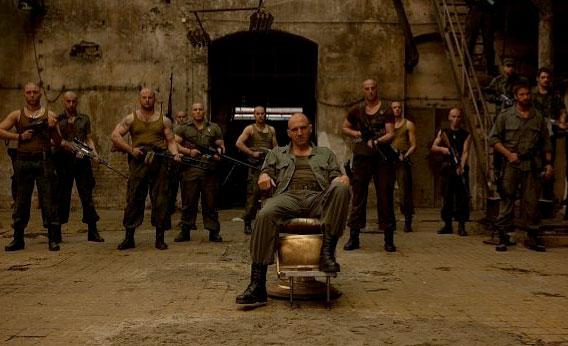
One of Shakespeare’s bloodiest plays is given a vigorous and stingingly  contemporary updating as Ralph Fiennes explores the tragedy of pride and the fickle tastes of “the mob” with “Coriolanus.” Taking the title role, that of a military hero modest enough to not readily accept accolades, snobbish and proud enough to refuse to pander to public tastes, Fiennes surrounds himself with a stunning cast. And as director, he gives this war drama a BBC/CNN war zone coverage, hand-held camera immediacy — men with M-16s shooting men with AK-47s — but men who know, as Shakespeare did, that the ugliest, most horrific combat is personal, hand to hand, knife to knife.
Martius has a super-patriotic mom, a devoted wife (Jessica Chastain), a son who longs to follow in his footsteps and allies (Brian Cox) in the Senate. But even single-handedly chasing off Tullus (Gerard Butler, not bad) and the enemy Volscians isn’t enough to make the impoverished classes of “a place called Rome” forget that he called them “dissentious rogues,” “curs” and worse when he was chasing them away from the city’s grain supplies.
Martius is unbending, unwilling to hear tributes to him in the Senate, unwilling to show a common touch or soft side. It will be his undoing, even after he’s been renamed Coriolanus, after his latest victory.
Fiennes has gone at this play the way Sir Ian McKellen adapted “Richard III,” and Orson Welles once updated “Julius Caesar.” He has updated the military setting and found a world filled with contemporary parallels to what Shakespeare was addressing.
What is his mob but the Arab Spring or Occupy Wall Street? What is the patrician Senate but “the one percent?” And who is Coriolanus but a noble man of heroic measure but myopic view of humanity?
Shakespeare fans will glory in some of the Bard’s flintiest dialogue.
“If e’er again I meet him beard to beard, he’s mine or I am his,” Tullus spits, talking about his sworn enemy, Martius.
Asked to dinner after her son’s downfall, Volumnia isn’t hearing it.
“ANGER is my meat!”
Redgrave hasn’t had a role this good since “Howard’s End,” and one this charged with fury since–who knows? It’s towering performance.
Fiennes, too, is in his element, rage so overwhelming he spits with every line.
The filmmaker in him highlights every timeless theme that Shakespeare trotted out, that age-old truism that the world loves a man in uniform, until he takes it off, the ways politicians rouse the rabble for their own nefarious ends. He and screenwriter John Logan trim the play and ends it, not with a whimper, but a deflating bang.
The great actors, from Welles and Olivier to Branagh and McKellen, want the popular audience to see what they see in Shakespeare — that he still matters, that he still moves, thrills and teaches. With “Coriolanus,” Fiennes brilliantly takes his place in their ranks.
MPAA Rating: R for some bloody violence
Cast: Ralph Fiennes, Vanessa Redgrave, Gerard Butler, Brian Cox
Credits: Directed by Ralph Fiennes, written by William Shakespeare, adapted by John Logan. A Weinstein Co. release.
Running time: 2:02

Posted in Reviews, previews, profiles and movie news | Comments Off on Movie Review: “Coriolanus”

Movie Review: “Jiro Dreams of Sushi,” and so will you

In a corner of Tokyo’s Ginza subway station sits a simple little restaurant of white walls and blond wood and just ten seats –Sukiyabashi Jiro. And in it, presides the oldest chef ever to earn a three star Michelin rating for his eatery, a stern, dour man who, in a quiet variation of Soup Nazi/”Cheeseburger-Cheeseburger” seriousness, reads unsuspecting visitors the law.
“No appetizers.” It is sushi only. Prices? They START at 30,000 yen. No walk-ins, reservations are required two-months in advance. And no, I DON’T have any brochures.
But land that reservation, sit down at one of those ten seats, and Jiro Ono will conduct a symphony of sushi — perfectly marinated, sliced and hand-patted fish wrapped around delicate, immaculately seasoned rice.
“Jiro Dreams of Sushi” is a movie as elegant, spare and tantalizing as its subject. In 80 minutes, filmmaker David Gelb captures a mild-mannered task-master who practices a zen approach to seemingly uncomplicated work — making sushi.
“You must dedicate yourself to mastering your craft,” Jiro says. “Every dining experience there “has to be better than the last time.”
And he has passed this on to his somewhat willing sons, men who gave up their own dreams of college or sports to serve their father and learn from the master.
Jiro, 85 when Gelb and his crew caught up with him, is a shokunin, a master craftsman who is passing on his legacy both to his sons and assorted apprentices who must serve him ten years before he’ll call them shokunin.
Gelb gives us some of Jiro’s background — he grew up poor, and served in the Japanese military during World War II — and takes us behind the scenes of one of the great restaurants in the world. Oldest son Yoshikazu sighs as he slaps mats of seaweed wrap against a hibachi grill. He wanted to be a racecar driver. But his life, chosen by his father, has him pedaling a bike to the seafood market at dawn, working with his tuna expert, his octopus guy, his halibut, abalone and eel vendors, each expert in his own right.
One of the underplayed jokes here is how Jiro seems to have bent this world to his will, his uncompromising standards. Yoshikazu is 50, and all that faces him is inheriting the restaurant from his father, taking on dad’s life’s work. Jiro’s younger son runs his own high-end sushi place, a mirror image of dad’s ten-seat diner.
Vendors — rice guys, fish guys — talk of being ready to retire, not in the best health. But they don’t because they won’t let Jiro down.
Gelb lets Jiro educate us on sushi — the difference between fatty tuna, “medium” tua and ruby-colored lean tuna.  He lets Jiro bemoan the proliferation of sushi as a food the world over and the awful over-fishing that leads to.
And Gelb photographs each dish as it comes off Jiro’s hands — minimalist works of art that melt in your eyes.
Everything is understated here, and that includes the conflict that normally drives any film, even a documentary. Jiro could retire. His eldest son is every bit as good as he is.
But does Yoshikazu live and breathe sushi? Does he dream of new sushi ideas? Only Jiro, the zen master of bite-sized morsels that seem to pop right off the screen and into your mouth.

MPAA Rating: PG for mild thematic elements and some smoking.
Cast: Jiro Ono, Yoshikazu Ono
Credits:  Directed by David Gelb. A Magnolia release.
Running time: 1:22

Posted in Reviews, previews, profiles and movie news | Comments Off on Movie Review: “Jiro Dreams of Sushi,” and so will you

Movie Review: Joaquin returns in “The Master”

Every movement has its founder, its days of working out its sacred text and its first fanatical acolyte. And it doesn’t matter if the founder is Mary Baker Eddy, Joseph Smith, Ayn Rand or Mohammad, the details are going to look messy.
That’s the fertile ground Paul Thomas Anderson tills in “The Master,” a fascinating film presented as a fictionalized version of the early days of Scientology.
Anderson (“There Will Be Blood”) vividly recreates the psychological climate of post-World War II nuclear-armed America and injects a charismatic charlatan into it. And set opposite the mesmerizing, arrogant yet oddly sympathetic Philip Seymour Hoffman in the title role is the bent, malnourished figure of Joaquin Phoenix, screen acting’s most tortured soul, given a comeback of startling dimensions.
Phoenix is Freddy Quill, a Navy vet of vulgar impulses and violent mood swings. He’s sexually voracious and unabashedly crude. Freddy doesn’t just drink. He used to drink the alcohol fuel from the torpedoes on his destroyer, so no libation that he hasn’t concocted out of paint thinner and pills does the trick for him.
He literally staggers into the orbit of The Master, a writer and self-described intellectual who has acquired a small, well-heeled following which he teaches to “process” others as he has processed them. Anderson presents a sober and fair-minded take on this procedure, which entails a hypnotic questioning and breaking down of the subject, supposedly revealing “trillions” of years of past lives that shape who we are.
“Do your past failures bother you?” the Master wants to know. “Is your life a struggle? Have you ever had sex with anyone in your family?”
The Master cares, calls Freddy a “silly animal” for his base urges and treats him as his ultimate “guinea pig.” Freddy, the most deeply disturbed person ever drawn into The Master’s orbit, will be the test case for the treatments proscribed in “The Cause” and the follow-up books the Master has in mind. He is going to upend a sick world and heal it, starting with Freddy.
Strip away any thought of “processing” as “auditing” and “The Cause” as “Dianetics” and you’re left with the portrait of a man whose life is a wreck and who finds some thread of hope in the attentions of this Kool-smoking guru.
Phoenix finds all sorts of new corners of disturbed to play in a performance that is not pretty on any level. The actor has never been more haggard, and the loss of weight makes him more menacing, a stooped Lee Harvey Oswald figure, a fanatic who barely contains his life-long rage and a man without a deep thought in his head.
Hoffman, all clipped sentences and self-control, makes this Master intellectually adroit, fearsome when he is challenged, sincere and mentoring when he sees the challenge Freddy represents.
“We are on a journey that risks the dark,” he intones in his lectures. He modestly offers his latest book as “a gift to homo sapiens.”
Amy Adams gives a Lady Macbeth edge to the Master’s latest wife, an unnaturally calm harridan who circles the wagons for The Cause whenever she sees it not being taken seriously.
“The only way to defend ourselves is to attack.”
“The Master” is captivating on a simple performance level. The story, an overlong, rambling personal journey that takes Freddy from the beaches of the South Pacific into his past and stumbling — perhaps healthier/perhaps lost –into his future, does little to break the spell the players cast.
Anderson cunningly lets the viewer add the “sinister” here. We can ponder a group that sees value in collecting and guarding the secrets of its members, that seeks out celebrities, the passion for litigation as a means of battling those who question it.
Hoffman, as The Master, may be full of it. But Anderson doesn’t have his film question The Master’s character or motives. He gives hints, suggests the costs as well as the benefits of this sort of imitation psychiatry.
The questioning, the worries over how such a cultish group might use its members, its influence and its clout for nefarious purposes? That’s up to us.

Continue reading →

Posted in Reviews, previews, profiles and movie news | Comments Off on Movie Review: Joaquin returns in “The Master”

Movie Review: “Searching for Sugar Man,” a Sundance darling, an Oscar favorite

It’s a standing joke in the music industry, an artist, frustrated by the lack of success in North America, hearing the consolation prize from an agent or record producer.
“But you’re HUGE in Australia” or Korea or Brazil or wherever.
At least somebody, they figure, “gets you.”
But what if you never knew that. What if you gave up your career after two failed albums, went back to your old life, and never realized you were “as big as Dylan” in say, apartheid era South Africa? The 1970s Detroit folk-rocker Rodriguez bombed in the U.S., but in sold hundreds of thousands of LPs and CDs sold in South Africa, his edgy, rebelious songs inspiring generations of folk-rock fans living in a heavily-censored police state. And he never had a clue.
“Searching for Sugar Man” is about the efforts of intrepid South African fans of the elusive Rodriguez, their years-long search for this artist who wrote “lyrics that set us free.” Rodriguez may have gotten lost in the post-Dylan Golden Age of the singer-songwriter in the U.S., when John Prine, Bonnie Laura Nyro, James Taylor, Dan Fogelberg and Jimmy Buffett owned the airwaves. But his albums, lush productions of immaculately produced songs such as “I Wonder,” “Crucify Your Mind” and “The Sugar Man,” sold and sold in South Africa, even if they were never officially exported there.
South Africans Steve Segerman, nicknamed “Sugar Man” all his life, set out to figure out who this mysterious figure was. His albums had few clues. He wore sunglasses and came off as a man of mystery. Legend had it that he’d killed himself on stage, which may have lifted his reputation and driven sales even further in South Africa. With journalist  Craig Bartholomew-Strydrom, he spent years “Searching for Sugar Man.”
The film, gorgeously shot by Camilla Skagerström, adds intrigue upon intrigue as the man’s producers, Motown music vets, sing his praises and scratch their heads over why he didn’t catch on. Then, as the searchers “follow the money,” the mystery deepens. Where did all that cash go? The film finds a Motown villain.
And then it finds the truth.
Using animation, grainy concert footage and picturesque travelogue scenes, director Malik Bendjelloul recreates this story and unravels the mystery. Some of it. Without giving too much away, suffice it to say that this story has an uplifting arcthat suggests this isn’t the last we’ll hear of this forgotten hero of pop.
But there are frustrations in “Sugar Man,” and not all have to do with Rodriguez himself. The film’s  first glaring omission is the lack of testimonials from the man’s peers, singer-songwriters who might remember the records and have appreciated their brilliance and maybe wondered “What ever happened to Rodriguez?” But perhaps there simply aren’t any who do.
The South Africans interviewed rather glibly distance themselves from the white minority regime which they say they opposed. But it’s a movie almost devoid of black voices, here or there. Continue reading →

Posted in Reviews, previews, profiles and movie news | 2 Comments

Weekend Box Office: “Hobbit” back on top, “Les Miz” and “Django” battle for #2

SkyfallThe heady Christmas Day opening of “Les Miserables” spiked it to a nice lead in the box office for the week, but Friday night — the night when fanboys and single guys hit the movies the movie — pushed “The Hobbit” back on top, headed to another weekend win. It could make over $30 million this weekend.

Friday also gave “Django Unchained” a temporary inside track on second place — headed for a $25 million plus weekend. “Les Mis” is running neck and neck with it, and came in third Friday night.

HOWEVER, Saturday is date date/night, and family movie-going day and night. So “Les Miz” could leapfrog the field, or at least “Django.” We’ll see.

“Parental Guidance,” having that family friendly thing all to itself, pretty much, is headed towards a comfy finish inside the top ten.

I’ve been counting the days until “Skyfall” passes the final “Twilight” film in overall US box office. They’re separated by about 2 million now. A decent weekend will take care of that gap.

Since I’m taking my wife to “Skyfall” later this afternoon, I figure I’ll be the tipping point, lifting Bond past Bella once and for all.

Posted in Reviews, previews, profiles and movie news | Comments Off on Weekend Box Office: “Hobbit” back on top, “Les Miz” and “Django” battle for #2

Movie Review: Barry Levinson warns us of the terrors of “The Bay”

Image

Alfred Hitchcock, so the story goes, wondered aloud one day what it would be like “if somebody really good” made a horror movie. And the result was “Psycho.”
Perhaps a similar wondering struck Barry “Rain Man” Levinson. Suppose somebody with an
Oscar and a few Oscar nominations, with first-rate credits such as “Avalon” and “Good Morning Vietnam,” albeit far in the past, made a “found footage” horror thriller.
That’s “The Bay,” opening Friday at The Enzian, a creature feature about footage of something —  viral or animal – that nearly wiped out a town on Maryland’s Eastern Shore a few years back. The video – from police cruisers, cell phones, home movie cameras, web cams and security cameras, was suppressed by the government. Hey, Levinson did “Wag the Dog” after all. Here, it’s the footage has been rounded up and leaked, in the form of a documentary expose narrated by a TV reporter intern (Kether Donohue) who survived the mayhem.
It didn’t start out as mayhem. The small town of Claridge was celebrating July 4, 2009, celebrating the desalination plant that enabled the big poultry producers in town to grow bigger, while dumping chicken waste by the ton into the Chesapeake Bay, when residents started getting sick.
They didn’t know that two very young oceanographers had stumbled into something weird in the water. One was French.
“Do you zink zis is anomaly?”
“Do I think it’s ‘Amelie?’”
Young Donna the would-be reporter deadpans a narration for an eco-leaks website, pointing out this person or that one in the various forms of found footage.
“And he would die, later that night.”
It starts with blisters. Competitors in the crab-eating contest turn it into a blood vomiting contest.  Some people go berserk. Others, we see from recovered cameras, are dragged by unseen “Jaws” under the murky brown waters of The Bay.
Posted in Reviews, previews, profiles and movie news | Comments Off on Movie Review: Barry Levinson warns us of the terrors of “The Bay”

Movie Review: “The Robber”


The odd, opportunistic and eccentric programming of Netflix streaming, the way the service lumps genres together and serves up possibilities, means that you’re always stumbling across something odd and old, or new and surprising — a movie you haven’t seen that you should have.
That’s a pretty neat trick for somebody who’s seen 500+  movies a year going back decades, like me.

I stumbled into “The Robber,” a German-Austrian thriller “inspired by a true story,” a prime piece of Euro-action worth remaking by Hollywood.
Andreas Lust stars as Johann, an Austrian loner whom we meet just as he’s finishing a stint in prison. He’s spent his time in stir doing lap after lap of the prison yard, perpetually training. He’s planning to pick up where he left off — running marathons — when he gets out. The authorities fret that he’s only focused on that, that marathoning isn’t a career, that a combination of financial need and an addiction to adrenalin rushes will see him tumble back into the practice that put him in prison in the first place — robbing banks.

Johann isn’t hearing it. He’s not making any promises. And sure enough, the minute he’s out, he starts vigorously prepping for marathons, obsessively monitoring his heart rate. Sure enough, he returns to the avocation that got him caught the last time — donning a mask and a hoodie, picking up a shotgun and hitting the hapless banks in this corner of Austria.
What co-writer/director Benjamin Heisenberg’s film does best is emphasize “The Loneliness of the Long Distance Runner,” to reference an earlier film about the mindset involved here. Johann’s solitary lifestyle has him alone with his thoughts and his demons. When you don’t talk to anybody, keep to yourself, steal cars to get to the banks, then ditch the cars and sprint miles and miles to get home, nobody can connect the dots.
Or so it would seem. You’d think that a masked robber who is in unusually good shape would point right back to a guy who just got out of stir. But the Austrians in the movie don’t make the connection.
Everything Johann does is to feed his adrenalin addiction, his need to marathon. He robs, buys monitoring equipment, uses the robberies as an excuse to spike his heart rate, takes up with an old flame Erika

(Franziska Weisz) so

he will have a place to stash his cash, all feeding his marathon habit. Even when he starts entering and winning marathons, bursting on the scene from out of nowhere, that’s not enough. It’s not winning that he’s in it for.
Heisenberger stages “”Point Break” styled getaways — long, desperate sprints through narrow streets, parking garages , through parks and alleys, emphasizing how easy it might be for someone with speed and epic stamina to outmatch and outwit legions of cops. In the right urban environment, Johann has advantages that the robbers of “The Town” could only dream of.
The film wastes no time on casing the banks, Johann’s apparent prep work. It limits itself to his (and Erka’s) point of view. So we have no idea why the cops haven’t pieced together this “We just let a marathon runner/bank robber out of prison, and this new robber seems to run like the wind” puzzle.
“The Robber” is bleak and yet exciting, a fascinating character study built around a pretty unpleasant “hero.” If Hollywood could find a star willing to get in spectacular cardio-vascular shape, a lean-mean running machine, I could certainly see a remake of this hitting it big.
“The Robber,” made in 2010, is currently available on Netflix streaming, and deserves a spot in your “to watch” list right after the

3starssuperb French thriller “Point Blank,” in your “foreign language thrillers” queue.

Posted in Reviews, previews, profiles and movie news | Comments Off on Movie Review: “The Robber”

Movie Review: “Your Sister’s Sister”

Image

It’s not really fashionable to label a film “mumblecore,” that much-scorned non-genre name used for no-budget indie fare that relied on attractive indie actors emoting, romancing and talking talking talking to tell its stories.

But even though it has big names — Emily Blunt and Rosemarie DeWitt are the half-sisters drawn to mumblecore icon Mark Duplass — “Your Sister’s Sister” is all about the chat, an improvised pseudo-farce that tumbles into melodrama — in between all the long, heart-to-heart talks.

We meet Iris (Blunt) and Jack (Duplass) at an awkward memorial service for Jack’s late, beloved brother. Jack drunkenly sets the other mourners straight about his flawed but still lovable sibling, who died a year before. And Iris, who once dated the dead Tom, feels the need for an intervention.

Get on your bike, she tells him. Go stay at my family’s cottage on an island off the Washington coast. Get through this grief.

“You just need some head space,” she tells her best friend.

The self-pitying Jack takes her up on it. Which is how he stumbles into Hannah, played with fetching vulnerability by Rosemarie DeWitt.

Unbeknownst to Iris, Hannah is already staying at the cottage. She’s a little weepy, and on a bit of a binge. She’s just split up with her longtime lover. And even though she’s a lesbian and even though Jack is an unemployed lump, the tequila starts talking.

“I haven’t been on that bicycle for quite some time,” she jokes, as the awkward, drunken hook-up gets off and running.

And then Iris shows up. Not in the middle of things, but the next morning.

Jack is all manic about Iris finding out.

“She’s your sister and she’s my best friend and it’s weird.”

So Hannah goes along. And as the weekend progresses, the half-sisters bond and Iris confesses her feelings for Jack and things get more complicated.

Writer-director Lynn Shelton (“Humpday””) had the makings of a conventional farce here. And while one respects her decision to not go that way, the clumsiness of the film makes you wonder if she didn’t because she couldn’t.

She attracted big name talent (DeWitt broke out with “Mad Men” and “Rachel Getting Married”) and then sicced them on — with all due respect, this guy? It’s not that Duplass, who is transitioning from indie fare (“Safety Not Guaranteed”) to studio pictures, usually as a supporting player, is nobody’s idea of a matinee idol. The character he’s playing has nothing to offer either of these women  — dumpy, no job, no ambition, lost in grief, a dash of charm, but sexually opportunistic. And he’s the brother of Iris’s dead ex-boyfriend. That’s a strange attraction.

The one-on-one exchanges have a rough, in-the-moment improvised feel. But the situations are arch and artificial, the romantic connections inorganic in the extreme. Shelton can’t manage the tension, the secrets and the big reveals with anything approaching a light touch.

So if we must bury “mumblecore” as a genre, let’s acknowledge that “Your Sister’s Sister” is all of its shortcomings in a nutshell — good actors and bursts of realistic dialogue need situations that aren’t sitcom ready, clumsy Playwriting 101 exercises.

Continue reading →

Posted in Reviews, previews, profiles and movie news | Comments Off on Movie Review: “Your Sister’s Sister”

Movie Review: Adam Sandler hits a new low with “Jack & Jill”


Forget “Jack and Jill” and the fact that Adam Sandler plays them both and not particularly well in his new “twins” comedy. Al and Pacino almost reason enough to see it, all by his bigger-than-life self.

Can I get a “HOO hah?”

Pacino plays a scary, cartoonish and more over-the-top-than-usual version of himself in this farce  and scores big laughs with every entrance. He’s performing Richard III on the L.A. stage, bellowing at cell phone users. He may take “Man of La Mancha” to Broadway, even though he sings like Sinatra’s pet bullfrog.

And he’s mad for Jill, Jack’s obnoxious Bronx cheer of a sister, whom he met while sitting next to Johnny Depp (in a Justin Bieber t-shirt) at an L.A. Lakers game.

Jack (Sandler) is a wealthy TV commercial director who can’t stand his yenta-sibling, Jill (Sandler again). She comes to visit over the holidays, craving a little “twin time,” and all Jack can think of is ditching her.

“We shared our mother’s WOMB,” Jill pleads. “We’re WOMB-mates!

Jack needs Pacino to do this new “Dunkaccino” commercial for Dunkin Donuts, so when Jill catches the wild-eyed Oscar-winner’s attention, Jack needs his twin, or her clothes in case he has to dress up like her to “close the deal.”

Even by sloppy Sandler movie standards, this one’s a wreck — fart jokes, potty zingers and pit-stain gags. Cameos from info-mercial stars and ex-”Saturday Night Live” colleagues litter the set, along with product placement from a certain pink stomach medicine, the aforementioned donuts and even a cruise line.  Mexican comic Eugenio Derbez does some catchphrase shtick.

A running gag that works — scripted and funny “interviews” with real twins open and close the film and are funnier than anything Sandler’s house director, Dennis Dugan, has ever managed. They’re the reason “Jack and Jill” starts off as though its going to be far more evolved than the usual lowbrow how-low-can-they-go wallow.

Sandler’s such a feeble actor that his bellowing rages never match the expression he musters on his blank face. He puts all his efforts into playing a woman, broadly and badly, so much so that the male twin is even duller than standard-issue Sandler.

But then there’s Pacino, out-of-place and yet somehow right at home. You want big? Al does BIG.  And since is as close as we’re likely to get to “Don Corleone Does Don Quixote,”  that alone is worth the price of admission.

MPAA Rating: PG for crude and sexual humor, language, comic violence and brief smoking

Cast: Adam Sandler, Katie Holmes, Al Pacino, David Spade

Credits:  Directed by Dennis Dugan, written by Steven Koren and Ben Zook. A Sony/Columbia Pictures release. Running time: 1: 34

Posted in Reviews, previews, profiles and movie news | Comments Off on Movie Review: Adam Sandler hits a new low with “Jack & Jill”

Movie Review: “Immortals”

Grisly, gross, messy — and I’m not just talking about Mickey Rourke’s table manners in “Immortals,” Tarsem Singh’s pseudo-arty melding of spatter film to the sword-and-sorcery genre.

Rourke, playing the megalomaniacal King Hyperion, out to release the Titans, crush humanity and thwart the Greek Gods in one stroke, chose to play this knife-wielding nut as a guy of appetites. He’s always eating nuts, pomegranates, what have you — food stuck in his teeth, his beard. He needed something to chase down his main course, the scenery he chewed in this bronze-tinted epic with pretensions of being the new “300.”

The director of “The Fall,” one of the most gorgeous, real-locations/real colors fantasies of recent history, goes digital, goes 3D and goes seriously boring in this movie, which could introduce filmgoers to the next Superman — Henry Cavill.

Cavill plays Theseus, an illegitimate mortal favored by Zeus, who has counseled him in the guise of an old man (John Hurt, our narrator), but who is really Luke Evans, ruling Olympus from on high.

Hyperion’s designs on Earth — Greece, to be exact — tempt many of the gods to meddle in human affairs. But Theseus is the one the Virgin Oracle (Fredia Pinto) has seen in a vision — Theseus the hero, leader of men, wielding the magical Epirus bow that Hyperion seeks.

Theseus is noble, of cleft chin and seriously cut eight-pack. “I draw my sword to protect that that I love.” And that means Mom. So when Mom is killed, Theseus is out for revenge. The thief (Stephen Dorff) and the Virgin Oracle come along for the adventure.

Making time for a little nude body double booty call, of course.

It’s a Greece of endless cliffs, labyrinths, salt flats and mazes, too much of it looking like digitally generated backdrops for Theseus to purse the bow, fight his foe and rally humanity against the forces of darkness.

“Deeds are eternal, not the flesh,” he lectures. But Hyperion isn’t listening. He’s determined to wipe out other men and their seed, and to spread his own — the Mongol horde form of genocide — breeding, and preventing others from doing so.

Continue reading →

Posted in Reviews, previews, profiles and movie news | 2 Comments