

Movie Review: “Speak No Evil,” as this Bully Prefers to do all the Talking

The remake of “Speak No Evil” becomes a furious tour de force for James McAvoy at his most villainous, a bristling thriller that presents an unspeakable dilemma that a fragile and trapped family cannot reason or trick their way through.

At some point, facing a pitiless, sadistic/narcissistic bully, you’ve got to fight.

Still, a simply-plotted lean Danish thriller about the futility struggling to maintain civility and good manners in the face of boorishness that masks seriously murderous intent becomes a more laborious Hollywood/Blumhouse remake in the hands of writer-director James Watkins (“The Woman in Black,” “The Take”).

Watkins makes this a star vehicle thriller, and given the performances of Mackenzie Davis, Scoot McNairy and McAvoy, it’s hard to quibble with that choice.

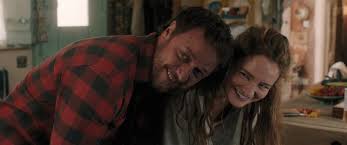
Two families meet on vacation — one American, with a troubled almost-twelve-year-old (Alix West Lefler) who still clings to her “worry bunny” and needs a therapeutic app to calm her and let her drift off to sleep. Louise (Davis) focuses on her and comforting tools from doctors and self-help books to guide her parenting. Bookish Ben (McNairy) figures the kid “needs to grow out of that,” but defers to a smart and beautiful wife he probably still worries is out of his league.

Gregarous Paddy (McAvoy) makes everything about his family’s Italian idyll bigger, noisier, more reckless and by extension, all about him. Wife Ciara (“Game of Thrones” alumna Aisling Franciosi) seems to get in the spirit of things, but their little boy (Dan Hough) is mute,

“He has a condition,” life-of-the-party-Paddy bellows, and as he’s a rich doctor who’s “retired” and only doing charity medicine for non-governmental organizations, the Americans accept his word on his authority.

Paddy is the sort of over-sharing, overly-friendly and handsy life-of-the-party who bowls over one and all by violating decorum and personal space, by never yielding the floor or surrendering the mike. Maybe he’s a bit cruel in the pranks he plays on other, less colorful tourists (Danes) at their resort.

But his overbearing “fun” quickly has Louise letting little Agnes play with the troubled mute child of strangers and ride a Vespa without a helmet with the cocksure and heedless Paddy.

The Americans have transplanted to London, where his job fell through and her career has little chance of restarting, thus the extra attention to mothering. If they’ve got the time, they simply must “come visit us in (England’s remote) the West Country!

Louise’s “maybe this will be good for us, all of us” implies trouble in the marriage and the manners of someone conditioned to not say “no” for risk of offense. Remembering the Danish film, I was surprised how well this cultural plot point translates from polite Danes to “let’s not be rude” Americans.

But once on this remote, old farm, Paddy’s Man of the Land macho, confidence in every assertion and overbearing ways come to full flower.

Louise is a vegetarian and a doting mother. He picks at the “morality” of her positions and lifetstyle and parenting, making her question herself.

Ben’s fretting over his sense of worth as a breadwinner, and about his masculinity. Paddy picks at that too, which could widen a rift in the Americas’ marriage.

This is classic bullying or “narcissistic personality disorder” behavior. Poke and poke until you find the weakness, then taunt your way into a dominant position in the relationship. And yes, we’ve learned a lot about that and psychological “projection” and the like the last four years.

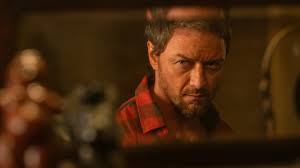
McAvoy has turned out to be a natural at this sort of villain, bulking up for the roles, fixing his face with a wicked gleam that can easily be read as on the “deranged” spectrum.

Adaptor/director Watkins gives him poses and shots, as the situation darkens and the “Big Reveal” turns things deadly, that summon up memories of Jack Nicholson in “The Shining.” Over-the-top? Sure. Subtle? Not in the least.

The “Big Reveal” was given away not just in the first film, but in the trailers to this one. With that surprise tossed aside, Watkins wisely concentrates on the adults, and the two children “working the problem.”

How might a mute child warn a fearful little girl? How can adults be alerted to the danger?

And once alerted, how far can one maintain “appearances” and “good manners” and hope for the best when just a look and a brief listen to the villain should make fleeing priority one?

I enjoy a good McAvoy scenery-chewing, be it “Split” or “The Book of Clarence.” And Davis and McNairy are quite good within the confines of the “types” they’re playing.

But there’s no denying that suspense and “thrills” in a thriller are heavily reliant on surprises and jolting twists. And it’s not just memories of the tighter, more tense Danish film that reinforce what’s lacking here. Giving away too much in the trailer hobbles “Speak No Evil.”

McAvoy’s performance leans more on the superficial than on the psychological just as his character is more “he’s just like that” than anyone we truly understand.

And slowing things down so that we savor the helplessness and work-the-problem dynamics of one family’s plight, trapped on the farm of a madman, only engages and entertains up to a point.

But slower and more superficial than the original or not, the riveting performances and the vague political parable of the way the story is spun this time out put this one thriller over.

The biggest monsters any of us will ever confront aren’t supernatural. They’re the ones who find our weaknesses and pick at them until we bleed to death, or abandon our manners and fight back.

Rating: R, graphic violence, sexual situation, profanity

Cast: James McAvoy, Mackenzie Davis, Scoot McNairy, Alix West Lefler and Aisling Franciosi

Credits: Scripted and directed by James Watkins, based on the screenplay for the Danish film “Speak No Evil” scripted by Christian Tafdrup and Mads Tafdrup. A Universal/Blumhouse release.

Running time: 1:50
Posted in Reviews, previews, profiles and movie news | Comments Off on Movie Review: “Speak No Evil,” as this Bully Prefers to do all the Talking

Movie Review: Killer production values, dopey thriller — “The Killer’s Game”

Say this for the action comedy “The Killer’s Game.” This eye-popping, gory cartoon of a movie should give stuntman/stun-coordinator turned-director J.J. Perry a helluva sizzle reel.

The production values on this Dave Bautista star vehicle pop, with cities all over Europe providing (second unit) settings, all of them matching Budapest in Matt Gant’s polished production design.

Cinematographer Flavio Martínez Labiano’s camera swirls through 360 degree pans, through interior drone shots of a Budapest opera house and into a modern dance piece, an assassin’s lair and epic brawls played for bloody laughs.

Balázs Lengyel and Felix Betancort should be in-demand fight coordinators after this film.

I’d plug the editor, too, but I didn’t catch a name on the screen and IMDb left it out of its credits. Well done, Mr. or Ms. slo-mo, split screens and whatnot.

But man, that story, this plot, that “twist” that isn’t.

The entire film is given away in the trailers, but for those who missed them, a brief summary.

Tattoo’d man-mountain Bautista plays Joe Flood, the best professional assassin in Europe, even though the tats don’t make him the most debonair Double-O wannabe in a tux.

His dizzy spells have a doctor telling him he’s got a rare disease and has months to live.

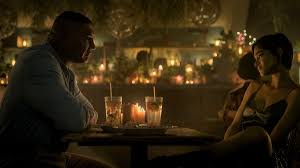
That puts a hold on the budding romance with a dancer (Sofia Boutella of “The Mummy”), whom he gallantly rescued after murdering his way to a human trafficker attending her opening night.

That challenges Joe’s contract-go-between, nickamed “The Rabbi” (Ben Kingsley) because, I guess, he’s Jewish.

“Leave judgment to God. Our job is simply arranging the meeting.” With God. By killing people. Get it?

Joe’s prognosis means he wants to die before the worst symptoms of the disease manifest themselves. Rather than killing himself, he breaks up with French dancer Maize and puts out a contract on himself

“I’ve lived by the sword. I want to go out the same way” is the most compact way of forshadowing that in addition to the punch-outs, neck-snaps, shoot-outs and grenadings he faces, Joe will find himself in a swordfight at some point.

Then, just as the hunt and the assorted colorful hunters (Terry Crews) and teams of hunters close in, the doc calls back and says “My bad” (not exactly) and that there’s “been a mistake.”

Uh oh. How many times have we seen that plot twist before?

The movie never overcomes that trot into “trite.” But the script tries to compensate by throwing a Korean gang, Hungarian and then Scottish brothers, a pair of stripper-assassins named “Ginni” and “Tonya” (Gin n’ Tonic?) and a spurs-wearing Spanish flamenco dancer killer at our Mr. Flood.

Cartoonish, to a one. Everybody’s overdressed and over-the-top, but none of them over-the-top enough to make much of an impression and shake off the script’s “This could not be dumber” feeling.

Bautista’s “Guardians of the Galaxy” castmate Pom Klementieff could have made her killer, daughter of a killer now a contractor herself, somebody special. But the writing gives her little to play with. Crews is saddled with a comical sidekick who isn’t that funny, nor are Crews’ reactions to the dope.

Scott Adkins plays the leader of a mercenary team, the most colorless of the many contract killers who descend on Flood in search of that $2 million price that he’s put on his own head.

At least Boutella got a chic haircut and a chance to dance and even sing (“Happy Birthday”) in this outing. Everybody else got a nice paid vacation in Budapest and environs.

And a select few of the production crew showed off their skills, making a bad movie perfectly tolerable every time a dance or chase or fight begins.

Rating: R, violence, profanity, sexual situations

Cast: Dave Bautista, Sofia Boutella, Terry Crews, Pom Klementieff, Scott Adkins and Ben Kingsley.

Credits: Directed by J.J. Perry, scripted by James Coyne and Simon Kinberg, based on a novel by Jay Bonansinga. A Lionsgate release.

Running time: 1:44

Posted in Reviews, previews, profiles and movie news | Comments Off on Movie Review: Killer production values, dopey thriller — “The Killer’s Game”

Movie Preview: A Christmas present titled “The Fire Inside”

Uplifting. Inspiring.  Oscar bait.

From Barry Jenkins and MHM/Amazon

Posted in Reviews, previews, profiles and movie news | Comments Off on Movie Preview: A Christmas present titled “The Fire Inside”

Movie Review: Greedy Grandson learns “How to Make Millions Before Grandma Dies”

“How to Make Millions Before Grandma Dies” is a sweet, sad and sentimental Thai end-of-life melodrama titled and set-up like a greedy-family farce.

A lazy, online gamer grandson (Putthipong Assaratanakul) sees an enterprising, mercenary cousin (Tontawan Tantivejakul) care for an elderly uncle, and “move to the top” of that uncle’s most-beloved-relative list and the top of his will. She inherits his house.

With his grandmother (Usha Seamkhum) freshly-diagnosed with cancer, “M” as the kid is called ingratiates himself with her, imposes his “help” on her life and even moves in to take care of Amah, who hasn’t been told her diagnosis.

“You took care of me when I was little,” he tells her (in Thai with English subtitles). “Now it’s my turn to take care of you.”

As the old woman favors her neglectful day-trader oldest son (Sanya Kunakorn) and indulges or at least tolerates her mooching, deadbeat younger son (Ponsatorn Jonwilas), while dismissing her devoted daughter, M’s mother (Sarinat Thomas), this seems like a canny way to corner the market on her affections and her estate.

But cousin Mui has let something profound slip into her tutelage of M’s scheme. As the kid poor-mouths this uncle or that one, Mui wonders if he thinks of “Amah as an asset.” He does. But that’s missing the point.

“What old people really want is ‘time,’” something her children, save for her struggling single-mom daughter (Thomas), don’t seem to have for her.

M eventually takes that to heart, even if we and granny fret over his motives and his honesty all along the way.

“Your grandson is not some kind of grandTHIEF! A scammer!”

Director and co-writer Pat Boonnitipat’s debut feature — he’s filmed some episodic Thai TV — borrows plot points and tone from “The Farewell.” But he then gently upends expectations in a film that immerses us in Thai life, Thai burial traditions and Thai superstitions as we meet people and see a slice of the country that’s wholly removed from “tourist” Thailand.

We get a taste of Amah’s routine — she’s cooked and run a congee shop most of her life — and rituals, the “goddess” she prays to, the shrine she turns a family burial place into.

And we see M evolve from predatory to understanding — well to “less predatory” and “more understanding” at least. Cash is cash, after all.

Boonnitipat gently sets-up scenes that might play for laughs — Uncle Kiang (Kunakorn) suspects M’s motives and tries to take Amah in, using his wife and wee daughter Rainbow to charm her and seal the deal — but plays them mostly straight and sober. M may scheme and counter-scheme here, but the idea is that he “grows” as a person and comes to really “see” his grandmother.

As things don’t go according to anybody’s plan, and even the “surprise” at the end turns in on itself, the universal message of “How to Make Millions Before Grandma Dies” wistfully lines up with John Prine’s classic tune, “Hello in There” and Mui’s one useful lesson to M.

“What old people want is really (YOUR) time.”

Rating: unrated, PGish

Cast: Putthipong Assaratanakul, Usha Seamkhum, Sanya Kunakorn, Sarinat Thomas, Pongsatorn Jongwilas and Tontawan Tantivejakul

Credits: Directed by Pat Boonnitipat, scripted by Pat Boonnitipat and Thodsapon Thiptinnakorn. A Well Go USA release.

Running time: 2:05

Posted in Reviews, previews, profiles and movie news | Comments Off on Movie Review: Greedy Grandson learns “How to Make Millions Before Grandma Dies”

Classic Film Review: Before “Wanda,” before “Ealing Comedies,” Crichton crackled in Combat — “Against the Wind”

It was “The Lavender Hill Mob” and “The Titfield Thunderbolt” that Monty Python’s John Cleese was remembering when he decided that well-past-70 Charles Critchon might be just the jolly sort to direct his screenplay for “A Fish Called Wanda.”

Those classic Ealing Comedies might date from another age, and the old rule about “old guys can’t do comedy” remains a hard prejudice to overcome. But Cleese, Jamie Lee, Palin, Kline & Co. turned out to be in the surest possible hands with 1988’s “Wanda,” one of the greatest screen comedies ever.

Yet the editor-turned-director was already making his mark in British cinema before comedies beckoned. World War II launched his directing career (“For Those in Peril”). And stumbling across “Against the Wind” on a streaming channel reveals this 1948 gem to be the “perfectionist” Critchon at his action-oriented best.

It’s a heist picture bent to fit the still-new commando thriller narrative, and as such it’s a jaunty, genre defining work.

A “team” is assembled, trained to fight, parachute and hit the enemy with gadgets from a military movie prototype for James Bond’s Q-Division. The mission goes wrong from the first — accidents, betrayals, characters’ Achille heels’ exposed.

But with that “Keep calm and carry on” doggedness, these men and a woman don’t give up. And if the viewer isn’t won over by the twists, narrow escapes and sacrifices of the early acts and Critchton’s brilliant shooting and cutting, the filmmaker tosses young actors John Slater and Gordon Jackson onto a moving train, imperiling one and all in some seriously jaw-dropping “They did their OWN STUNTS” action for the climax.

An Urtext thriller becomes downright dazzling, and Crichton takes a giant step to making his name in British cinema in the process.

A priest (Robert Beatty) with a gift for languages and experience on The Continent is recruited by Ackman (James Robertson Justice of course, later of “Guns of Navarone”) to an asymettrical warfare unit specializing in “sabotage” behind enemy lines.

Future Oscar winner and “Diabolique” icon Simone Signoret, still in her ’20s and making her first English language film, is Michèle, bridling at desk duty, longing to return to Nazi Occupied Europe for revenge against a turncoat lover. Bomb-gadget guru Duncan (Jackson) will have to hide his feelings for Michèle – — “Once you start mixing duty and affection, you start digging graves!” — and his Scots-accent and iffy French from the authorities if he’s ever sent on a mission. Show dancer turned radio operator Julie (Gisèle Préville) will have to get over her crush on Father Philip (Beatty). Hulking man without a country Cronk (Jack Warner) could come in handy. Emile (John Slater) will undergo plastic surgery so convincing his own wife won’t recognize him on this assignment.

And Picquart (Paul Dupuis of “Passport to Pimlico”) will have to have a fascist image makeover before making his way back to Brussels. Because that’s where they’re bound. Their former instructor, master saboteur Andrew (Peter Illing) may have masterminded the work records office fire that threw a wrench into Nazi foreign labor impressment. But he was caught, and By Jove, they’re going in to get him.

Everything that can go wrong does when you’re dealing with parachute jumps, espionage, explosives, agents of mixed allegiances and locals you may not wholly trust. But the mission endures, with “suicide pills” a final out for those captured.

The deaths here are dramatic, sometimes to the point of shocking, and each has meaning and consequences. Signoret is the standout in the cast, but Dupuis, Slater and Jackson have some great moments.

Jackson, later immortalized as the fusty, traditionalist butler in “Upstairs Downstairs,” an early hit for PBS in the US and the template for “Downtown Abbey,” is most impressive as the sexist Scot who swoons for the jaded, loveless Michèle, only to have to depend on her professionalism to save his life.

But watching him cling to rolling rail-stock in the film’s climactic rail chase (much of the movie was filmed on location in Belgium) we don’t see “performing” “as if my life depended on it.” The actor, and Slater as Emil, are white-knuckling onto couplings and other parts of rolling freight cars because one false move and they’re dead or at the very least badly injured.

Ealing Studios would make its true mark on film history via the comedies to come — “Whisky Galore,” “The Ladykillers,” “Kind Hearts and Coronets” — a couple of them directed by Crichton.

But with the sentimental, sad and sometimes thrilling “Against the Wind,” one and all proved that it wasn’t just twee, quaint and distinctly British charm and wit that made Ealing a revered institution. Definitive genre pictures about “Their Finest Hour” did Ealing and Crichton & Co. credit, too.

Rating: TV-PG, combat violence

Cast: Robert Beatty, Simone Signoret, Gordon Jackson,
Gisèle Préville, John Slater, Paul Dupuis, Peter Illing and James Robertson Justice.

Credits: Directed by Charles Crichton, scripted by T.E.B. Clarke and Michael Pertwee, based on a short story by J. Elder Willis. An Ealing Studios/J.Arthur Rank release on Tubi, Amazon, etc.

Running time: 1:36

Posted in Reviews, previews, profiles and movie news | Comments Off on Classic Film Review: Before “Wanda,” before “Ealing Comedies,” Crichton crackled in Combat — “Against the Wind”

Movie Preview: A “magical” time travel “safe house” for crooks on the lam — “Things Will Be Different”

Ok, the concept/conceit here is kind of LOL.

Riley Dandy and Adam David Thompson, playing robber-siblings, hope we’re expecting great things in the thriller’s execution. Buzz is pretty good.

Oct. 4.

Posted in Reviews, previews, profiles and movie news | Comments Off on Movie Preview: A “magical” time travel “safe house” for crooks on the lam — “Things Will Be Different”

Movie Preview: Victoria Justice, from Child Star to “Depravity”

Yes, there’s a whiff — a tiny hint — of rival ex-child-star Selena Gomez’s TV hit “Only Murders in the Building” in this “Only Serial Killer on Our Floor, and he’s Rich” thriller.

Blood and cleavers and Dermot Mulroney and a big payday.

This drops Oct. 15, streaming.

Posted in Reviews, previews, profiles and movie news | Comments Off on Movie Preview: Victoria Justice, from Child Star to “Depravity”

Movie Preview: Kelly MacDonald and Damien Lewis bring their accents to New School/Old Country horror — “The Radleys”

Love the casting.

This looks fun, Jekyll/Hyde twins tossed into a vampire salad.

Oct. 4.

Posted in Reviews, previews, profiles and movie news | Comments Off on Movie Preview: Kelly MacDonald and Damien Lewis bring their accents to New School/Old Country horror — “The Radleys”

Movie Review: Mary Louise Parker wrestles with the Big End of Life question, trapped in an “Omni Loop”

An academic physicist confronts the Big Existential question at life’s end in the deliberate, low-key sci-fi dramedy “Omni Loop,” a film that ponders “What was it all for?”

A career with great promise and a life of paths taken or not taken hangs over a kind of “Edge of Tomorrow” meets “Groundhog Day” tale of a scientist who tries everything to fend off the inevitable, perhaps missing the larger “point” of her life in the process.

Mary Louise Parker is Zoya Lowe, a woman about to die because somehow a black hole has opened in her chest. She’s got another physics text co-written with her husband (Carlos Jacott) at the printers, ready for a last edit, a daughter (Fern Katz) who needs her and a big fat regret hanging over her life at this terminal juncture.

But “terminal” goes into overtime every five days, as Zoya has some magical pills that pop her back a week, in time to get the worst news again, have a premature 55th birthday party arranged by her grieving family again, visit her aged mother in a nursing home one “last” time and deal with her will and her publishers all over again.

The life-extending “loop” might be “Hail Mary” way of giving her existence meaning, “making my mark.” Or is it a trap, a way of obsessing about the outcome, about scientific pursuits she didn’t complete which might have “solved” her problem? What’s she not getting?

“Omni Loop” — Bernardo Britto’s film takes its title from a line on Miami’s downtown “Metromover” commuter rail — is about Zoya’s long, last ditch effort to get answers and maybe get results. Meeting a community college science student with Zoya’s “An Introduction to Modern Physics” book, she breaks the pattern, tracks the kid down, and day after day, re-explains her dilemma and her “plan” to young Paula (Ayo Edebiri from TV’s “The Bear”).

Existence that has lost all meaning through the endless, soul-sucking grief of the repetition of the last week of Zoya’s life takes on purpose again as they take over an unused lab, pore over old research and brainstorm new approaches that will put Zoya back in contact with her youth, a disappointed mentor (Harris Yulin, terrific) and perhaps the “reason” she was gifted with these magic pills as a “promising” child.

Parker, of “RED” and TV’s “Weeds” and many other credits, has always done her best acting with her incredibly expressive eyes and emotionally open facial expressions. A simple side-eye from her is usually worth a laugh. Here she gives us glimpses of wide-eyed puzzlement at her dilemma, always washed-away by the resignation of despair.

Parker makes the “loop” of repetition eye-rollingly funny, forlorn and wistful, even hopeful in a “Maybe this time we’ll get it” way.

The narrative lets us see things from Adeberi’s Paula for a few scenes, in that “everybody’s going through something (not just Zoya)” aphorism. The younger actress matches Parker puzzlement for puzzlement, always in her case impulsively replaced by hope. The kid, remeeting and re-learning Zoya’s plight, time after time, almost instantly engages with the challenge, bringing a fresh set of eyes and a new appreciation for Florida’s community college system.

The picture drifts out of its loop in the latter acts, and the messaging of Britto’s debut feature can seem downright retrograde in an era of reviving feminism.

But “Omni Loop” gives us a less gonzo, more reflective and frankly sadder riff on themes explored in time travel tales and in the “alternate universes” of “Everything Everywhere All At Once.” Confronting Paula with her “gift” pills, Zoya has to learn “Do you really think you’re the only person who has a reason to go back” in time?

And even with that “gift” of a do-over, who among us knows what we would do with it, why, and if it will provide the “fix” we figure our lives need?

Rating: unrated

Cast: Mary Louise Parker, Ayo Adeberi, Carlos Jacott and Harris Yulin.

Credits: Scripted and directed by Bernardo Britto. A Magnolia release.

Running time: 2:09

Posted in Reviews, previews, profiles and movie news | Comments Off on Movie Review: Mary Louise Parker wrestles with the Big End of Life question, trapped in an “Omni Loop”

Netflixable? Comic Rachel Sennott copes with trauma — “I Used to be Funny”

“Shiva Baby,” “Bottoms” and “Bodies Bodies Bodies” have given Rachel Sennott acting baggage, typecasting her as a confident-to-the-point-of-brazen, comically-blunt and cocksure (sorry) young woman whose allure has a contract rider.

You don’t want to cross her, or anybody she plays.

That makes the downbeat dramedy “I Used to be Funny” an inspired choice on her part. She plays into type and against it as a promising Toronto stand-up comic who has suffered trauma, abandoned her dreams and all but refused to ever leave her friends’ apartment.

Sam Cowell used to swagger onto the stage, swatting the audience with good-natured man-bashing, pronoun-curious teasing, femininity and rough sex jokes.

“My big flirty move on a date is to make the guy pinkie promise not to kill me…We need a Volkswagen level recall of men in general…Who am I to judge Justin Bieber’s youth pastor? Because I wanted to f— the Biebs, too.”

But something happened a couple of years back. She hasn’t left gay besties Paige (Sabrina Jalees) and Philip’s (Caleb Hearon) house since.

Seeing that the kid she used to nanny on TV listed as “missing” triggers flashbacks, a need to act and a recognition that “I Used to be Funny” and that she has a prayer of being that way again. If only she can get some closure.

Writer-director Ally Pankiw, a veteran of music videos and some pretty good TV series (“The Great,” “Black Mirror”) and Sennott create a young woman of means and a hint of direction — she has a fine arts degree, was an au pair in the UK for a couple of years, and has been a stand up for more years — and a glib way of looking at every subject, even the most serious ones.

“Ok, I’m gonna open with a ‘rape’ joke tonight.”

That’s what comics do.

Interviewing with the humorless cop-dad (Jason Jones of TV’s “The Detour”) of a twelve year old (Olga Petsa) in need of a nanny goes better than it should. At least Sam doesn’t joke about the unseen terminally ill wife.

Brooke, the child, doesn’t want a nanny. But the sassy, mouthy, conspiratorial Sam wins her over.

“You’re not like other nannies, are you?”

“You’re not like other kids, are you?”

We can too-easily guess what went wrong with all this, long before the many flashbacks to the nature of their confidences and Sam’s sense of responsibility about Brooke are laid out.

Sam saw Brooke a day or two after she disappeared. It didn’t go well. The cops she speaks to “know” Sam.

Her ex-beau (Ennis Esmer) figures in the flashbacks. Might they have a future? And those stand-up sets sampled suggest that maybe she’ll move beyond simply visiting her old comedy haunts and take up the mike again. Or not.

That depends on whether Sam can find the missing Brooke, who “hates” her.

Pankiw does a decent enough job keeping this narrative moving despite a slow pace that seems to predict a stall-out.

The milieu may be familiar, and the third act revelations and actions are both predictable and somewhat clumsily handled. But Sennott wraps herself completely around this character, giving us vulnerability behind the cocky facade, worry and responsibility in a profession not known for producing the stable and well-adjusted.

She’s good enough in this to make fans pine for the next time she chooses to be funny and nothing but. Well, funny and mean.

Rating: TV-MA, sexual assault, substance abuse by minors, profanity

Cast: Rachel Sennott, Olga Petsa, Jason Jones, Caleb Hearon, Ennis Esmer and Sabrina Jalees.

Credits: Scripted and directed by Ally Pankiw. A Utopia release on Netflix.

Running time: 1:41

Posted in Reviews, previews, profiles and movie news | Comments Off on Netflixable? Comic Rachel Sennott copes with trauma — “I Used to be Funny”