
Netflixable? A French “Jumanji” with time-travel and werewolves — “Family Pack”

“Family Pack” is a slick, silly, hot-mess of a fantasy comedy, a French “Jumanji” based on a French board game.

A French family — including aged, forgetful Grandpa (the great Jean Reno) — tempts fate by playing an old, carved “Kill ze Werevolves” game and finds itself transported into the late 15th century, after Columbus visited the Caribbean but before superstition gave way to logic and the law.

That set-up is good for a few laughs, and a few one-liners as music teacher Dad (Franck Dubosc), legal aid lawyer Mom (Suzanne Clément), his teen influencer daughter (Lisa Do Couto Texeira) from his first marriage, her son (Raphael Ramond) from hers and their always “STARving!” little girl (Alizée Caugnies) contend with werewolves and a lop-off-their-heads/ask-questions-later sheriff (Grégory Fitoussi).

No, this is no “Renaissance Faire.”

Starting the carved board game and carelessly putting it away is what lands them in 1497, in a Medieval version of Granpda’s house. They eventually figure out they’re each “characters” in the game — a shape-shifting “thief,” the “muscle” (Grandpa), a witch, an invisible woman etc.

Dad’s the quick thinker who tries to pass them off as “traveling minstrels” to the suspicious locals, grabbing a lute and getting the family to sing along. No, he doesn’t know the “hits” of the day — “Good King Charles VIII,” “I Slaughtered a Burgundian.”

They much use their “powers” to sniff out the werewolves in town, kill them and collect game pieces.

Joking through a beheading, grimacing when the crown officer acknowledges “we made a mistake” about that beheading, they must keep themselves from turning into werewolves, too.

At least Grandpa is strong again, and a lot less forgetful. Reno gets the film’s best line about offspring avoiding their elderly parents.

“It’s very hard watching people disappear.”

If you watch it, let the kids practice their French comprehension and let Reno speak in his real French voice, with subtitles. The English dubbing spoils some of the (limited) fun.

The effects are passable and the cast is game, but there isn’t much to this, and the silly is never quite silly enough to take it over and give it full-fledged-farce status. There’s entirely too much tidying up this era’s shortcomings via the gay Italian painter and inventor Piero (Bruno Gouery) offering “inventions” (an electric guitar turns on the Renaissance Faire crowd to French heavy metal).

But “Family Pack” is far from the worst time-killer on Netflix right now.

Rating: TV-MA, violence, some profanity

Cast: Franck Dubosc, Suzanne Clément, Lisa Do Couto Texeira, Raphael Romand, Bruno Gouery, Alizée Caugnies, Grégory Fitoussi and Jean Reno.

Credits: Directed by François Uzan, scripted by François Uzan and Céleste Balin, based on a French board game. A Netflix release.

Running time: 1:34

Posted in Reviews, previews, profiles and movie news | Tagged , , , , | Comments Off on Netflixable? A French “Jumanji” with time-travel and werewolves — “Family Pack”

BOX OFFICE: “Venom: The Last Dance” opens at $52, not the blowout/bow-out Hardy’s Boys and Girls Hoped For

UPDATED FINAL SUNDAY NOON from @TheNumbers feed.

A lot of things are distracting America from the idea of “We MUST go see the third ‘Venom’ movie” this weekend.

Baseball’s World Series, other sports, fall leaves reaching their “peak” and politics join Comic Book Film Fatigue in pushing the opening take of “Venom: The Last Dance” down into the still-robust but low for the genre and the franchise $51 million. Deadline.com notes that the exit tracking from Thursday night and Friday’s showings are below the first two “Venom” movies.

Reviews have been bad to just brutal.

As Box Office Mojo reminds us, “Venom: Let There be Carnage” opened at a whopping $90 million in post-pandmeic 2021. The first of the Tom-Hardy Marvel anti-hero action comedies arrived to some $80 million in ticket sales back in 2018.

Projections had been in the $65 million range, because even Sony knew they didn’t have the goods, that the franchise was toast and that the whole comic book movie thing is running on fumes.

Don’t blame “Dodgers v. Yankees” for audiences being kind of over the franchise. Last summer’s “Deadpool & Wolverine” was an outlier, pairing up two beloved actors/characters for a one-off that all but sends off the genre’s days of “biggest box office ever” contests every year. The bell is tolling.

The film is making decent money overseas, which means no red ink.

The wider audience may have little interest in another Captain America movie or Florence Pugh in that “Thunderbolts” spin-off that was pushed back from last summer to next summer. Outside of ComicCon, who’s all jazzed for another “Superman” (next summer) or Robert Pattinson “Batman” outing (2026)?

“Smile 2” is not showing the legs that “Smile” did, losing well over half its lower-than-expected opening weekend audience for a $9.4 million or so take. Being slightly better than the first “Smile” can’t hide the fact that “Smile” came out less than two years ago.

“The Wild Robot” is still enjoying that all-alone-in-the-family-movie (animated) marketplace advantage, plugging along with another $6 million. It’ll be over $110 by Monday AM, not animated blockbuster numbers, but it’s a good movie that is sticking around in a fall characterized by slack competition.

But the new, higher-minded papacy thriller “Conclave” is opening on a limited number of screens and Ralph Fiennes is pulling in over $6.5 million in clerical robes.

“Terrifier 3” is right on those two film’s heels — $5.5 million projected, with a possibility of climbing over $6. It’s earned $41 million, all-in.

That pushes the Florence Pugh/Andrew Garfield romantic weeper “We Live in Time” out of the top five. It expanded its release, doubling the number of theater screens, and is still managing to only slightly best its opening weekend take of $5 million or so. It’s not all that, but being great counter-programming and a “date movie” with stars who have comic book film exposure attached to them is giving it a boost. It looks like this one will clear $20-25 once all is said and done and it fades from screens next month.

“Beetlejuice Beetlejuice” is still in the low millions ($3 million). It won’t reach the $300 million mark domestically before shedding all its screens. But it’ll come close.

“Your Monster” opened to a whopping $515K. “Memoir of a Snail,” a title which I asked and asked and asked for a review screener of going back weeks, did $69K.

Posted in Reviews, previews, profiles and movie news | Tagged , , , , | Comments Off on BOX OFFICE: “Venom: The Last Dance” opens at $52, not the blowout/bow-out Hardy’s Boys and Girls Hoped For

Movie Preview: Peter Sarsgaard is Roone Arledge at the Munich Olympics — “September 5”

A terrorist attack on the ’72 Munich Olympics Village and ABC…Sports is there.

A behind the scenes thriller about how TV responded to a live event of global implications, this looks solid if not star studded.

If you’re wondering about the timing of a film about Israeli victimhood coming out I’m the middle of an Israeli genocide, you’re not alone.

Nov. 29 this hits theaters

Posted in Reviews, previews, profiles and movie news | Comments Off on Movie Preview: Peter Sarsgaard is Roone Arledge at the Munich Olympics — “September 5”

Movie Review: “We Live in Time” and Weep — Just in no Particular Order

“We Live in Time” is an old-fashioned weeper, a “Love Story” with a British accent with a “meet cute” and falling hard and Big Dreams and tragedy just around the corner.

But director John Crowley and screenwriter Nick Payne tell this ever-so-conventional tale out of order, jumping from meeting with an oncologist to backo that first date to rearing a little girl on a farm to shaving the wife’s head to “remission” to a chef’s grasp at the big prize at “the culinary Olympics.”

And all due respect to Crowley — whose “Intermission,” “The Goldfinch,” “Boy A” and “Brooklyn” challenged and engrossed and were sometimes gimmicky yet all terrific showcases for their stars — but that time-shifting tends to pull his latest picture’s punches.

A sad moment here and a potentially wrenching one there all feel muted as the drama doesn’t build towards a catharsis for the viewer.

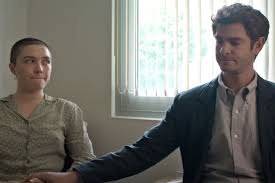
Stars Andrew Garfield and Florence Pugh have chemistry as a couple, and barely a natural moment as “parents,” never quite shaking “They’re play-acting this” in those scenes.

And the narrative’s turn towards a Big Finish is so conventional that it trivializes what’s come before.

Garfield plays an ever-traveling marketer for a Brit breakfast cereal who meets Ms. Right by accident. She runs him over in her Mini Cooper (so he survives) on a night when he has stumbled out of his latest hotel room — in his robe — in search of a convenience store that sells pens.

He needs to sign his divorce papers. And when Tobias awakens to Almut’s presence in a hospital corridor, there’s no messiness about doctors, possible police charges, etc. Just lots of eye contact with the lovely chef who’s just put him in a neck brace.

So OK, maybe OPENING with that “meet cute” would have been a bit much. Better to tuck the cute-falling-into-cutesie into a flashback.

The story of their romance will let her discover he’s not “married,” after all, when he shows up at her restaurant for her make-up-for-that-little-accident free meal she offers plays-out after we’ve heard a doctor tell them the tumor she has is “too big” to operate on, that there’s been a “reoccurrence.”

“I’m not sure I know how to go through all that again,” the Anglo-Bavarian chef Almut tells Wheatabix seller Tobias when facing a year of chemo, surgery and the all that entails.

The idea is that we know they’ve got a little girl, and “We Live in Time” will show us what they went through to make that decision and the uncertain future that awaits every choice they and we make in life.

“We live in time, ” the Julian Barnes (“The Sense of an Ending”) quote goes. “It holds us and molds us.” And we never know how things will work out at the moment we make every fateful decision.

The film’s disordered structure hides clunkier moments in between winning ones. And while it isn’t hard to follow, the fact that it’s a puzzle we’re putting together as the film serves-up piece-by-piece undercuts the chemistry and the emotional build-up, and can’t disguise the cloying.

Random bits of his doting architect dad (Reginald Hodge) cutting his 30something son’s hair — kind of an emotional upending of the “emotionally unavailable Brit” stereotype — or the idea that “Anglo-Bavarian cuisine” (another stereotype steamrolled) isn’t a punchline get lost in the literal — and gimmicky — shuffle.

But Pugh shimmers and Garfield gushes and blushes and even if they both overdo that parenting pose. Grace Delaney plays their adorable little girl, deployed sparingly.

Such movies are manipulative by nature and we embrace them for that. Here, that’s more obvious and heavy-handed, and the manipulation tends to spare us tears — and laughs — when the tears are entirely the point.

Rating: R, sex, nudity, profanity

Cast: Andrew Garfield, Florence Pugh and Grace Delaney

Credits: Directed by John Crowley, scripted by Nick Payne. An A24 release.

Running time: 1:48

Posted in Reviews, previews, profiles and movie news | Tagged , , , , | Comments Off on Movie Review: “We Live in Time” and Weep — Just in no Particular Order

Movie Review: “Venom: The Last Dance,” and Thank God for That

Well, that’s enough of THAT, thank-you very much.

Maybe now that the steadily deteriorating Marvel franchise “Venom” has stuck out its tooth-ringed tongue one last time, we can get our Tom Hardy back.

The actor who made his mark in Christopher Nolan epics (“Dunkirk,” “Inception”), high concept thrillers (“The Drop,” “Legend”) and stand-out indies (“Bronson,” “Locke”) has been so swallowed up by this crap/crappier/crappiest comic book series that he’s managed only recurring roles on “Peaky Blinders,” the summer bust “The Bikeriders” and the occasional…podcast?

That’s criminal.

So they needed to give us “Venom: The Last Dance,” a picture that would wrap-up the trilogy about the mild-mannered reporter “possessed” by a toothy, carnivorous, foul-mouthed alien beastie with “boundaries” issues. Hardy, playing Eddie and voicing that alien smartass Venom, gave writer-director Kelly Marcel (she scripted “Fifty Shades of Grey” before selling her soul to “Venom”) some thoughts and earned a story credits for coming up with this alien invasion action comedy.

But that’s about all he got out of this, other than paychecks and a working vacation in Spain.

Eddie Brock is on the lam with his inner-voice bestie in Mexico, drinking both of them into a stupor, sometimes shifting “universes” to stretch out the definition of “last call.”

Venom has thoughts about “that multiverse s—.” As do we all.

Back in the U.S., Eddie’s wanted for murder, Area 51 is about to close and commando commander Strickland (Chiwetel Ejiofor) is hellbent on finding Eddie and his alien “symbiote” first. His elite team of soldiers dangling from lines beneath a V-22 Osprey are no match for Venom, even if they can track Eddie down to Mexico, or follow “We ARE Venom” making “our” way to New York by way of Vegas.

A white-haired alien entity, Knull (CGI Andy Serkis), from Venom’s old stomping grounds is seeking to end life in the universe as we know it, and sends more monstrous symbiotes in search of a “codex” key to…unlocking something — whatever’s strong enough to keep Knull in lockdown. Venom has it.

Lightning-scarred researcher Dr. Payne (Juno Temple) works in the super secret lab and symbiote research facility BENEATH Area 51. She’s hoping these shape-shifting beasties will be our friends.

But before all these characters and agendas can collide, Eddie/Venom have to “possess” a horse and hitch a ride with a UFO cultist (Rhys Ifans), his hippie wife (Alanna Ubach) and their non-believer kids, leading to a Sing-along-to-“Space Oddity” in a VW Microbus.

Because none of this is remotely serious, even if Hardy was too “serious” to sing along.

Characters return from earlier films, a stop in Vegas goes rather like one would expect and there’s an epic CGI brawl involving one and all that drives the finale, where Eddie and Venom the “lethal protector” of Earth fight creatures just as lethal as them.

None of its the least bit interesting, with only an occasional laugh landing amidst the mayhem and PG-13 profanity. The pacing is slow, the Spanish scenery (meant to be Mexico, Area 51, et al) generic.

And while I appreciate the attempted light tone of these films, the jokes that “We ALL have a monster inside of us” and “No one PHONES HOME (like E.T.) from here” don’t pack much of a punch.

The fights are less of a blur than earlier “Transformers/Marvel” CGI throwdowns, but nothing that would keep any non-fan awake through to the end.

Hardy, perfecting the “meek” American shlub “type” he tackled in “The Drop” years ago, soldiers through this and has as much fun with the synthesized voice of Venom as he can.

But the best thing about that is even if this is a hit he won’t have to do it again. Ever. I can’t wait to see him in something else. Anything else. Even a “Peaky Blinders” movie would do nicely, thank you very much.

Rating: PG-13, violence, alcohol abuse, profanity

Cast: Tom Hardy, Chiwetel Ejiofor, Juno Temple, Stephen Graham, Peggy Lu, Alanna Ubach, Cristo Fernández and Rhys Ifans

Credits: Scripted and directed by Kelly Marcel. A Sony release.

Running time: 1:44

Posted in Reviews, previews, profiles and movie news | Tagged , , , , , , , | Comments Off on Movie Review: “Venom: The Last Dance,” and Thank God for That

Movie Review: Switzerland’s Oscar contender has a Peruvian flavor — “Reinas”

When the Academy of Motion Picture Arts & Sciences changed its “Best Foreign Language Film” category at the Oscars to “Best International Feature,” it was designed to make the Academy Awards seem less Hollywood-centric, less like “English” was the official language of Oscar-worthy movies.

They’d invented “Best Foreign Language Film” in the late ’40s as an honor going to a film from a designated culture and country, with each far-from-Hollywood non-English-speaking nation submitting one film as their “best” in a given year. They removed “language” from the equation.

That leads us to “Reinas,” Switzerland’s official entry for this year’s Oscars, a period piece set in the turmoil of early ’90s Peru, a tale of all-Peruvian characters all speaking Spanish. Which is not commonly spoken in the country that produced it.

But when your writer-director is “Swiss-Peruvian” (Klaudia Reynicke-Candeloro), she could submit her entry from whichever country wants to claim credit for it or perhaps back an Oscar campaign for the film.

The film itself is smart, sharp and immersive, a festival award-winner that takes us into a country collapsing into hyper-inflation driven by a government that teetered back and forth between military dictatorships and civilian rule, between Soviet alignment or seeking aid from the U.S.

The Shining Path guerrilla movement was carrying out murders and bombings. Power went out, off and on in the cities. And people were fleeing.

That’s what Elena (Jimena Lindo) has planned. She’s got a job lined-up in Minnesota, passports at the ready with Visas arranged for her two daughters –teen Aurora (Luana Vega) and much younger Lucia (Abril Gjuinovic).

But their estranged father, Carlos (Gonzalo Molina) won’t sign their permission-to-leave documents, and he has rights. He’s not overtly fighting this move over Elena’s plans for his little queens, his “Reinas.” Yet he never can seem to make it to the notary with her to sign-off and allow his kids to grow up somewhere more stable, less communist and/or fascist.

Carlos is “still trying to get back on my feet” (in Spanish with English subtitles) driving a cab, describing himself as an “actor” to the paying customers. To his ex and his kids, he’s “been in the jungle,” “working in security,” “a secret agent” or some such.

“The Great Carlos” or “Crazy Carlos” seems to know everybody. The hyperinflation hammering the economy has him cagily moving to the barter system — a sack of hard-to-get sugar in his battered taxi’s trunk, a spare tire traded for swimsuits for the girls, and so on.

He’s sketchy enough for us to wonder just how “connected” he is, which side he might be on, what that police-issued “special” ID might convey.

Oldest daughter Aurora doesn’t care. Self-involved and 15, she’s fretting over leaving her friends and her first boyfriend. Whatever Mom’s got planned, impulsive, naive Aurora is sure to interfere. Little Lucia wants to stay with Mom, but Aurora thinks Dad’s life in Lima would be more to her liking.

As Dad lies and hustles with his every breath, that plan may not be a plan at all.

Director and co-writer Reynicke-Candeloro maintains the mystery as long as she can so that we’ll stay engaged in a personal story of realizing “When it’s time to leave” your country.

Police and soldiers all over the streets, prices skyrocketing, everybody racing to exchange their cash for yankee dollars via street-vendors and a president finishing his litany of bad news with “God help us” on TV — those are signs it’s probably already too late to escape.

Elena is a travel agent, which helps. She lives with her mother (Susi Sánchez) and they are “privileged,” Elena is the first to admit.

But her oldest child hasn’t got a clue. And as the picture shifts to her point of view in its second half, we start to wonder how much havoc one teen can wreak as Aurora sprints towards a cliff only her mom sees.

Molina does a great job of skating the line between “lying loser” and “maybe a guy we’re all underestimating.” That mystery gives the viewer something to latch onto in a film that saves most of its suspense and “action” for the third act.

Lindo lets us see the wheels turning in a woman trying to charm her ex into saving her family, tamping down her fury at his procrastinating, his lies to the kids and the like.

And Vega testily gives us a taste of every headstrong teen about to “find out” we’ve ever been or known.

The payoffs to the various storylines are, to a one, something of a letdown. But “Reinas” is a Peruvian-Swiss filmmaker’s caution to the world about the risks of voting your way into political extremism, or helplessly watching as clueless others seal your country’s fate for you.

When authoritarianism hits the fan, cruel incompetence is the governing ethos. And not everybody’s a travel agent with an escape plan already lined-up, no matter what their ex or rebellious teen want.

Rating: unrated, threats of violence, teen drinking, adult themes

Cast: Luana Vega, Gonzalo Molina, Jimena Lindo, Abril Gjurinovic and Susi Sánchez

Credits: Directed by Klaudia Reynicke-Candeloro, scripted by Klaudia Reynicke-Candeloro & Diego Vega. An Outsider Pictures release.

Running time: 1:43

Posted in Reviews, previews, profiles and movie news | Tagged , , , , , | Comments Off on Movie Review: Switzerland’s Oscar contender has a Peruvian flavor — “Reinas”

Movie Review: A Child’s turn as Robinson Crusoe in “Kensuke’s Kingdom”

“Kensuke’s Kingdom” is a simply but attractively animated film based on a Michael Morpurgo novel.

The novel, in turn, is based on the classic tale “Robinson Crusoe,” here modernized to place a shipwrecked boy and his dog in tropical paradise, an island all but deserted save for a Japanese WWII survivor.

In subject matter, look and feel it’s a lot like those “Famous Classic Tales” — condensed fiction animated for children and shown on American TV in the ’70s and ’80s and repeated for years beyond that.

But while this British/Welsh/Luxembourg co-production shares the same simplified-for-children story and under-animated look of TV animation of that era, it features the voices of an Oscar winner — Cillian Murphy — and two Oscar nominees, Sally Hawkins and Ken Watanabe — as the adults in the cast.

Michael (Aaron MacGregor) is a headstrong lad stuck on a 44 foot ketch with his parents (Hawkins, Murphy) and big sister (Raffrey Cassidy) as the grownups have lost their jobs and decided “a fresh start” means buying a sailboat for a world cruise.

Michael is too young for responsibilities, or to have a say in whether or not the family dog gets to come with them. But he’s smuggled Stella onboard, something nobody else figures out until weeks into the trip.

Right.

The boy’s hardheadedness includes his reluctance to wear his safety harness, which is how he almost falls overboard, and after all that foreshadowing a storm whips up in the South Seas, he finally does, with Stella tumbling after him.

They survive without life jackets and awake on an island, marooned on a beach he can’t seem to reason or explore their way off of. When food and water start appearing before them in the mornings, they eventually realize it’s from Kensuke, a tall, skinny old man who speaks no English and can’t understand why they insist on cooking his sushi.

The island features dense forest, steep waterfalls and a widely-varied eco-system of wildlife including great apes, whom Kensuke has befriended. He lives in the standard issue Robinson Crusoe kids’ fantasy tree house, elaborately engineered and plumbed in bamboo in a Japanese fashion.

A faded family photo tells us of Kensuke’s wife and child, and flashbacks give away his story. He survived the late WWII sinking of his destroyer, his family back in Nagasaki did not.

Now he broods and hides from the world, with the island itself his only real purpose.

The outside threat to their paradise comes from poachers who’d love exotic birds and a baby ape for their sellable menagerie. The headstrong boy must learn caution, responsibility and empathy if he’s to get along with this stranger hellbent on protecting his “kingdom.”

The “learning” is soft-pedaled here as the script’s ambition doesn’t extend much beyond hurling a child into a “Survivor” situation with only his dog and a magnifying glass compass to help them survive.

Well, and their Japanese Robinson Crusoe savior.

“Kensuke’s Kingdom” is engaging enough for its target audience, and parents probably won’t mind explaining the “Famous Classic Tale” that Michael Morpurgo leaned on. Maybe plant a little bamboo in the backyard, because as Crusoe to Kensuke to Gilligan, there’s just no plante that’s more useful in a pinch.

Rating: PG

Cast: The voices of Sally Hawkins, Cillian Murphy, Aaron MacGregor, Raffrey Cassidy, and Ken Watanabe.

Credits: Directed by Neil Boyle and Kirk Hendry, scripted by Frank Cottrell Boyce, based on the children’s novel by Michael Morpurgo. A Blue Fox release.

Running time: 1:24

Posted in Reviews, previews, profiles and movie news | Tagged , , , , , , | Comments Off on Movie Review: A Child’s turn as Robinson Crusoe in “Kensuke’s Kingdom”

Movie Review: Glenn Close stars in a “Beach Read” that might cure insomnia — “The Summer Book”

“The Summer Book” is a picturesque period piece based on a novel Tove Jannson wrote, inspired by her own experiences living on an island in the Gulf of Finland. It aims for “lyrical” and “meditative” as it tells the story of a little girl and her father dealing with or avoiding the grief that came with the loss of the child’s mother.

But if the distributors of it were cheeky enough to make their own book “based on the film,” it’d be nothing but pretty pictures. It’s characterized by dry, scenic emptiness, a dash of melodrama and a Glenn Close performance of pointillistic perfection.

Nothing much happens, and not all that much is experienced in it, either.

Sophie, her illustrator father and wisened grandmother boat off to the deserted island where their family has summered for decades. The child (newcomer Emily Matthews) is six or so, and whatever happened to her mother is not something she can articulate or properly process. Dad (Anders Danielsen Lie) has memories of this place that probably haunt him, so he throws himself into his work and in coaxing back to life a poplar tree he planted — perhaps with his wife, or in her honor the year before.

Grandma (Close) twinkles and stumbles about with the infirmities of great age but the confidence of someone who knows every rock at the seaside, ever corner of the tiny forest there. She has a notion of what these two are going through, but doesn’t have much in the way of words of comfort or wisdom to offer.

The child can be a chatterbox, and granny has only so much patience for the incessant observations and questions such as “Are there ants in heaven?”

“Life is long, Sophia.”

They will spend the summer wandering, boating around the archipeligo and planning for the Midsomer bonfire, something they’ve always celebrated here.

Dad puts up a tent, another tradition, and grandma introduces Sophia to the wonders of nature and woodcarving as Dad practically disappears from the picture.

Thank heavens somebody brings Sophia a cat to adopt. Too bad it’s a cat.

“The more I love him, the less he loves me!”

But the child experiences this world and this life in what should turn out to be the formative memories of her future. Perhaps as an adult she’ll decide this was when she realized what loss was (not likely). But certainly she’ll figure out how inane she sounded saying this to her granny, who’s told her and us she helped found The Girl Scouts of Finland.

“I came to tell you what it’s like sleeping in a tent. I thought you would like to know.”

Too much of the movie is a read-between-the-lines/fill-its-holes-yourself experience — quiet idylls, grandma looking at the sea, the cove, the cabin and the trees as if this might be the last time, indulging Sophia as she’s really “getting” the place for the first time.

At one point, grandma runs naked through the trees, a scene not set up as “something we did as children.” That is merely implied. Or perhaps granny is going natural. Or a bit balmy.

The insights about the fragility of moss balance with the superstitions of grandma’s people.

“We’ll put seven leaves under your pillow and you’ll dream of the man you’ll marry.”

Sophia decides to test her newfound interest in the Almighty with a prayer — “Dear God, I’m bored as BEEF. Let SOMEthing happen.” Because “even a STORM” would be a break from the tedium.

Sure enough, that’s what happens, something served up in six thousand, two-hundred and seventy-two melodramas that preceded “The Summer Book.”

Whatever the meditative, “inspiring” merits of the novel, veteran British TV writer Robert Jones and “The One I Love” nepo baby director Charlie McDowell (son of Mary Steenbergen and Malcolm McDowell) don’t find its cinematic equivalents in this adaptation.

But Glenn Close, America’s Judi Dench (Give her an honorary Oscar, for the love of Mike.), makes the film watchable with another spot-on performance. Every gaze at the horizon, every movement, every gesture seems exactly right, calculated to seem as natural as taking that next deep breath.

Even if the script doesn’t move us through this character, Close almost manages that with just a look, a sigh or an old woman’s last wistful twirl of her Scandinavian pony tails.

Rating: unrated, nudity

Cast: Glenn Close, Anders Danielsen Lie and Emily Matthews

Credits: Directed by Charlie McDowell, scripted by Robert Jones, based on a novel by Tove Jansson. A Charades release.

Running time: 1:35

Posted in Reviews, previews, profiles and movie news | Tagged , , , , , , | Comments Off on Movie Review: Glenn Close stars in a “Beach Read” that might cure insomnia — “The Summer Book”

Classic Film Review: A Grifter Dramedy Urtext –“Elegant Beast” (1962)

Before “Parasite,” before “Shoplifters,” and even before “The Grifters,” there was the darkly comic Japanese morality play “Elegant Beast,” which makes the old W.C. Fields saying, “You can’t cheat an honest man” universal.

Yûzô Kawashima’s 1962 film, titled “Shitoyakana kedamono,” which is sometimes translated as “The Graceful Brute,” is a minor masterpiece in amoral, entangled thieving at its most personal. Confined to basically a single set — a modest but well-stocked Tokyo apartment — Kawashima’s film of a Kaneto Shindô screenplay is paranoid, callously amusing and cruelly cautionary.

There’s no such thing as a “victimless crime,” after all.

The apartment belongs to the Maedas. Or so we think. Their rush in hiding their TV, their Polaroid camera, the Renoir that sometimes hangs on the living room wall, their liquor collection and even members of the family tell us something’s up when three people come to their door.

Mr. Katori (Hideo Takamatsu), a talent agent hoping to book an “Evelyn Presley” tour of Japan, is furious. He’s brought along his accountant, Yuki (Ayako Wakao) and the ridiculous-looking but possibly tough jazz singer (Shôichi Ozawa) for backup.

There’s money missing from the office, and the Maeda’s son Minoru has taken it!

“There must be some mistake,” Mr. (Yûnosuke Itô) and Mrs. (Hisano Yamaoka) protest, in Japanese with English subtitles, the first of MANY such protests. “Our son would never do such a thing!”

A tirade of bellowing accusations filled with facts, details and precise amounts confronts a lot of very Japanese apologizing and bowing.

But it’s only afterward that Katori’s “I’ll go to the POLICE” threat is dissected. That’s when Minoru, played by Manamitsu Kawabata with an Alain Delon edge and swagger, comes out of hiding.

“He cheats on his taxes,” Minoru cackles as changes out of his sharkskin suit. No, Katori won’t be ratting them out to the cops.

When tarted-up daughter Tomoko (Yûko Hamada) sashays in, we start to get a picture of the scope of the crimes of this family that preys together. The novelist she’s been cleaning out has kicked her out. Something about Dad’s “pimping her out” to him as his mistress rubbed him the wrong way.

When novelist Yoshizawa (Kyû Sazanka) barges in to “break things off,” he makes himself at home and asks about his Renoir. That’s when we figure out he pays for this apartment. He apparently recommended Minoru for the booking agency job. Minoru didn’t just loot them, he apparently stole book residuals by passing off Yoshizawa’s business card to his publishing house.

“It might be rude of me to talk this way, but are you all in this together?”

Every knock at the door of this apartment further complicates this delicious plo and the relationships, and adds money to the tally and layers to all the grifting that’s going on.

“Elegant Beast” was one of the last films of Kawashima (“The Temple of Wild Geese”) and an early jewel on screenwriter (“The Naked Island,” “Hachi: A Dog’s Tale,” “Postcard”) and sometime director Shindô’s resume.

The early scenes set it up as a con artist family farce, with the “Evelyn Presley” references and jazz singer with the silliest spitcurls this side of “Alice in Wonderland.” But as sketchy women talk of using and letting themselves be used, sexually, for money and as corrupt men rage at being used in simular fashion, we start to taste the “cost” of all this conning, however one and all rationalize it.

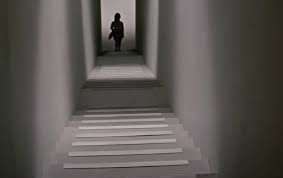
Kawashima shows characters ascending or descending a shadowy symbolic white staircase, up towards their dream life, or down into debt, jail or hell.

Conversations are overheard as characters are glimpsed listening via a fan vent, a doorway, through an air duct or down a stairwell. The compositions by cinematographer Nobuo Munekawa are pristine and striking, and the editing (by Tatsuji Nakashizu) crisply underscores the combative — without fisticuffs — nature of the many harangues and bowing apologies that constitue the story’s conflicts.

The acting is blunt and brisk — sinister coming in all shapes and sizes here.

But best of all is the clockwork screenplay that complicates the characters and their interrelationships, allows them to miss seeing others just out of the frame and allows us to wonder not simply where the grifting ends, but who, in all this corruption, will come out clean and who will pay a price.

That makes “Elegant Beast” the mother of every dark grifter tale to follow. Because not every scam ends with a twinkle, a smirk and “The Sting.”

Rating: TV-14, but racy — nudity, profanity, innuendo

Cast: Ayako Wakao, Manamitsu Kawabata, Yûnosuke Itô,
Kyû Sazanka, Yûko Hamada, Hideo Takamatsu,
Hisano Yamaoka and Shôichi Ozawa

Credits: Directed byYûzô Kawashima, scripted by
Kaneto Shindô. A Daiei Release on Tubi, Amazon, etc.

Running time: 1:35

Posted in Reviews, previews, profiles and movie news | Comments Off on Classic Film Review: A Grifter Dramedy Urtext –“Elegant Beast” (1962)

Movie Preview: An Adrien Brody epic in Ayn Randian Tones — “The Brutalist”

Actor turned director and co-writer Brady Corbet (“Vox Lux”) named the hero of his immigrant saga Lazlo Toth, the name of the fellow who busted up a famous statue way back when.

Not the same fellow, but what’s really interesting to me about this festival-buzzed epic is the fellow in the lead role.

Adrien Brody has marched to his own drummer, pretty much from the start of his career. He’s been a hep cat with not-unjustified delusions of Brando, gave one of the most memorable Oscar speeches in recent memory and has played roles large and small in big pictures and indie ones.

Felicity Jones and Guy Pearce also star in this drama with an Ayn Rand vibe — a visionary architect and his wife (Jones) flee Europe after WWII for America and make their fame — with the aid of a mysterious wealthy patron (Pearce).

This one comes to theaters at the height of Awards Season — Dec.

Posted in Reviews, previews, profiles and movie news | Comments Off on Movie Preview: An Adrien Brody epic in Ayn Randian Tones — “The Brutalist”