Movie Preview: “Ocean’s Eight” Lady-Splains the Caper Comedy

First thing that made me laugh here was Anne Hathaway playing around with her hated image. Gwyneth Paltrow wasn’t available? Bullock’s deadpan is as solid as ever, as is her obsession/vanity over her hair.

Blanchett and Helena Bonham Carter and Mindy Kaling — funny on their own.

Using “These Boots Were Made for Walkin'” is, as the comics say, “a little on-the-nose.”

It’s opening in June and is earning all these hot takes that it arrives “just in time.” Could be a hoot, but the trailer doesn’t really do it for me.

Posted in Reviews, previews, profiles and movie news | Comments Off on Movie Preview: “Ocean’s Eight” Lady-Splains the Caper Comedy

Movie Review: History is Written as Democracy is Defended by “The Post”

post3

Harry Truman once said that “The only thing new in the world is the history you do not know.”

And in our inter-connected, up-to-the-moment, instant-gratification seeking culture, what we “do not know” seems to grow by the hour.

As necessary as a history lesson we’ve forgotten and as timely as the day’s latest Trump or sexual harassment (or both) scandal, “The Post” is a newspaper movie about a turning point in political history and the legacy of the news organization whose motto in these trying days is “Democracy Dies in Darkness.”

Steven Spielberg’s sturdy, gripping film is about the “Pentagon Papers,” a secret history of the Vietnam War which the government compiled, laying out the schemes, blunders and lies to cover all that up, and which that government never wanted to see the light of day — especially not while the national nightmare of Vietnam was still going on.

And it’s about America’s loss of innocence, a reminder of the temptations of quaint and parochial Washington, where the powerful enjoyed and sometimes still enjoy entirely-too-cozy relationships with those in the media whose job it is to hold them accountable to the American public.

“Who’s the longhair?” some GIs in Vietnam in 1966 want to know. He’s Daniel Ellsberg (Matthew Rhys), an academic and government analyst embedded with the troops on patrol on this day, eyewitness to an awful ambush, and truth-teller to Robert McNamara (Bruce Greenwood), a clear-eyed Secretary of Defense on a “fact-finding” tour of America’s growing involvement in Southeast Asia.

Troop buildups, vastly increased bombing, more “training” of the South Vietnamese Army — “Are we making progress,” McNamara wants to know?

What strikes Ellsburg, he tells his boss, is “how much things are the same.

Watching McNamara then lie to reporters at a press conference completes Ellsberg’s disillusionment. We see his covert efforts (with other “radicals”) to copy this “secret history” he’s been writing. Americans need to know their government has been lying to them — for decades.

Years later, Washington Post publisher Katherine Graham (Meryl Streep) is struggling to overcome her reputation as a D.C. socialite and hostess and well-earned label of “lightweight” as she takes the newspaper company she inherited public.

We see a woman of power and wealth talked-over by boorish bankers and her boorish board (Bradley Whitford is boor-in-chief). Only her lawyer, ally and confidante Fritz Beebe (Tracy Letts) has her back. Even with his support, she’s still too meek to make her own case to the money men.

So it’s no surprise that her employee, gruff bull-in-a-D.C. china shop Ben Bradlee (Tom Hanks) doesn’t so much as bother to get up when she joins him for their weekly breakfast meeting. Her urging him to “cool it with the White House,” which is denying gossip columnist Judith Martin (later “Miss Manners”) access to a Nixon daughter’s wedding, gets Bradlee’s dander up.

“Katherine, keep your finger out of my eye!”

There it is, centuries of sexism summed up in a single scene. As her dogged, principled and idealistic employee puts Graham in her place, the dynamic of “The Post” becomes clear. Streep plays the character with a story arc, the shallow social insider who grows a spine to become the Iron Lady of newspaper, Watergate and  film (“All the President’s Men”) legend.

What takes us and her there is the tale of how the world-beating New York Times got the scoop on Ellsberg’s “Pentagon Papers,” how paranoid, profane and punitive President Richard Nixon (glimpsed in silhouette, heard on the infamous “tapes”) and his Justice Department stopped it, and how the Washington Post stepped in, found its edge, voice and spine and took up cause, fighting (with the Times) all the way to the Supreme Court for “the public’s right to know.”

post1

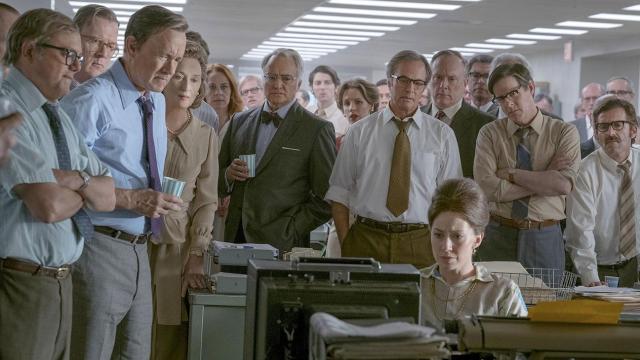
Spielberg’s picture is a shiny showcase of reportorial intrigues. The Post spying on the Times when Bradley realizes he hasn’t seen a story by star Times Vietnam reporter Neil Sheehan in months (something must be up), editor Ben Bagdikian (Bob Oedenkirk) working his own sources to figure out where the leaks came from, a competitive newsroom straining to play catch-up on the biggest scoop of the year.

And “The Post” is about a heroic — yes heroic — intellectual and ethical tug of war, with Graham sentimentalizing the Washington that will vanish for her as she gets tips from and confronts her “old, dear friend” McNamara, endangers her newspaper and its public offering over her newly-realized principles.

A favorite scene — Graham and Bradlee go toe-to-toe over who is more “compromised,” the social butterfly, or the hard-drinking, hard-charging Bostonian who cozied up to Kennedy in the most infamous example of media/government cronyism of the era. (See HBO’s fine documentary “The Newspaperman”HBO’s fine documentary “The Newspaperman” for more on Bradlee and that ethical lapse.)

As the lawyers (Jesse Plemons, adorably cast as in over-his-head) and Old Boys of the Board clash, and tensions and threats rise, we wonder just what it will take for Graham to, in a Shakespearean sense, grow into the crown?

If there’s a failing to the film, which has the frisson if not the urgency of your typical “ticking clock” newspaper drama, it’s the lack of grit. The cinema’s great visual stylist didn’t go for a ’70s cinema film stock look. The cars and costumes are right, but the reporters aren’t sweaty enough, the newsroom not smoky enough, the streets (and street protests) too clean and calm, the gloom just isn’t there.

But Hanks does a splendid Bradlee, or at least Bradlee as Jason Robards (“All the President’s Men”) played him, bluff and profane and antsy (We don’t have to be told his latest wife, Toni — Sarah Paulson — won’t last.). Streep offers another sublimely subtle turn as Graham, making the journey from Julia Child to Margaret Thatcher in such understated steps that we almost can’t see the transformation as it happens.

They, Spielberg and screenwriters Liz Hannah and Josh Singer never for an instant let us lose sight of why this history has to be remembered, and why a trustworthy press is even more important in an era when too much of it is being lumped in with “fake news.”

3half-star

MPAA Rating: PG-13 for language and brief war violence

Cast: Meryl Streep, Tom Hanks, Bob Oedenkirk, Bruce Greenwood, Sarah Paulson, Tracy Letts, Bradley Whitford

Credits:Directed by Steven Spielerg, script by Liz Hannah, Josh Singer. A 20th Century Fox release.

Running time: 1:55

Posted in Reviews, previews, profiles and movie news | Comments Off on Movie Review: History is Written as Democracy is Defended by “The Post”

Movie Review: Churchill’s “Darkest Hour” is Gary Oldman’s Finest

dark2

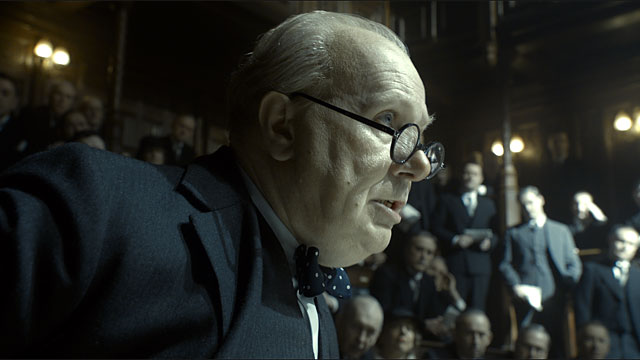
From the instant he appears, in the flash of a match in an unlit room as he lights his cigar in bed, we forget Gary Oldman is playing a part. He transforms into Winston Churchill, the bulldog face and jowly rumble of a voice immortalized in history, the wordsmith with Shakespeare and Cicero committed to memory — a quip, insult or neatly-turned phrase always on his tongue.

In “Darkest Hour,” Oldman, director Joe Wright and screenwriter Anthony McCarten give us the iconic Churchill, and the one his contemporaries and peers will recognize as well — hard-drinking, mercurial, “in love with the sound of his own voice” and sure his soaring rhetoric will be enough, when plainly, at first at least, it wasn’t.

Britain’s “Darkest Hour” came in May and early June of 1940, when the appeasing Conservative government of Neville Chamberlain collapsed, along with France. And the only acceptable alternative for the opposition parties joining a coalition government was the bellicose and often-blundering First Lord of the Admiralty, Churchill.

His own party preferred the unctuous Viscount Halifax (Stephen Dillane), a practical man whose practicality sounded a lot like the appeasement of the unpopular Chamberlain (Ronald Pickup). The lisping Halifax (Churchill calls him “Holy Fox,” and not admiringly) was a great favorite of the stammering King George (Ben Mendelsohn), who despised Churchill.

But even his enemies wanted the Goat of Gallipoli (Churchill’s greatest World War I blunder), with a failed Norwegian intervention freshly added to his resume, to take power. Things were so bleak that he was sure to fail, leaving the way open for more reasonable leadership.

Wright (“Atonement,” “Hanna”) and cinematographer Bruno DelBonnel (“Inside Llewyn Davis”) give us a gorgeously literal “Darkest Hour,” showing us the raucous debates of a dimly-lit parliament, a world pre-florescent (or LED) lighting in Buckingham Palace, Churchill’s country estate (Checkers) and the underground bunkers of his war rooms.

The gloom infects Churchill as well, a man who has lived “since the crib” for this moment, who spent the 1930s shouting into the void that Britain needed to prepare to defend itself against global fascism (and communism). Screenwriter McCarten (“The Theory of Everything”) gives us his stumbles, his high-handedness, loopy impulses and drunken, slurred speech, letting all comers name the old man’s shortcomings.

“I wouldn’t let him borrow my bicycle!”

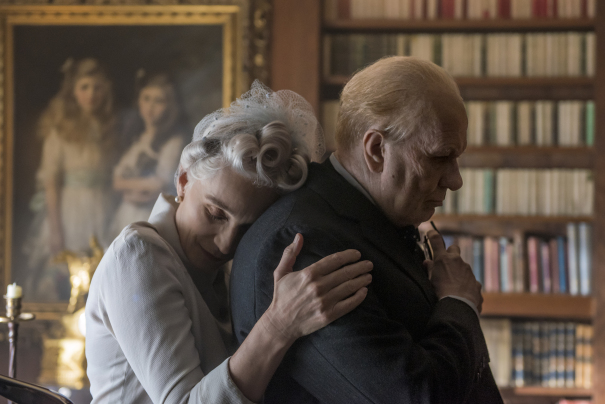
His one champion lives under his roof, the mother of his children, wife Clementine (a steely Kristin Scott Thomas).

“When youth departs, may wisdom prove enough.”

DARKEST HOUR

The story is more or less seen through the eyes of the mumbling old grump’s new secretary, played by Lily James, as a young and over-matched typist forced to endure tongue-lashings and insults because she comes to recognize the dire straits they’re in. She’s the very embodiment of “Keep Calm and Carry On.”

Oldman lets us see the despair as Churchill pleads with President Roosevelt (David Strathairn, uncredited) over the phone and cajoles the unimpressed, defeatist French. We hear the stumbling thoughts and incoherent sentences that take over as the repeated doses of whisky take hold.

Still, Oldman’s Churchill carries the weight of the world right to his breaking point, while never losing sight of the infamous wit.

“Will you stop interrupting me while I am interrupting you!”

And McCarten humanizes that wit by showing the careful deliberations of Churchill dictating, editing and polishing his speeches, “deploying the English language” as a weapon of war.

Oldman is blessed with a better movie than Brian Cox, whose “Churchill” captured the leader as he wavered and meddled with invasion plans, losing his nerve right before D-Day. But Oldman’s performance goes beyond uncanny impersonation and into the realm of inhabiting a man. Watch the playful way he and Mendelsohn exchange formalities when he’s summoned to take control of the government, the sentimentality he gives this patrician blowhard who ruled a country whose working class people he had virtually no connection to.


dark4

The story overlaps, neatly, with Christopher Nolan’s brilliant “Dunkirk,” the year’s best film. “Darkest Hour” is more a character portrait than a cinematic immersion in a place and time. But thanks to Oldman’s unerring portrayal of a deeply flawed man rising to face a crisis and inspiring a nation to rise with him, it’s an equally worthy reminder that there have been bad times before today’s, and that people, great and small, saw them through.

3half-star

MPAA Rating:PG-13 for some thematic material

Cast: Gary Oldman, Kristin Scott Thomas, Ben Mendelsohn, Stephen Dillane, Lily James

Credits:Directed by Joe Wright, script by Anthony McCarten. A Focus Features release.

Running time: 2:05

Posted in Reviews, previews, profiles and movie news | Comments Off on Movie Review: Churchill’s “Darkest Hour” is Gary Oldman’s Finest

Movie Preview: Peter Jackson “presents” “Mortal Engines”

You’d think the guy who finally freed himself of Middle Earth would want to cut loose, maybe do that “Dam Busters” remake he’s talked about. But no. Peter Jackson’s got “Mortal Engines” on his mind. He wrote the script,produced and we can assume oversaw the production. He’s not the director, but he’s hoping this is the movie that Eats Christmas — in Dec of 2018.

Impressive, even if you know nothing about the source material.

Posted in Reviews, previews, profiles and movie news | Comments Off on Movie Preview: Peter Jackson “presents” “Mortal Engines”

Movie Review: Another Drunken ex-Cop is on the case in “Small Town Crime”

crime2

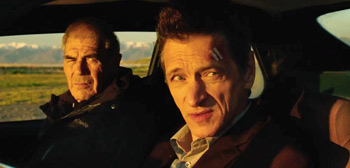
It’s no stretch to think of the rawboned character actor John Hawkes (“Winter’s Bone,” “Three Billboards Outside Ebbing Missouri”) as an unrepentant alcoholic, and the sort of man who’d bring that up in a job interview.

That’s how we meet Mike Kendall, the “hero” of “Small Town Crime,” an engaging swing-and-a-near-miss at film noir.

Jack is willing to say, “I have a problem with alcohol” to any potential employer. He’s willing to say he’s “not much good” until he’s had that first beer, that as long as he’s not required “to operate any heavy machinery in the morning,” he’ll be fine.

Even if he’s disguised it well enough to get a job offer, he won’t lie about this one thing.

“There a reason you’re not still a cop?”

“Yeah.”

Broke and jobless, tossed out of any bar he frequents, he’s so far down the rabbit hole that he’s all “Let’s hit the Dead Dog (bar)” to a friend after an AA meeting.

But we quickly learn that’s about the only thing Jack won’t lie about. He’s delusional about getting back onto the police force in the unnamed small town at the foot of the mountains where he lives, drinks and drunkenly drives his hot-rodded ’70 Nova. He fibs about his prospects to his sister (Octavia Spencer, he was adopted) and brother-in-law (Anthony Anderson).

And when he  stumbles across a bloodied and battered prostitute, lying in the ditch, it’s got to be the booze thinking for him as he sees this as his way back to his badge. Although he shares his information, somewhat freely, with the dismissive “real” cops (they know why he was fired), he lies and lies to the victim’s family, to possible suspects, to anybody who takes the business card with the made-up name on it announcing that he’s a private investigator. That’s bound to get him into trouble.

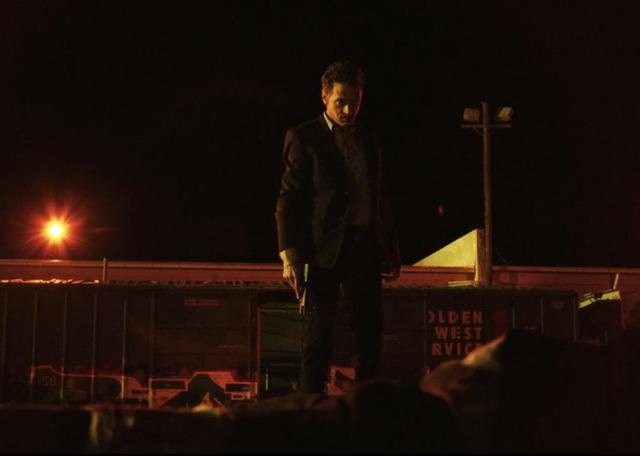
“Small Town Crime” is set in a sort of “Twin Peaks Lite” — a piece of the not-quite-urban West where hookers abound, blackmailers ply their trade, something bigger must be afoot because everybody’s packing heat, and more than willing to whip it out. Hookers are dying and the cops are slow-footing their way to solving the murders.

crime1

This is a genre picture that leaves logic in the dust, here and there, but fills the screen with watchable character players, from Clifton Collins, Jr. (“Capote”) as a drawling pimp with a “code,” Robert Forster as the grandfather of the crime victim and Dale Dickey and Don Harvey as hard-bitten bartenders.

The Oscar-winning Spencer gets a few chewing out scenes and Anderson does his usual, light “I got you dog” sidekick turn.

The filmmaking Nelms brothers tap into one unerringly accurate piece of small-town life. You are what you drive. They become enamored of Kendall’s Nova, filling the dead-time between scene after scene of peel-outs and rumbles through town. The pimp drives an absurdly distinct purple ’68 Impala. It’s how the locals know each other.

The climax is straight out of the Old West, or Old Noirs. But the picture’s little lapses — as bodies pile up Kendall isn’t one of those bodies, which makes little sense — send it adrift some while before that climax arrives.

Still, the players keep us intrigued, and unlike the endless “Fargo” and “Twin Peaks” and “True Detective” variations on the small screen, “Small Town Crime” keeps its scale small and its storytelling compact. It doesn’t transcend its genre, it wallows in it. Sometimes, that’s almost enough.

2stars1

MPAA Rating: R for strong violence, language and some sexual references

Cast: John Hawkes, Octavia Spencer, Anthony Anderson, Clifton Collins Jr., Robert Forster

Credits: Written and directed by Eshon and Ian Nelms. A Saban Films/DirectTV release.

Running time: 1:31

Posted in Reviews, previews, profiles and movie news | Comments Off on Movie Review: Another Drunken ex-Cop is on the case in “Small Town Crime”

Movie Review: Cage is Uncaged and Unhinged for “Mom and Dad”

Mom1

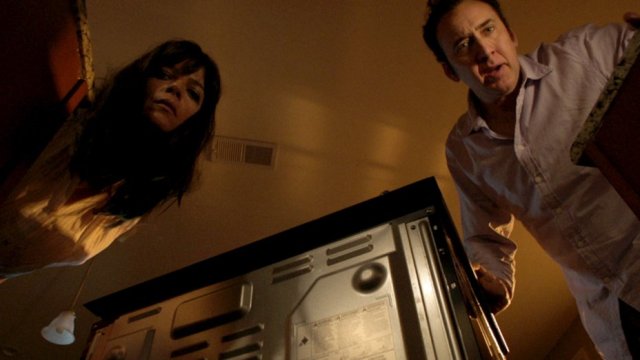
You could cast other actors. ut if the role you’re filling calls for a coiled-spring of psychosis, generating dread as we know this guy is going to awaken one day, having dozed off watching porn on his work computer, and go on a killing spree, why would anybody look further than Nicolas Cage?

He’s the second most affordable Oscar winner these days (after Cuba Gooding Jr.). And if anybody’s screen persona screams twitchy, ranting, Trans-Am wrecking/Reciprocating Saw whacking spree slaughtering ill-mannered teens that they’ve raised, it’s an uncaged Cage.

Maybe there are actors who could have made this fusion of “The Purge” and “Living Dead” titled “Mom and Dad” funnier than Nicolas Cage. But Brian “Crank” Taylor knows a thing about gonzo, violent and hilarious. And so does that “Kick Ass” bug-eater, Mr Cage.

“Mom and Dad” is a jaw-dropping horror farce about American parents, waking up nationwide (It seems to have something to do with static, which is what your TV did pre-HD) and murdering their kids.

In quick, broad strokes basically focusing on one family headed by Selma Blair (as scary as those bangs suggest) and Cage, we’re reminded that today’s kids may have it coming. Indulged, rude, electronically independent and out of control on a cellular and cell-phone level, they’re labeled narcissistic little monsters because sometimes the label fits.

Carly (Anne Winters of TV’s “13 Reasons Why”) is a rude, profane and self-absorbed high school sophomore who keeps her school uniform skirt too short and her temper shorter. She steals from her parents, ignores them in favor of social media and is planning on something sexual with her forbidden beau, the upper-classman Damon (Robert T. Cunningham).

The stealing? It’s so her out-of-control pal Riley (Olivia Crocicchia) can score some Molly for them.

Younger brother Josh (Zackary Arthur) is Dad’s little man. The movie’s first big laugh is Cage charging in on the boy for an enrage…tickle fight.

Then, one school day, kids are called out of class, one by one. They’re greeted by a deranged mob of parents, screaming for them on the other side of the gate. A couple answer their parents’ summons. One is jabbed to death with car keys, another suffocated with a garbage bag, a third impaled by a yardage marker on the football field.

This “Purge” of those we’ve given birth to? It’s on.

Carly and Riley make their getaway, with Carly freaking out over what’s happening — turning on the TV to news crawls of “”Terror Attack or Mass Hysteria?”

Parents are warned, by radio, “Do NOT go near your children!”

Which they ignore. Carly, Josh and Damon try to survive the slaughter. Their parents seem to have no control over these deep impulses, though flashbacks do tell them (and us) how they’ve doted on these kids, no matter how big their respective childhood mistakes.

Cause and effect, we wonder? That, and maybe a certain bitterness about the lives that were lost when new life was brought into a family.

“I used to be Brent. You used to be Kendall. And now we’re just…Mom and Dad.”

Taylor treats us to a series of show-stopping scenes — a hospital childbirth  that climaxes with the new mother trying to murder her newborn babe, a grim glimpse of new fathers, staring through the window of the hospital nursery, longing to “get at” their children.

“Mom and Dad” (opening in limited release and VOD Jan 19) is peppered with tasty, nasty lines. The teacher in Kendall’s Zumba class is a player.

“He’s making his way through that class like stomach flu!”

TV quack Dr. Oz tries to explain away the crisis. And the third act of this brisk little nightmare? It features the dazzling arrival of Lance Henriksen.

The performances are somewhat uneven — young Josh (Arthur) is the only character to exhibit genuine terror. The climactic struggle is packed into the suburban family home, much like “The Purge.” a

It’s not ambitious and not particularly deep. It’s all about the one-liners, with Dad Brent and Mom Kendall (“That’s not even a REAL NAME!”) breaking out their trusty reciprocating saw, “It’s a SAW ALL. It saws ALL!”

But “Mom and Dad” is a reminder of how much gonzo fun a B-movie can be, how hilarious “Crank” was and what a hoot Nicolas Cage — who makes almost entirely B, C and D movies these days — is when he’s uncaged and unhinged.

2half-star6

MPAA Rating: R for disturbing horror violence, language throughout, some sexual content/nudity and teen drug use

Cast: Selma Blair, Nicolas Cage, Anne Winters, Lance Henriksen, Olivia Crocicchia

Credits:Written and directed by Brian Taylor. A Momentum/eOne release.

Running time: 1:24

Posted in Reviews, previews, profiles and movie news | Comments Off on Movie Review: Cage is Uncaged and Unhinged for “Mom and Dad”

Netflixable? Angelina Jolie’s “First They Killed My Father”

first

It takes little away from “First They Killed My Father,” a remembrance of the Cambodian civil war and the Khmer Rouge genocide that followed, to say it’s too polished.

The grim narrative, a child’s-eye-view of war that could just as easily been set in Iraq, Syria, Bosnia during the ’90s or Nigeria today, and its moving finale stand on their own, powerful statements by themselves.

It’s just that movie-star turned director Angelina Jolie is a bit too enamored of vast panorama shots created with drones and keeping her mostly under-age cast clean, well-fed and front-and-center in the story.

We meet no villains, develop no appreciation of the swirling forces and circumstances that led to the reign of terror of the Khmer Rouge. We just experience the confusion and shock of those too young to be as terrified as we are for the.

So the film, now on Netflix, that summons up memories of “The Killing Fields” and the child-soldier drama “Beasts of No Nation” suffers by comparison to those films. The grit, the gruesome horrors of being trapped in a country cut off from the civilized world, enslaved and just waiting for the moment when their captors discovered the family’s father was a captain in the old Cambodian army, are doled out in small doses. It robs the story of some of its power in the process.

“First They Killed My Father” is the memoirs of Loung Ung, a family friend of Jolie’s. Loung was just six when the U.S., which had been secretly bombing Cambodia, occupying parts of it to stem to flow of North Vietnamese troops into South Vietnam, suddenly pulled out.

Her family — seven siblings and their parents (played by Phoeung KompheakSveng Socheata) — had to abandon middle class comforts when the Khmer Rouge (Red “Khmer” or Cambodian people, who wore red scarves as their uniform) took over. They were instant refugees, forced to flee the city on the new regime’s orders. It was all part of a plan to strip the country of Western influences and force it back into a more primitive, plebian state.

This genocidal leadership was most memorably described as “Cambodian rednecks,” uncultured but Communist armed rural folk resentful of the educated and professional classes, hellbent on making Cambodia Great Again by murdering those they resented and making the country an agricultural collective.

Loung, played by  Sareum Srey Moch, is mostly a passive witness to all this, the repeated robberies of what few possessions her brave-faced parents as they drive, then march, then ride in a relative’s ox-cart into rural exile.

And that’s just the beginning of the nightmare. More marches, re-education camps and eventually child-soldier training awaits her, as she and her family are threatened, harangued and starved in the middle of a brainwashing that demands that they “renounce all personal property,” “Angkor” (the new regime) “is your family now. We are all equal.”

But as we learned in “Animal Farm,” some pigs are more equal than others. If you dare to eat more than the bare sustenance your overseers provide, stealing the rice and vegetables you’re laboring to grow, beatings, humiliation and even death await.

Loung clings to her family, and keeps her fear in check (her dreams and nightmares are about food), except for those moments when she overhears despairing, whispered conversations between the adults. As bad as things are, eating bugs and all, they’re sure to get worse.

first2

If you remember “The Killing Fields,” you know the arc of history that these children rely on to survive. Yes, they’re indoctrinated into the makeshift army, and yes, salvation could only come from defeat. The Vietnamese invade and the Khmer Rouge learn why one shouldn’t take a country back in time when your neighbors are armed with the latest hardware from the current century.

The adults are the real actors here, the children only required to act blank-faced with shock, and occasionally shed tears. The cast rarely has the stressed, emaciated look of genuine survivors (“The Killing Fields” managed that), partly because Jolie rarely lets the camera roll on dirty faces, even when they’re digging ditches and planting rice paddies.

There’s too much aerial footage capturing the scale of the tragedy, a sea of refugees fleeing Phnom Penh, armies of the newly-enslaved working the fields.

But Jolie deserves praise for getting this EveryWar reminder onto Netflix, highlighting the horrific human cost of land mines in war zones once the war is over. And if the first casualty of war, as a World War I era senator famously said, is truth, the second surely must be childhood.

2half-star6

MPAA Rating: TV-MA, violent, gore

Cast:Sareum Srey MochPhoeung KompheakSveng Socheata

Credits:Directed by Angelina Jolie, script by Loung Ung and Angelina Jolie, based on Ung’s memoir. A Netflix release.

Running time: 2:16

Posted in Reviews, previews, profiles and movie news | Comments Off on Netflixable? Angelina Jolie’s “First They Killed My Father”

Box Office: “Jedi” Headed for $208, “Ferdinand” bombs

box1

A $97 million Friday followed a $45 million Thursday means that “The Last Jedi” seems headed towards a $208-212 million opening weekend, right smack on the lower end of pre-release projections.

Fox, once again releasing a pricey cartoon opposite a “Star Wars” film (They used to release those, remember?), is paying a steep price. “Ferdinand,” which has its charms and generally good reviews, is opening at a deathly $12 million. That’s a disaster. 

In limited release, “I, Tonya” is winning the per-screen average, “Three Billboards Outside Ebbing, Missouri” is going to need awards season help to get back into the top ten (“The Disaster Artist” is seventh, “Lady Bird” is still tenth), and “Call Me By My Name” is doing quite well in a handful of cities.

Meanwhile, “Wonder,” a feel-good sleeper with Julia Roberts and Owen Wilson on the bill, will clear the $108 million mark.

And the best movie to taking the older relatives to over the holidays? “Murder on the Orient Express” will clear $100 million before next weekend.

Posted in Reviews, previews, profiles and movie news | Comments Off on Box Office: “Jedi” Headed for $208, “Ferdinand” bombs

Netflix Preview: The Winter of Jack Black’s Comeback continues with “The Polka King”

It’s got financial chicanery, Vanessa Bayer and Jason Schwartzman and polka music — lots of oom-pah-pah.

And Jack Black, whose quote may go up if “Jumanji” hits it big next week.

Jan 12., you will worship “The Polka King.”


Posted in Reviews, previews, profiles and movie news | Comments Off on Netflix Preview: The Winter of Jack Black’s Comeback continues with “The Polka King”

Movie Review: Woody Waddles off into the Sunset with “Wonder Wheel”

Wheel1

So here’s where we are with regards to Woody Allen.

You’ve got the black screen, the white credits in what looks like Clarendon font.

There’s the scratchy record playing classic jazz, The Mills Brothers, in this case.

A “Who’s Who” blend of the hot and the offbeat make up the cast.

The words coming out of their mouths don’t sound like human conversation. Theatrical. A little Tennessee Williams, a lot Eugene O’Neill.

“I’ve become CONSUMED with jealousy!”

Long before the Allen surrogate fesses up to an O’Neill obsession, we’ve guessed that’s where he’s going with his latest, “Wonder Wheel.” Sure, there’s a disturbed, freckled redheaded kid who lives in the middle of the Coney Island amusement park, a favorite bit of fake Allen autobiography. But the kid is a tweenage pyromaniac, his mother’s pushing 40, an unhappy actress “playing the part” of a waitress at a clam restaurant.

Her second husband is a two-fisted drunk whose mob moll daughter is on the run, and comes to stay with them.

And there’s a narrator, that pretentious Would-be Woody, playing the Lothario (a lifeguard, in this case), leading on the mother in an affair not rendered less tawdry by their banter about “Hamlet,” Chekhov and “The Ice Man Cometh, toying with the step daughter and pontificating and self-justifying in some Woody-written-variation of his infamous “the heart wants what the heart wants” press conference confession of some decades back.

“The heart has its own hieroglyphics.”

Like too many Woody movies that preceded it.

Yes, he’s Big Game hunting with “Wonder Wheel,” a love triangle melodrama set in a stunningly-recreated Coney Island of 1953. He’s aiming for O’Neill in what can only be called Weak Woody/Cut-rate Eugene kitchen sink theatrics.

Justin Timberlake is Mickey, the narrator/hunk who tumbles with Ginny (Kate Winslet) and falls for stepdaughter Carolina (Juno Temple).

And if these ladies can afford it, they should both keep cinematographer Vittorio Storaro and his lighting crew on retainer for the rest of their careers. The honeyed glow of backlit sunsets frames them in most every scene. Winslet is getting Oscar buzz for this well-acted, over-written but perfectly photographed performance, and one suspects all that buzz is mostly from the look. The movie borders on abhorrent.

Jim Belushi has the Andrew Dice Clay role, a classic O’Neill drunk, a doting father and broken man almost-redeemed by a woman who will probably break him anew.


wheel2

Timberlake, having the Cusack/Eisenberg/Jason Biggs role — Mickey — is given to letting a flirtatious Carolina off the hook for not having anything in common with him but good looks — “Ignorance is no sin. It just means your experience hasn’t brought you into contact with certain things.”

Winslet gets the big emotions, the big speeches describing broken dreams, broken promises and broken spirits. Yeah, she cheated on her creepy, indulged kid’s father, “a drummer whose rhythm pulsated with life.”

Unlike this stiff of a movie, whose every scene — even on the beach, under the boardwalk or on Staten Island’s Scholar’s (Chinese) Garden — feels as dusty and stagebound as that little speech.

Perhaps that’s where the future lies for the prolific and increasingly tone-deaf Allen — the New York stage. This might work better there, and would certainly confine his hit-or–miss-miss-miss-miss-miss scripts to the audience that hasn’t stopped adoring him, doddering director that he’s become, pedophilia accusations be damned.

1half-star

MPAA Rating:PG-13 for thematic content including some sexuality, language and smoking

Cast: Kate Winslet, Justin Timberlake, Juno Temple, Jim Belushi

Credits:Written and directed by Woody Allen. An Amazon Studios release.

Running time: 1:41

Posted in Reviews, previews, profiles and movie news | Comments Off on Movie Review: Woody Waddles off into the Sunset with “Wonder Wheel”