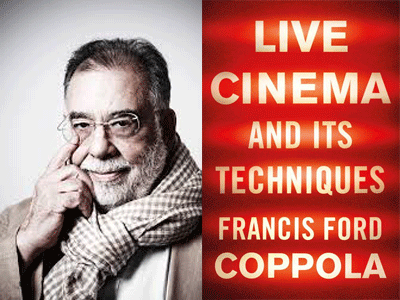
 Francis Ford Coppola is one of the undisputed masters of cinema,masters of cinema, screenwriter of “Patton,” auteur of “The Godfather” movies, “Apocalypse Now,” “Tucker,” “Peggy Sue Got Married,” masterpieces married to commercial motion pictures, with the Oscars and “Greatest Film of All Time” listings to prove it.
A friend who crashed a party at a Brooklyn warehouse Coppola owned some years back related the story that the Old Master sat, drinking wine and shrugging, “I’m finished,” to anybody who cared to ask.
So when a boutique studio nabbed his “Tetro” a few years back, I tracked him down for an interview. I was dazzled by how curious he still was about movie-making, trying new things, and impressed by how he shrugs off failure (“Tetro,” an experiment, didn’t come off, I thought).
He tried running a studio. He was a breakthrough digital filmmaker (“One from the Heart”). He makes wine. He’s dabbled in opera, TV. He’s predicted the future of film, at various times, with varying degrees of success. He teaches workshops at any college lucky enough to have him.
Now he’s written a book — “Live Cinema and its Techniques” — about his efforts to marry his myriad storytelling passions — the “live” impact of theater and teleplays produced “live.”
It’s a lively read, a plea for embracing new tech and applying it to filmed storytelling techniques that were perfected during the 1950s, the era of “live” TV drama, which Coppola worships. He workshopped and shot a couple of short films, whose scripts and notes and production diaries he includes in the book.
He suggests that sports TV technology, and increasingly image-perfect digital cameras, make the idea of performing a movie (it’s actually TV, but let him have that) “live,” shooting it in order, with the odd pre-produced bit, in 90 minutes to two hours.
With 8K cameras capturing the action on the set, most of them hidden, establishing shots can be grabbed, and from them, the bytes of data compromising a smaller part of the screen blown up to allow a filmmaker to cut to close-ups from the same shot from the same lens of the same camera.
There’s a little history in the book, about film’s early days, TV’s invention, the folding modular stage sets of experimental theater, the joys of “little imperfections” that you see every week on “Saturday Night Live” (adds excitement to the viewing experience).
And there are anecdotes, little ways Coppola learned to make the limited rehearsals usually given to film production more like theater. He hit on an idea making “The Godfather,” inviting the cast to an introductory dinner, where he seated them in the pecking order of their characters. He discovered that getting actors to make a meal together, improvising in character, made the sense memory stronger and the connection between actor and character stronger.
“Live Cinema” is a quick read, a fun book and thought-provoking. Like many an old master, Coppola’s become more impressionistic as he grows older — bold strokes, not fretting over perfection or exactitude, impatient to do something quickly, with the heat of inspiration spilling over cast and crew.