In Europe, they remember who the Evil Empire is, and why you don’t let them have a say in your elections.
This has a fall opening in Europe, coming soon to the US — Thomas Vinterberg (“The Celebration,” “Far from the Madding Crowd” and “Submarino” directs “Kursk,” about the infamous Russian submarine disaster, and the impressive cast includes “Girl with the Dragon Tattoo” co-star Michael Nyqvist is his final role.
Posted inReviews, previews, profiles and movie news|Comments Off on Preview, Firth, Von Sydow and Seydoux and Schoenarts star in historical thriller about Putin letting a lot of Russians drown on board the “Kursk”
All the upgrades, tech advances and iPhones since “Fear.com” (2002) came out, all the variations of “Friend Request” and “Unfriended: Dark Web” in computer-streaming/cell camera/web camera murder and the formula hasn’t changed. Not much, anyway.
It’s still a lot of first-person (holding a phone camera) point-of-view, limited settings, narrow field-of-vision, a handful of people talking into a laptop or phone camera, multiple windows folded into a Skype screen and lot of screen-freezes, image-ghosting, blackouts and buffering.
In “E-Demon” friends gather for an informal online college reunion. They’re 30, each at different places in his or her life — married with kids, or broke and moved back in with the parents, richer than rich or struggling to get that first book published.
But the one thing New York author Kendra (Julia Kelly), doting Dayton dad Dwayne (John Anthony Wylliams), Seattle high-roller A.J. (Christopher Daftsios) and struggling mental health counselor Mar (Ryan Redebaugh) have held onto is “Freak Out.” That’s their name for elaborate scary pranks they play on each other.
And in the Internet age, separated by a wide continent, the gags have moved online.
But Mar stages one that most would admit, “goes too far.” He’s shown the others (walking the camera down the hall) his dotty grandmother and the younger brother who does a lot of her caregiving (Vincent Cooper).
“Gamma, tell me the story of the cursed trunk!”
So she does. Her story takes them back in family history, to a relative executed during the Salem Witch Trials, with “The cursed trunk is being kept in our attic! The end of days will come!”
Mar then goes to the attic, trots out a little Latin incantation over a mirror and a voodoo doll he finds in said trunk, and OW. OUCH. Hah! Gotcha! Scary, right?
Wait, did I mention that Mar and his family of shrinks lives in Salem, Massachusetts? Never mind. Probably not important.
Next thing you know, whatever went “KLUNK” on Mar leaves his camera (Must be attached to his head.) upside down, dragged into another room.
Mar’s sister lets a glimpse of a pentagram carved on her belly show. A.J. is acting out a simulated ritual sex act with his girlfriend. Kendra freaks out and Dwayne, drawn away to tell bedtime stories to his kids, misses the escalating weirdness happening to four people logged in to Skype.
Something wicked is downloading into their digital lives.
Writer-director Jeremy Wechter parks this picture in real-time. We’re watching a recording of events that transpired in four cities involving scores of victims on that night, a voice-distorted spokesperson for the “E Demon Resistance Network” tells us.
“We need your help!”
That lame framing device aside, “E-Demon” sticks to formula. Bad things happen, characters grow paranoid about each other even as they’re trying to reason out what’s going on, innocent bystanders — relatives, boyfriends, paramedics and cops responding to 9-11 calls made cross country — are sucked in, possessed.
“Remember my theory…cameras speed up the process.”
Oh, and then the magical “explainer” shows up to talk us and them through demonology, maybe suggest solutions. Yes, Jeremy Wechter discovered “Magical Negro” all by himself.
The violence has a certain voyeuristic immediacy — helpless people watching their screens as this character is about to be attacked — “BEHIND you!” — or that one fights off demonically possessed people within the field of view of a laptop camera.
There’s blood on the lens in one scene, a person (their camera) dragged and held under water in a tub, clever effects. Movies like this are exercises in meticulous staging. It’s like the theater equivalent of a “door slamming farce,” characters enter and exit in varying degrees of logic, not knowing what the rest of the Skypers have seen or experienced while they were gone.
It’s kind of clumsy and obvious, but it moves things along.
Wechter keeps having attackers drag their victims out of the frame, because there’s only so much room on a screen filled with other screens, side-chats and Internet research
Windows on how to fight a demon, etc. And you can’t have the hero/heroine tripping over bodies as the next attack begins.
I’ll give the film this much — it holds your interest.
That’s despite the constant reliance on formula, the generally inane dialogue, some head-scratching logic you have to avoid if you want to buy into “This is somebody’s live camera capturing that view” conceit.
The performances occasionally hit “indifferent,” in between a few genuinely fraught moments. This far removed from actual terror — a screen within a screen showing events far, far away — it’s hard to get much acting in. Kelly and Wylliams have their chances.
But the people experiencing the violence in person don’t get close-ups. The camera is sitting on the computer desk far in the foreground of the brawl going on in the background.
Close-ups make scares. Ask John Carpenter. So no, “E-Demon” isn’t particularly frightening. And that problem was fixable, Drag the fights into the camera, and not just dropped cell cameras, which hold no closeup.
“E-Demon” would make a good movie to pick apart in film school, simulating the work-shopping process Wechter & Co. could have used to add close-ups, make the traveling cameras more logical, declutter the screen a bit and find a fright or two in this now well-worn wickedness on the world wide web formula.
MPAA Rating: unrated, graphic violence, sexual content, profanity
Every time you think “torture porn” is dead and gone, here comes another blood-and-bludgeoning tale to try and revive it.
A famous, rich musician is tased and yanked into a van only to wake up lashed to a school desk in “The Basement.” As we’ve just seen Craig (Cayleb Long) texting his girlfriend while on a liquor store run for his wife, maybe he has “sins” to atone for.
Shades of “Saw.” Every “Saw” movie. Ever.
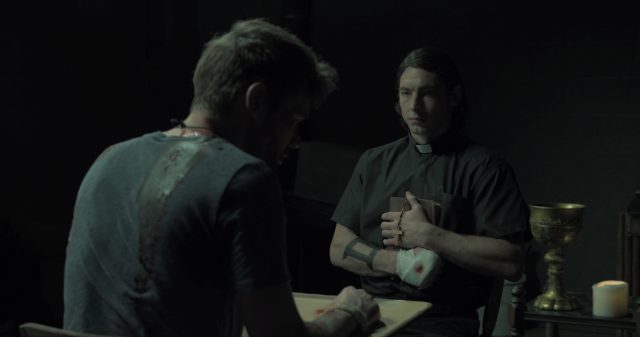
The twist here, the variation of an excruciating theme, is that his captor (Jackson Davis), is some sort of performance artist. He’s messing with him, play-acting a sadistic English-accented clown, a cop, a drawling doctor, an old school detective, a prison guard, a priest, parents, a lawyer, a psychotic inmate…
“Welcome to SAN QUENTIN!”
Even as he’s slapping, punching, teasing, firing a pistol near Craig’s ear, tearing out his teeth — “Chew’em! Swallow’em!” — gouging and lopping off, well, you’ll see — Craig is trying out strategies for getting out.
Threats, pleading, bargaining, empathizing with and play-acting along with this guy, who must be “Billy,” “The Gemini Killer.”
“Please Doc, you took an oath to HELP people!”
“It’s natural to lash out! Here’s my card.”
To the lawyer — “What about my INSANITY plea?”
Anything to buy time, to figure out some way to break loose in between “performances,” which of course entail costume changes.
Meanwhile, wife Kelly (Mischa Barton) Kelly nags the police, questions the liquor store clerk (Tracie Thoms) and confers with her best friend (Bailey Anne Borders), who happens to be Craig’s secret side-chick, and both wonder if he’s “relapsed.”
As we’ve seen a blowtorch and a nearly-naked woman victim in the first scene, we fear the gruesomeness to come.
But every now and then, Craig forgets his pain, sensitively recounts his fading career, his failing marriage, “fumbling along in a haze.” He starts storytelling, weaving suggestions into his tales, connections with his captor, struggling to outsmart him.
The odd pointless chest-eye-view camera shot, endless red herrings, false hopes, middling acting, graphic injuries graphically administered and sets that look like “sets,” an epilogue “twist” that comes after we’ve given up on the movie — “The Basement” has it all.
A grandfather suffering through his “last party” at his home takes a break from posing for family photos to hunt down the missing face from the group shot.
It’s his granddaughter, who could not be more than seven or eight.
She’s a bit of a grump, like him, and she’s holding out. Next thing he knows, he’s haggling with a funny brat who wants money for an iPhone. She plays hardball. He lowballs her. And when he relents, he taunts her that he would have given in at her original price.
She smirks that she lied about the price and will have money to burn, AND a phone. Old Man Burzstein’s face flushes.
“This is why you’re the FAVORITE!”
Thus begins “The Last Suit,” a road picture comedy about…The Holocaust. It’s an adorable Argentinian odyssey about a survivor who makes his way to the land of his birth to repay a debt.
Exacting revenge? Maybe. Honoring someone he lost? He will not say.
He’s a tailor, and the one thing he takes from his house as he abandons it to his badgering daughters is his “last suit,” and it’s not for him.
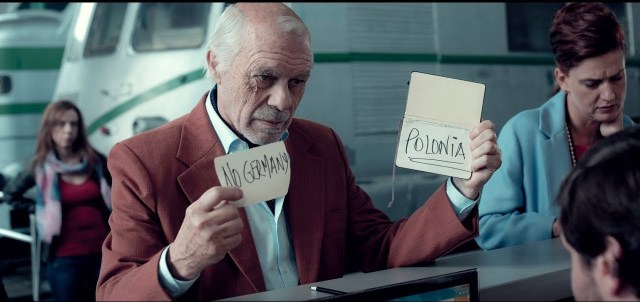
Miguel Ángel Solá plays Abraham Burzstein in “El último traje,” a stubborn old man who raised a large family in Argentina, but who emigrated from Poland. Only he won’t say the it, and his daughters grew up knowing of it as “the dirty word,” (“Polonia” in Spanish).
That makes this secret journey — he is 88, has a bum leg his doctors want to amputate and doesn’t tell his family what he’s up to — extra tricky.
An off-the-books “travel agent” (an actress-granddaughter of the agent he once used, nagged backstage at a theater to make his online reservations) helps him out. No, there’s no “discount” for knowing granddad.
Say this for writer-director Pablo Solarz. He’s not shy about assorted Jewish stereotypes. As Abraham flies to Madrid, overnights in a hostel and makes his way overland, haggling is a funny, necessary part of the process.
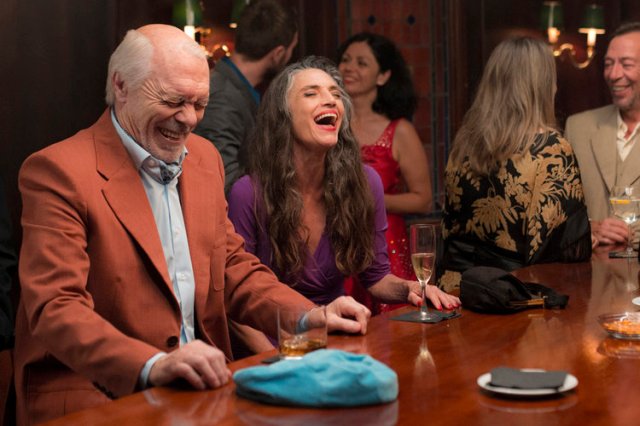
So is bickering — with the rude young man (Martín Piroyansky) sitting next to him whose ear he wants to talk off on the plane (a trick), with the hostel keeper and sometime Spanish chanteuse (fiery and sarcastic Ángela Molina) who gives as good as she gets in the haggling department, with the helpful but persistent German woman (Julia Beerhold) who wants to help him “not touch one meter” of German soil on his quest.
The young French ticket agent may have forgotten “what happened here a long time ago,” may not know what that number tattoo on Abraham’s arm signifies. German Ingrid hasn’t. There’s a bargain struck even in her assistance to this very old man on a mission — help, for his story.
Solarz serves up flashbacks to Abraham’s youth in Lodz, Jewish community dances. And we see Abraham upon his release from a death camp, the origins of the bum leg he’s named “Tzures,” and see 1945 visions of the man “who is expecting me” even though “we haven’t kept in touch.”
The screenplay — in Spanish, Yiddish, French, German and Polish with English subtitles — gives us a fresh take on the hell of growing old, the indignities, humiliations of a body that keeps letting you down, the memories you’ve piled up that you cannot shake.
Solá — “I Know Who You Are” is his best-known film in the English speaking world — gives Abraham a biting whimsy, with little touches of folksy as he imparts the wisdom of old age. We elderly, he says, “face the time we have left to live” and “doesn’t want to be a burden” even as he’s being a burden.
He’s amusingly annoying as Solarz concocts the work-arounds that a man who refuses to say “Poland” (“Polonia”) out loud tries to travel there, and without seeing, setting foot in or interacting with Germany or Germans. Abraham is going to get his way, no matter what.
Which makes “The Last Suit” a hopeful film, sweet at its core, even in the flashes of horror that built the bitterness Abraham has carried with him all life
As horrific as the subtext is, Solarz finds universal humor in a cranky old man on this one last quest. But he doesn’t let Abraham, assorted bystanders or the audience off the hook either.
Try and not be moved by the finale. That’s as futile as fighting this old man on his one-way trip into a past the world can “never forget.”
MPAA Rating: unrated
Cast: Miguel Ángel Solá, Ángela Molina, Martín Piroyansky
Credits:Written and directed by Pablo Solarz. An Outsider release.
I had, quite frankly, written off that raving egomaniac Julian Schnabel after his last debacle.
But if anybody is going to do “Vincent” justice, even with an actor who should have played him 25 years ago, it would be the director of “Basquiat.”
Willem Dafoe is 63 when Van Gogh died at 37. But he still looks and sounds right, doesn’t he?
Check out the supporting cast — great French actors Mathieu Amalric from Schnabel’s “Diving Bell and the Butterfly,” Emmanuelle Seigner, Niels Arestrup, Rupert Friend.
It’s not secret that a documentary’s subject matter is more important to our reaction to it than its originality, “plot” and execution.
We fill the theaters for political docs we agree with, be they from Dinesh D’Souza or Michael Moore.
When Ricky Gervais jokes about Holocaust films and their record at the Golden Globes and Oscars, he’s making the same point — subject matter that connects with the audience is more important than dazzling style.
So it’s no surprise that “Science Fair,” an upbeat look at kids from around the world embracing science, was the Audience Award Winner at the Sundance and South by Southwest Film Festivals. At a time when reactionary politics and know-nothingism has reared its ugly head in too much of the world, here is the next generation, smart as can be, bubbly about learning, straining at the bit to solve big medical, social and technical problems of the future AS TEENS.
Subtexts? You can’t miss the fact that many of America’s best and brightest, our hope for the future, are the children of immigrants, even in places that aren’t particularly welcoming of immigrants. An immigrant science teacher who fills ISEF — the International Science and Engineering Fair, a worldwide contest founded and championed in America — with her most dazzling Long Island students, lays it out there. Immigrants have always tried harder and they’re what made America great.
“I can’t wait until one of my kids wins the Nobel Prize,” Dr. Serena McCalla brags. Don’t bet against.
There is NOTHING more American than competition, striving for excellence, bringing in new brains with new ways of looking at things and new ideas, a past winner, Martin Lo of NASA, declares.
And what’s more American than bragging about it?
“Science Fair” introduces us to entrants in the 2017 ISEF, a gathering of 1700 of the smartest,, most ambitious teens the world has to offer, from 78 countries, competing to see who has the best new ideas in Earth sciences, life sciences and medicine, technology and engineering.
Filmmakers Cristina Costantini and Darren Foster traveled to Brazil and Germany, South Dakota, West Virginia and Kentucky, finding bright-eyed kids with unbridled enthusiasm for science and solving world problems with their ideas.
Anjali is one of the science stars at the best school in Kentucky. The DuMont Manual School produces kids who get into ISEF almost every year, and she’s one of them.
“A lot of people are very jealous of me. It sounds arrogant, but it’s true,” this daughter of immigrants declares. She’s a polymath with a dazzling array of scientific interests including this sensor that measures arsenic in drinking water, a global health concern.
“My research is great. I’ve always been a good public speaker. that’s why I win.” But even when she loses, she is unfazed. “It keeps me grounded. I’m just another kid.”
Of course Anjali has her own web site. She knows marketing herself towards a top college is the real goal of science fairs, and being in a documentary can be part of that.
We meet three other kids from DuPont Manual — Harsha, Ryan and Abraham — a real life “Big Bang Theory” of smarties. They’re working on a diagnostic stethoscope usable the world over.
We don’t have to be told that this is all happening in a state infamous for its Creation (Creationism) Museum and science denier in chief Mitch McConnell.
Ivo in Lorch, Germany has taken a new approach to an old, mostly-abandoned concept, the flying wing, and engineered a new design that could change aviation. He’s on Youtube, helpful because his is the most cinematic of the Big Ideas that the kids profiled here pitch.
Myllena and Gabriel are the film’s underdogs, working class kids from tiny Iracema, Brazil, modeling and analyzing new drugs that could battle a local crisis that’s gone global — the Zika virus.
If this was just a movie, or the audience got to pick winners, you’d make these two the favorites. But ISEF isn’t sentimental. Real scientists from California’s tech and space industries and best of the best colleges judge each project on its originality, scientific soundness, presentation and methodology documentation. They’re demanding, a little cold-blooded about it, and go to great pains to reward the best, soundest ideas.
Just like science.
Robbie is entirely too smart for his corner of West Virginia — cocky, clever, hipster nerdy in his Hawaiian shirts. He whipped up an app that can invent raps just like Kanye West. JUST like Kanye. His ISEF project is a device/process for monitoring how machines learn, an important component in the machine-learning (self-driving cars, for instance) future.
We can see, straight out, that Robbie needs to be challenged and the movie hints that this won’t happen in Shenandoah Junction, West Virginia.
But his mountain to climb is nothing compared to what Kashfia Rahman faces in the flatlands of Brookings, South Dakota. Her school is depicted as sports-obsessed,, endless money poured into facilities in pursuit of a glory that adds nothing to the culture.
The biggest laugh in “Science Fair” might be the kids at Brookings, shrugging at the millions the alumni and the state have dumped on a WINLESS football team. The saddest moment in “Science Fair” is the school’s dimwitted refusal to formally or informally acknowledge this contest-winning genius in their midst, child of Pakistani immigrants. Her hijab might have something to do with it, the thing that makes her feel uncomfortable, “especially at Walmart.”
Even the football coach knows that’s messed up.
And then there’s Dr. Serena McCalla, the daughter of Panamanian immigrants badgering, demanding excellence from a legion of students — many of them children of immigrants — from her Long Island school. She’s a mother figure to them all right — a Tiger Mom.
“Science Fair visits with past winners of ISEF, which started life as a US national competition during World War II, showing us the shakers and movers of science that many of them became — at NASA, MIT and elsewhere.
In the 1960s during the space race, ISEF was a very big deal. “Science Fair” suggests that maybe it can be again.
A recent past winner, Jack Andraka, was 15 when he took the top prize, a $75,000 award named in honor of Intel founder Gordon Moore (of Moore’s Law fame). His exultant, just-won-the-Super Bowl reaction as confetti cannons went off behind him made him and ISEF famous a few years back, and he’s here to tell the prospective winners how this event will change their lives.
But win or lose, this global gathering of the tribes lets smart kids be smart among others who care about science as much as they do, to check out what the competition is attempting and thinking about, to learn, to dance at a nerd prom (they don’t call it that, but they should, with pride).
As I alluded earlier, a lot of what is depicted here isn’t necessarily cinematic. Ovarian cancer detection and “Hum Your Way to a Better Life” don’t make for great pictures. The science is always explained or described rather than shown (save for Ivo’s wing), and by focusing on so many kids, the personality profiles feel a little shortchanged.
The actual judging is done off camera, so the most fraught and grueling part of the story, the “big game” they’re all counting down towards, is a non-starter.
“That makes “Science Fair” more an Audience Award winner than a great film. But that doesn’t mean it isn’t inspiring, that the kids and their heroically supportive teachers aren’t winners worth celebrating, heralding and deserving of parades down Main Street, Brookings, South Dakota.
Bravo, National Geographic Channel, for flying in the face of the zeitgeist, getting this made and putting it in front of audiences in theaters, and later on TV.
MPAA Rating: PG for some thematic elements and brief language
Credits: Written and directed by Cristina Costantini, Darren Foster. A National Geographic Channel release.
I was chatting with Jordan, one of my favorite cineplex managers at one of the busiest theaters in the entire Regal Cinemas chain, on my way in to see “Peppermint” and “The Nun” the other day, pondering what sort of weekend we’d see at the box office.
“Maybe things’ll pick up with ‘Predator,'” he says. “But I don’t know. Dead couple of weekends.”
Well, it’s a brand, and that’s what fans flock to — the familiar, the “universe.”
Even “The Nun” I added, has that “brand” going for it — ‘Conjuring’ universe and all.
But hell’s bells, NOBODY saw this coming. A $50 million blowup for a movie exploring the history of a character from “Conjuring 2,” pre-“Annabelle,” pre-“Conjuring?”
Demian Bichir and Tessa Farmiga are both in a blockbuster. Imagine that. I’d love to have a fly on the wall when older sister Vera Farmiga pitched baby sis on horror. “Just DO it. Money in the bank.” Even without profit sharing points, both stars should see their profiles rise.
“Peppermint” didn’t earn great reviews either, but STX can put $12 million, or their share of it, in the vaults by midnight Sunday. Not bad for a Jennifer Garner action outing that needed a better villain and maybe a less over-explained and “justified” plot.
“Crazy Rich Asians” nudged past the other Chinese flavored smash of the summer, “The Meg,” and is still going strong enough to hit $150 before it loses its screens. It leads “Meg” $135 to $130 now.
And Spike Lee’s “BlackKklansman” is the comeback Jordan Peele hoped it would be. The “Get Out” director’s producing help turned this into the first Spike movie to reach $50 million (by next weekend) in ages.
A tactless/ruthless acting coach/stage director and a wounded, bipolar mother battle for an unstable young actress’s affections and soul in “Madeline’s Madeline,” an extremely disquieting drama about art, ego, fragility and cruelty.
Whatever the mother’s concerns, to the director, this struggle is worth it. Madeline is a young actress who REALLY gets into character.
Working with an improvisational “immersive” theater troupe, nobody takes “be a cat” more seriously, no one goes as deep and far with “performance as the the beautiful but brittle 16 year old.
Because Madeline, played by newcomer Helena Howard, isn’t quite right. She’s fine on stage, wearing masks, making her moments up in the moment, even wandering the streets of the city, grunting in character. But when Mom (indie icon Miranda July) picks her up, the beaming smile fades — gradually or quickly. You never know what will set her off.
And as she suggests to Mom that she’d have liked to stayed after rehearsals to talk with the other mother figure in her life, Evangeline (Molly Parker of “Deadwood”), Mom shows how quickly SHE can be set off.
A hovering, worrying, fretful and indulgent parent turns on a dime — or rather stops her Volvo wagon on one. “Get out. GET OUT.”
Director and co-writer Josephine Decker’s film is a hazy and heady depiction of the breathless enthusiasm of actors wholly-engaged — their brains and every usable sense — and a blurred, confused look at that process through the eyes of a novice who only feels “normal” with that freedom and license, that adrenaline, on or off her meds.
Evangeline is struggling, with a large ensemble of actor/mime/dancers, to invent a show out of “process.” She brings in an ex-con who explains the mentality that gets you through confinement, and orders, “Improvise ‘no way out.'”
There are pig masks and minimalist costumes, ideas worked towards something well short of resolution. Her cast is devoted and celebrate Evangline’s pregnancy announcement. She praises Madeline to the heavens, and we both agree with that praise and wonder how much of it is an acknowledgement of whatever happened in the girl’s past.
Then Mom, interrupting her curious, cute teen’s offstage adventures with boys who discover her father’s porn collection, shrieks “You want her in a PSYCHE ward for another SIX WEEKS?”
Evangeline? She’s foundering and desperate. Until that first time she gets Madeline to play-act one of her arguments with her mom, playing her mother. As the rest of the cast exchanges increasingly alarmed looks, Evangeline puts Madeline on a gurney. She says “psyche ward” and orders Madeline to essentially play Madeline, we fear for the girl, the cast, Evangeline, her unborn baby and the future of “immersive theater.”
Because that’s messed up, and probably legally actionable.
In the 1980 cult hit “The Stunt Man,” a director (Peter O’Toole) takes sadistically cruel advantage of a young man (Steve Railsback) on the lam who turns up on his set and is hired as a stunt man. The director seems hellbent on killing the guy.
Parker’s Evangeline isn’t that sadistic, but she has all the power in this dynamic, showing concern about the obviously dysfunctional apple-tree, mother/daughter relationship she’s witnessed — “Do you feel SAFE around your mother?”
We feel sorry for Madeline, sorrier for her hapless mother and take to the edge of our seats, wondering how this dangerous “game” will play out. This rebellious and sometimes violent kid throws ashtrays and pulls her mother’s hair out. How’s she going to understand what’s being done, and how will she react?
What will her improvisations reveal? How will “Madeline’s Madeline” act out this directorial manipulation, and how far will she go in hurting her mother or others?
Howard’s magnetic performance, delivered in a blizzard of mood-swing close-ups, hints at any number of possibilities.
And whatever the balance of power appears to be in Decker’s demanding, quixotic film, never underestimate the dynamism and control a charismatic performer, left to her own devices on the stage, to even those odds.
MPAA Rating: unrated, violence, adult situations, profanity, teen drinking and smoking.
Cast:Helena Howard, Miranda July, Molly Parker, Okwui Okpokwasili
If Shakespeare was writing today, he’d be having a blast with “catfishing.”
The guy who wrote the book — the plays, actually — on “mistaken identity” romances, disguises, girls dressed as lads, etc., would have been all over social media’s creepy/funny/scary practice of pretending to be someone you’re not and the complications that ensue.
I’ll bet he could find a way to make catfishing romantic. Screenwriter Lindsey Beer, director Ian Samuels and star Shannon Purser? A bit beyond their grasp.
“Sierra Burgess is a Loser” is about the smartest girl in school, the daughter of a famous writer with chip-off-the-old-block (Alan Ruck) tendencies, Stanford ambitions and nothing at all that would get any guy’s attention at school.
Sierra (Purser) is freckled, plumpish and knows it. “You are a magnificent beast!” is her morning mirror affirmation, and hints at both confidence and self-awareness.
She has debate team, marching band, her probably gay BFF (RJ Cyler of “Me and Earl and the Dying Girl”) and the enduring contempt of the Mean Girl Three.
That would be Chrissy, Mackenzie and Queen Bee/Cheerleader Veronica (Giorgia Whigham, Alice Lee and Kristine Froseth).
Sierra has the thick skin to shrug off their insults, even Fairest of the Fair, Veronica’s. She has the brains to burn her right back.
“Move, before you break the mirror, Frodo,” in the bathroom gets a smart-girl correction.
“Quasimodo.”
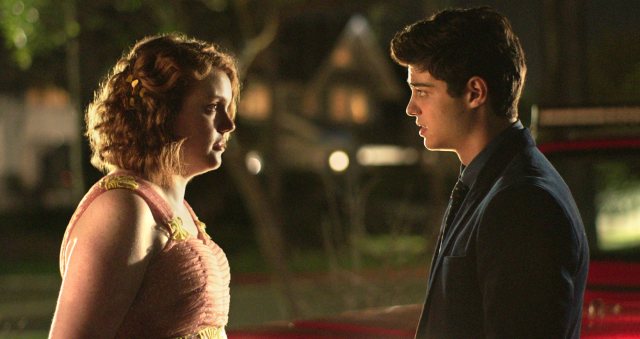
Veronica’s revenge? Palming off Sierra’s number when some cute guy (Noah Centineo of “To All the Boys I’ve Loved Before”) who asks for hers. He texts and texts, and Sierra is overwhelmed, and then wised-up. She figures out what happened. But can she break free of this boy she’s connecting with? You know, tell him the truth?
“He’s imagining her when he’s talking to me…but…they’re MY words!”
As Mean Veronica is a bit of a dumb blonde, jilted by some college freshman she’s dated, Sierra strikes a bargain. Pretend to be interested in the guy who wanted your number and Sierra will “teach you to study.”
Sierra makes a shocking discovery. Veronica’s home life is a comic fallopian hell — shrieking little sisters, a pushy mom living vicariously through her. Veronica’s “discovery?” Sierra is smart, and smart can be cool.
“‘To be or not to be,’ I’ll have to teach you that next.”
“Nietzsche is like a sexy German vampire. He whines a lot and thinks everything’s pointless.”
BFF Dan frets at what could become of Sierra’s new occupation with boys — “Things escalate, texts turn to calls, calls lead to hand holding, holding hands lead to teen pregnancy, unemployment, lady baldness.”
Purser, of TV’s “Stranger Things” and “Riverdale,” doesn’t have funny in her bones. She makes Sierra thick skinned but not needy or touching enough to root for. Her line readings are teen-real — rushed blurts — which prevent her jokes from landing, ruining her few funny lines.
Even Cyler seems a bit off his wacky-sidekick game here — “Are you a catfish, or a ‘can’t fish?”
They’re not helped by the production. Their wittiest exchange comes in the middle of band practice, blurted out between flute or clarinet parts in the arrangement that’s being played around them. Hilarious? No, mostly inaudible, killing the timing.
Froseth has a winsome way with the prettiest girl, the “Dorian Gray” of high school, suffering in her own way and compensating by lashing out. Even when she’s not lashing out, her little kindnesses have a tactless edge.
“She’s not a lesbian. She just has no taste.”
“Loser” has flashes of empathy and a high mindedness about literature and philosophy and book learning in general.
It’s just that it’s light on “heart,” and has a touch of what the Bard labeled “lackwit” in its banter and the ways its few funny lines are played.
Screenwriter Beer kicks the most interesting relationship, Sierra and Dan, to the side. The two smartest kids in school palling around, rivals in seeking something outstanding or just odd to make them “stand out” in their college applications.
Little grace notes are scattered around the edges — a girl who turns a poetry assignment into a furious rap, the hapless track coach (Geoff Stults) forced to let resume-padding lumps try out for his team — don’t overcome the general sourness of the proceedings.
Slapping a bunch of teen comedy stars of yesteryear in supporting roles — Ferris Bueller’s pal Ruck plays Sierra’s dad, Lea Thompson is her mom — doesn’t bestow that John Hughes magic on the film. Giving the hilarious, empathetic Loretta Devine nothing funny to play (she’s the English teacher) is criminal.
So yes, “Sierra Burgess IS a Loser.”
MPAA Rating:PG-13 for sexual references, language, teen partying and thematic material
Cast: Shannon Purser, Kristine Froseth, RJ Cyler, Noah Centineo, Loretta Devine, Giorgia Whigham, Alice Lee, Alan Ruck
Credits:Directed by Ian Samuels script by Lindsey Beer. A Netflix release.
Jennifer Garner shows she can still get a dirty, bloody, job done in “Peppermint,” an avenging angel action picture about a widow who lost husband and daughter to “The Cartel” and The System, and means to get her justice the hard way.
It’s a problematic, bloody exercise in formula from those throw-cash-at-stars and anything-at-the-wall-to-see-what-sticks scrap shooters at STX Films.
Counting “Mile 22” and “Happytime Murders,” “Peppermint” is their third turd in a row.
An over-scheduled, over-worked LA mom misses her daughter’s botched birthday party and she and the hubbie (Jeff Hephner) guilt-drag her to The Christmas Carnival to make up for it. Husband and child are murdered right before heroine Riley North’s eyes, just as she’s fetching peppermint ice cream from a food stall.
The cops (John Gallagher Jr., John Ortiz) are leery about working this case too hard. Riley’s husband kind of got himself into something the The Cartel and its boss, named for the Indian Ocean island Diego Garcia (Juan Pablo Raba).
The prosecution phones it in. The judge shrugs Riley’s positive ID’d suspects off. She should have taken the opposing counsel’s bribe, delivered with a smirk and a threat by Michael Mosley — nicely done.
Which is more than you can say about El Jefe. Raba has the Cartel mustache, the bulk to be scary, but he’s kind of a pussycat when it comes to murderous drug lords. What did Hitchcock say? “Good villains make good thrillers?” See where I’m headed, there?
Riley cannot know that when she robs the bank she works for, flees to Hong Kong where she takes up cage fighting (to train you understand) and masters every weapon America’s Equip an Army gun stores carry.
Really stupid idea number one, that she’d wait five years to begin exacting her revenge. Stupid idea #2, having her rob such a “military grade” gun store to carry out her scheme.
It’d be a real movie had this lame script thought to put her, overmatched and untrained, into “Death Wish” mode, improvising, stumbling. She should be picking up and stealing weapons from the scores and SCORES of Cartel mobsters, Korean gangsters and crooked cops she takes down, a “spree killer” who finds herself all over the news, and all over the streets as she is bloodied, repeatedly, and must perform that action film staple — “self surgery” — vodka for antiseptic and anesthetic, staples for deep cuts, more vodka for everything else.
I enjoyed watching Garner get back to her “Alias” chops, cuts, slices, shots and head-butts. The editing makes you think she could do this stuff, and her reactions to pain — emotional and ammunitional, is genuine.
But it’s a silly slaughterhouse of a movie — bored cops who have no urgency about them, a cute FBI agent who wears high-higher-highest heels on the job (Annie Ilonzeh), adorable urchins who live on LA’s Skid Row with Riley, a place where she can lay low and nobody will know.
The funniest stuff, Garner’s forte, is Riley’s mission creep — the moment she takes to school a drunk whose little boy deserves better — “This is one of those life-altering moments!” — and her revenge on the Mean Mom who ruined her little girl’s birthday, the one on the night she was murdered.
The unfunny stuff, the sadistically gory stuff, is everything else. It’s so unpleasant and unchallenging that even Garner seems to play Riley as “OK, final scene here, let’s get this over with” in scenes that aren’t the final scene. And the final scene.
MPAA Rating: R for strong violence and language throughout
Cast: Jennifer Garner, John Ortiz, Juan Pablo Raba, Annie Ilonzeh
Credits:Directed by Pierre Morel, script by Chad St. John. An STX release.









 I was chatting with Jordan, one of my favorite cineplex managers at one of the busiest theaters in the entire Regal Cinemas chain, on my way in to see “Peppermint” and “The Nun” the other day, pondering what sort of weekend we’d see at the box office.







 Movie Nation