


The “greed is good” ’80s and the vast wealth gap of today created by the “trickle down economics” of the Reagan administration was just kicking in when“Trading Places,” an anarchic comedy about the greedy getting their just deserts, hit theaters.
An R-rated farce from the director of “Animal House” that cemented Eddie Murphy’s status as a movie star and Paramount’s most bankable asset, it smirked in the face of the Reagan era tide that brought official corruption, homelessness and racism “officially” back into vogue while the middle class was being dismantled right before our eyes.
So does this Christmas season-set high-concept comedy have something to say to Trump era viewers? You bet.
Dan Aykroyd gives his best-ever best performance as Louis Winthorpe III, an entitled Ivy League posh brought low as “a social experiment” by his cheating, entitled betters, his bosses, the Duke brothers. Old money and generational privilege is undone by older inherited money and status of historic weight in the playful, wholly-committed performances of Golden Age of Hollywood legends Ralph Bellamy and Don Ameche.
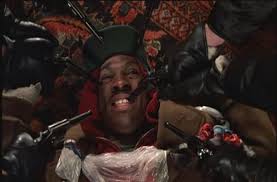
And Murphy, introduced with the grandest sight gag he’d ever pull off, would be the streetwise underclass foil to the entitled Dukes and their ilk as the other half of their “nature vs. nurture” “experiment.”
Could an impoverished underclass Black man — Billy Ray Valentine — with no higher education be dropped into the affluent white elite and thrive, once he’s given the same leg up that class offers? How quickly would a white child of wealth like Winthorpe “turn to crime” once he’s stripped of his wealth, status and unnatural advantages?
Bellamy positively twinkles as the “enlightened” brother of the duo who used inherited money and status to start their commodities trading firm. “We want to HELP you, Mr. Valentine,” Randolph Duke assures Billy Ray through the open door of their Rolls Royce limo. This is after he was unjustly arrested for mugging Winthorpe, who only has to accuse the man fleeing police (For panhandling in disguise, I guess?) who ran into him for Billy Ray to wind up in jail.
The Dukes gave Winthorpe his job and apparently his Philadelphia townhouse, as he’s set to marry their neice. All it takes is a word from them, assistance from their white collar crime “fixer” (Paul Gleason of “The Breakfast Club”) and cooperation from the townhouse’s British “gentleman’s gentleman” valet (an in-on-the-fun Denholm Elliott) and Winthorpe’s life becomes Valentine’s life.
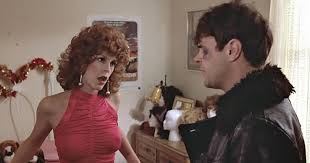
Billy Ray will use street smarts to play the commodities futures market, and thrive. A framed-for-theft and drugs and now broke Winthorpe will have to rely on a “hooker with a heart of gold” (Jamie Lee Curtis, breaking out of the horror niche), albeit one who drives a hard bargain, to survive.
Winthorpe is no more able to save himself, right the wrongs done to him or avenge himself on his tormentors than any other working class/lower class mug would be. Until that fateful moment when Billy Ray overhears how the scheme was laid out and joins forces with Winthorpe with a line so universal it could be right out of the social justice comedies of the 1930s, one that rings just as true in the 2020s.
“The best way you hurt rich people is by turning them into poor people.”
The chemistry between the different-era “Saturday Night Live” veterans Aykroyd — who got top billing — is born of a battle of instant-equals. Murphy keeps most of his “SNL” born shtick in his back pocket and Aykroyd, affecting a Brotherly Love Brahmin accent, stays in character with only his insistence on arguing with everybody who claims he was busted for “heroin” when he knows PCP is “Angel Dust” hinting at one of his own comedy crutches — being pedantically expert in drugs and drug culture (See “Saturday Night” for a version of this)
“Trading Places” was originally set up as a Richard Pryor/Gene Wilder star vehicle, which Murphy reminded us of in “Being Eddie.” It’s easy to see the sort of broader, easier if perhaps angrier (thanks to Pryor) movie this might have been, as that comic duo were like an old married couple by the time Pryor set himself on fire.
But Paramount pulled out all the stops for its rising star, giving the film a prestigious, jaunty, quotes-from-lots-of-holiday-songs-and-classical-music score by the esteemed Elmer Bernstein.
The settings are opulent and grand, a great production design/art direction underscoring of “little people” held down by the richest of the rich, the folks who control these vast institutions.
And director Landis, given another “Blues Brothers” blank check, spared no expense in casting this.
Elliott, prefiguring the amusing direction his character would take in the later “Indiana Jones” movies, has a droll blast as a fight-the-power cynic in a butler’s livery.
Curtis, vavavooming and gum-snapping her way through the proceedings as a leading lady in the making, throws herself into her supporting role.
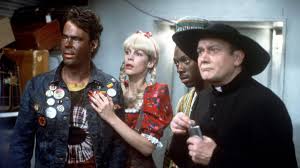
Director, sometime actor and longtime muppet Frank Oz plays a bribeable cop. Jim Belushi wears a gorilla suit and “Saturday Night Live” writers/regulars Al Franken and Tom Davis land laughs as railroad porters. Rock legend Bo Diddley kills in a single scene as skeptical pawn broker Winthorpe tries to sell his high-end watch to.
And keen-eyed viewers will spy legendary character actors Bill Cobbs (“The Hudsucker Proxy”), , James Earl’s dad Robert Earl Jones (“The Sting”) and a very young Giancarlo Esposito who later came to fame in “Do the Right Thing.” Jamie Lee’s sister Kelly Curtis, Christopher Guest’s brother Nicholas Guest and even director Landis have bit parts or cameos.
The screenwriting team of Timothy Harris and Herschel Weinrod would go on to script “Twins,” “Kindergarten Cop” and “My Stepmother is an Alien.” But this, their best film, is notable for the racial punches it doesn’t pull. Mortimer (Ameche), the overtly racist Duke, is sure “breeding” and race matter and is not shy about saying it, and not just that one time where he drops “the N-word.” The way he says the other “N-word” speaks volumes.
“He’s a Negro. Been stealing since he could crawl.“
Murphy’s Billy Ray slings vintage homophobic slurs and Winthorpe’s complaints about jailhouse rape and the like remind us of the film’s “Animal House” origins. They kind of date the movie.
But a lot of that was cut out when you’ve seen “Trading Places” on TV over the decades. I’d argue that Landis being Landis, the shorter TV edits — 1:45 or thereabouts — play better than the theatrical version, which I re-watched to review it now. The nudity, for instance, is gratuitous and sexist, even if Jamie Lee Curtis handles her share of it with gusto.
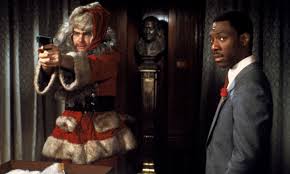
Comedy is meant to play quicker, and while the film never drags, at 1:56 you notice the tone-deaf and dated elements more and the fact that Winthorpe storms a Duke & Duke Christmas party and holds people at gunpoint — without so much as a 911 call — and other moments where logic vanishes stand out.
The extravagant two-and-a-quarter-hour excesses of “The Blues Brothers” come to mind once or twice here. But the commodities trading big finish to “Trading Places” make you glad Landis got this assignment, as a sea of extras and our leads stage a riotous “game the market” caper for the ages.
Of all the production, character and story elements that render this early Eddie outing a classic, the theme, the “nature vs. nurture” subtext and the overt “The Rich are Not Our Friends” messaging are what make it timeless.

Rating: R, nudity, drug humor, profanity, racial and homophobic slurs
Cast: Dan Aykroyd, Eddie Murphy, Jamie Lee Curtis, Ralph Bellamy, Don Ameche, Paul Gleason, Al Franken, Bo Diddley, Jim Belushi, Frank Oz, Tom Davis and Denholm Elliott
Credits: Directed by John Landis, scripted by Timothy Harris and Herschel Weinrod. A Paramount release on Pluto, Bounce, Youtube, Amazon and other streamers.
Running time: 1:56


 Movie Nation