
When we think of the Hollywood comedies by the great German expat Ernst Lubitsch, we remember Garbo at her drollest, a Bolshevik who falls in love in “Ninotchka,” the doors-slamming-on-Nazis backstage farce “To Be or Not to Be” and the oft-remade wit of “The Shop Around the Corner.”
We recollect the sophistication, the famed “Lubitsch touch” that made his films stand apart, even those less timeless titles (“That Uncertain Feeling”).
The monied, high-society setting and comedy of manners and mores “touch” is in evidence in his adaptation of the play “Birthday,” which the studio retitled “Heaven Can Wait” for its 1943 release.
Some critics at the time park this one in the pantheon of Lubitsch pictures, and a few today still do. But blame it on the limitations of the Technicolor production process, the time the film premiered — right at the height of World War II — the screwball-averse cast or the source material itself if you want to. Any way you slice it, this picture’s a sentimental stiff.
Glancing at reviews of it at the time on the film’s Wikipedia page, the greatest critic of the era might have been the only one to see the light. “Not up to his best,” James Agee opined. I’d go so far as labeling it a “Magnificent Ambersons” with fewer laughs.
The game is given away straight off as Alfred Newman’s score quotes freely from that 1909 tune “By the Light of the Silv’ry Moon.” Whatever else is going on here, a fat coating of sentiment will be lathered over it.
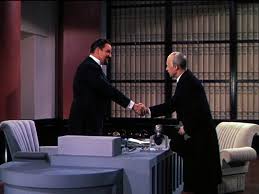
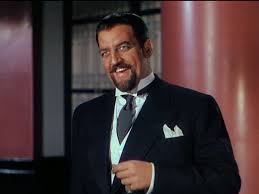
A “great cavalier of the gay ’90s” has died and gotten an appointment with “His Excellency,” Satan. The womanizing old man (Don Ameche) taking a seat before a towering Lucifer (Laird Cregar) is sure he’s hellbound and that he’s earned it. But the tall, tuxedo’d Old Scratch will decide if he meets “our requirements.”
So Henry Van Cleve of the Manhattan Van Cleves tells us and His Excellency the story of his privileged life and his lifelong infatuation with “girls,” from the child in pigtails he crushed on as a tween, through his marriage and into his dotage.
Impressing one of a couple of schoomates he was sweet on as a child required the gift of a captured beetle. Life lesson learned?
“If you want to win a girl, you have to have lots of beetles.”
We meet the oft-fired housemaid/French teacher (Signe Hasso) who gave teen Henry his first drink and it’s implied, first taste of sexual experience. Henry’s mother is quite put out at his “ill” her son must be, mumbling and half-passed-out as he is.
“Oh Randolph! Our boy, DELIRIOUS in a foreign language!
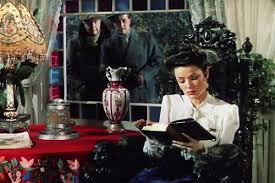
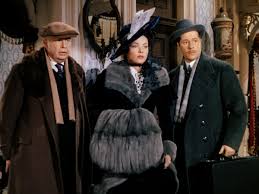
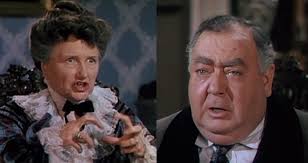
We see the young 20something Henry fall hard for a vision of 1890s femininity — Martha. Gene Tierney, who’d film the movie’s she’s most remembered for, “Laura,” the next year, makes Martha Strabel beguiling and guileless, just a girl from new money in Kansas who has no intention of letting her parents (Marjorie Main and the blustery character comic Eugene Pallette) keep her in Kansas. She’s just gotten engaged to Henry’s square young lawyer cousin Albert (Allyn Joslyn) to ensure she gets out.
Not for long.
When Henry poses as a store sales clerk (she’s interested in a “How to Please Your Husband” self-help book), poor Martha doesn’t even know she’s being courted and set up for an elopement at Henry’s birthday party later that evening. Albert barely has a chance to make their big announcement and introduce his prospective in-laws before the happy not-quite-a-couple-yet are off.
These scenes, stuffed with a smorgasbord of the best character actors of the day, charm and merit a grin, maybe two. Louis Calherne is Henry’s indulgent “keep a stiff upper lip” father. Spring Byington is a my-boy-can-do-no-wrong mom. But the venerable Charles Coburn has the most chances for laughs as the all-knowing grandad who sees through the lad and his son and daughter-in-law’s failed parenting. Grandpa sees enough of himself in the 26 year-old to give it all away.
He gruffly questions his butler, whom he sends after the elopers in mock outrage, shoving cash into that butler’s hands to get the young couple out of town.
“She was packed by E.F. Strabel / To be served at Albert’s table / But that Henry changed the label. Now that’s poetry!”
Wisecracks about Kansas “yokels” and the like keep the tone light in the early scenes. But the stodgy “My life story as told to the Devil” framework slows the pace and drains the light out of laughs that should trot by at a sprint.
Henry can’t think of any one capital offense that’s earned him the right to Eternity in Hell.
“But I can safely say my whole life was one continuous misdemeanor!”
For me, “Heaven Can Wait” doesn’t light up until the setting shifts to Kansas, an HOUR into the narrative. There’s where Martha is fleeing after years of Henry’s constant philandering around the fringes of their “happy” marriage.
The bickering Strabel matriarch and patriarch, who disowned Martha, can’t bear to sit closer than 25 feet apart at breakfast. An early 1900s disagreement over “the funny papers” has to be adjudicated by a long-suffering servant (Clarence Muse, who almost steals these scenes).
Pallette, who was Little John to Flynn’s “Robin Hood” and the blustering, flustered employer of “My Man Godfrey” is in his usual dudgeon, and Main (the future “Ma Kettle”) is more than his match.
The film’s screwball possibilities are evident early on, but mildly dithered away. That broken promise is only kept (almost) in this Kansas sequence, with Henry dashing in to lie and finesse his wife back home.
The stately pacing seems to reflect the somber mood of the country, the world and time the film was conceived and released in. I’ll bet this pattered by at a sprint on the stage.
Ameche had a sort of Ralph Bellamy handsome guy who doesn’t always get the girl career in his younger years. Whatever possibilities this scoundrel Henry Van Cleve afforded him weren’t really realized until his grand ’80s comeback — “Trading Places” (co-starring with Bellamy), two “Cocoon” movies and “Things Change.”
Tierney was a star hitting just hitting her peak, but she was never known for comedy.
Cregar’s turn as Satan is more of a sight gag than anything the screenwriter or the actor tried to have any fun with.
One can wonder if re-casting with a Stanwyck/Jean Arthur type would have goosed the pacing and the picture’s punch, with Ameche amping up his performance just to hold his own.
Shooting it in black and white might have stripped the “stately” out of this “escape” and allowed Lubitsch to pick up the tempo. Technicolor slowed many a feature film production to a crawl.
But what’s here is never more than a wry template for a sendup of dated mores and manners with a sentimental Satan there to hold our anti-hero’s hand and assure him that he’s not really suited for “down here,” even if “up there” seems like a bigger stretch.
And through it all, Alfred Newman keeps coming back to his idea of the right “Sentimental Journey” tone that the score needed, the maudlin but not-quite-sappy-enough to be funny (here) “Silv’ry Moon.”
Seen today, “Heaven Can Wait” — which was the title of the play that became the film “Here Comes Mr. Jordan,” which Warren Beatty remade as “Heaven Can Wait” in 1978 — feels like a polished production of a darkly funny film on the page rendered into something too sober by half on the screen.

Rating: “approved,” TV-PG
Cast: Gene Tierney, Don Ameche, Charles Coburn, Marjorie Main, Eugene Pallette, Louis Calherne, Spring Byington, Allyn Joslyn, Signe Hasso, Clarence Muse and Laird Cregar
Credits: Directed by Ernst Lubitsch, scripted by Samuel Raphaelson, based on a play by Leslie Bush-Fekete. A 20th Century Fox release.
Running time: 1:52


 Movie Nation