

Jean-Luc Godard, the most-analyzed, dissected and critiqued auteur of his generation makes his grand statement on the compromises and sell-outs required by salope déesse cinema with “Contempt,” his biggest-ever hit, a movie about making movies.
The critic turned cinematic revolutionary pretty much says it all with his film’s title (“Le mépris) in French). “Contempt” positively swims in Godard’s disdain for artistic compromise in “the movie business,” as well as theoretical maxims about the “reality” of cinema and of film reflecting or perverting life.
The film boasts the novelty of featuring Fritz Lang as himself, a great German director making an American production of “The Odyssey” in Italy with an Italian crew and a French crime novelist/playwright and screenwriter all in service of an obnoxious, oversexed and hammy Hollywood producer, played by future Oscar winner Jack Palance.
But the reasons for “Contempt’s” success remain as obvious as the film’s bare-bottomed opening.
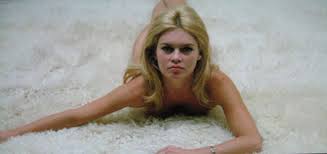
The scene, a writer (Michel Piccoli) and his wife (Brigitte Bardot) discuss their relationship, post coitus, in their marriage bed. Bardot is nude throughout it. It’s not her only nude scene in the film. Once, we drop in on her sunbathing on the Isle of Capri with a copy of a book on Fritz Lang’s cinema draped across her butt.
Cute.
So that was the film’s obvious “appeal” back then. How does it play, now? More than a little dated and a tad ponderously, I have to say.
“Do you see my behind in the mirror,” Camille coyly teases (in French with English subtitles)? “Do you think I have a pretty bottom?”
What, is he blind?
Writer Paul is besotted to an “I love you completely, tenderly and tragically” degree. Camille is out of his league, out of most every man’s league. “Contempt” is about that rewrite offer on “The Odyssey” and what Paul will do to keep his gorgeous wife happy.
Or at least, that’s how braying, posing producer Jeremy Prokosch (Palance) sees it. Paul, who can’t be that much of an idealist, seeing how he got his start writing pulp crime novels, will take that $10,000 offer.
“You have a very beautiful wife,” Prokosch oozes. “You need the money.”
They watch the pretentious dailies legendary director Lang has filmed, with the producer, Lang, Paul, Camille and the Italian personal assistant/translator (Giorgia Moll) who communicates between the American, the German, the French folk and the Italian crew. Who will Paul listen to as he sets out to rethink this screenplay that Lang is turning into montages of Greek statues, art and “culture?”
It’s the LA hustler who just sold the troubled Italian studio backlot, the one who snaps “Whenever I hear the word ‘culture’ I break out my checkbook.”
Prokosh wants more sex, more Odysseus/Ulyssees temptations, more sexual heat in the wandering soldier and sailor’s return to his beloved Penelope. But is that the point of “The Odyssey,” that homecoming? Maybe generations of readers have got it wrong, Prokosch suggests in his most gauche moment. Maybe the guy was in no hurry to “hurry” home from the Trojan War.
Lang is dismayed. Paul hesitates, and then runs with it as the oily producer throws other ideas out there.
“I found a book of Roman paintings that I think would help with ‘The Odyssey.'”
“‘The Odyssey’ is Greek,” Paul protests.
When he opens the book later, Paul realizes it’s of ancient Roman porn. And when he tries to praise Lang’s already-filmed footage, shot in Cinemascope, the old man draws his line in the sand.
“It wasn’t made for man,” the director of “M,” “Metropolis,” “The Big Heat” and “Rancho Notorious” mutters of the popular widescreen filming process. “It was made for snakes and funerals!”
Camille isn’t just a bystander in all this. We see her growing “contempt” for the man she married, even if this sell-out means they’ll be able to pay off their posh, sleek mid-century-modern apartment.
As Paul tries to please and appease her — she spies him swatting the bottom of Francesca the personal assistant — and Camille fends off the advances of the predatory producer, can this marriage be saved? Even by a long, tortured afternoon-long debate back in their apartment about whether they should leave for Capri with the producer to watch the filming, and rewrite that script to his tastes, or bail?



Whatever Godard was saying about the arch artificiality of the cinema and the banality of “real life,” that opening scene with the great French sex symbol of her era nude was added to the picture after most filming was done — at the insistence of the producers.
That’s as on-the-nose as “life-imitates-cinema” gets.
The opening credits are recited by Godard over footage of a film being shot on a backlot. And when the movie proper begins after those four minutes of nude conversation, the shooting strategy reverts to form.
Paul, summoned to a meeting with this grandiose, theatrical producer, is led through an empty, overgrown backlot, street scene repaintings interrupted, a newly-sold s (Cinecittà Studios) will make way for tacky redevelopment, Prokosch rages.
That lays out the central debate within the film. Do you let artists be artistes, or do the Philistine producers and bean-counters control the art and the number of nude scenes they figure it’ll take to sell this sometimes scenic, always melodramatic talkathon?
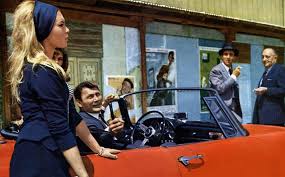
“Contempt” has long been regarded as a cinephile’s comedy, and there’s humor in Lang’s bemused sangfroid over the state of the cinema. Palance, hurling film reels, throwing his arms up in “Evita!” salutes of despair, is worth a histroinic laugh or two. Prokosh’s power play to finish their conversation has him climbing into his Alfa Romeo Spider to zip to the spot they’ll make their deal, forcing Paul to literally wade through weeds, led by the apologetic Francesca, to cover the same 30 or so meters.
But that long husband/wife end-of-first-act argument after Camille has been brought along to experience this world is stiff and stagebound, punctuated with Camile trotting out a brunette wig as if to dampen the ardor of the producer she thinks her husband is practically pimping her out to in order to get this job and more like it.
Godard’s infamous sexism isn’t just on display in all the nudity included here. Paul slaps his wife to win an argument (he doesn’t). He smokes cigars and never takes off his hat because he wants to look like Dean Martin in “Some Came Running.” Paul’s an “ass” who takes up the Italian-trademarked pat on women’s bottoms privilege.
As Camille has agency and is the most important element of this storyline the most charitable way of interpreting that is that this is a sexist commenting on sexism in cinema and the “possession” of women in the real world, and in the cinema at the opening of the “liberated” 1960s.
The performances are good, with Bardot the stand-out and Palance the scenery chewer.
The filmmaker broadened the world’s notion of how a film should sound, with music used sparingly, boom microphones capturing the echoey emptiness of the back lot and its empty interiors, and close-miking reserved mainly for more intimate conversations.
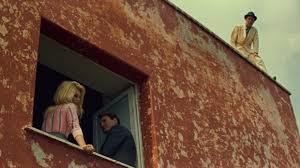
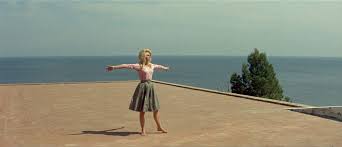
Casa Malaparte and the waters off the Isle of Capri lend the picture a moment-in-time scenic touch, and the “La Dolce Vita” era car, clothes, hairstyles and furnishings that would later be labeled “mid century modern” give “Contempt” historic resonance.
But the central conflict is a melodramatic trope that works better when the stakes are “The Postman Always Rings Twice” or “Double Indemnity” higher. The debate between art and commerce plays as very ’60s. And Truffaut’s “Day for Night” and heck, Richard Rush’s “The Stunt Man” were more entertaining movies about making movies.
“Contempt” is more slow-moving proof that film buffs were more patient in the ’60s than they were in earlier eras, or in the decades since. While there are ’60s “art” films that I couldn’t bear to sit through again (“Last Year at Marienbad,” etc.), “Contempt” never quite settles into that self-conscious quicksand. It’s too cool for that.
But I’d say it’s best appreciated today for its impact on the budding auteurs who grew up on it, the cinephiles it converted to the True Faith and the generations of Bardot worshippers who carried that torch until she retired, a movie that taught us all that the rich guy with the Alfa Romeo convertible always gets the blonde, or seems to, unless he has an accident.

Rating: TV-14, nudity, profanity
Cast: Brigitte Bardo, Michel Piccoli, Jack Palance, Giorgia Moll and Fritz Lang
Credits: Scripted and directed by Jean-Luc Godard, based on a novel by Alberto Moravia. A Marceau-Cocinor/Embassy Pictures release on Tubi.
Running time: 1:42


 Movie Nation