
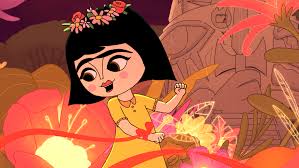
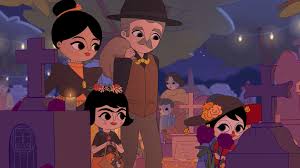
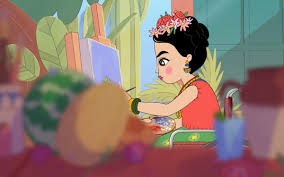
“Hola, Frida” is a charming animated imagining of the early years of the great Mexican artist Frida Kahlo. Adapted from a book by Sophie Faucher, this Canadian/Quebecois production takes the tidbit that Kahlo had an imaginary friend as a little girl and fancifully spins that into a tale of a tough, creative and unconventional girl whose early life shaped the artist and icon she became.
Hobbled by illness and literally stalked by “La Muerta” — death — Frida didn’t let physical challenges or sexist Mexican parochialism break her spirit or limit her creativity. Filmmakers Karine Vézina and André Kadi tell this adult-friendly children’s story in the colors of Kahlo, recreating the culture she grew up in and the heritage she embraced, reminding us that she was a lot more than a famous face — her favorite subject — with one long eyebrow.
Six year-old Frida and younger sister Christina are doted on by Matilde, their mestiza mother and Guillermo, their German-Jewish photographer dad in La Casa Azul in Coyoacán. She plays with a pet monkey and feeds a stray dog and shows her first drawings — of The Coyote Fountain — to her classmates, not all of whom are art lovers.
Visits to the market are where her mother tells her of her ancient Zapotec heritage, the pre-Aztec/pre-Colombian “cloud people” whose descendents wear colorful traditional clothes and flowers in their hair.
Then Frida gets sick — “polio.” Her father tries to find things to distract her as she recovers from fever and finds herself burdened with a leg brace for what her crueller classmates call her withered “chicken leg.”
“I don’t WANNA take my mind off things,” she rightly protests. She draws and revels in the company of the stray dog her little sister smuggles in to her.
The cloud visages of her cloud people? They weep for her. And that skeletal ghoul who lingers at her bedside? That’s “La Muerta,” who has come for her. But thanks to the pleas of Frida’s invisible friend, La Muerta takes a rain check.
Frida recovers enough to resolve to “become a doctor,” a profession women were only just getting into in Mexico, so that she can “heal people,” like her epileptic father and herself.
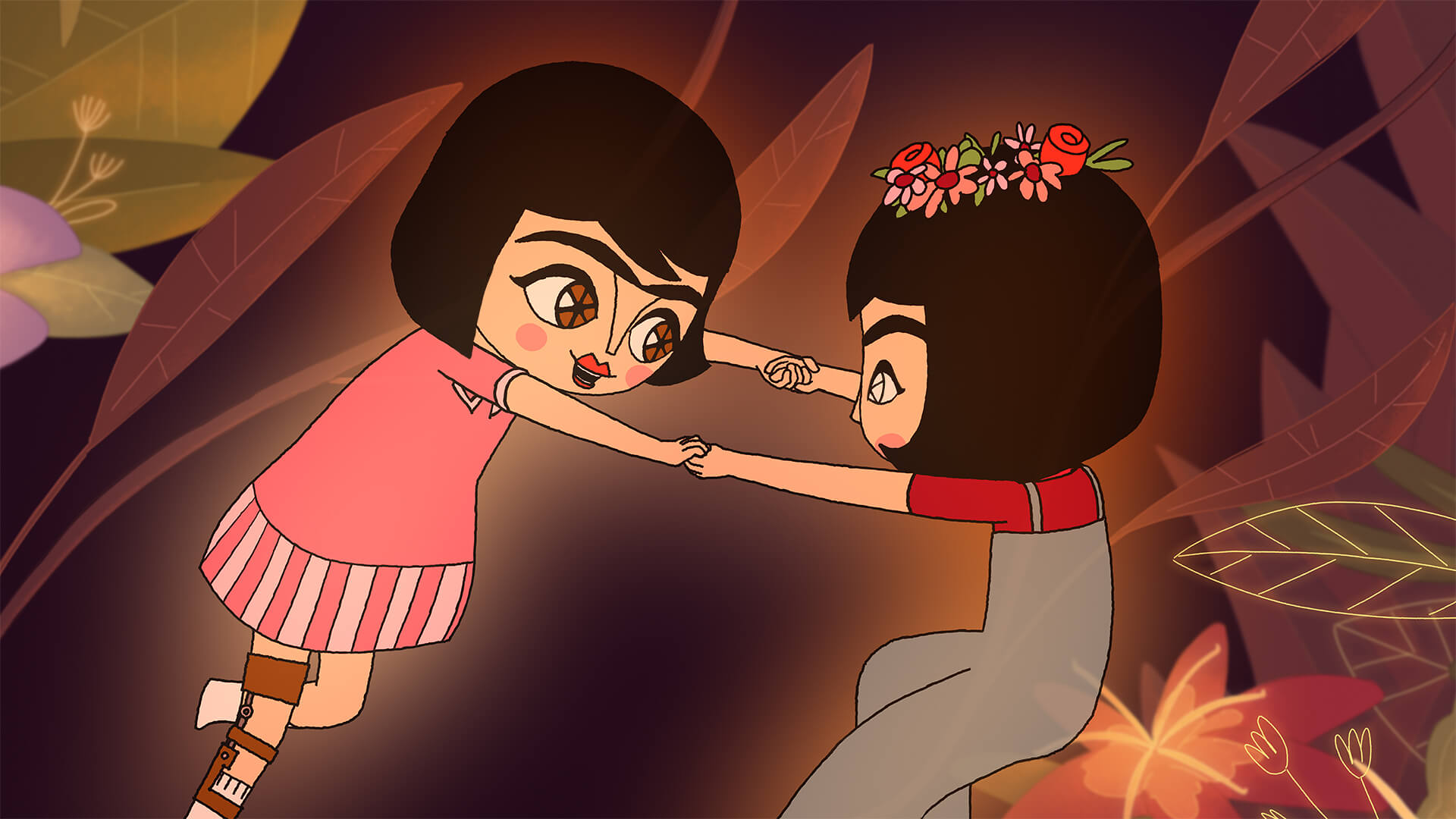
In her dreams, she meets with her imaginary friend and gets sage advice when, for instance, she falls into quicksand. That’s just “fear and doubt dragging you down,” she’s told. Her dad, who photographs her even in her lowest moments, teaches her that art can “shine a light on the sad moments in our lives.”
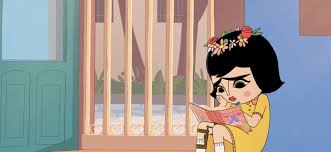
Her mother may disapprove of her desire to wear pants and men’s suits. But we see the unconventional artist taking shape, all of it captured in the early notebook that the adult Frida flips through and reminisces about from her wheelchair.
Our filmmakers may invent a roller skating race for the child to compete in, but they don’t shy away from showing a little girl in pain and misery, bullied but refusing to be limited by the hand nature dealt her and the provincial culture she could celebrate once she overcame its sexism.
The animation has an early “Dora the Explorer” simplicity blended with a Kahlo color palette that gives this delightful film kid-appeal, a movie small children will enjoy and learn from that their art-history fan parents can appreciate as well.

Rating: unrated, worthy of PG
Cast: The voices of Layla Tuy Sok, Lucinda Davis, Angela Gallupo, Marcel Jeannin, Eleanor Noble, Holly Gauthier-Frankle, Robert Naylor and Frankie Bowen.
Credits: Directed by Karine Vézina and André Kadi, scripted by Anne Bryan, Sophie Faucher and André Kadi, based on a book by Sophie Faucher.
Running time: 1:23


 Movie Nation