

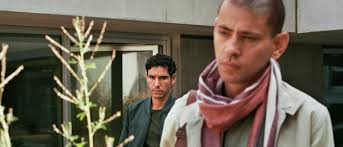

An obsessive search for justice and closure consumes a Syrian on the hunt for an Assad regime war criminal in “Ghost Trail,” a quietly gripping thriller about Syrian expats in Europe pinning their hopes on “international justice” as they conspire to track down a torturer.
But is the trail cold? Is their quarry too careful and cunning? With “justice” imperiled all over the world, will they get what they’re looking for from others? Or will the tempation of simple revenge be too hard to resist?
Back home, our hunter was Hamid, a professor of literature in an Aleppo university imprisoned at Sednaya, released in the middle of desert by callous soldiers in the film’s grim opening. But in Strasbourg, France, he calls himself Amir. Or Saleh. Many names. He (Adam Bessa) does day labor in construction. But that’s just to get to know the crew so that’s he comfortable asking around.
“Have you seen” his cousin, he wants to know? He questions anybody who was ever in a refugee/resettlement camp, haunts the welcome conters and visits the Turkish quarter where some Syrian refugees settled. His photograph of the man he’s looking for is blurry. His vague questions earn mistrust. Escaping a murderous dictatorship leaves one and all paranoid.
When Yara (Hala Rajab) says that she knew someone who knew “Sami Hanna,” after she tests him by quoting Arabic literature. She goes so far as to flirt a little. He barely notices.
Hamid is on a mission, one that has him lying to his mother (Shafiqa El Till) in a Beirut refugee camp, lying to French authorities who insist he’s overstayed his welcome and should return to the country that accepted him — Germany. He will seek psychological counseling if that will prolong his stay.
Hamid is “sure” his quarry is here. He rebuffs doubts from the online first-person-shooter video where he and his co-conspirators chat. He takes the money from his French go-between (Julia Franz Richter) in silent spy-game exchanges.
And when he spies someone who fits his profile, Hamid will not let anyone distract him from his prey or dissuade him that he’s got the wrong guy. It’s him, he tells his compatriots (in Arabic, French and German with English subtitles).
“I can sense it.”
He will stalk, eavesdrop and spend days and weeks looking for this college chemistry student (Tawfeek Barhom) to give himself away.
Bessa, of “Mosul” and “Extraction,” internalizes everything about Hamid, an educated man driven by loss, grief and revenge to listen to the victims’ tapes and plumb the depths of his own trauma to see if he has a match.
Others speak of being covered with a hood, counting the steps their persecutor took and smelling the sweat, breath and cologne of this creep who beat, electric shocked and burned his victims with acid. What detail will be the one that confirms or denies that our obsessive, disturbed stalker has his man, or that he’s lost any ability to be objective and weigh facts?
Barhom’s performance has a caginess that leaves room for doubt. And Richter’s Nina lets down her guard long enough to show the wrenching emotions about her reasons for joining this search-and-expose-or-kill cell.
Director and co-writer Millet scrupulously avoids melodrama and he immerses us in Hamid’s isolation, in the life he’s lost and the future he abandons for this obsession, his desire to get that closure and perhaps give all that was taken away meaning.
We invest in this quest, put ourselves in this man’s shoes and wonder, like him, if “justice” is itself a ghost, if it’s even possible in a world where tyrants and their minions face no consequences for their crimes, even in alleged democracies.

Rating: unrated, violence
Cast: Adam Bessa, Julia Franz Richter, Hala Rajab, Shafiqa El Till and Tawfeek Barhom
Credits: Directed by Jonathan Millet, scripted by Florence Rochat and Jonathan Millet. A Music Box Films release.
Running time: 1:48


 Movie Nation