

The first time I pondered the “coincidence” of a classic film turning up on my TV at a particular moment in history was coming home from school in the ’70s and seeing the Cold War era gem “Seven Days in May” showing on a local CBS affiliate.
This was in the mid-70s, during the debate over one of the SALT treaties — Strategic Arms Limitations Talks. It can’t have been a coincidence that John Frankenheimer’s Kirk Douglas/Burt Lancaster/Ava Gardner and Fredric March 1964 thriller, about an attempted military coup staged when a president dared to propose such a treaty, was airing on WFMY-TV at this precise moment in time.
It wasn’t until years later, when I was making newspaper-sponsored movie review appearances on that same station, that I pondered what message a right-wing-owned-and-leaning TV affiliate in North Carolina was sending by dropping that movie in that time slot at that moment in history.
Since Jan. 20 of this year, BBC America has been slapping 1984’s America-taken-over-by-communists thriller “Red Dawn” in its lineup on a regular basis. Nudge nudge, wink wink.
And then the little-seen WWII classic “The Mortal Storm” turned up on Turner Classic Movies the other night. Showing that movie now is, again, no coincidence.
An MGM film that pretty much pulled off the gloves and bluntly called-out Germany, Naziism and what was going on there over a year before America entered the war, I remember being gobsmacked by its outspoken anti-fascism during a university film society screening in grad school.
You go to film history classes and read all that was written about Hollywood in the run-up to war, with Warner Brothers films the first and most prominent to call out fascism and big, heavily-invested-in-Germany-and-Occupied Europe markets MGM’s timidity on the subject. And then Mr. Mayer’s studio went and made the one film they’d avoided making, an all-star thriller calling blasting Nazi Germany and contrasting fascism with American values in the most direct terms imaginable.
It was MGM’s only anti-Nazi movie before the war. But it’s a doozy.
The courage and urgency that the studio lacked wasn’t reflected by the career of Oscar-winning director Frank Borzage. He’d already made “Little Man, What Now?” and “It Happened Here,” films with similar themes, settings and warnings.
The film’s infamous avoidance of using the word “Jew” as it depicts the early days of the Hitler regime, with its assaults on academics and ethnic minorities, may be the one cowardly thing about it. But much of what is in this adaptation of a novel by the wife of a British diplomat, who viewed this history from postings in Austria and Germany during that period, still stings.
The film was banned by Hitler. Because big conservative and sentimental MGM lands some political punches, for once.
” I think peace is better than war. A man’s right to think as he believes is as good for him as food and drink.”
“We should be intolerant, of anyone who opposes the will of our leader!”
“Tell him peasants HAVE no politics, they keep cows!”
“They want to KEEP their cows, they’d better have the RIGHT politics!”
“May we not believe as we choose and allow others to do the same?
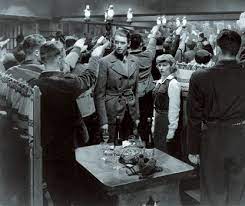
University science professor Viktor Roth (Frank Morgan) turns 60 and is feted by his admiring family and colleagues, and is treated to a verse of the university song (“Guadeamus igitur”) by his adoring students.
But on this Jan. 30, 1933, it’s not his birthday that’s big news in town. Adolf Hitler is named Chancellor of Germany, and smart academics, civil rights watchers and Europe’s Jews appreciate what that means, even if a lot of young people and the Roth family’s Hitler-loving maid do not.
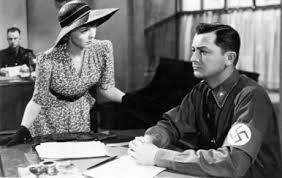
“The Mortal Storm” is about the conflicts and moral stances taken under the roof of the Roth household, with adopted sons donning the swastika and a pushy student with a closet full of brown shirts, Fritz (Robert Young) insisting that daughter Freya (Margaret Sullavan) say “Yes” to his enthusiastic proposal even though she’s merely pondering the question.
Freya has another option. Martin (James Stewart) is savvy enough to know what the Nazis will do and what it means to peace, and to “freedom” for Germans in Germany. Martin stands up for Professor Roth in front of Nazi bullies, and for others similarly threatened.
That doesn’t mark him. Not right away. But as Professor Roth and others are rounded up and sent to camps where they wear “J” badges, the gauntlet is thrown. Martin must join or face consequences and Freya and family had best take the next train out.
The Nazis don’t say “Not so fast.” But as every move they make is aimed at obliterating independent thought, burning books and banning the teaching of Einstein and other scientists with the wrong surname, we and the characters know what’s coming.


One thing that impresses about this classic 85 years since its release is the fervent commitment of the cast to their parts in this anti-fascist passion play.
Stewart is fiery and fiesty as the unbending humanist and anti-fascist. Morgan, the one and only Wizard of Oz, is properly saintly and martryed. And Sullavan manages to seem confused, despairing and put-out, sometimes all at once.
A Nazi’s assuming she’ll marry him as her dad is among the first rounded up? The nerve!
But it is the actors playing Nazis who stand out in the “fervor” department.
Young has no trace of his future as “Father Knows Best” and “Marcus Welby, M.D.” He’s gleefully hateful. Robert Stack’s clipped, efficious cruelty is a few years shy of leading “The Untouchables.” Dan Dailey‘s future as a song and dance man (“There’s No Business Like Show Business,” “Give My Regards to Broadway,” “My Blue Heaven”) is nowhere to be glimpsed in the wide-eyed fanatic he portrays in his MGM debut.
Ward Bond? Considering his later coming-out in far right politics and Hollywood “Blacklist” mania, he slips into his Nazi guise the most easily.
Character actors were the backbone of every studio in Hollywood’s Golden Age. But it’s still jarrring when the familiar, cracking whine of the busybody neighbor commenting on George Bailey’s inept courting of Mary in “It’s a Wonderful Life” and the future mayor of Mayberry, Dick Elliott, demanding to see “Your PAPERS” as a Nazi passport clerk.
Borzage won two Best Director Oscars, including the very first one ever handed out — for “Seventh Heaven” (1929). “The Mortal Storm” isn’t his or screenwriters Claudine West, Hans Rameau or George Froeschel’s subtlest work.
But in 1940, that was very much the point. Europe was in flames and seven years after Hitler’s ascendency as Chancellor, there could be no doubt of the threat he represented to democracy, personal freedoms and Western Civilization itself. Subtlety and “both sidesing” were out of fashion.
And there’s little subtle about showing “Red Dawn” or “The Mortal Storm” to American viewers in 2025, either, for very much the same reasons. This 1940 film is a stark reminder of when we had a surer sense of our values and the common sense to act on them when faced with a man and a movement antithetical to them.
Pointing out that ignorant totalitarians and their violent minions always go after academics, learning and books first is always a welcome first step, even if it’s a belated one.

Rating: “approved, TV-PG, violence
Cast: James Stewart, Margaret Sullavan, Robert Young, Dan Dailey, Anita Granville, Robert Stack, Irene Rich, Maria Ouspenskaya, Ward Bond and Frank Morgan.
Credits: Directed by Frank Borzage, scripted by based on a novel by Phyllis Bottome. An MGM release on Youtube, Roku TV, TCM’s Amazon Channel, etc.
Running time: 1:40


 Movie Nation