

More charming than amusing, chosing sentiment over “edge,” the Andrew Ahn remake of Ang Lee’s 1993 queer cinema classic “The Wedding Banquet” gives the viewer time to reflect on just how much American and world culture have changed in the past 30+ years.
Lee’s film, about a gay Chinese-American who marries a female tenant renting an apartment from him as a way of appeasing and fooling his traditional Chinese family, seems positively demure now. The characters are tentative, dreading “coming out” and going to great extremes to ensure that they don’t have to.
Ahn (“Driveways”) gives his film hip cachet in casting Bowen Yang, Lily Gladstone, Kelly Marie Tran and Joan Chen in lead roles. He recognized that the comic possibilities of fooling relatives in The Old Country (Korea, this time) are exhausted, and moved beyond that as gracefully as he could.
If his picture lacks the understated delight that the original “Banquet” provided and fails to find many laughs in that promising cast, he at least charts the journey from gay “stereotypes” to gay “archetypes.”
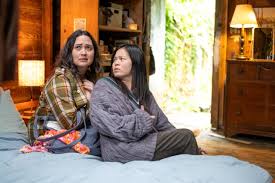
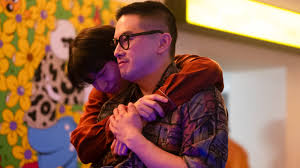
Gladstone and Tran play Lee and Angela, a long-paired lesbian couple struggling to conceive via In Vitro fertilization. Yang and Hang Gi-chan are Chris and Min, the gay couple renting the garage apartment in the house Lee inherited from her father.
Lee, a “professional” lesbian (activist, organizer, etc) and “worm” scientist Angela are feeling the psychological and financial strain of trying to have a baby. Chris and Min have other issues, with older Chris having put-off finishing his Phd — “Queer Theory takes the joy out of being queer!” — and quick to rebuff Min’s proposal.
Min’s a perpetual student, an artist in cloth and a Korean citizen. Is the marriage for a Green Card? The fact that his homophobic grandfather will cut him off from the family fortune should he come out worries Chris more than it does Min.
Why not fake-marry Angela instead? Appease Zoom-call businesswoman granny (Youn Yuh-jung), get that Green Card and provide the family cash necessary for Angela and Lee to finally have a baby?
The movie introduces this epiphany and that jolting turn of events every bit as abruptly as that description implies.
Old friends Angela and Chris get weepy drunk over this idea and wake up naked. And then Granny shows up and the whole scheme struggles to get on its feet.
Casting Yang, famed for his bitchy, adenoidal put-downs, promises more laughs than this “Wedding Banquet” delivers. The first forty minutes are deathly dull. Then the fake marriage plot is set in motion and things pick up a bit for at least part of the remainder of the film.
Yang and Hang have little chemistry, in contrast with Tran and Gladstone, who click as a couple and make the buy-in easy.
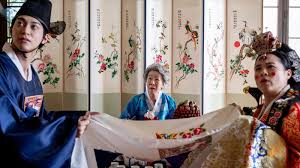
Ahn’s efforts to deepen the Taiwan/America cultural contrast of the original film by mixing up Chinese and Korean and Native American characters (Bobo Lee plays Chris’s lesbian hipster cousin) comes to almost nothing — a hint of cuisine, a drag vamp on Chinese dragon costumes, a little Korean customs and Chinese culture bashing.
Screen legend Chen (“Twin Peaks,” “The Last Emperor,””Marco Polo,” “Didi”) is a breath of fresh air as Angela’s overbearing, over-sharing mother, a woman “all-in” on the who PFLAG super-supportive Mom thing, which infuriates her fuming daughter. Chen and Youn (“Minari”) almost set off sparks and suggest another promising angle Ahn didn’t choose to develop.
The few antic bits play. The rush to “de-queer” the house when Granny is coming shows DVDs, CDs and the Elliot (formerly Ellen) Page autobiography grabbed and hidden, along with a Lilith Faire concert poster.
“The Indigo Girls are surprisingly popular in Korea!”
But this “Banquet” never gets up a head of steam, never unravels into anything fun. Yang ensured that they’d have enough zingers to make the trailer funny. The film itself is more recognizably human and considered, while lacking any comic edge or sense that the romantic stakes are high.
When the climax lurches into the anti-climax, it’s hard to see what much of the fuss of any of this would have been about, when even the most transgressive moments have lost their sting.
But that’s just the final confirmation of shifts in the culture. “Coming Out” stories are passe, and half-heartedly flipping their twists won’t change that, no matter how much pushback the reactionary culture seems to embrace at the moment.

Rating: R, nudity, alcohol abuse, profanity
Cast: Bowen Yang, Lily Gladstone, Kelly Marie Tran, Hang Gi-chan, Bobo Lee, Youn Yuh-jung and Joan Chen.
Credits: Directed by Andrew Ahn, scripted by Andrew Ahn, based on the screenplay to “The Wedding Banquet” by James Schamus. A Bleecker Street release.
Running time: 1:42


 Movie Nation