
“Harbin” is a stately, somewhat tense Korean period piece bathed in the gloom that hangs over many an espionage thriller.
Director and co-writer Woo Min-ho already has conventional thrillers (“The Drug King”), period piece thrillers (“The Man Standing Next”) and political thrillers (“Inside Men”) on his resume. Here he focuses on the last conflict between historical enemies Korea and Japan, taking us into Korean resistance to Imperial Japan’s annexation of the peninsula in the early 20th century.
The men and women involved in the Korean Independence Army were determined to upend Japan’s latest conquest of their homeland, because they know who writes history — the winners.
“If Japan writes our history, no one will remember us,” one fighter (Jo Woo-jin) intones, in Korean with English subtitles.
Japan, fresh off a decisive victory in the Russo-Japanese war of 1904-05, forced the Korean emperor to abdicate in 1907 and those fighting their occupation were already years into the sacrifice that required by 1909. At this point, many involved were all-in on fighting back until victory, the film tells us. But it suggests that for many, they’d already reached the point where they were fighting mainly to ensure that those who already died didn’t do so in vain.
“Will we be remembered?” is a major theme of this retelling of the story of an effort to assassinate Japan’s prime minister, Itō Hirobumi, the ultimate revenge for the Japanese massacres and racist attempts to erase Korean names, language and culture already under way.
The Independence Army has had successes and defeats, the latest of which has them questioning General Ahn Jung-geun‘s (Hyun Bin) leadership and even his loyalty after he released Japanese prisoners after a victory, only to be tormented by the enraged released officer Lt. Col. Mori (Park Hoon).
“Trust” and mistrust underscore this “operation,” as the Japanese, working with the Russians, use every means necessary to protect their prime minister (character actor Lily Franky of “Shoplifters” fame), who is traveling through China to Russia and a meeting about Japan’s “annexation” of Korea. Harbin, a city that changed hands from Manchurian to Russian to Japanese to Chinese, is one of the stops on this trip.
There is a “mole” in the Korean movement. Plans are made and dashed and remade. Sacrifices will be demanded and treachery will be exposed.
And the Japanese would still occupy their Korean “colony” until they lost WWII in 1945.
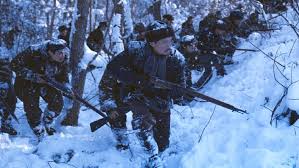
The film’s stately pace between accomplished, visceral scenes of winter combat, street ambushes and the like allows us to appreciate the grey-scale production design by Gunda Bergmane and crisp overcoats and hats provided by Katrina Liepa to the actors who play the men and women who have roles in this bloody scheme.
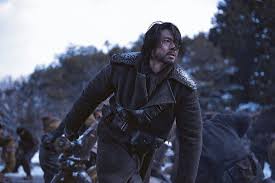
Hyun Bin impresses as the lead, letting us question the character’s judgement and motives before embracing the way the film sees him — as one of the great heroes of Korea’s modern history. Jeon Yeo-been makes her version of the war widow “Ms. Gong” a reserved figure who rises to the occasion for a chance to ensure her late husband’s sacrifice will be remembered.
Franky lends a noble tone to the prime minister, perhaps blinded by racism, who sees Japan raising Koreans’ standard of living as Japan absorbs their land and their population.
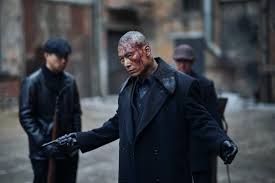
And Park Hoon (“Memories of the Alhambra”) makes a hissable villain, the Japanese officer obsessed with avenging his “honor” and loss of face for being captured, ignoring his ignoble methods and summary murders of civilians and anybody else who stands in Imperial Japan’s way.
The slow pace of the picture kills any ticking-clock tension that might have been generated by foes racing towards a confronation. There’s not much visual urgency to any of this.
And the slower a film is, the more anachronisms you notice in a period piece. “Mole” was a term introduced to the public by spy novelist John le Carre in the ’70s. Train stations didn’t have eletronic PA sytems in 1909, because Magnovox didn’t invent them until 1915. The hats and many haircuts seem out of their time, too.
But “Harbin” still rises to the level of “solid,” in thriller terms, and fascinating in historical ones. Centuries of conflict between Japan and Korea — with Japan the aggressor — have led to a lot of Korean historical epics about land and naval battles, and to this intriguing and always watchable espionage thriller about an assassination attempt much of the world has never heard about.

Rating: unrated, bloody violence
Cast: Hyun Bin, Park Jeong-min, Jo Woo-jin, Jeon Yeo-been, Jung Woo-sung, Park Hoon and Lily Franky
Credits: Directed by Woo Min-ho, scripted by Kim Min-seong and Woo Min-ho. A Well Go USA release.
Running time: 1:54


 Movie Nation