



“The Last Run” is a tidy if not exactly tight template for generations of “driver” movies to come.
Here is George C. Scott as the original “Transporter,” taking out and thrashing a collectible BMW from Portugal to the Pyrnees all the way to Perpignon and back.
Every Luc Besson “Transporter” project, every getaway driver picture from “The Driver” to “Drive” to “Baby Driver” to “Wheelman,” every Clive Owen “The Hire” TV commercial, can be traced back to this lightly-regarded but lean road picture/thriller, an indulgent project that Scott treated as his reward for winning the Oscar (which he didn’t accept at the time) for “Patton.”
Scott got his then-wife Colleen Dewhurst cast as a Spanish prostitute, got the young mob moll role recast with his next wife Trish Van DeVere, and threw his weight around so much that director John Huston dropped out, replaced by Richard Fleischer of “20,000 Leagues Under the Sea,” “Compulsion” and “Fantastic Voyage.” John “Point Blank” Boorman was the first guy Scott wanted behind the camera.
Sven Nyquist filmed it, on his way to becoming one of the legendary cinematographers of his generation. At least Scott didn’t run him off.
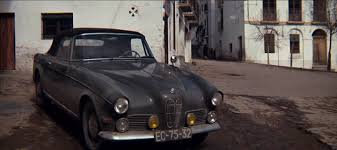
Our anti-hero here is Harry Garmes, nine years off “the job,” a wheelman laying low in Albufeira in Portugal’s Algarve region. He’s got a stake in a local fishing boat. And he’s got that rare ’56 BMW 503 to tinker with. When he takes her out for a spin, we see that he’s modified it — given it some sort of boost “supercharger.”
Harry needs the convertible in top shape because he’s going on one last “business trip,” “driving again to see if my nerves and my brain are still connected.”
Nobody uses a convertible as a getaway car. But that’s kind of the idea, being inconspicuous and touristy by being conspicuous. And Harry’s a poetic sort, dressed in Steve McQueen “Bullitt” turtlenecks, chain-smoking, a solitary man who confides in his local prostitute (Dewhurst) and the fisherman who runs Harry’s boat, and who confesses to an empty and ancient Catholic church.
He’ll soon bear witness to one of most compact prison break scenes ever, a Spanish Guardia Civil bus stopped by a wreck on a bridge. That’s where the American punk Rickard (Tony Musante) makes a run for it.
Somebody wants Rickard out. But when he gets out, Rickard changes the plan. There’s a woman (Van DeVere) waiting for him. And no, this “old man” “hearse driver” doesn’t have a veto on this detour.
Whatever Rickard was in prison for, he’s got “Paris and some easy living” lined up for himself and Claudette, “Claudie” he calls her. A mob history buff, he gets under Harry’s skin, and ours. Claudie warns Harry of how murderously self-preserving Rickard is.
And we’re off.
The ’70s were a new decade and the anti-heroes would dip deeper into the nihilism and existentialism born in the ’50s that flowered in classics of the ’60s, before blockbusters arrived and changed the cinema into a megacorporation industry.
The script’s foreboding becomes Harry’s foreboding as he ponders the slow-to-catch-on Rickard’s fate, and what that might mean for “the girl.”
The violence is realistic and just jolting enough. The action beats, including car chases, crashes and shootouts, are a lot simpler and more realistic than what we see in thrillers today. Cars do what cars do, without digitally-assisted, physics-defying spectacle.
If Harry gets shot, Scott makes damned sure he feels it, grimacing with every labored limp.
Scott, who was nominated for another Oscar for “The Hospital” the same year “The Last Run” came out, was a mercurial screen prescence — brooding between volcanic erruptions. He’d scowl, growl, show his teeth and give us epic bug-eyed glares. He might have been less subtle than his contemporary, Brando, but he was always fun to watch, larger-than-life by nature.
I’ve not been able to track down just how much of this Huston filmed on location (almost entirely in the last years of Franco’s backward, under-developed Spain). It had to be early if Huston was never around for Van DeVere’s casting and arrival.
Dewhurst was always earthy enough to play most any flesh and blood character they gave her, even if she seems miscast as “Spanish” here, a rare false note for her. But whatever their star’s demands, Fleischer and Huston created a consistent tone for our “man alone” tale.
The car chases are more primitive than we see today, if damned effective. Long shots emphasize the deadly design of this switchback-lined mountain road, that piece of sharp-turns, steep-cliffs and no-guard-rails coastal highway. And wheel-arch level shots show ordinary cars of the day — a Spanish-made Dodge, a ’69 Jag and the Beemer — wrenched and rolled through their paces on pavement that’s become familiar to film fans into the Netflix era, as modern day smuggling tales with motorcycles and cars cover some of the same terrain.
But the pleasure here is in seeing how so much of the myth of the mob “driver” spun out of this early example of such tales, and watching Scott do what few actors today would accept — submitting to pages and pages of “old man” and “Hopalong” and “uncle” “hearse driver” jabs…at the ripe “old” age of 44.
“The horse is OK,” he growls with relish at the newer/faster Jaguar that’s running him and his two passengers down. “Let’s see what the jockey’s like!”

Rating: PG, violence, sexual situations
Cast: George C. Scott, Trish Van DeVere, Tony Musante and Colleen Dewhurst.
Credits: Directed by Richard Fleischer (and John Huston), scripted by Alan Sharpe. An MGM release on Tubi, Amazon, etc.
Running time: 1:36


 Movie Nation