

There’s a gentility about “Hard Times,” a bare-knuckle brawling drama set during the Great Depression. It’s a genre piece populated with veteran character actors playing archetypes bound by their own code, playing their parts in a story so pre-ordained that “formulaic” doesn’t do it justice.
It’s a film of fists and fate, of Edward Hopper shot compositions and “anything goes” fights that can seem quaint in the ultra-violence of today. These hard men have their limits, lines that they won’t cross.
First-time feature director Walter Hill apprenticed under Peckinpah and John Huston, whom he wrote scripts for, and Norman Jewison, Peter Yates and Woody Allen, for whom he served as second assistant director on “The Thomas Crown Affair,” “Bullitt” and “Take the Money and Run.”
But when he made his first feature, it was Howard Hawks and an earlier generation of filmmakers that seemed his inspiration. He cast a who’s who of character players, some legends and some who would become regulars in his films. He sentimentalized unsentimental men and women in an unsentimental variation of “The Sting,” and showed a flare for action, violence and hardboiled dames and mugs who knew their way around a flinty line.
“What does it feel like to knock somebody down?”
“It makes me feel a helluva lot better than it does him.”
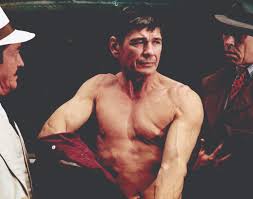
Charles Bronson is Chaney, a bit long in the tooth to be a broke hobo on the bum. But that’s what a Depression does.
“I don’t look past that next bend in the road.”
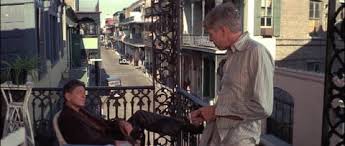
He stumbles across a “pick up fights” betting operator named “Speed” Weed, played by James Coburn, Bronson’s “The Magnificent Seven” and “The Great Escape” co-star.
Speed is a hustler and a degenerate gambler. When Chaney pays off for him, he drags him “home,” to New Orleans where he has connections, associations and an ability to talk, borrow and stumble into debts with the wrong sorts of people.
With his poetic friend, a med school dropout Poe (Strother Martin of “Cool Hand Luke), a man with a “weakness for opium” who ruminates on the knuckles properly engineered for fistfights, mouthy Speed will fast-talk his way into loans from Mississipi Delta sharks (Felice Orlandi and Bruce Glover) and a challenge match with Mr. Old Money, Chick Gandil (Michael McGuire).
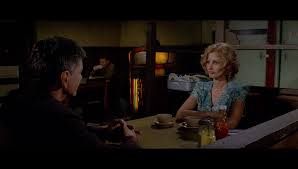
Chaney? He’d like to get to know the “fallen” woman Lucy he meets in an all-night diner, played by Mrs. Charles Bronson, Jill Ireland.
The plot is structured to lead up to “The Big Fight.” That comes at the midway point of the story, setting us up to see how these losers deal with sudden success or crushing failure. Everything that comes after could be an anticlimax. But of course there’ll be a second Big Fight.
Mid-’70s American cinema had the same sort of grit about it, thanks to the Nixon-Ford Recession, decaying cities and a “national malaise.” Casting older actors, up and down the line, gives the story a timeless, folk tale quality. Everybody cast-to-type here has a specific function in the plot. It’s to everybody’s credit that we don’t so much notice this as the film is playing a pick up on how virtually everybody involved, including the future Oscar winner Coburn, was never better.
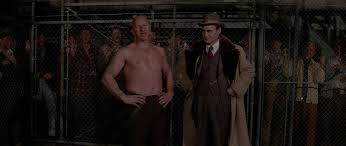
Veteran stuntman and screen heavy Robert Tessier, has his best role ever as the bald, hulking fighter “Big Jim,” the brawler with the guts to point out the obvious — “Hey Pops, a little old for this, ain’t you?”
But Bronson was tailor made for this part, a man of few words, simple needs and not much interest in anything else. His scenes with Ireland are perfunctory, transactional with just a hint of softness. Chaney knows better than to get sentimental over Speed and Poe. Or does he?
Watch Bronson’s eyes in the simple but percussive fights. It’s not just ducking roundhouses and throwing haymakers — a lot of them to the ribcage (Hill famously improved on Hollywood’s dated fight-sound-effects library by simulating punches with a ping pong paddle on a leather sofa). Bronson lets us see fear, confusion and concern, even for brutes who taunt and would crippled Chaney if they could.
Hill artfully blocks, shoots, edits and stages fights in abandoned factories, warehouses and the deck of a freighter. Martin’s floridly poetic Poe, his hair dyed and his suit Southern white, is introduced attending a Black New Orleans’ church’s Sunday service.
“The Pentacostals present a number of — points of interest.“
The river makes a beautiful backdrop for dips into Cajun culture for one bout, something Hill would dive into deeper for the National Guard Vietnam analogy “Southern Comfort” a few years later.
Genre pictures like “Hard Times,” cast with familiar faces put through their familiar paces, aren’t challenging cinema by any means. But they’re great comfort food, an amusing, engrossing and in the end satisfying experience.
Hill, like Hawks before him and John Woo after him, would go on to be damned good at delivering the goods in many such satisfying stories — “The Warriors” to “The Driver,” “48 Hours,” and “The Long Riders” to “Johnny Handsome,””Wild Bill” and “Last Man Standing.”

Rating: PG, fistfights, other violence, profanity
Cast: Charles Bronson, James Coburn, Jill Ireland, Michael McGuire, Margaret Blye, Robert Tessier, Felice Orlandi, Bruce Glover and Strother Martin.
Directed by Walter Hill, scripted by Bryan Gendoff, Bruce Henstell and Walter Hill. A Columbia release streaming on Tubi, et al
Running time: 1:34



