

Denzel Washington furthers his efforts to keep his promise to “do right by” the late, playwright August Wilson by producing another film of one of Wilson’s plays, this one he assigned to his sons, actor John David Washington to star in and director Malcolm Washington to film.
“The Piano Lesson,” already the subject of a fine and far more brisk TV movie 30 years ago built around Charles S. Dutton, Alfre Woodard and Courtney B. Vance, earns a stately and cinematic treatment from the Washingtons, with Danielle Deadwyler, Ray Fisher and Samuel L. Jackson fleshing out the leads.
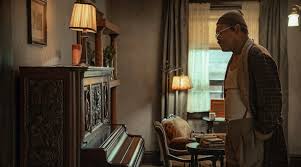
The limitations of the stage demand that poetic word images to tell the story — anecdotes, reveries, backstory and events of the past recalled in the fictive present. Wilson excelled at this, with this Pulitzer Prize-winning masterpiece relating the experience of the African American diaspora via the story of how an old, slave-decorated upright piano made its way from Mississippi to 1936 Pittsburgh.
For his feature directing debut, Malcolm Washington “opens the play up” by showing us those past events, visualizing the supernatural element of the play — the piano’s white owner’s ghost “wants it back” — and making much that was mystical, magical and metaphorical literal in the process.
We don’t have to imagine the fraught circumstances of how the piano was stolen in 1911 or the truckload of watermelons Boy Willie (John David Washington) and his truck-owning pal Lymon (Ray Fisher) have hauled to Pittsburgh’s Black neighborhoods for a lucrative sale in 1936.
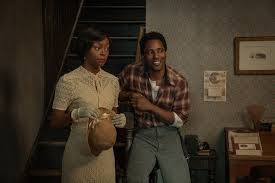
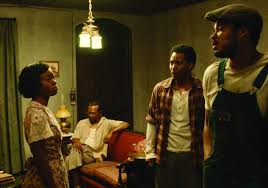
Boy Willie is there to visit his sister Berniece (Deadwyler) and Uncle Doaker (Samuel L. Jackson). And he’s there to talk Berniece into selling that heirloom piano to raise the last of the cash he needs to buy a chunk of the very land their family was once enslaved on.
Old Man Sutter, last of his farming line in that part of Mississippi, has died. “Fell into a well,” Boy Willie crows. It’s the “Yellow Dog Ghost” at work, a bit of supernatural karmic revenge visited upon the morbidly obese old racist for a lynch mob he headed twenty-five years before.
If Boy Willie can just buy that land… At least Uncle Doaker seems to get it.
“As long as Sutter had it, he had us. We was still in slavery.”
Berniece, whom we learn is widowed, isn’t selling that piano.
“Money can’t buy what that piano cost!”
Uncle Doaker gets that, too. But he wonders about the “bad luck” that hangs over that keyboard. And their kin, the blues singer-songwriter and drinker Wining Boy (Michael Potts, terrific), sees the instrument as a curse that needs to be banished.
Berniece has a would-be suitor, the Pastor Avery (Corey Hawkins) and a little girl. Is that piano holding her back? The preacher thinks so.
“Everybody got stones in their passway. You ain’t got to carry them with you.”
But through Boy Willie’s storytelling, bargaining and pleading and Berniece’s blunt rebuffs, we pick up on the rift in their relationship and the weight of violence on African American families, then and now.
To my tastes — I’ve seen the play a couple of times, and the 1995 TV movie — director Malcolm Washington gets too caught up in the literal and loses track of the allegorical nature of the events of the play. The words do the work here.
We can duck into a jazz club where the lads try their hands at winning the attention of local ladies as a vocalist croons “Don’t You Feel My Leg,” a ‘sexy ’30s blues tune made famous in the ’70s.
But “opening up” a claustrophobic play tends to undercut the emotional, oppressive weight of the remembered family history, memories that haunt generations and literally close in around characters as the play progresses.
So “Piano Lesson” isn’t as moving, gripping, immersive and polished as “Ma Rainey’s Black Bottom” or “Fences,” two prior Wilson adaptations to make it to the screen.
Our first time director slows the proceedings to a crawl at times, as lively “new” elements in the script make the many conversations and negotiations seem more static. But that doesn’t ruin the show.
And even though I’ve been slow to warm to Denzel’s other “nepo baby” son, John David, as an actor, he summons up the garrulous, not-thought-this-through essence of Boy Willie. Here’s a man a little too anxious to unload a family heirloom that has blood on it, a man who may have blood on himself.
The playwright Wilson sometimes spoke of the meaning of his shows sneaking up on him. And that gives filmmakers a bit of leeway in adapting his work.
The Washingtons have revived an American classic and given it new currency by serving up a visual and visceral taste of the oppression this diaspora fled the Deep South to escape, oppression which scarred such families for generations, and from the looks of things, for generations to come.

Rating: PG-13, profanity, violence, racial slurs, alcohol abuse
Cast: John David Washington, Danielle Deadwyler, Ray Fisher, Michael Potts, Corey Hawkins and Samuel L. Jackson
Credits: Directed by Malcolm Washington, scripted by Virgil Williams and Malcolm Washington, based on the Pulitzer Prize-winning play by August Wilson. A Netflix release.
Running time: 2:06


 Movie Nation