
“Le samouraï” (1967) is rightly regarded as the hit-man movie, the one which most modern thrillers in this lone-gunman genre spin out of.
It’s got a handsome solitary “Killer,” living in a non-descript apartment with only a pet bullfinch (not a houseplant), getting his contracts through shady third parties, dependent on that one guy who can provide him with fresh license plates and registration for all the Citroens he steals, and a revolver when he asks for it.
John Woo, David Fincher, Walter Hill, Luc Besson, Nicolas Winding Refn and Quentin Tarantino have borrowed elements of this film to formulate a cinematic cliche — the loner who makes his (or her, “La Femme Nikita”) living by clocking in and killing targets for cash.
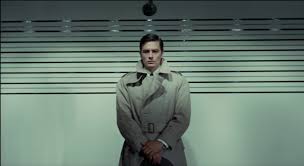
The movie that inspired this romantization of professional murderers is a spare, suspenseful thriller that parks handsome Alain Delon in the title role, a 30ish shooter so meticulous in his preparations that he cooks up not one alibi for “the night of,” but two. He’s expecting to get caught and he wants to be ready for the inevitability of the French police commissioner (François Périer) and his “routine roundup” of all Paris’s usual “suspects” — some 400 in number, in this case.
Delon’s Jef Costello uses his killer looks to score one alibi (played by Nathalie Delon, his then-wife) and his underworld savvy (a mob poker game) for the other.
He carries a vast collection of keys sure to fit whatever Citroën DS he comes upon along the street. He swipes one, drives it to an open, unmarked garage where no words are necessary for the fixer (André Salgues) to change the plates and registration, and surrender Costello’s pistol of choice — a revolver — for the night’s work.
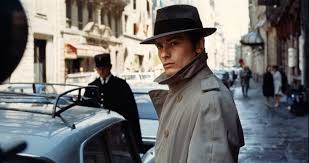
But hitting the owner of a posh club in the middle of a busy night, even in a trenchcoat with the collar turned up and a fedora pulled down over his eyes, doesn’t seem smart. It’s as if our killer wants to be picked-up, as if he relishes the ritual of the ’60s French version of a police line-up.
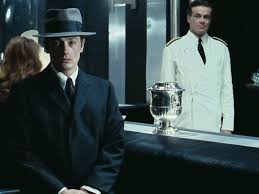
The star piano player (Cathy Rosier) in the nightclub “made” him. The uniformed barman (Robert Favart) and others got a damned good look, too.
With no anonymity in the “Can you identify the man” process, virtually everyone involved is “uncertain” that Jef was the shooter. And he’s got those alibis. So he walks.
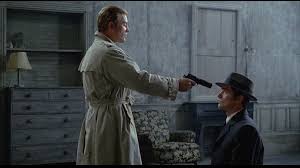
As is the way of such tales, his “payoff” turns into a double-cross. Now Jef must elude not just the police, who tail him and bug his flat, but the monied heavies who turned on him when he got arrested.
The film’s tone is set by a ten minute prologue in which no words are spoken, a touch borrowed by almost every filmmaker who sets out to do a film in this genre and understands the point of that tribute.
There’s a steely fatalism to Delon’s performance that sells this picture and made the character iconic. But no, he and writer-director Jean-Pierre Melville (“Bob le Flambeur,” “Army of Shadows”) didn’t invent any of this out of whole cloth.
When you look at Delon’s distinctive costume for the film– suit, fedora hat and trenchcoat — the cinephile can’t help but see the handsome Frenchman as cosplaying Alan Ladd in “This Gun for Hire (1942).” That is true urtext for this genre, whose hired assassin anti-hero can be traced back not just to American Westerns, but to Japanese samurai stories — as Melville argues — and tales of Chinese swords-for-hire.
The creepy touch Melville liked to give his killers — white cloth (film editor’s) gloves — seems ahead of its time, now.
The moral ambiguity of much of Melville’s underworld cinema is biographically traced back to his time with the French Resistance during World War II. He relived that experience through the film that followed this one, “Army of Shadows.”
Like many movie-mad members of his generation, after the war he was crazy about all things American — films, filmmakers and film genres. He was leaning into “This Gun for Hire” on purpose, just as he gave the hit-man’s would-be killer a Cadillac for a getaway car. You didn’t see many Yank tanks that size in the narrow streets of 1960s Europe.
Even given the picture’s stand-out attributes, I think “Le samouraï” is best appreciated today as a reset and relaunch of the genre. There have been better “lose your tail” chases, more colorful killers and grimmer final showdowns in the half century since this came out.
Melville’s films didn’t often get U.S. distribution, and this one arrived five years later, dubbed. But when it showed up you know Hollywood filmmakers and aspiring filmmakers took it in. The homages started in the ’70s and continue to this day.
It wasn’t just Luc Besson who’d make a name imitating Melville’s “cool” spin on familiar archetypes, even if nobody else was bold enough to dress their killers like Alan Ladd. To truly reinvent the genre Melville reinvented, you’d have to show us a “real life” hitman’s personality, world and crimes. Only “The Iceman” had the nerve to do that.

Rating: TV-MA
Cast: Alain Delon, François Périer, Nathalie Delon, Cathy Rosier and André Salgues
Credits: Scripted and directed by Jean-Pierre Melville and Georges Pelligrin. An S.N. Prodis/Sima release on Tubi, Amazon, etc.
Running time: 1:41



