

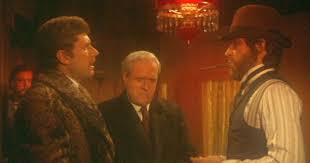

Scenes rarely play like “scenes” in the films of Robert Altman. They don’t so much begin, reach their point, and end. The dialogue is cluttered, non-stop, layered in around the leads. “Important” lines from the characters the story is about melt into the conversations going on all around them, some punchy and funny, some inane.
It’s like lives — a world — the viewer drops in on, eavesdropping or even invited into by the human comedy — sometimes tragic — unfolding in front of you.
Altman brought “Altmanesque” to the Western with “McCabe and Mrs. Miller,” a scruffy, gorgeous star driven drama about a gambler and entrepreneur (Warren Beatty) who meets a prostitute (Julie Christie) who introduces herself life this.
“I’m a whore, and I know a LOT about whorehouses.”
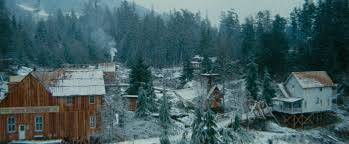
“McCabe and Mrs. Miller” was a big studio star vehicle with a stunning Pacific Northwest setting (Squamish, British Columbia was the filming location). Altman had spent a little of his “M*A*S*H” capital in Hollywood on the wildly eccentric “Brewster McCloud.” He tried to play Hollywood’s game with films like “McCabe,” the later Elliott Gould/Raymond Chandler mystery noir “The Long Goodbye” and the gambling buddy dramedy “California Split.”
The set is almost as detailed, wooden and “lived-in” as “Popeye’s” Sweethaven, which came later. The wintry location shooting, with themes and images borrowed by such later films as “The Claim” and” The Hateful Eight,” would provide a backdrop for a tale a of man trying to live “up” to his reputation and a British prostitute trying to get her piece of the American Dream before she aged out of that chance.
But being an Altman film, the obvious isn’t “obvious” and the chiaroscuro of the crowded images and “world” we’re immersed in is what’s paramount in this Warner Brothers box office bomb.
Beatty’s McCabe rides into newborn village Presbyterian Church — named for the structure they’re building, a symbol of “civilization” — as a man with a bearskin coat, a bowler hat and a reputation.
The proprieter of the bare-bones-minumum saloon (Rene Auberjonois) thinks he knows the man’s name, and his reputation, that he killed a fellow a while back. McCabe does nothing to deny this, insists he only be called by his last name, and rolls out a tattered red duck table cloth to invite the locals to play poker.
An Altmaneseque touch — we don’t see McCabe win, clean out the locals and finance everything to follow via his skills at five card stud. He loses. A lot.
But next thing we know, he’s secured land, planned a saloon and brothel and traveled back down the trail to Bear Claw to procure prostitutes, the saddest and most ill-used hookers in the West.
It isn’t until Mrs. Miller rolls up on him, asks him to feed her and lays out her “hygiene” and long-term plan (to make enough money to buy a San Francisco boarding house for her declining years) that everything starts to pay off for McCabe.
Mrs. Miller makes him build a bathouse, makes patrons of their brothel — which he also builds — visit and pay to bathe before they’re allowed to be near the new “San Francisco” sex workers she brings in, and McCabe almost doesn’t care that his saloon and gambling parlor takes a back seat.
McCabe kind of, sort of, goes sweet on Mrs. Miller, who indulges that ardour — for a price. Mrs. Miller has a secret. So does McCabe, we figure.
When McCabe is challenged to sell out his property to a bloody-minded mining concern (Michael Murphy represents them), we start to wonder if he’s as tough as his bluff, foul-mouthed bravado makes out.
“If a frog had wings, he wouldn’t bump his ass so much, follow me?”
All these decades later it’s easy to forget the highly-regarded “McCabe” came out the same year as the lighthearted James Garner/Jack Elam farce “Support Your Local Gunfighter.” They share similar themes (a gunman who may NOT be a gunman) and milieu (a mining town with an infamous brothel).
Altman’s film, which Warren Beatty has sometimes claimed he co-directed (he did that a lot), buries that connection and indeed that very familiar Western “reputation” theme, along with the possible romance in something like an allegory about American capitalism and the “civilizing” of the West.
Not that “Support Your Local Gunfighter” didn’t do that, too.
Members of Altman’s forming repertory company (Auberjonois, John Schuck as an overdressed dandy of no visible means of support, Bert Remsen, Keith Carradine, Shelley Duvall) populate Presbyterian Church. And trouble, when it comes, is larger than life, as it was in “M*A*S*H,” “Popeye,” etc.
Altman’s reputation as part of a new generation of filmmakers is partly built on the way he used music and musicians, went for a hip score with songs by then-young-and-upcoming Canadian singer-songwriter Leonard Cohen, whose tunes comment on characters and action.
Cohen’s music works well enough, but it dates the film as surely as the “Ballad of Jeremiah Johnson” dated Pollack and Redford’s Western of the same era.
Altman went out of his way to show us a truer picture of The West — integrated, with African American and Chinese participants in the Building of America. And he was never shy about letting racism show itself, too. Playing slurs for laughs was common in the “Blazing Saddles” era.
Altman’s touches render the soundtrack cacaphonous and “Altmanesque,” not always to the film’s advantage. And burying the obvious “reputation” and “budding capitalism” themes doesn’t hide them.
But Beatty is in rare form, blustery and bluff with his crude come-ons to potential customers — “Go home and pay with Mary Five-fingers.” The mere presence of cockney(ish) Christie turns him soft and blushing.
“You think small because you’re afraid to think big,” she barks. And he obeys. Christie gives us the notion that most mortal men would.
The third act’s attempt to use “the law” is one last moment of “message,” before the epic showdown in the snow has been celebrated and copied by more than just Tarantino and Michael Winterbottom (“The Claim”).
But you can see why this downbeat, against-the-traditional-grain Western bombed at the time. So much effort is put into avoiding showing or stating the obvious, in making McCabe weak and obscuring the town’s flawed and generally unsympathetic “citizens,” that what made other versions of this sort of story work is missed.
This can feel like “Paint Your Wagon” without the cast doing the singing.
It’s still a richly-rewarding plunge into the smelly, dirty, greedy and lawless West, where getting there first and setting up shop before the competition mattered more than any “morality” of the business or the unsavory chancers who ran them, where nobody was under the illusion about “noble,” “civic-minded” townspeople rallying to see that justice is done.
Everybody here moved here because they’d failed elsewhere, and “reinvention” was the true lure of the American frontier. And as hard or easy as making one’s fortune might be, the real test was keeping it from those set on taking it.

Rating: R, violence, drug abuse, nudity, profanity, smoking
Cast: Warren Beatty, Julie Christie, John Schuck, Rene Auberjonois, Bert Remsen, William Devane, Keith Carradine, Michael Murphy and Shelley Duvall
Credits: Directed by Robert Altman, scripted by Robert Altman and Brian McKay, based on a novel by Edmund Naughton. A Warner Bros. release on Tubi, Criterion, Amazon, etc.
Running time: 2:00


 Movie Nation