

In an earlier life, I used to produce and engineer (record and edit) radio programs at the University of North Dakota public radio stations. A great favorite was the weekly taping with historian and history teacher Robert Wilkins, host of a big band music show called “Out of the Past.”
On the air and off– as we were taping — Wilkins would regale listeners and sometimes just me with tales of his years in Chicago, playing “the brass bass” (a euphonium, a tuba without a bend in the horn) for assorted dance bands of the era.
He was a genuine character, avuncular, knowledgable beyond the point of “authoritative” and occasionally quite opinionated. The first time I ever heard of Horace Heidt and his Musical Knights was in an “Out of the Past” episode on what Wilkins called “Mickey Mouse Music.” Heidt led a popular swing band that produced “ditties,” cutesy little songs that seemed made for the radio of that era because they were.
And talking about Heidt, Wilkins brought up the radio show “Pot o’Gold,” and the movie it inspired, mentioning that Jimmy Stewart and Paulette Goddard starred in it, a “ditty” of a movie from 1941.
Darned if this Youtube staple didn’t turn up on Roku, and I’m always down for Jimmy Stewart and Paulette Goddard, especially in a film by George Marshall, who directed “Destry Rides Again,” Jerry Lewis comedies, musicals like “Pot’o Gold” and lots and lots of TV, a former silent film actor who directed into the 1970s.
There are hints of Stewart’s classic “It’s a Wonderful Life” — still five years away — in this sweet little nothing of a comedy, inspired by the Heidt radio show and co-starring Heidt and his band, featuring singing comedian Art Carney 14 years before “The Honeymooners.”
Our hero “Jimmy” is a small town character, beloved as the guy who inherited his father’s music shop, which has been “failing successfully for twenty-five years.”
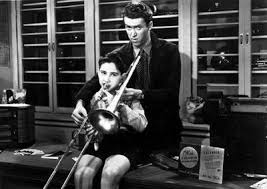
Jimmy Haskell (Stewart) is content to let child prodigies practice at the shop’s piano, kid trombone virtuosos use a horn for a bit and teens listen to records over and over again rather than buying them.
His rich “healthy” breakfast food (cereal) tycoon uncle (Charles Winninger of “Destry Rides Again”) blusters that he’s “frittering his life away,” but this George Bailey of the B-flat harmonica (Jimmy’s chosen instrument) sees himself as a vital member of the community.
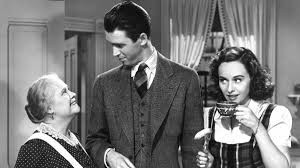
Only when his pal, the sheriff, serves him with unpaid debt papers does Jimmy accept the inevitable. But once ordered to the big city, he stumbles into his uncle’s sworn enemies –the McCorkles, because cute singer Molly (Goddard, Chaplin’s ex-wife and “Modern Times” and “The Great Dictator” co-star) mistakes him for somebody else and calls him “stupid.”
The McCorkles are letting a nascent big band (Heidt et al) live and rehearse in their boarding house just to irk Old Man Haskell. Falling for Molly seems like the last thing Jimmy would want to do, even if the band lets him join them on harmonica for “Pete the Piper,” adding him to their harmonica trio.
Did I mention Uncle Charlie hates “the infernal racket” and “dad-blasted bedlam” of big band music? He does. That he calls the cops on the band and the McCorkles? That he has a nationally broadcast radio show of homilies, geezer bromides and very low ratings?
“Sort of a stinker, isn’t he?” Jimmy admits.
It takes very little tomfoolery, a little japing, mistaken identity and a prank or two to throw Jimmy and the old man in jail, and then Mr. Haskell off to the remote, telephone-free wilds of Canada to recover, which is how a “Pot o’Gold” radio show is born.
There is nothing in this brisk, breezy and formulaic comedy that would challenge the great comic films and filmmakers of its era. It’s not Sturges sophisticated or laughably Lubitsch-esque.
But Stewart, leaning into the laconic Everyman and Anti-heroic hero that became a part of his image after “Destry,” is a laid-back delight. He fakes harmonica playing, sings “When Johnny Toots his Horn” and even acts out a Cyrano-esque “Romeo & Juliet” balcony scene (in a dream sequence) where better singer Larry Cotton croons his love for fair Molly as Jimmy lip-syncs.
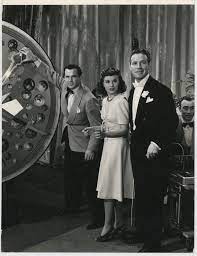
Goddard’s singing was doubled by the velvet-voiced Vera Van. Future Emmy and Oscar winner Carney can be spied, in the raven-dark hair of youth and in his motion picture debut, in a few shots and has a line or two as the band’s radio announcer in the third act. Also notable is the fact that President Roosevelt’s son James produced this clever, tuneful quickie, which Stewart shot simultaneously with an MGM film “Ziegfield Girl,” where he had a featured role.
That’s how “demanding” the work was.
The cleverest things our director delivers in this production include Jimmy’s welcome-to-the-big-city scene, where he meets characters who burst into song — a trucker, a Chinese laundryman, Black shoeshines and others crooning and dancing “What’s a’ Cooking?” — and an a’capella “Musical Knights” hymn to Irish Mother McCorkle’s (Mary Gordon) cooking at dinner time.
“Pot o’Gold” is never much more than a musical ditty, and the music itself was so lightly regarded that the United Artists release fell into copyright’s public domain, like many movies of this era.
But you can see hints of Stewart’s “Wonderful Life” turn in this small town/small-timer comedy.
And as movie musical ditties go, this one plants an earworm or two and lets Stewart, Goddard & Co. crack wise, break into song or break out the old mouth harp in ways that must have tickled audiences then and still packs a few delights in a minor key all these many years later.

Rating: “approved,” G-worthy
Cast: Jimmy Stewart, Paulette Goddard, Horace Heidt, Mary Gordon and Charles Winninger, with Larry Cotton and Art Carney.
Credits: Directed by George Marshall, scripted by Walter DeLeon, inspired by the radio show created by Haydn Roth Evans and Robert Brilmayer. A United Artists release on Roku TV, Youtube, etc.
Running time: 1:26


 Movie Nation