


“The Tunnel to Summer, the Exit of Goodbyes” is a poetic, understated anime romance about “first love” and fulfilling your heart’s desire via a supernatural tunnel. That’s a place where time stands still as you reconcile yourself with your past, or discover whether you’re worthy of your heart’s desire.
It’s minimalistic, with little dialogue and lots of space for the viewer of this manga (graphic novel/comic book) adaptation to fill in one’s own interpretation of its cryptic intention and meaning.
The animation style is classic anime — lovely watercolorish pastel color palette, slightly under-animated movement and human characters reduced to simplified anime detail and standard manga “types” in a story that — due to its limited effects — can make one wonder why animate it at all.
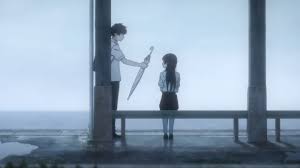
The boy, Kauro Tono, is an archetypal mop top, an introverted uniformed schoolboy taking his fashion cues from boy bands and his life story from every Lonely Kid who dreams of handing the pretty new girl in school an umbrella, just when she needs it.
The teen girl, Anzu Hanashiro, is a shy, standoffish and bookish beauty who accepts that umbrella at the Kouzaki train station, makes the gesture of getting his number so that she can return it, and expresses relief when it turns out that they’re in the same class in the bucolic coastal suburb (No cars?) where they live.
Tono (voiced by Oji Suzuka in the subtitled version I saw) lets on that he lives with his alcoholic, abusive single dad (Rikiya Koyama) and we understand before Hanashiro (Marie Iitoyo) does that Tono suffered a loss — his beloved sister Karen (Seiran Kobayashi).
Hanashiro doesn’t have anything “like parents.” Convenient? Well, such is the way of anime romances. She’s an aspiring manga writer/artist who dreams of a career writing immortal works in that art form. He’d like to find some way to reconnect with his sister, maybe reset his family’s life.
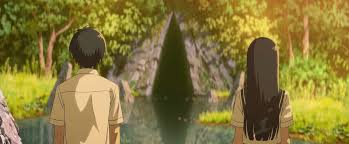
That’s when he stumbles across “the tunnel.” It’s more of a cave actually, and notorious. Walk into “The Urashima Tunnel” and time stands still for you even as it continues to pass outside. You wade threw leaf-strewn waters under red maple trees and encounter things about yourself, your past, and maybe your hopes.
Tono tells Hanashiro about it, she deducts an interpretation of the magic and makes him join her as she resolves to lead them on a “joint operation,” investigating the tunnel, its effects, how time passes there, etc.
They’ll do this via text messages on their flip phones. The risk involed is of walking so deep into it that they age at different rates, disappearing from their current lives, with only the hope that Hanashiro’s manga will be read “1000 years from now” as consolation.
Will mastering this mystery, perhaps on summer break while other kids are at “the summer festival,” give them what they want?
“The Tunnel to Summer” begins with promise, heart and what almost passes for edge. Hanashiro may be quiet, but she is assertive, pushing Tono around, pinning him to the floor in every 15 year-old heterosexual boy’s fondest fantasy. And when the mean girls demand her attention in class and belittle her choice of reading material (“Old manga?”), she punches one out.
The abusive childhood Tono is living through may be a cliche, but at least it is emotional and right out there on the surface.
Tono’s first “disappearance” in the tunnel — with classmates blowing up his phone with “Are you dead? Did you die?” texts as he’s gone for a week — hints at a subtext ingrained in Japanese culture — suicide.
But the navel gazing here is so very Japanese and self-referential to an onanistic degree that I found almost nothing to grab hold of in this tale.
The dialogue is so banal the imagery has to carry the film. And it doesn’t. The story, from its anime Incel male wish fulfillment fantasy “meeting in the rain at a train station” to the new-in-town-and-thus-attainable fantasy girl (whose background isn’t so much as sketched in) is the hoariest of cliches.
How can you tell the author of “The Tunnel to Summer, the Exit of Goodbyes” was a man? Start with that, and work your way through the lonely mop top manga/anime tropes.
And making Hanashiro an aspiring artist who wants to obtain “special talent” is that myopic trap of “write what you know,” an aspiring manga writer writing about an aspiring manga writer.
Nothing in the “magic” of this tunnel, as adapted by Japanese TV anime veteran Tomohisa Taguchi, makes up for the spareness of the story, the low stakes or limited chances for engagement, which may be a hallmark of Japanese art but in this case adds up to a film seriously thin on meaning and entertainment value, I thought.

Rating: unrated, some violence, alcohol abuse
Cast: The voices of Oji Suzuka, Marie Iitoyo, Rikiya Koyama and Seiran Kobayashi
Credits: Scripted and directed by Tomohisa Taguchi, based on the manga/comic book by Mei Hachimoku. An IFC release.
Running time: 1:23


 Movie Nation