

“And Then Come the Nightjars” is a droll and poignant tale of male bonding and how a traumatic event scars such a relationship and sounds a death knell for a way of life.
It’s distinctly British elegy, a two-handed piece scripted by Bea Roberts, based on her award-winning play and given a verdant, wistful treatment by first-time feature director Paul Roberts. With original stage stars David Fielder and Nigel Hastings recreating the characters for this “opened up” production, “Nightjars” makes for a funereal film with flashes of wit, drama and fire.
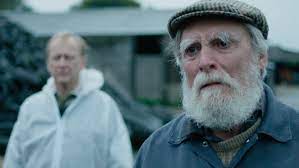
A solitary white-bearded farmer (Fielder) works on his gates, grates and his outbuildings, fastidiously scrubbing down surfaces left and right, dipping and splashing disenfectant everywhere as snippets of the news play out on the radio.
It’s 2001 in Devon, and he’s doing his due dillegence as what is shaping up to be one of Britain’s worst foot-and-mouth disease outbreaks ever is crawling from Essex into other Home Counties.
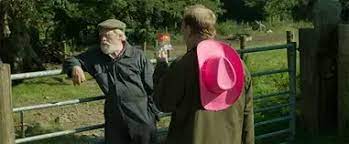
That fellow who shows up in a pink cowboy hat “I won at the fete?” He’s Jeffrey (Hastings), the local veterinarian.
Don’t let the pink hat and crusty Michael’s “Christ and f—–g baby Moses in a basket” reaction to it throw you. And Michael doesn’t let Jeff’s hours-long “stop by” chat as they keep vigil over Dolly, who is about to calf, distract him. With disease about and a vet in his calfing barn, he senses what Jeff won’t tell him.
But the reassurances that “you’ve be fine,” that this disease isn’t close, that his herd — Michael names every cow — is healthy, seem enough.
“You’re the only one I trust with my girls.”
And maybe Jeff’s just killing time here because things aren’t great at home. Michael guesses that, too.
But that bird Michael hears but never sees? It’s a nightjar, “the bird of death…bad luck.”
Days later Jeff comes back in his haz-mat coat to talk Michael down from a shotgun stand-off with government officials there to “dispose” of the herd. Everything’s gotten worse, from Jeffrey’s marriage to Michael’s denial of the foot and mouth disease almost at his door. No, his cows aren’t sick, but no, Jeff can’t “go talk some sense” into those who have a government mandate, which he’s hear to oversee and perform.
He’s going to have to kill Michael’s cows. And his pleas work their way around to what can go wrong when this sort of this is rushed because of delays like Michael’s attempting here. “Humane” goes out the door.
Their easy, joking and over-familiar relationship — Jeff doesn’t hesitate to take nips off his ever-present flask, but never offers it to the farmer — bends from friendly/tetchy to testy and panicked. Jeff is haunted by what he must do. Michael is lashing out, even at his friend. They need each other to get through this. They just need to figure that out.
Roberts scripts lovely exchanges that show how entwined in each other’s lives these two have become. This isn’t just a customer/businessman connection, not just a vet who makes his living off these folks’ livelihoods. It’s a whole way of life tied together in family, the rhythms of the farm work year, the changing of the seasons and the unchanging nature of their community, an ecosystem that needs every farm to work and pay off, every animal cared for, every institution and every person there to survive and their farm to make it to another generation.
The story jumps forward in time a few more instances, showing how events of 2001 impacted that delicate interconnection and changed the two men’s relationship.
The simplest way to describe “And Then Come the Nightjars” is as a “kitchen sink” play that’s escaped “to the Country.” It’s beautiful to look at, from the working interiors of a 200 year-old cattle farm to the tree canopy-tunneled backcountry roads.
Fleshed out with a farm country wedding as well as a more directly sinister “they’re coming to get my herd” stand-off, it’s a lovely film with a somber, sad undertone, a country life “dying of the light” that makes the journey from stage to screen with its heart still broken, but intact.

Rating: unrated, profanity, disturbing images
Cast: David Fielder, Nigel Hastings
Credits: Directed by Paul Robinson, scripted by Bea Roberts, based on her play. A Gravitas Ventures release.
Running time: 1:20


 Movie Nation