Movie Review: Canadian satirist notes further decline, “The Fall of the American Empire”

empire1.jpeg

Much has changed in the decades since the French Canadian filmmaker Denys Arcand first cast a satiric eye on Western Civilization, especially its North American practitioners, in chatty, thoughtful films such as “The Decline of the American Empire,” “Jesus of Montreal” and “Barbarian Invasions.”

The history we know about and are living through. And Arcand? He’s gone from chatty to long-winded in his late 70s.

“The Fall of the American Empire” has another French Canadian philosopher bemoaning how out of place thinkers are in the modern age, scoring clever points about what’s troubling about Canada and what “destroyed” — emphasis on the past tense — The United States.

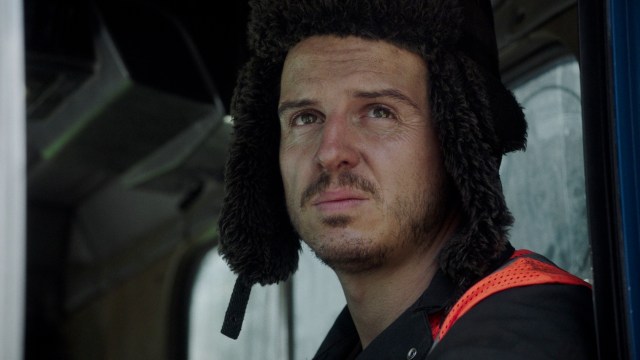
It’s the value system that emphasized money over all, something of a running thread through Arcand’s work, that displaces men like deliveryman Pierre Paul (Alexandre Landry). He is, he tells his longtime banker-girlfriend (Florence Longpré), “too intelligent” for most jobs in modern life.

“It’s a handicap,” he says, dismissing whole classes of very smart people which she brings up to counter him.

Novelists?

“The great writers were dumb as mules,” he declares. Hemingway thought he could box, for starters. He rattles down a list of authors and their foibles.

And don’t get him started on politicians. Bush, Blair, Sakozy — Pierre Paul charts the decline in thinking, morality and the intelligence of public life through the lot of them.

“Trump?”

“Imbeciles worship cretins!”

Pierre Paul quotes philosophers (also flawed, he notes) by the dozen in an enervated despair. When Linda questions their relationship and says “I can’t go on,” there’s not a hint of shock, heartbreak or meanness in his curt reply.

“Then don’t.”

Writer-director Arcand will test this too-smart-for-this-world misanthrope by hurling him into the conventions of a hoary, dope-who-comes-into-money thriller.

Pierre Paul drives his express delivery truck into the middle of an armed robbery. The money is plainly dirty, which puts Pierre Paul on the horns of a dilemma as the robbers, and the folks they’re robbing, kill each other or flee, wounded.

Bags of money are dropped at his feet. And on an impulse, this moral man in an amoral world does what people always do in such tales. He grabs those bags.

In short order, Mr. “Too Intelligent” is making every idiotic blunder we’ve ever seen in a “Nobody knows I have stolen dirty money” thriller. One of them is hiring, online, the most expensive hooker in Montréal (Maripier Morin) just because she quotes Racine and Aristotle on her website, and in the assumed name she takes on — Aspasie.

Another blunder? He instantly falls for this outlaw woman who arrives at their appointments in a bodyguard (not pimp) driven Jaguar.

And thirdly, the first person he seeks advice about his newfound stash is a famous criminal (Rémy Girard of “The Barbarian Invasions,””Jesus of Montréal” and “The Decline of the American Empire”). Yeah, tell a money launderer, fresh out of prison (where he was on college-work release, studying tax evasion) your ENTIRE story, and trust him to help you hide the money.

“Too intelligent” to ever go to the movies. Apparently.

There are mobsters in search of the cash, willing to gruesomely torture the one surviving and on the lam robber (Patrick Abellard). And the cops (Louis Morissette, Maxim Roy) are onto the hapless Pierre Paul in a flash.

He doesn’t even have the presence of mind to know his rights, blow off their blunt accusations and keep them from simply barging into his apartment.

empire2

Arcand gives Pierre Paul a righteous avocation. He connects with the West’s soaring population of homeless people, volunteering in a soup kitchen, listening to the stories of the displaced workers and Inuit who live on Montréal’s streets, handing out cash when he can.

The writer-director scores points on the broken capitalist system with Pierre Paul’s mild-mannered diatribes and in college lectures, where we’re reminded that “money has its own language,” that “poor people need the money, but corporations (and the super -rich) get all the handouts”

But “The Fall of the American Empire” may be the most sloppily plotted thriller to come along in decades. Why? Because Arcand would rather score his meek satiric points than sweat the details.

It’s great seeing very good actors we recognize, in the dim recesses of memory, from his earlier films. But we can’t help but notice this one is almost half an hour longer than the others.

And hell — who watches “The Decline of the American Empire,” “The Barbarian Invasions” (a post 9-11 summation of the state of the world) or “Jesus of Montréal” any more?

It’s not so much that they aren’t “holding up,” as we say. They may be prophetic, in a lot of their discourse and debate (in French, with English subtitles). But they were achingly of their time.

Arcand wastes too much of our time with this stumbling, dry, unfunny satire of thrillers, money and how to launder it. If you thought Netflix’s “Ozark” was long…

The filmmaker literally loses himself in the arcane “Panama Papers” business of how money is shuffled around, off-shore, or swapped out among the ranks of those eager to avoid taxes and hasten the end of Western Civilization as they do.

And like many a first-time filmmaker, his veteran of a half century of film can’t figure out when to drop the mike, how to extract himself from the talky-tangle he’s chatted his characters into.

“Fall of the American Empire” isn’t an awful film, and it probably will prove as prophetic as “Decline of the American Empire.” But it never lets you forget that its filmmaker identifies too closely with his hero, that he’s “too intelligent” to make a thriller, or bother with getting one right.

And in so-doing, his blunders are just as obvious as Pierre Paul’s.

2stars1

MPAA Rating: R for some strong violence, sexual content/nudity and language

Cast: Alexandre Landy, Maripier Morin, Rémy Girard , Florence Longpré, Louis Morissette, Pierre Curzi, Maxim Roy

Credits: Written and directed by Denys Arcand. A Sony Pictures Classics release.

Running time: 2:07


Posted in Reviews, previews, profiles and movie news | Comments Off on Movie Review: Canadian satirist notes further decline, “The Fall of the American Empire”

BOX OFFICE: The only records “Spider-Man” can touch are his own

“Spider-Man: Far From Home” did a vigorous $27 million+ on Wed., breaking the record for Marvel properties Wednesdays. Yes, that’s a record they’re keeping track of

Add that today to the stupid money the latest webslinger outing pulled in on Tuesday — $39 million — and Sony is looking at having $150 million in the box office bank by midnight Sunday.

Yes, it’s tailing off, but not before it comes out of the gate at a dead sprint. An $80 million weekend to go with the $66 million first two days and it’ll clear $150 with ease.

The grisly but not that frightening horror tale “Midsommar” had middling Tuesday night previews numbers — $1.2 million — and a decent Wed. and looks to have about $13 million in the bank by midnight Sunday. Not a dazzling take for a creepy movie that’s more about grief and haplessness in the face of cultish groupthink, it’s generating some of the more loopy, off-message reviews of the summer.

“Yesterday” is generating decent word of mouth and expects to have a strong second weekend — maybe $10 million or more.


Posted in Reviews, previews, profiles and movie news | 2 Comments

Documentary Review: “Mike Wallace is Here”

Mike Wallace Is Here - Still 1

For decades, four words invoking his name so inspired fear in the hearts of public figures that they became a cultural punchline.

“Mike Wallace is Here.”

The famous and the infamous were said to dread the thought of defending themselves, on camera, to the vaunted, veteran TV interrogator. His dogged insistence on asking those questions others avoided, not generally without tact — he always threw in a  “Forgive me!” after the bluntest queries — became Mike Wallace’s reputation, his legend.

Sure, it’s an exaggeration, which is the best reason to open “Mike Wallace is Here,” Avi Belkin’s documentary celebration of Wallace in the words of Wallace himself and colleagues and interview subjects who occasionally turned the questions around on him, with a sampling of his combative chat with disgraced Fox News host Bill O’Reilly.

O’Reilly professes to admire and emulate the aged Wallace (he stayed on TV for most of his 93 years on Earth), “the driving force behind my career” that to his “gotcha” and “don’t let him off the hook style.” Wallace, in that clipped bark of a voice that never failed him, has his producer play O’Reilly a sampling of O’Reilly’s shout-down style of “interview,” and corrects him.

“That’s not an interview, that’s a lecture!”

Maybe he was, as O’Reilly insisted, “a dinosaur.” But Wallace endured in a business that sheds most of its stars long before they’re ready to leave the stage, used his clout to achieve some of the biggest “gets” in TV history (Ayatollah Khomeini, Putin, Bette Davis) and became as big a celebrity as anyone he ever interviewed.

The proof of that is this film, more an editing job than a directing one, which is built around many interviews the notorious Wallace sat down for with his own colleagues — Lesley Stahl, Morley Safer and others.

Television talker Dick Cavett in the ’70s hosted the man whose name had already come to “strike fear in the hearts of brave men.”

We see Bette Davis, as tough as they come, called “difficult” to her face. We see Barbra Streisand comically bristle at being called “impossible,” and hear his equally prickly, more accomplished journalist co-star Safer ask Wallace the ultimate Wallace-style question.

“Why are you sometimes such a prick?”

Myron Leon Wallace, a Massachusetts son of Russian-American Jewish immigrants (“Wallik” was the family name, which Belkin and generations of Wallace interviews don’t bring up), graduated from the University of Michigan at the post-World War II peak of radio, and got into announcing and acting on that medium. He jumped straight into the newly-born medium that fast-displaced radio.

But he didn’t arrive as an interviewer. He was a voice-over announcer, a game show host, talk show producer, actor and TV pitchman.

And when the chance presented itself, he recognized a gaping hole in the TV interviews of the ’50s, even when they were conducted by the great Edward R. Murrow. “Softball” questions were the order of the day. He would be “nosy” “and insistent.”

He’d ask hard questions. His first series to attempt this style was “Night Beat,” a bracing slap in the face of puff piece profiles of the 1950s. Blunt “unrehearsed” interviews with klansmen, political figures (Eleanor Roosevelt), great artists and others.

wallace2.jpeg

Wallace, as the wrinkles piled upon wrinkles and he became the eminence grise of the medium, would hold later interviewers Oprah Winfrey, Larry King and others to the standards that became his reputation.

“People say you’re a patsy,” he snipped to Larry King.

He’d take people aback, make not-really-famous people, the accused and convicted by TV footage caught in a “gotcha,” cry, and shrug it off with “I’m sorry. I didn’t mean to do that.”

We get a peek at the person behind the persona, the father who lost a son, Peter, who died touring Greece in the 1960s, the four-times married “married to my job” workaholic.

And we sample decades upon decades of interviews, from America’s most celebrated playwright, Arthur Miller, to a then-young self-promoting New York real estate heir who achieved his greatest fame after Wallace died in 2012.

“Mike Wallace is Here” is too celebratory to be a genuine dissection of his legacy, the awful stumbles at “60 Minutes” merely touched on (sued by General William Westmoreland, hanging Big Tobacco whistleblower Jeffrey Wigand out to dry, the embarrassing sports profiles that were the ultimate puff pieces on later-caught cheaters like Lance Armstrong, Tiger Woods and (fawningly interviewed by Wallace himself) Roger Clemens.

His “gotchas” were widely criticized for coming down hardest on the relatively powerless.

But Lester’s film underscores how few TV talkers today have the stature, much less the spine, to ask questions that people don’t want asked, much less be required to answer. Wallace might have been a “dinosaur” at a TV show that has become known, in its latter years, for becoming a virtual TV interviewer museum. The door is open for somebody else to step into those shoes, even if most of today’s imitators limit themselves to barely trying them on.

3stars2

MPAA Rating: PG-13 for thematic material, some violent images, language and smoking.

Cast: Mike Wallace, Bette Davis, Lesley Stahl, Morley Safer, Oprah Winfrey, Salvador Dali, Arthur Miller, Barbara Walters, Jeffrey Wigand

Credits: Directed by Avi Belkin.  A Magnolia release.

Running time: 1:31

Posted in Reviews, previews, profiles and movie news | Comments Off on Documentary Review: “Mike Wallace is Here”

Preview, comedy in the confessional, “Surviving Confession”

Don’t recognize any of the faces in this conceptual comedy.

It comes our way (VOD, etc.) July 30.

Posted in Reviews, previews, profiles and movie news | Comments Off on Preview, comedy in the confessional, “Surviving Confession”

Movie Review: Bautista is the Uber passenger from Hell in “Stuber”

stuber1.jpeg

From the moment they meet, Stu the Uber driver in “Stuber” is a smart-ass.

Doesn’t matter that he’s a Pakistani-American pushover driving a Nissan Leaf in the evenings for extra cash, and his new passenger is a roided-up, tattoo covered LA cop. Stu, played by “Big Sick” comic Kumail Nanjiani, instantly wises off.

“Lemme guess, you want to me to take you to aaaaaall the Sarah Connors in town!”

Stu has little compassion for the Lasik surgery glasses Vic (Dave Bautista of “Guardians of the Galaxy”) has to wear.

“You going to a racketball game later?”

Nanjiani just kills when he’s grabbing stereotypes (meek, moral South Asians, overly-polite drivers) and shaking them to their senses. But the wisecracks thin out and grate when the violence takes center stage. And “Stuber” is stupidly violent.

Canadian director Michael Dowse, who did the hockey comedy “Goon” and the romance “What If,” kind of lost me sometime after the torture, maybe in the middle of the insane first act shoot-out in a critters-in-cages crowded veterinary clinic.

We’ve seen versions of this hapless civilian tied to an ultra-violent cop before, with Bruce or The Rock or DeNiro as the tough guy. And the chemistry between this mismatched couple isn’t awful.

Bautista can be funny, but mainly he’s here for the mayhem — which he delivers, first scene to last. And Najianni makes a memorable ninny, bullied by his sporting goods store boss, forever in “the friend z)one” with his college crush (Betty Gilpin of “Glow” and the recent “A Dog’s Journey”), lured into business ventures just to be near her and still not listening to advice from “Douche Lundgren,” the Uber client who hires/”kidnaps” him for an evening-long pursuit of a murderous martial-artist/drug dealer (Iko Uwais).

“You know, I really don’t remember signing up for this TED talk!”

stuber2

“Stuber” has one running debate, about “manhood,” with the sensitive male getting unwanted “Man Up” lessons from Mr. Raging Testosterone, and the brutish cop earning quasi-feminine lectures on being a better father to his artist-daughter (Natalie Morales).

The film makes its obligatory visit to a strip club, and utterly upends that #MeToo moment in most action movies. “Full frontal” was never sillier in a shoot-em-up.

But aside from that,this is strictly cut-and-paste formula filmmaking, from the off-the-books “Doc” (Scott Lawrence) who can patch up people, even though he’s a veterinarian, to the heroin dealer house in the barrio that Vic the half-blind cop cracks up to get his next lead.

Bautista makes what he can of a character who squints through his anger-management issues, and Nanjiani can be a funny foil, probably riffing lines like “That’s a hard ‘no'” at every suggestion he buy into this cop/customer’s ethos and mission.

But how funny can that fifth or 25th exploding head shot be? The shooting, the gun shopping, the body count don’t just pile up. They slow the picture down and break the flow of what’s funny.

Still, you’ve got to hand it to filmmakers with the guts to gut Uber, and the wit to make a “silent but deadly” electric car a plot device.

If only they’d been quicker to the punch line, and a lot less quick to pull the trigger.

1half-star

MPAA Rating: R for violence and language throughout, some sexual references and brief graphic nudity

Cast: Kumail Nanjiani, Dave Bautista, Natalie Morales, Karen Gillan and Betty Gilpin

Credits: Directed by Michael Dowse, script by Tripper Clancy. A 20th Century Fox release.

Running time: 1:33


Posted in Reviews, previews, profiles and movie news | Comments Off on Movie Review: Bautista is the Uber passenger from Hell in “Stuber”

Bloomberg News says Movie Theaters are doomed.

Yeah? And?

This has been where things are going for a few years, but the death spiral has been interrupted repeatedly by this or that trend or genre that suddenly exploded in popularity

Maybe the death will be sudden, but my guess has always been a lingering “Last Picture Show” passing.

Kids these days, though– they’re locked into phone media, not dating or going out as much, unless their horror/comic book or musical tribe insists on it.

https://t.co/ASVRWGGelH https://twitter.com/BWilliLiou/status/1146084343967834112?s=17

Posted in Reviews, previews, profiles and movie news | 1 Comment

Preview, a comic murder mystery with Collette, Craig, Chris Evans — “Knives Out”

Craig sounds like he’s goofing on Pierce Brosnan in this trailer for the Thanksgiving comedy.

Christopher Plummer and Lakeith Stanfield are also on board.

Posted in Reviews, previews, profiles and movie news | Comments Off on Preview, a comic murder mystery with Collette, Craig, Chris Evans — “Knives Out”

Preview, “Jacob’s Ladder” remade

Michael Ealy stars in this remake, which is coming out later this summer.

It’s a reinvention of the story that Bruce Joel Rubin told, with Tim Robbiins and Danny Aiello and others back in 1990.

I interviewed Rubin when the original film came out, and the writer of “Ghost” and “Jacob’s Ladder” had a serious obsession with The Tibetan Book of the Dead he was working out, to say nothing of that famous short story turned short film on TV’s “Twilight Zone,” “An Occurrence at Owl Creek Bridge.”

I see a little of that here, a few repeated images, and a LOT of credited screenwriters probably NOT as familiar with “The Tibetan Book of the Dead.”

Posted in Reviews, previews, profiles and movie news | Comments Off on Preview, “Jacob’s Ladder” remade

Movie Review: “The Last Black Man in San Francisco”


black3.jpeg

Operatic in tone, a love poem that’s “Howl” raw in scope and despair, “The Last Black Man in San Francisco” is a deadpan elegy to a city, its ever-shifting populace, family lore and the weight of the past.

If Joe Talbot and Jimmie Fail‘s love letter of a film is not great, it at least has the whiff of greatness about it.

It’s about two lifelong friends trapped — by choice — in a San Francisco that’s left them behind, just as it must have left their parents behind.

Fails, who came up with the story, plays a character named Jimmie Fails, a young homeless man not far removed from living in his father’s El Dorado, now rooming with longtime friend Montgomery (Jonathan Majors) and Monty’s blind grandfather (Danny Glover).

Jimmie doesn’t work. He just skateboards, and waits for the folks who live on this ancient pre-Earthquake house in the Fillmore District to leave for the day. That’s when he gets to work — painting, yard work.

“My grandfather built it, with his own two hands back in 1946,” he tells the homeowners, when they inevitably return and start thanking him and yelling at him and pelting him with vegetables. San Francisco manners, you know.

The viewer is allowed to doubt Jimmie’s tale of the house, because unlike Monty’s granddad, we are not blind. We just need to know that Jimmie’s obsession with “keeping the house up” goes back years.

Monty is a sketch artist and writer. He draws what he sees and jots down what he hears, the passing parade of young bloods (a Greek chorus) and loons, nudists and an ex-con street preacher (rapper Willie Hen).

Here they all are, at “the final frontier for Manifest Destiny,” a city whose industrial and shipping past are crumbling, the descendants of those who worked it trapped in an increasingly elitist metropolis that redevelops and gentrifies them out of existence, bringing in Haz-mat -uited clean-up teams to remove the pollution that longtime residents have lived with for decades upon decades.

When the house on 958 Golden Gate is vacated, Jimmie decides here’s his chance. He will take what he’s learned from years on the street, from his vagrant/squatter father (Rob Morgan) and move into the house.

Montgomery, who works in the city’s famous fish market, will join him.

black2

Jimmie introduces himself to the locals, promising to be “the best damn neighbor you ever had.” He makes himself at home, takes his touch-up painting inside and revels in the home’s ancient pipe organ, hide-away library and “witch hat” garret.

“What if we shouldn’t be here?”

“Who should be here more?”

Talbot, who co-wrote the script, peppers the picture with San Fran “types” — hipsters, go-getter realtors (Finn Wittrock), hippy tourism holdouts (Jello Biafra leads Segway-mounted historic district tourists, others pile onto Haight-Ashbury party trolleys).

The street people in the neighborhood once called “The Harlem of the West” include an opera baritone, and later a tenor who knows all the words to “If You’re Going to San Francisco.” The Jefferson Airplane complete the aural picture of the City by the Bay, underscoring other bits of the soundtrack.

The familiar faces here — Glover, former child star Thora Birch and funnyman Mike Epps — have just enough to do to warrant their presence. Epps, playing the guy who “borrowed” the car the Fails used to live in, riffs on Jimmie’s need to reconnect with his father.

“He ain’t at home, but he’s alone. Home, but not alone!”

What Talbot and Fails get across here is a lovely sense of displacement, of staying in a city so long you no longer recognize it, a place that has moved on and left you behind, financially if not psychologically — left you behind even if you’re still there.

That gives “The Last Black Man in San Francisco” a forlorn if occasionally comic feel, with an open-endedness that can be unsatisfying. The music and Greek chorus (who do not advance the plot) give it a “magical realism” edge. That pervades the unreality of it all, the disconnect between lifelong residents and those who ruthlessly, but in the most genteel manner imaginable (San Fran’s manners again), politely and tolerantly squeezing them out.

Fails gets across the mild annoyance of a powerless man, displaced from the culture that reared him, unaccepted at face value as a skateboarding, flannel-wearing homeless guy among hipsters.

Majors, seen in “White Boy Rick,” “Hostiles” and TV’s “When We Rise,” tracks a much broader character arc, submissive to Jimmie’s whims, but an artist and observer who can — when the need arises — channel every character he’s watching in the passing parade.

The narrative has a compactness that Talbot’s filmmaking renders meditative, slow and somnambulant. The slack pacing and contemplative tone reminded me of “Beasts of the Southern Wild” and other space-specific stories told by filmmakers who connect with a locale and immerse us in its vibe.

It’s a wonder to behold, a San Francisco Hollywood and The Travel Channel don’t show us, and an odd duck of a movie that will stick with you long after its specifics evaporate from the memory.

3stars2

MPAA Rating: R for language, brief nudity and drug use

Cast: Jimmie Fails, Jonathan Majors, Danny Glover, Tichina Arnold, Rob Morgan, Mike Epps, with Thora Birch, Finn Wittrock and Jello Biafra

Credits: Directed by Joe Talbot, script by Joe Talbot and Rob Richert (story by Talbot and Jimmie Fails).  An A24 release.

Running time: 2:01

Posted in Reviews, previews, profiles and movie news | Comments Off on Movie Review: “The Last Black Man in San Francisco”

Next screening? “Stuber”

Whatever the quality of this Fox farce, they’ve done a helluva job selling it.

Kumail and Dave, a “Throwback” exploitation style trailer this time, and it’s “Early reviews be damned. I am DOWN for this.”

Those early reviews have been mixed, but I have liked a film or two by the director. “Stuber” opens July 12.

Posted in Reviews, previews, profiles and movie news | Comments Off on Next screening? “Stuber”