It’s no great surprise that the great Australian director Bruce Beresford wrings every ounce of sweet out of “Ladies in Black,” an upbeat Down Under tale of women who work in a prestigious department store back when there were such things.
He made “Driving Miss Daisy,” “Tender Mercies” and “A Good Man in Africa,” so this slight, sugary confection set in his homeland didn’t present much in the line of difficulties. He makes the characters distinct, their trials easily overcome and keeps the soap opera aspects in check in adapting Madeleine St. John’s novel for the screen.
And if there’s this charming subtext about the world-broadening vitality of immigrants, refugees, derisively labeled “REF-os” back in old Oz, that’s just an Old Master keeping his tale topical.
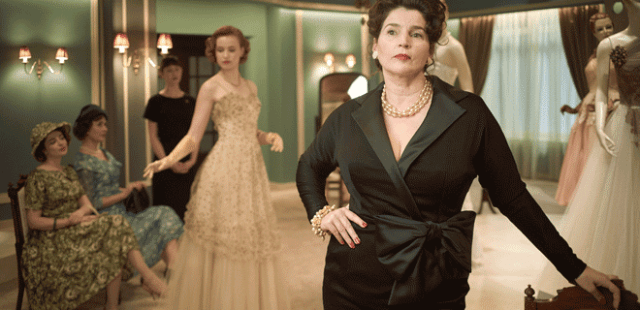
Goode’s is the posh multi-story Macy’s of 1950s Sydney, a city block of elegance where culture and couture meet in a country just then discovering them as it comes into its own not far removed from World War II.
There’s a uniformed doorman, a dapper greeter and floor manager (Nicholas Hammond) in tails, and a pianist playing Chopin as the customers pour in.
And there’s a locker room out back, where the saleswomen put on their “war paint,” change into their personal black dresses, earrings and heels and become “Ladies in Black” for the day.
Lisa (Angourie Rice, “Spider Man’s” Betty) is the new girl, gawky and 16 and brought in for the Christmas rush, a teen ready for “the leaving.” That’s what they call graduation in Australia.
The staff veterans, Fay and Patty (Rachael Taylor, Alison McGirr) are to show her the ropes, which they do. They’re nice enough, and posh as all get-out in appearance. But they’re working class, through and through, and they’re awfully quick to warn Lisa away from the “REF-o” Magda, a regal foreigner in charge of the “Model Salon,” where one-off designer dresses are sold.
“Soon you veel come to me,” Magda (Julia Ormand) sniffs to Lisa. “Some help I kan use.”
Our girl longs to be a poet. Or an actress. Or perhaps a novelist. The other ladies may raise an eyebrow, her parents (Susie Porter, Shane Jacobson) may range from “Let her dream” to “No daughter’a mine’s goin’ t’university!” But not Magda.
Over the course of that holiday season, Magda will give Lisa a makeover, the polish she’ll carry into adulthood, and expose her to The Big Wide World by way of her life experience and meals with her husband, Stefan (Vincent Perez).
Lisa, who is trying to outgrow her parents’ hand-me-down provincialism as sweetly as she can manage (“Lisa” is the name she’d prefer, not the one Mum gave her), reads “Anna Karenina” over lunch and exposes Fay to Great Books and Big Thoughts. Fay’s xenophobia is about to be overwhelmed, her horizons forever broadened beyond “the cocoon” Australia, at the time, was.
And Patty struggles to make her ranch worker husband (Luke Pegler) more “attentive,” so that they can have a baby.


There’s nothing particularly dramatic in any of this, but some of that is how gently Beresford handles this admittedly old-fashioned story and well-worn characters. All the rough edges, if there ever were any, are rubbed off every situation and every character.
Still, he never leaves his heaping helping of corn stuck in our teeth.
The perfectly-appointed store is home to many a recycled situation; the drudgery of the work, dealing with women who say “This has ALWAYS been my size” in the changing rooms, and cleaning up after vomiting little boys whose mothers dragged them shopping in this oasis of The Good Life in the middle of a city of streetcars and lunchpail jobs.
The players are well-cast, but the screen veteran Ormond (“Sabrina” and “First Knight” were her break-out films in 1995) has the most to play and the most fun, it would seem, playing it.
She purrs in a Croatian accent that “the Amerikins are sooooo modern,” that her fashion line is all gowns “too small for zees beeg Australian girlz,” that dresses made in Britain are ugly because they are cut to fit a nation of women “shaped like pears.” Lisa she takes under her wing, telling the others she wants to “steal your leetle slave girl” — just for a minute.
“Be heppy, ALL-vays! Eese goot choice!”
The European “REF-os” all have the whiff of displaced nobility (men in cravats), the Aussie men are either dandies or “manly” beer-swilling dullards, and Lisa, her mind broadening, has one piece of encouragement to carry with her into the liberating (even in Australia, to some degree) 1960s. Dated, yes, but worth remembering, Beresford suggests.
“A clever girl…That’s the most wonderful thing in all creation.”

MPAA Rating: PG for some suggestive material, mild language, and smoking
Cast: Julia Ormond, Angourie Rice, Rachael Taylor, Susie Porter, Alison McGirr and Celia Massingham
Credits: Directed by Brcue Beresford, script by Sue Milliken and Bruce Beresford, based on the novel by Madeleine St. John. A Sony release.
Running time: 1:48