
This documentary about the big rivalry game between two largely Latino high school football teams, opens Nov. 8.
This documentary about the big rivalry game between two largely Latino high school football teams, opens Nov. 8.
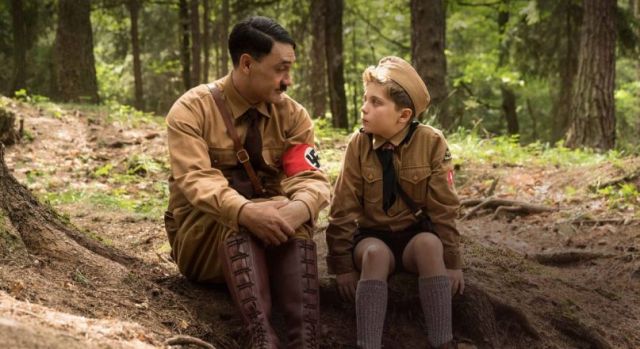
“JoJo Rabbit” is “Life is Beautiful,” as directed by Wes Anderson, co-starring Pee-wee Herman as Adolf Hitler.
Yeah, that’s it.
New Zealand director Taika Waititi’s playful, wildly eccentric film of Christine Leunens’ satiric novel mixes daffy charm with poignant personal politics in a coming of age story set in Nazi Germany.
A little boy (Roman Griffin Davis), a new member of the Hitlerjugend (Hitler Youth), is an ardent Nazi at 10, and a devout anti-Semite, even though he — like his best friend (Archie Yates)– doesn’t really understand what that’s all about.
And his imaginary friend, that dizzy Adolf himself (Waititi), isn’t much help in that regard, either.
The tale, set in a colorful bubble of “No war, here” Bavaria in the last months of World War II, follows little Johannes or “JoJo” as he tries to fit in with the Hitler Youth, struggles to master the martial skills passed on to him by the older boy/bullies in his troop and please the commander, Captain Klenzendorf (Sam Rockwell), a soldier demoted to this duty after losing an eye in combat.
They give the children uniforms with an “S” rather than “SS” on the lapels, stylish daggers — which lead to dagger accidents — and indoctrination. How do you recognize a Jew? Look for the scales, the tail, the horns, their instructor (Rebel Wilson) insists.
“They smell like Brussels sprouts!”
The older boys are already fanatics, and JoJo is one in the making, thanks to his obsession with his playime friend, who quizzes him on Nazi dogma and propaganda, and makes him practice his “Heils.”
“Heil Hitler” jokes have been around ever since the silly phrase was invented, and that’s a running gag here, worn-out, but still funny and thanks to the global revival in mimicking Hitler’s “very nice people,” still germaine.
JoJo gets his “Rabbit” nickname when he refuses to murder a bunny in a Hitlerjugend initiation rite. But his pal Adolf isn’t hearing the “You’re a coward, just like your father” taunts, and the Captain is more understanding than the Proud Boys of their troop.
JoJo’s adoring mom (Scarlett Johansson) accepts her kid’s fanaticism in the “just a phase” sense. We see her tiny acts of defiance and resistence to the fascism that rules their lives long before JoJo stumbles into “the Jew in the walls.”
That would be Elsa, played by Thomasin McKenzie of “Leave No Trace.” She’s being hidden by JoJo’s mom, and she’s mean enough to fit JoJo’s idea of a Jew. But what about the tail, the scales, the horns?
“We get those when we turn 21.”
Think she might temper JoJo’s devotion to Naziism?
Johannson has never played a sweeter character on the screen, and she delivers an endearing performance.
Rockwell can always be relied on to find the off-center center of an oddball like Captain Klenzendorf.
Stephen Merchant makes an amusing, “Heil” happy Gestapo agent, and young Mr. Davis makes this little Aryan adorable, but deeply troubling. McKenzie is a teen talent to be reckoned with.
But Waititi makes the overpowering impression here, one played up in all the film’s advertising. He does everything but sing “Springtime for Hitler” in this performance, the writer and co-star of the vampire dramedy “What We Do in the Shadows” giving us the insanely silly, and just enough of the psychotic menace of Hitler to remind he wasn’t that funny.

But the film’s blend of the precious with the precarious, pratfalls chased by poignant moments that remind us of the historical trauma that was unfolding around them, can be jarring.
Truth be told, the laughs rarely have much gusto to them.
Yes, these children will be hurled into combat, something JoJo’s grenade accident in the Hitlerjugend foretells.
Yes, millions of Jews, gays, Gypsies and Slavs were murdered — outside of this picturesque Bavarian bubble. Elsa gets that. Rosie (Johannson) knows.
Yes, it’s kind of funny that people fell for an infantile, tantrum-tossing fraud like ditzy Adolf. Or it used to be.
And yes, it’s topical. The accident of timing could make one wince when the film does its own version of “American liberators” arriving, a familiar trope of World War II movies set in Europe only recently stained and tarnished by the direction the “liberators” and their current dear leader have taken.
It’s just that removed from the heady group-think of its various film festival premieres, “JoJo” seems like a serio-comic hothouse flower, too fragile to pack much of a satiric punch, too delicate to deliver the comic sting Waititi aspires to.

MPAA Rating: PG-13 for mature thematic content, some disturbing images, violence, and language
Cast: Roman Griffin Davis, Thomasin McKenzie, Sam Rockwell, Rebel Wilson, Stephan Merchant and Scarlett Johansson
Credits: Written and directed by Taika Waititi, based on a Christine Leunens novel. A Fox Searchlight release.
Running time: 1:48

Canadian iconoclast Neil Young is one classic rocker you can be sure will never just “show up and play the hits.” He’s still making new music, still cranking out ballads, rockers and protest songs well past his 70th year.
“Mountaintop” is his fly-on-the-wall-in-the-studio documentary about recording an album that’s due out Oct. 25. It’s a choppy film, using everything from time-lapse to fish-eye lenses to put us in the place where it was recorded, the Studio in the Clouds outside of Telluride, Colorado, and capture the process by which he and his sometime band of 50 years, Crazy Horse, arrange, practice, engineer and record their songs.
And in between takes, they take hits off small, disposable bottles of oxygen. They’re recording at 8750 feet above sea level, we’re reminded.
We watch four jowly, white-haired old gents — only “new” guitarist Nils Lofgren is under 70 — show the kids how it’s done. They joke, complain, curse and harmonize, everybody deferring to Young, who is still in fine voice and still in charge — of the tunes, the arrangements, the recording session and the film, which he directed under a nom de plume, “Bernard Shakey.”
Ten new songs including “Milky Way,” “Shut it Down” and “Think of Me” are put on (analog) tape in a ski-lodge like studio that one and all complain about — loudly.
Drummer Ralph Molina steps out from behind the hit to add a “clickety clack, clickety clack” soft-shoe tap dance (on a tap dancer board) to one track. Young and Lofgren trade licks on their Gibson Les Paul guitars.
A glass harmonica — an instrument invented by Benjamin Franklin that never caught on (wet fingertips play a spinning series of glass jars, leading to nerve damage) — is trotted out to play chords on a mournful ballad.
Engineer and co-producer John Hanlon listens to the band’s complaints about feedback, poor playback quality studio monitors (speakers) and hits the roof over the state of the place’s wiring and electronics. Of course, that could be his epic poison oak infection acting out.
“Rollin’ around in the grass with some babe in Malibu?” Young slyly jokes.
Young reminds us he can still high some pretty high notes, and he still has a political chip on his shoulder, on songs like “Rainbow of Colors,” his denunciation of Trump era xenophobia.
“There’s a ‘Rainbow of Colors’ in the old U.S.A.,” he croons. “No one’s gonna whitewash those colors away.”

The sessions, according to a Telluride newspaper account I read, happened in August, so this project was pieced together in great haste — live, on tape, with snatches of songs performed in an intimate concert setting edited in.
As a film, it’s not particularly revealing and adds little to what we know and understand about Young, who has been the subject of more tour documentaries with snippets of biography included than virtually any musician alive. The best were made by his friend and devoted fan, the late Oscar winning director Jonathan Demme.
But Young believes in documenting it all. He’s got 15 more concert and studio recording films in production, sessions recording the album, “Harvest” in 1971, Tokyo and London concerts, solo tours from the ’80s.
Yes, they’d make a better movie if they were artfully cut together to create a single complete “history” of the man and his band. But he’s hellbent on serving the “completists” in his fanbase, so into the editing bay he goes — suspending touring while he knocks these many projects out.
Vanity? Money? Money for charity? Who knows? He’s determined to do it and he’s certainly enough of a presence in music to pull them all off.
“Mountaintop’ will have a special one-night-only national theatrical release Oct. 22, three days before the album “Colorado” comes out.
MPAA Rating: unrated, profanity, drug jokes
Cast: Neil Young, Billy Talbott, Ralph Molina, Nils Lofgren, John Hanlon
Credits: Directed by Bernard Shakey (aka “Neil Young”). An Abramorama release.
Running time: 1:31
Everybody says that Kiwi comic Taika Waititi, of “What We Do in the Shadows” and “Hunt for the Wilderpeople,” has made his masterpiece with this satiric comedy set during the heyday of the Hitler Youth.
That’s the writer-director co-starring in it in this clip. He plays Adolf, or a child’s fantasy version of him.
“JoJo Rabbit” goes into limited release Friday, wide release in early November.
The trailer gives it a New Zealand/Wes Anderson feel, and one can only hope.

The horror B-movie “The Gallows” opened four years to near universal critical derision and a piddly $22 million or so, all in, at the box office.
So why, exactly, is there a sequel? Did it blow up online? Was it a Netflix smash?
Whatever its reception, SOME of us thought enough of the premise back in 2015 to think SOMEbody missed an opportunity with it. Bringing back the same writer/director team for “The Gallows: Act II” and making it for another distributor turns out to be no way to avoid repeating that mistake.
The pitch? There’s this haunted play, “The Gallows,” that a kid named Charlie Grimille died performing, hung onstage by the “gallows” of the show’s title. Just reading the play aloud sets “the curse” in motion.
So what we’ve got is a high school theater geeks version of the “Slender Man” or “Bloody Mary” curses of legend, hyped into “Blair Witch” territory by Internet viral discussion, shared videos of deaths, theories, etc.
If you’ve ever worked in the theater, on any level, you’ve heard ghost stories — the older the theater, the better the tale. My college theater allegedly had one, and a theatre I’ve attended and reviewed shows in over the years has long had an infamous spectral inhabitant.
For the sequel, the writing/directing team of Travis Cluff and Chris Lofing keep the play, abandon the “theater” and limply play up the viral side of the “curse,” how it is spread, how information about it is shared and why teenagers would put this stuff up online.
For fame and money, of course.
The prologue has teens messing around with a fake ouija board, scaring each other and recording it on their phones, before pulling out a battered copy of the play’s script. Reading from it brings rumbles of thunder, and a delayed hanging or two via a swingset.
Ema Horvath plays Auna Rue, and with a pretentiously theatrical name like that, you KNOW she’s got a yen to perform. She’s starting a new school, living with her step-sister (Brittany Falardeau), a costumer at a local theater company. And she blows her big reading in front of drama class because it’s from some insipid kiddie fantasy video she loved as a child, and she’s nervous and maybe a little light on talent.
But she’s led to this play, that sure enough, the library has on file. A reading from “The Gallows” for a college theater program talent scout could be her ticket to fame.
Because this Youtube channel she started isn’t doing the trick. Like every cute teenager, she wants attention and “followers” online via her vlog. It’s not until she starts reading from the play for that vlog that the traffic explodes.
She’s at a loss to explain that. Then she watches the video. Furniture MOVES in the background. A later reading is interrupted by something flying off the wall at her.
Best moments in “The Gallows: Act II?” Hovarth, as Auna, giggling at this as if the supernatural is something every kid her age accepts at face value. The dears.
Reading from “The Gallows” turns around her standing with the drama kids and teacher (Dennis Hurley). The only problem is, she tends to zone out and not remember performing the piece, she’s so lost in the part.
She’s hallucinating threats, as is her stepsister — shapes in the shadows around the house. Even her first injury at the hands of this “curse” isn’t enough to wake her up.
Who can she turn to? The classmate/cute former child actor (Chris Milligan) who’s hitting on her? The step sister that thinks she has no talent?
The INTERNET!


The web-side of the storytelling has been done better in scores of movies over the years. The plot packs all its surprises in the finale, which is cheating of the far-too-little-too-late school.
I’m guessing Lofing and Cluff do really good pitch meetings, because there’s nothing here that explains that “green light.”
The frights the filmmakers conjure up are middling, at best. And “Act II” may be the mildest “R” rating in the history of horror films. Garroting the victims with ropes and whatnot is never going to be as gory as the leavings of a chainsaw massacre.
No tension, no titillation and far too little theater nerd connection leave this sequel — say it with me — hanging.

MPAA Rating: R for some disturbing violent content
Cast: Ema Horvath, Chris Milligan, Brittany Falardeau and Jono Cota
Credits: Written and directed by Chris Lofing, Travis Cluff. A Blumhouse/Lionsgate release.
Running time: 1:37

The Wrap reports that this is a record. A lot of shots were taken at elusive (mostly) kiddie audience this year.
That Oscar category is usually a three film field of nominees, so 29 movies — probably including “Addams Family,” and a list that should certainly include the middling “Abominable” (Will they tick off China by leaving it out?) — will be left out. https://t.co/hG2EsFn4DS https://twitter.com/TheWrap/status/1184519527599489024?s=17

When the snowball was first forming on the ever-swelling avalanche that began as “The Trump/Russia Investigation,” the increasingly embattled 45th president was quoted making this plea from inside the White House.
“Where’s My Roy Cohn?”
He was elected, apparently with massive foreign intervention, by millions of Americans who should have remembered that name and been instinctively repulsed by Donald Trump’s “protege” association with the most dishonest, corrupt and repellant figure in American politics, “America’s Machiavelli,” a man whose evil took on Bond villain proportions.
The name “Roy Cohn” inspired fear and revulsion during his lifetime, and provided the perfect self-loathing monster in the epoch-defining Broadway show “Angels in America.” He was that infamous.
But here’s a documentary for the millions who didn’t get the name or the association. Documentarian Matt Tyrnauer (“Studio 54,” “Valentino: The Last Emperor”) finds another gay subject to profile in this portrait of a man whose very proximity let you know, one witness in the film declares, “you were in the presence of evil.”
Tyrnauer’s thorough rummage through Roy M. Cohn’s life and the damage he left in his wake is built on interviews he did from an early age. He was a high profile Justice Department lawyer interviewed on an ocean liner in 1951, at age 23. He’s seen bantering on chat shows over the decades, swapping shots with novelist and wit Gore Vidal (who was ONTO him, and witheringly so) all the way to his bitter — and one cannot stress that word enough, BITTER — end-of-life chat with Larry King.
The cornerstone interview featured here is with journalist Ken Auletta, whose 1970s Esquire Magazine profile of Cohn the reporter recorded. The tapes capture Cohn’s dissembling, counter-attacking style, a man described by family as a classic “self-hating Jew” who only gets rattled when Auletta brings up the open secret of Cohn’s life — that he was also a self-loathing homosexual.
“Where’s my Roy Cohn?” traces Cohn’s birth, into a wealthy family whose father was essentially bribed to marry “the ugliest girl in the Bronx.” An only child and a homely one whose parents never let him forget that, he carried secret and not-so-secret shames and a very public chip on his shoulder out of that wealth and into the walls of power.
A relative relates how he committed his first bribe at 15, finished law school too young to yet take the bar, learned how to bully from his corrupt family and how to play the demagogue once he hooked up with Senator Joseph McCarthy, whose media-grabbing lies, tirades and attacks gave a name to an entire era.
There is history here that even those who remember Cohn and his lying, thieving, mob-connected legacy (he was finally disbarred late in life) might have forgotten. Cohn’s first public work was his involvement in the Rosenberg spy case, and he took credit for getting (in phone calls he claims he had with the judge) atomic-secret stealing Julius and Ethel Rosenberg the electric chair. Tyrnauer’s witnesses suggest Cohn and Judge Irving Kaufman, both Jewish like the Rosenbergs, pushed for execution to prove their own loyalty to America.
His time as McCarthy’s “handmaiden” — whispering in the senator’s ear during Senate hearings McCarthy lorded over — is recounted, as is the senator’s fall. The end of McCarthy and the tipping point of the entire McCarthy Era, which had succeeded in putting Eisenhower in the White House, came because of Cohn’s secret sexuality and his willingness to use power unscrupulously.
He tried to get a favor for a handsome colleague he had a crush on, a fellow McCarthy staffer who had just been drafted. The “Army-McCarthy Hearings” spun out of Cohn’s eagerness to deliver special treatment and placement of his “special friend,” G. David Schine.
We’re shown clips of hearings pierced with laughter about “pixies” and “fairies.”
Yes, it took nationally-televised gay bashing to end the amoral, self-destructive witch hunt of McCarthyism. Didn’t see that in “Good Night, and Good Luck,” did you?


As a person and as a lawyer, he “never played by the rule book,” one and all agree. There was his underhanded way of taking over the extended family’s most famous property, the Lionel Trains toy company (“which he ran into the ground”), the mysterious fire that sank his heavily-insured motor yacht “Defiance” and killed a young crewman, and the death’s door-bedside visit with a “client” wangling a signature that made him executor of an estate, the final straw crime in a career littered with them that led to his disbarment and undoing.
“Amoral” is one of those words, like “cutthroat” and “ruthless,” that Cohn relished having attached to his name. And the implication is, these are all ways of lying, living and operating that he passed on to his star protege and sometime client, Donald J. Trump.
Cultivate the press with gossip and favors, “wrap yourself in the flag.” “Never apologize, never admit defeat, or that you’ve lost, never leave a paper trail,” don’t be shy about endlessly repeating the same lies, always “attack” so that you control what the conversation is about (changing the subject), avoid taxes to the point where you “die owing the IRS a fortune,” and if “they’re on to you,” “rat out other people.”
Sound familiar? In the month since this documentary went into limited release, it’s proven prophetic about events as crimes are alleged or revealed in Washington. “Where’s My Roy Cohn?” even seems to predict how the tidal wave of high crimes and misdemeanors might play out.
The end game for Roy M. Cohn, who died in 1986, makes it all seem too familiar.

MPAA Rating:PG-13 for thematic content, some sexual material and violent images
Cast: Roy Cohn, Ken Auletta, Liz Smith, Gore Vidal, Larry King, etc.
Credits: Directed by Matt Tyrnauer. A Sony Pictures Classics release.
Running time: 1:37
Paramount has picked this up, and the casting alone just tickles me no end.
Via The Hollywood Reporter.
@johnkrasinski & Ryan Reynolds (aka @VancityReynolds).
John Krasinski will write, direct, produce & star, Reynolds to co-star in “Imaginary Friends.” https://t.co/xXlNnJisa2 https://twitter.com/Borys_Kit/status/1184246092637954048?s=17

The most violent movie since “Joker?”
That would be “Maleficent: Mistress of Evil,” a Disney fantasy allegedly for children, but a sure way to scare tinier tykes into premature therapy. Because even the Joker didn’t lock pixies and fairies in a church and…
Never mind.
Featuring production design, costumes, makeup and effects that would turn J.R.R. Tolkien, or at least Peter Jackson, green with envy, it’s built on a story borrowed from every lazy fantasy typist since Tolkien and C.S. Lewis — “WAR! Between the magic folk, the fairies, Valkyries (called “Fays” here), woodland sprites and humans!”
The mayhem promises genocide, chemical weapons and Michelle Pfeiffer taking on Angelina Jolie, even though Jolie’s title character is reduced to a glorified, winged cadaver of a supporting player in this sequel.
Where’s the wit of the first film, an upside-down take on “Sleeping Beauty” where the “Evil Queen” got a bum rap?
“He’s very kind,” Maleficent is told of her goddaughter’s suitor.
“Kind of what?”
Maleficent is counseled to smile, “Show a little less fang” when she meets the humans who gave her that bad reputation. Well, comedy was never the Oscar winning Jolie’s forte.
The story, about the human Kingdom of Ulstead making peace with and “joining” the creature Kingdom of the Moors via marriage, is built on a romance that lacketh spark or warmth. Elle Fanning’s Queen Aurora smiles and smooches on Prince Phillip (Harris Dickinson), but they won’t make anybody forget “The Princess Bride.” Or even its many inferior imitations.

Pfeiffer is the obviously-scheming Ulstead queen who baits her future in-law over dinner, brings down the wrath of Maleficent and triggers a war.
Chiwetel Ejiofor is a fellow winged-one, a genetic relative of Maleficent’s “Descended from the Phoenix” folk.
Warwick Davis, required casting for ALL fantasy films, plays an alchemist who carries out deathly experiments on fairies.
The script forces director Joachim Rønning to overwhelm the screen with forest and swamp creatures, although thankfully, we don’t pause to admire and identify these “fantastic beasts. The damned movie would be a Potter-length four hours long if that happened.
You’ll recognize Juno Temple and Imelda Stanton in fairy form, with all manner of snout-nosed frog-pigs, tree creatures EXACTLY like the “Ents” of “Lord of the Rings,” glowing flowers a la “Avatar,” all packed into a digital dreamscape of gardens and streams, castles and a aeries.
It’s impressive for a minute or three. But “Maleficent” could make you long for the days when folklorists like old friends Tolkien and Lewis spent lifetimes studying legends, myths and folk tales before building their own.
“Maleficent” sounds, looks and feels as if it was contrived out of an algorithm, a heartless commodity formed from other heartless commodities.
The endless on-and-on-it-goes finale grasps for emotions it only earns by being so very appalling in the build up to it.
One doesn’t feel redeemed or revived after enduring this “Maleficent. Just relief.

MPAA Rating: PG for intense sequences of fantasy action/violence and brief scary images
Cast: Angelina Jolie, Michelle Pfeiffer, Elle Fanning, Sam Riley, Chiwetel Ejiofor, Ed Skrein and Robert Lindsay.
Credits: Directed by Joachim Rønning, script by Linda Woolverton, Micah Fitzerman-Blue and Noah Harpster. A Walt Disney release.
Running time: 1:58
This has a lot of promise, even though Lionsgate is sort of still a “poverty row” (horror and cheese) distributing studio.
They’ve got Oscar winners Charlize Theron (as Megan Kelly), Nicole Kidman (as Gretchen Carlson). They’ve got Margot Robbie and Kate McKinnon.
And as Roger Ailes, the sexually harassing Evil Genius in Chief? John Lithgow in lots of makeup.
December.

 Movie Nation