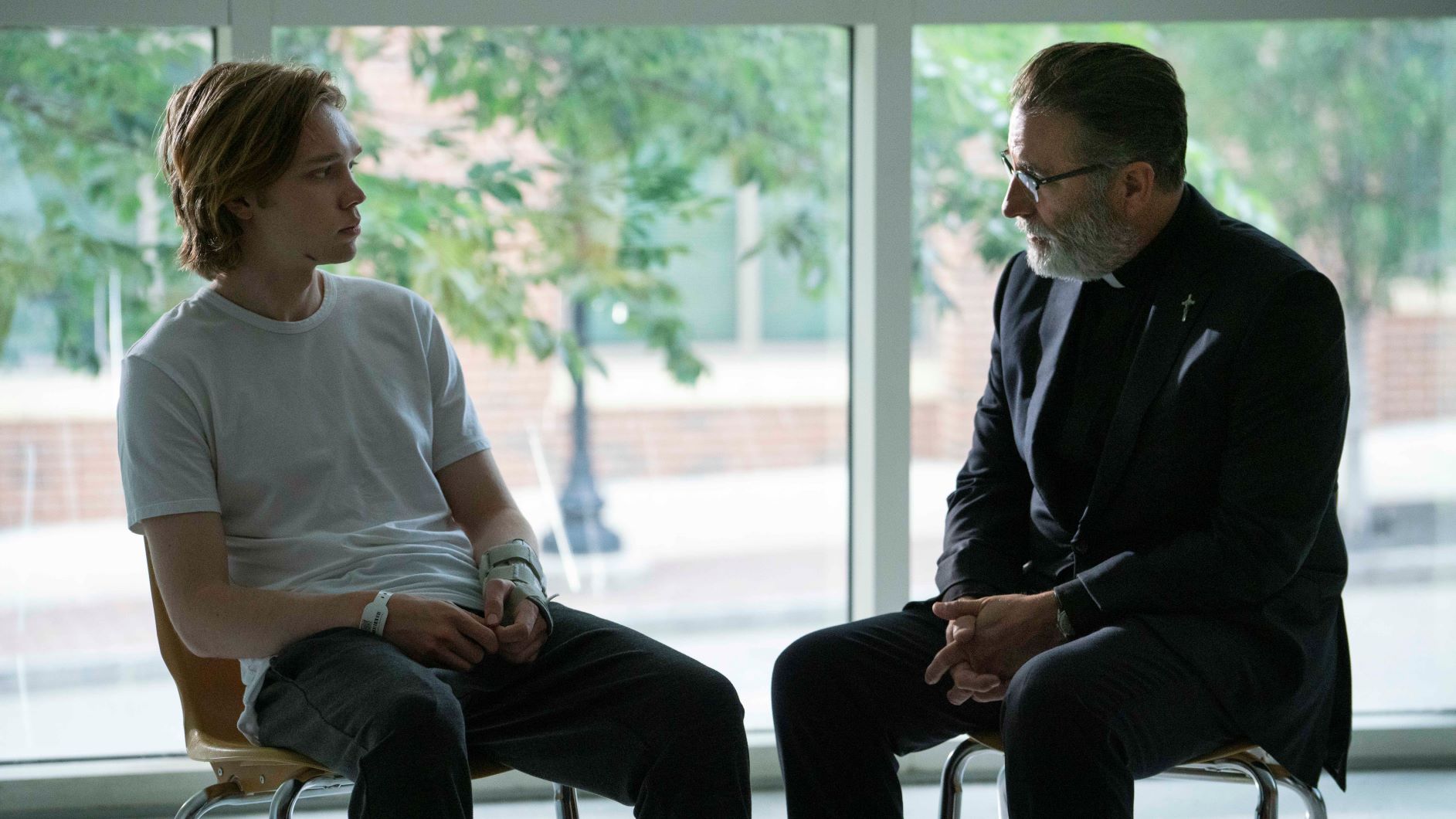

The idea of multiple universes, multiple realities, multiple “outcomes” to life and our existence gets a sleep-inducing workout in “Expulsion,” a no-budget thriller about scientists who DIY a teeny tiny Haldron Collider in a desert Southwest garage.
Indifferently-acted, with funereal pacing and (high school) student film action, the viewer has five minutes to catch up with its introductory premise, and spends the next 90 minutes two or three steps ahead of this clunky, obvious and dull screenplay.
Scott (Colton Trap) almost manages a convincing “WooHoo” after his “Eureka!” moment. His garage-built gadget has given him a portal, a first glimpse into another universe.
It doesn’t matter that his research partner Vince (Aaron Jackson, also the film’s co-writer/director) declared that “two people (have to be) present at all experiments.” As some discussed when the Large Hadron Collider at CERN first fired up, there is this risk of “destroying the planet” when you go around “smashing God Particles.”
It doesn’t matter that their “real” research, trying to develop safe cryonic storage of bodies that might be revived at a future date for the Cicero Corp, has taken a back seat. Cicero will provide them the power to properly give their portal a test.
And it really doesn’t matter that strange things start happening as they test it — cryptic warnings, a mysterious assassin, a colleague (Robert F. Glass) whom they see shot and killed, but who shows up for work the next day.
It isn’t until Scott breaks that “both of us have to be here” rule again that he gets a whiff of the “expulsion” theory, which posits that you and your doppelganger from a parallel universe can’t interact or you’ll go “poof.”
The fact is that the movie doesn’t pick up after that. It never properly gets on its feet, and the zero-heat performances just smother whatever ideas this comic book idea of a term paper script throws out there.
Stay in this universe. Watch a different movie. Ever seen “Primer?” Rent that instead.
MPA Rating: unrated, violence, sexuality
Cast: Colton Trapp, Aaron Jackson, Rosalie Fisher, Lar-Park Lincoln, Robert F. Glass.
Credits: Written and directed by Aaron Jackson, Sean C. Stephens. An American Pop release.
You never want to “grade on the curve” when it comes to film reviews. But “Love in Dangerous Times” comes as close to earning an exception as anything I’ve come across of late.
It’s a no-budget indie romance about loneliness and love in our current pandemic. They obviously filmed it with an eye toward “social distancing,” and characters react in what feels like real time as they respond to what they know or don’t know, what might be “blown out of proportion” or indeed “the end of the world.”
Much of the acting and inter-acting is done via Facetime, Skype or whatever video call chat app you prefer. Director and co-writer Jon Garcia and co-writer/star Ian Stout make that limitation work, if not exactly pay dividends.
It’s as current as a headline, and as it is set in Portland, has last summer’s protest marches and unrest served up in a montage in the finale.
So yeah, the acting is uneven and the script only occasionally amuses or tugs at the heartstrings. But there’s enough here to recommend this cute, quaint artifact of the Nightmare That Was 2020.
Stout plays Jason, a playwright/restaurant-delivery driver in Portlandia willing to question this “blown pt of proportion” lockdown, but not taking any chances, either.
He’s trying to finish a play that sounds like an intimate, epic downer, trying to talk his boss into keeping the restaurant open for deliveries only, coping with his annoyed Dad (Bruce Jennings), who isn’t taking to Jason not “coming home” to ride this out with him with, and trying to meet somebody via his favorite online dating app.
He’s needy, and it shows. He’s gently blunt, and faintly creepy, or comes off that way at a time when “we’re facing extinction.”
But all this might help him break through with his play, his belief that “love will save me.”
Right now, though, he’s like a lot of folks living alone, disappointed that “nobody’s reached out to see how I’m doing.
One “ghosting” later, after his Dad has bragged about getting a bidet for his “bunker,” after his singer/guitarist pal Ishmael (Jimmy Garcia) has hung out, air-hugged and noted “I could be the last dude you see in a very long time,” ItsaMatch.com comes through. Jason meets somebody.
There’s a wary, arm’s-length chill to Sorrell (Tiffany Groben) the first time they chat, live, screen-to-screen.
In chats and chapters that go on for months (“One Month Later, 2 Million Infected”) they have ups and downs. A deflating answer to the “Are you talking (online) with any other guys” question, a scare over a delivery customer’s cough, sickness reaching people they know, this movie covers a lot of emotional ground.
There’s just a hint of pathos, a touch of erotica and not nearly enough good humor to this screenplay. Attempted jokes don’t land, and when they don’t, the airlessness of this whole situation makes the silence overbearing.
That impacts the charm Jason is supposed to be laying on this out-of-his-league blonde, and their chemistry. This guy is supposed to be a wordsmith?
But there’s enough here to merit a look, to see “What kind of movie romance can you make in a pandemic?” and to feed 2020 nostalgia.
Where were YOU during the first lockdown?
MPA Rating: unrated, sexual situations, profanity
Cast: Ian Stout, Tiffany Groben, Jimmy Garcia, Bruce Jennings
Credits: Directed by Jon Garcia, script by Jon Garcia and Ian Stout. A Dark Star release.
A little celebration of Sean as Bond, at AMC and (I think) other cinemas with an eye toward using nostalgia and our affection for Sean Connery, who just died at 90, to lure in patrons.
C’mon out. Party like it’s the early 1960s! See the Aston Martin and Gert Frobe and Honor Blackman. And Connery.
“My Summer as a Goth” is a coming-of-age tale with too much black, too much makeup, and synth rock, it’s the “Strike a Pose” or “How I spent my summer vacation” romances.
A winning cast, novel “tribal” setting and some witty dialogue put this one over.
Natalie Shershaw is Joey, a high school sophomore we meet at the cemetery. She’s a tad morbid. She talks to a dead person there.
“I’m the girl whose Dad died, remember?”
That’s to her classmates. To her BFF Molly (Rachelle Henry), she’s a bit more flippant when playing for sympathy.
“My Dad’s body is still warm...too dark?”
Mom (Sarah Overman) is on a book tour, so there’s nothing for it but for standoffish/no-fun Joey to spend the summer with her grandparents. But as cool as these aged hippies (Fayra Reeters, Jonas Israel) might be, with their “So, who wants to do drugs?” and Grandpa’s nude breakfast cooking, it’d be nice if she could meet someone her own age.
That would be Victor of the vampire glam rocker makeup, grandson of the friendly seniors next door. Victor, played by Jack Levi, is forward, a tad femme and flirty. Oh, and “smug” — “If by ‘smug,” you mean ‘awesome.‘”
She spies him in a dress, faking a hanging in his bedroom in his grandparents’ house. She is smitten and he is all-in to be a tour guide to his “not just a scene, it’s a way of life.”
It begins with an “emergency makeover” — hair dye, fishnets, the works. A party in a cemetery — everybody dancing to a shared mix via ear buds — leads to spending the night in a tomb.
“You know, there’s no going back.”
And there isn’t. Not for a summer, anyway. Sixteen year-olds try stuff on and discard it by design. We call them “phases.”
A whirlwind summer of parties — her first joint, her first drink — bullying by rednecks and punks (Eduardo Reyes) making out and Goths on a camping trip give our shy Joey a tribe. Well, maybe she’s just a poseur, but the look suits her.
“I wear black on the outside to show how I feel inside.”
Director and co-writer Tara Johnson-Medinger doesn’t hide her cards well, but there are surprises here, largely in the picture’s tone.
Dark clothes, young couples wearing a vial of each other’s blood and making a death pact, New Romantics pop and lots and lots and lots of makeup — “Oh my God I think I’m TANNING.” “When are you EVER going to get the concept of re-appLYING?”
And it’s all so damned sweet, maybe not “strictly PG,” but as our heroine lives her season-long story arc, she comes out in a different place than where she started, bonds with her “a little too cool” grandparents, works out some Mommy/Daddy issues and grows.
Shershaw is a vulnerable, naive delight and former child actor Levi simply loses himself in the makeup, the pose, the effete snobbery and “the scene,” which may be the best thing about “My Summer as a Goth.”
The movie version of this culture may not be the most representative. But it certainly makes all that steampunk black look fun.
MPA Rating: unrated, drug use, sexual situations, smoking
Cast: Natalie Shershaw, Jack Levis, Eduardo Reyes, Fayra Reeters, Jonas Israel and Sarah Overman
Credits: Tara Johnson-Medinger, script by Tara Johnson-Medinger and Brandon Lee Roberts. A 123 Go Films release.
Sordid, slow and stupid, “True to the Game 2” is a drug-trade sequel to the 2017 thriller about falling in love with a drug dealer and paying the price.
An opening scene shoot-out and a trio of coordinated brawls in the finale are little compensation for the tedium in between.
Vivica A. Fox returns as Shoog, streetwise tough gangster who leads Bria (Iyana Halley) in a revenge hijacking of a drug shipment intended for drug boss Jerrell (Andra Fuller).
Poor Jerrell figured he was done with drug dealer Quadir’s minions after taking him out in the first film. He hadn’t counted on the dead drug dealer’s family.
The haul? “A meal ticket,” which is a cool million in cocaine-and-cash-speak.
“It’s gonna be an early Christmas in the (Philly) hood!” Shoog figures.
Gena (Erica Peeples) buried Quadir, finished grad school and is now a workaholic at a New York fashion webzine. She lives large — larger than any mere online mag writer could manage. Yes, she has drug money backing up her lifestyle.
But that bloody shootout that opens the picture has Jerrell and his minions — one played by model and former “Hot Felon” Jeremy Meeks — hunting high and low for those who hit him. That sends Saleem (Meeks) into Quadir’s memorial service and Jerrell off on a hunt for Gena, who decides to drive her Range Rover to California to do an assignment on an LA cannabis king.
That’ll eat up the two week vacation her borderline-harassing boss forces her to take.
The middle acts — full of asking around, intrigues, costume changes and little that animates the plot even if, in theory, scenes do advance it (sort of) — stop “2” dead in its tracks.
We lose track of the hardened anchor of all this, Fox, and dwell on the bar hopping, drinks, kidnappings, threats and what have you that it takes to get Jerrell and his man Saleem closer to their quarry.
Meeks lands one good thug line, announced to a prisoner he’s slapping around in the trunk of his ride.
“STOP! You gonna KILL me?”
“You in the trunk. You already dead.”
The only chuckles are in the memorial service, where Faith Evans sings and Quadir’s mom talks about what “a good boy, a good MAN” her son was.
He was a DRUG dealer. But sure.
All this violence — in New York, Philly and LA — has people in the center of the action “on edge.”
“It’s Philly. People are BORN on edge.”
Love V.A. Fox, but when you leave her out, you’re not being “True to the Game.”
The acting is uneven, the action not awful but not great either (some of the stage punches are obvious) and the ending a total cheat.
Aside from that…
MPA Rating: R for violence, pervasive language, sexual content, nudity and drug content
Cast: Vivica A. Fox, Erica Peeples, Andra Fuller, Jeremy Meeks, Iyana Halley, Rotimi, Tamar Braxton
Credits. Directed by Jamal Hill, script by Preston A. Whitmore II, based on a novel by Teri Woods. An Imani Media Group release.
It begins and ends as an elegy, a somber remembrance of past times and personal loss set against a spare, plaintive plucked-guitar score.
The story has a seething villain and climaxes in a fine, melodramatic fury.
But “Let It Go” is a thriller best-appreciated for its trio of tour de force performances — for Diane Lane and Kevin Costner’s understated Western American couple that’s so familiar and lived-in that their most powerful moments are wordless, and for Great Brit Lesley Manville’s furious, uncompromising North Dakota matriarch.
This intimate Western odyssey marks a return to form for writer-director Thomas Bezucha, years removed from his first break, the Montana-set “Big Eden” and from his break out “The Family Stone.” Adapting Larry Watson’s novel, he tells a story of family, loss, guilt and a seemingly irrational over-reach, a grandmother longing to raise and protect her grandson.
Because we’ve seen Margaret monopolize the child, dismissive of the boy’s mother even when her daughter-in-law (Kayli Carter), son (Ryan Bruce) and their newborn were living with them. But son James dies, Lorna remarries and little Jimmy (Otto and Bran Hornung) is suddenly removed from their lives, abruptly off to “live with his parents.”
Margaret wordlessly packs a bag, loads the station wagon and sits, ramrod straight, until George comes home and gets a clue. He says what we’re thinking.
“What the hell, Margaret?”
They’re off on a late-winter trek through eastern Montana and into western North Dakota, where the second husband’s Weboy clan holds sway. Asking questions about them tell retired sheriff George more than he wants to know.
“You let it be known you’re looking for a Weboy, they’ll find YOU.”
Finding Bill (Jeffrey Donovan of “Burn Notice”) and the ranch matriarch, Blanche (Manville, of “Maleficent” and “The Crown”) leads to tense, brittle conversational stand-offs — Margaret’s pasted-on smile not covering George’s I-know-what’s-coming glower.
Bezucha takes his time getting to that meeting, sharing a little of the Margaret/George backstory, filling in the sad blanks of their son’s death with flashbacks. The pre-Interstate vistas are filled with Patsy Cline and fundamentalists on the crackling AM radio on their ’58 Chevy Nomad wagon, and not-quite-bickering as George scolds Margaret for her doggedness and naivete.
Their stops along the way start with Margaret’s grinning, disarming chatter — “beating around the bush” as she promises to not beat-around-the-bush — and devolve into the old lawman’s blunt “bad cop” questioning.
They even stumble across a Native teen (Booboo Stewart), with hints of the horrors of the Bismarck “Indian School” he escaped.
But meeting the Weboys turns this mournful journey into what the movies long ago nicknamed “A Mexican Standoff.” The music changes from guitar to Thriller Strings and we wonder how we or Margaret or anyone, for that matter, could make the case for the kid without an eruption of violence.
Manville’s Blanche is all cruel, regal bluster, putting her “guests” on notice they’re on her turf. “Anyone knows me knows I can’t be insulted,” she drawls, but we know and George and Margaret know that she can.
Lane’s Margaret shows her mettle without having to proclaim it, but her abrupt way of turning off the sweet smile and the “beating around the bush” suggest she’s absorbed some of George’s wariness and impatience.
And Costner, the Western American Master, lets us see George’s submission to the will of “this woman I married by can’t figure,” and his age. The experience means the mind is willing, even if the body’s lost its fastball.
Some of the characters’ changes in mood and approach seem abrupt. Surely any of the leads would lay on the disarming honey just a little longer before flashing their respective talons. But they all have a hint of George’s sense of fate that’s in play.
Once the Blackledges undertook this quest, there was no pleasant way for it to play out.
The finale is over-the-top and melodramatic, Old West and Old Fashioned in its own way.
But “Let Him Go” is a real showcase for fine talent — veteran villain Donovan included — and a nicely-blended mix of sentiment, sadness and the violence that we know, as well as any character on the screen does, is coming.
MPA Rating: R for violence
Cast: Diane Lane, Kevin Costner, Lesley Manville, Jeffrey Donovan, Kayli Carter, Will Brittain and Booboo Stewart.
Credits: Written and directed by Thomas Bezucha, based on a Larry Watson novel. A Focus Features release
In the title role of Tatsushi Ohmori‘s “Mother,”Masami Nagasawa gives us one of the great screen monsters of recent memory.
Her Akiko Misumi is a Japanese “Mommy Dearest” — cruel, callous, self-absorbed, violent and still enough of a hot mess to appeal to any man who crosses her field of vision.
When we meet her she’s manic, grabbing her little boy for a day of playing hooky from primary school. When we last see her she’s dead-eyed and pitiless, her life of selfish narcissism and emotional brutality doesn’t phase her as she lacks a conscience.
A social worker (Kaho) is the epitome of Japanese good manners and understatement when she describes Akiko as “incapable.” We’ve seen what she did to her son, Suhei, played as a child by Sho Gunji and as an older teen by Daiken Okudaira.
“Mother” invites the viewer to play a grueling waiting game, its suspense stemming from the viewer’s growing desire to see the boy stand up to the woman who has made him cadge cash off relatives, steal, take beatings from abusive boyfriends and lie in blackmail schemes.
And even though Tatsushi (“Every Day a Good Day”) never heard the English expression “too much of a good thing” in drawing this story out over years with a running time north of two hours, his villainess rarely loses our interest or our eagerness to see her pay for her crimes.
“Mother” is a story of co-dependency and loyalty, of lives lived on the street and promise squandered because of an impulsive, martyred mother who A) has a gambling problem, B) ruthlessly uses men, including her little boy, and C) has the idea that her children are hers “to raise as I see fit” (in Japanese, with English subtitles).
Shuhei can never shake her, never defy her. Not after she ditches him at seven to run off with a new thug, Ryo (Sadao Abe), on a drinking/gambling binge. Not after she and Ryo use Shuhei to blackmail the hapless civil servant she talked into “watching” the boy while she left him for her latest misadventure.
Shuhei is who she sends to beg for money off her sister and parents. Shuhei, as a teen, is the one with a job she talks into getting advances from his boss.
We need only one scene to establish Akiko’s addiction. Her eyes glaze over when playing a pachinko (slot) machine. We never see her win, never see her pay a bill. It’s all-consuming, and the boy she brought into the world is just here to facilitate her habit.
There’s wailing and shouting in her encounters with her distraught and had-enough family. And there’s violence as Ryo enters and leaves their lives, slapping around Mother and the little boy who can’t protect her as he does.
It’s not giving anything away to say that a second child enters this world of flophouses and sleeping on the street, when they hit bottom. Akiko’s lack of self-control extends to all things, even the unfiltered insults she rains upon her boy when ordering him to skip school and babysit, or anything else she can command.
Through it all, Masami lets us see the instant calculating, the in-the-moment impulsiveness, with narrowing of the eyes when she sends the boy in search of the next need she orders him to fulfill.
Tatsushi’s storytelling is deliberate and slow, showing us the agonizing days an abandoned child spends eating uncooked noodles because Mother didn’t pay the gas bill, playing video games until the moment the power’s cut off, because guess what?
It gets to be too much after a while, and Tatsushi’s ending is drawn-out, downbeat and deliberately unsatisfying. But every Japanese filmmaker knows that not every monster movie ends up with Godzilla blown up and sinking into the sea.
MPA Rating: TV-14, violence, much of it against children
Today’s assignment, class, is compare-and-contrast “Come Play,” now in theaters, with “Noise in the Middle,” now streaming.
They’re both thrillers about haunted children. Their shared hook? Both the kids are autistic.
“Come Play” has a name cast and a few decent chills. But for my money, “Noise in the Middle” has a better villain, a more interesting kid and a better grasp of (movie) ASD (Autism Spectrum Disorder).
Veteran character actor John Mese is a difference maker here. He plays a Seattle divorce attorney always on the edge of seething. We meet this impatient, short-tempered dad as he’s taking his daughter Emmy (Faye Hostetter) to Canada, turning down the chance to put her in “a home” to take a chance on an experimental treatment for her disorder.
“It’s what Sarah wanted,” Richard says. And Sarah’s wishes are important, because she died just a few weeks ago. A friend’s lent him his three story modernist mansion near the clinic trying this magnetic brain scan therapy.
Testy Richard’s about to get a crash-course in autism. Nurse Zandra (Juliette Jeffers, quite good) picks up on the fact that Richard was never that involved in his moaning, rocking and wandering-off-prone daughter’s care. She doesn’t have to hear him bark “Emmy, I don’t have TIME for this” more than once.
Dr, Helmond (Jim Holmes) explains the “communications disorder” nature of autism, that Emmy is “always saying something” even though she can’t yet speak. “We just have to hear it,” to “sort out the noise in the middle” between her efforts to communicate and Richard’s inability to hear it.
Richard, sweating a case-gone-wrong back at the office, dosing himself with whisky and Xanax, quickly regrets his decision to not commit his child. And Emmy, just starting to learn the text-to-talk phone app that will bridge their gap, has something alarming to tell him.
“Mom here.”
All those giggling kid noises, the skittering up stairs in the night? There are ghosts around, so there’s nothing for it but to talk to the crystals-and-astrology shop owner (Tom Konkle, fun) and figure out what’s afoot and what to do about it.
The frights come from simple effects — nightmare sequences, “Mom” (Tara Buck), glimpsed in a mirror. An evil future incarnation of ill-tempered Dad is in there, too. They’re not big jolts, although the movie does manage suspense in making us fear for Emmy, and fear what Dad might be pushed into doing by the spirits in the house.
While this film makes more of an effort to explain the disorder, the autistic characters “break character” here and there with excessive eye contact, and in the case of “Come Play,” a need to turn its victim into a brilliant child who has agency in his fate thanks to a lot of magical movie thinking.
Both films should have made more of an effort to show the terror as the autistic child experiences it. Because as neither thriller wholly comes off, that shared lapse seems the most obvious way both fall short.
Emmy’s peril, which she cannot fully articulate, should have more of the focus. Making it all about Dad’s credulous acceptance of “spirits” and ghosts, and his breakdown under the strain, just isn’t as interesting, no matter how much seething he does in the process.
MPA Rating: MPA Rating: unrated, violence, drug and alcohol abuse
Cast: John Mese, Faye Hostetter, Juliette Jeffers, Tara Buck and Tom Konkle.
Credits: Directed by Marcus McCollum, script by Glen Kannon and Marcus McCollum A Terror Films release.
The formula goes way back before “Airplane” or even its antecedent, “Kentucky Fried Movie.” Scholars trace it back to 1941’s “Hellzapoppin,” a farcical musical that made the transition from Broadway to the big screen pretty much intact.
Unfortunately (for you), that formula is alliterative. Random, rapid fire running gags and randy retorts, delivered in a comedic blur over 90 minutes.
That’s what the creators of Canadian Christmas farce “Cup of Cheer” were going for. Co-writers Jake Horowitz (he also directed) and Andy Lewis throw a whole lot of laugh-lines on the soundtrack, mostly neglecting sight gags and slapstick, and hope enough of them land for this to come off.
They don’t and it doesn’t. But there are a few chortles as they jingle all the way through the holiday.
It’s a “How do we save Christmas” comedy starring Storm Steeson and Alexander Oliver. She’s Mary Nice Lady and he’s Chris Mast. Subtle. And that’s as subtle as it gets.
Mary is an aspiring magazine writer reporting a feature on a small town during the holidays. He’s inherited Grandma’s Cup of Cheer, a Canadian hot cocoa institution in Snowy Heightsville Falls, which changes names every time someone mentions it.
They “meet cute,” and testily.
“I look forward to never seeing you again!”
Oh yeah? Well “not seeing each other ever again would be too soon to…not see each other ever again.”
“You and your big city double-negatives!”
What’s more, “You’re only ‘small town hot.'”
“I’d rather be small-town ‘hot’ than low-budget Christmas movie leading man material!”
At her magazine, Mary claimed to be from Snowy Heights. Or Falls. Or Heightsville Falls. Probably not. But once there, she sees the impending closure of Cup of Cheer as her feature story — which won’t make print until what, two months after Christmas? Never mind.
Mary, in makeup that would pass muster at any Noh Theatre in ancient Japan, gets sized-up by every single “friendly” small town person she meets.
“You young Aryan Princess, you!” “Oh. You’ a lesbian. Most folks in the big city are!”
There’s a “town’s racially diverse cop” (Steve Kasan) and the local foul-mouthed busybody (Helly Chester).
She wisely counsels Chris that “Love is always right under your nose,” running her finger under his nose as if to wipe it — then sucking on that finger. She also marvels that this Christmas is breaking out in “wholesome white dudes from all over.”
One is a time-traveling red-coated British royal from the past who goes by “Authuh” (Jacob Hogan), another the farting fellow (Shawn Vincent) with serious intestinal distress who wants to close the Cup of Cheer.
“He’s my ex,” Mary confesses. Yes, and his name’s “Mai Ex.”
Mary’s constantly wondering “What would my dead parents do?” Authuh tries to be helpful by showing off his marksmanship/hunting skills.
“I’ve procured dinner! I hope you like ‘child.'”
And on and on it goes, over 90 minutes of film, maybe 30 minutes of one-liners that land. But as Mary laments, that’s par for the course due to “unsolicited recaps of your life” and “the needs of the story and the characters’ relationship arcs.”
It’s all cheerfully cheesy with the occasional off-color crack, a whole lot of jokes that don’t land, and a cast that’s not-quite-amusing-enough to remind us that Leslie “Airplane/Naked Gun” Nielsen was the Best Canadian at this kind of comedy. And he’s long gone.
MPA Rating: unrated, profanity, sexual innuendo, drug humor
Cast: Storm Steenson, Alexander Oliver, Liam Marshall, Jacob Morgan, Helly Chester, Braden Barrie and Shawn Vincent.
Credits: Directed by Jake Horowitz, script by Jake Horowitz, Andy Lewis. An IndieCan release.
“His House” is a high-minded horror film, a ghost story/witch movie with a message.
If it’s not as edge-of-your-seat frightening and involving as “Get Out,” its elevated intentions still put it in the same conversation.
It’s as current as a headline and as hot as a political hot button allows. And as the film plays out against the backdrop of the trauma of emigrating from a war-torn homeland, the cost in lives, morality and sanity, it manages to “both sides” this controversial issue.
We see what immigrants go through to get “here.” And we see the cost children pay on that journey.
Rial and Bol went through hell to get here, “here” being the UK. Local bureaucrats may not be granting them their most fervent dream, but “bail as asylum seekers” will do, “a home of our choosing” while their case is being considered is as close to the finish line as they could hope.
Because we’ve seen the race that got them here. In a quick, impressionistic montage, first-time feature director Remi Weekes shows Bol (Sope Dirisu) toting daughter Nyagak (Malaika Wakoli-Abigada) across the Sudanese desert, the over-crowded boat that sinks as they cross the Mediterranean, the screams and the horror on face of Rial (Winmi Mosaku) was they lose the child in the chop.
Now, the functionary (Matt Smith of “Doctor Who”) who shows them around a dilapidated, buggy and smelly apartment enthuses that “a new beginning starts with a single step,” and takes Bol’s firm declaration of “We’re NOT going back” as “that’s the spirit.”
All they need to do is be on their best behavior, check in once a week and “fit in.”
Bol resolves to do just that. Rial is resisting. English pleasantries fall on her deaf ears, conversations with strangers take on the darkest passages of the memoir of their journey.
“We’re not like them,” she tells her husband. They don’t belong here. They should go home.
And that flat? It’s not just the upkeep and amenities that give them the creeps. There are noises in the walls, voices, flashes of the little girl who drowned on their way here. Both hear the voices, both hallucinate.
Bol starts haunting the local home improvement store, buying hammers, pry bars and box cutters. The wallpaper comes down, then the drywall. What is IN there?
One clever bit, him grabbing at the wiring, yanking until it leads to seaweed which turns out to be tangled in Nyagak’s doll, which a hand reaches from inside the wall to yank back.
Rial seems resigned to all this, a hard, knowing woman with an answer. There’s an “apeth,” a witch. And it’s followed them all the way from Sudan, egged on by the terror of their night crossing of the sea that went so wrong.
The hallucinations crop up at odd times and tend to reflect the growing cracks in their marriage. She wants to eat on the floor, with their fingers, as in the old country, to speak in Dinka, their native tongue.
“ENGLISH!” he barks. “Next time, let’s try the TABLE.” But all she gets out of using a knife and fork is the “taste” of the “metal.”
It’s not close to being the scariest movie you’ve seen this year. But the political/immigration subtext, the grim cause-and-effect of their haunting and a pretty good twist or two make “His House” a haunted British council flat tale well worth checking out.
MPA Rating: TV-14, violence, horrific images, death
Cast: Sope Dirisu, Wunmi Mosaku, Malaika Wakoli-Abigaba and Matt Smith.
Credits: Written and directed by Remi Weekes, story by Felicity Evans and Tony Venables. A Netflix release.