Documentary Review: Traumatized vets seek inner peace via alternative medicine in “From Shock to Awe”

shock1

The statistics are shocking.

In the decades of commitment to the “War on Terror,” millions have served, and a whopping twenty percent of those who have say they suffer from Post Traumatic Stress Disorder from the experience.

Twenty-two veterans a day kill themselves.

One image in the new documentary “From Shock to Awe” sums this disaster up just a few seconds of screen time. Army veteran Matt Kahl shows us his double-sized bathroom medicine cabinet, stuffed to the gills with prescriptions.

“Everything in this cabinet right here almost killed me, multiple times,” he says. He’s attempted suicide, and of course, he’s not alone. The horrors of what many lived through and witnessed is devouring a generation of patriotic young men and women who volunteered for service.

What can be done for them? Because whatever the VA and the medical/pharmaceutical establishment are trying is failing.

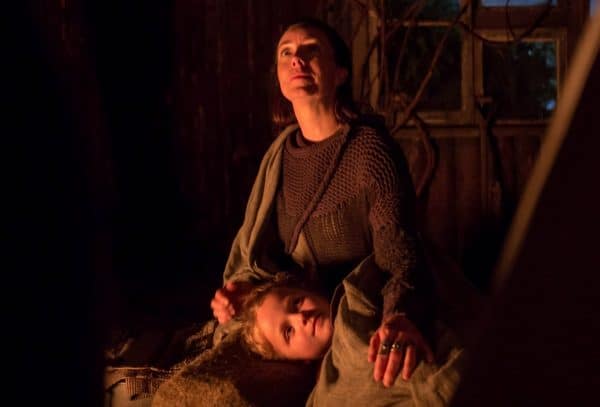
As a piece of advocacy filmmaking and movie rhetoric, “From Shock to Awe” takes its sweet time getting to its “solution step,” which we’ve seen teased in the opening scene. Bearded, tattooed veterans gather around a fire pit, being served “the medicine” and wished a pleasant “journey” by a top-knotted shaman, or priest and drug-trip tour guide.

The answer for many of these men, apparently, is the Amazonian herbal tea mental and digestive purgative known as Ayahuasca.

“Shock to Awe” takes us into the shaky lives of Matt and Aimee (his wife) Kahl, the flashbacks (illustrated with combat footage of Matt and others), and Michael and Brooke Cooley (both traumatized veterans), Coloradans struggling to get back to square one years after their tours of duty ended.

Michael lets filmmaker Luc Côté (“Four Days Inside Guantanemo”) ride with him to school at the University of Colorado-Colorado Springs, and we hear the myriad things that trigger panic attacks in this former MP. Cities, with rooftops which he used to scan for snipers, traffic jams where any tailgater is a potential convoy ambush tend to freak him out.

Loud noises, flashes of light in the dark, the veterans here  — and the sample Luc Côté documented is VERY small — share triggers and after-effects, struggling to keep marriages and families together in the face of an illness that has almost killed them and is killing a score of their comrades in arms every day.

shock2

All that changes when the PTSD victims travel to Orlando. It’s not the magic of a theme park they seek, but the faddish “miracle” enlightenment cure-all of the moment, administered in a safe space (out of doors) provided by Soul Quest, led by the top-knotted Ayuhuasca expert Chris Young.

“Feel the medicine,” Young, of the Ayuhuasca Church of the Mother Earth, counsels. You will feel “connected to everything,” he says, coaching them and basically providing the language they will use to describe their experiences later.

And in these two cases (Matt and Michael), the hallucinatory tea seems to work. You would hope, even in our seriously retrograde times, that this substance and this “cure” would undergo rigorous study as psychotherapy tries new drugs to use in conjunction with therapy. Some of that is happening, although not that we see this in the film.

Anything to stem to flood of suicides, right?

But Côté’s film screams out for words like “cure” and “medicine” to be slapped in quotation marks. There is not only no contrary voice here, no skeptic suggesting that maybe this is just this year’s LSD substitute and PTSD victims are merely switching one dependency for another.

No academics or scientists appear, pro or con. Like other Ayuhuasca documentaries I’ve reviewed, there’s a built-in credulity that spending too much time thinking about the self-annointed “expert” we see here invites. It’s not wrong, no matter what anecdotal evidence the film provides, to question where dude went to shaman school.

The alternative is spelled out on Brooke Cooley’s t-shirt in an early scene. “Cannabis cures cancer. Google it!” Maybe it does, but “Google” isn’t proving that, any more than a couple of veterans who ask for multiple ayahuasca trips to calm their anxiety — and that treatment seeming to work — proves the thesis of “From Shock to Awe.”

We can collectively recognize the crisis, urge the study and testing for therapeutic value and do it in all haste, realizing how desperate suffering people are for some relief.

Limiting your arguement to a couple of guys tripping around a fire in Orlando isn’t making your, even if it makes that sale.

2stars1


MPAA Rating: unrated, with drug use, profanity, accounts of violence

Cast:Mike Cooley, Brooke Cooley, Matt Kahl and Aimee Kahl, Chris Young

Credits: Directed by Luc Côté. An Adobe International release.

Running time: 1:27

Posted in Reviews, previews, profiles and movie news | Comments Off on Documentary Review: Traumatized vets seek inner peace via alternative medicine in “From Shock to Awe”

Movie Preview: A graphic novel comes to life, in Dutch, as “Bloody Marie”

This Nov. 1 release (VOD soon after) is about an alcoholic comic artist who loses it in her journey into Amsterdam’s dark side.

“Sin City” and “Terminal” lurid, Susanne Wolff has the title role.


Posted in Reviews, previews, profiles and movie news | Comments Off on Movie Preview: A graphic novel comes to life, in Dutch, as “Bloody Marie”

Movie Review: Run and hide “Sunday Girl”

sunday1

Blondie fans will remember the “Sunday Girl,” whom Deborah Harry described thusly in song.

“I know a girl from a lonely street
Cold as ice cream but still as sweet…Live in dreams Sunday girl.”

In Peter Ambrosio’s witty, biting and amusingly inconsequential indie comedy, Natasha (Dasha Nekrasova) is a woman with shades, a red trench coat and a mission.

“Sunday Girl” follows her through what we guess is a Sunday as she motors in her vintage VW Beetle from house to hipster house in Lafayette, Louisiana, dumping guys.

She’s dating five. Four have got to go, because she’s decided the bearded hipster, George (Brandon Stacy) is the one.

“Sunday Girl” is a movie of those conversations. Natasha knocks on a door, often having to approach it several times, building up a little more nerve each time.

She’ll say something like “You’re not ‘it’ for me.” Usually, that’s before she offers breakup sex. At some point, she’ll angle for the door. Maybe she’ll ask for gas money before popping on her shades and moving on.

“I have a busy day.” Indeed she does.

The guys? Most of them aren’t even identified in conversation. Neither is the film’s location. I stared at the cute, older Southern Arts & Crafts houses, sitting on cinderblocks, caught the name of a restaurant, “Eat Leauxcal,” and tracked it to Louisiana. Nobody here has an accent.

The guys — some of whom quake or break down — struggle to cope with the news. One has a good old fashioned tantrum.

Victor (Bilal Mir) is a poet, so he has her best description.

“I don’t really think of you as a person, more a feeling.”

Jack (Dave Davis) lights into the “cheating, lying blonde nightmare.” Sorry, he’s just “venting.”

Natasha? In writer-director Peter Ambrosio’s eyes, she’s “Sunday Girl” chilly. A suitor says “Sometimes I just want to kill myself,” and her eyes light up.

“How would you DO it? That always hangs me up!”

But she plainly has something — charisma, sex appeal, libidinous tendencies. Even if she’s just “Lafayette hot,” they’re all drawn to this artist who photographs people in tears, “usually in hospitals or cemeteries.”

In an earlier age, she’d have taken her ’71 Beetle to Austin. The rents are lower and the competition to stand out thinner in little Lafayette.

Here, she’s the best game in town. Even her boss, the older art photographer Anton (Anthony Marble), makes a play, an offer to take her abroad for some “assignments.” She’d…like to.

“It’s not what people claim they want,” he huffs. “It’s what they actually do.”

Sunday2

Nekrasova, an indie film actress and writer (she turned up in “Mr. Robot”) makes an entertaining locus of all this comical angst and upset. There’s an unpolished quality to her performance, the affected way Natasha dons and removes her sunglassses, smokes a cigarette as if the only times she touches one are on a film set.

She isn’t the new Greta Gerwig, even if “Sunday Girl” smacks of Early Greta “Mumblecore” (it’s awfully chatty) fare. She’s her own deal, playing Natasha as a young woman fronting her “confidence” while confused, impulsive, scared to death people will see through her pose.

As Anton suggests, it’s not what she says she wants, but what she does that counts. And for this “Sunday Girl” (limited release, Nov. 8), her drunk dialing tendencies give away the game.

2half-star6

MPAA Rating: unrated, smoking, smoking, profanity

Cast: Dasha Nekrasova, Brandon Stacy, Dave Davis, George, Evan Holtzman, Morgan Roberts, Ashton Leigh, Anthony Marble.

Credits: Written and directed by Peter Ambrosio. A Subliminal Films release.

Running time: 1:18

Posted in Reviews, previews, profiles and movie news | Comments Off on Movie Review: Run and hide “Sunday Girl”

Movie Preview: Robert Downey Jr. talks to the animals as “Dolittle”

Good to see a fine actor take on meatier roles once he’s made bank wearing a metal flying suit.

Posted in Reviews, previews, profiles and movie news | Comments Off on Movie Preview: Robert Downey Jr. talks to the animals as “Dolittle”

Book Review: Crawford’s “Summertime: George Gershwin’s Life in Music” has a movie in it

As a non-fiction fan as a reader, a lifelong history buff and somebody who considers period pieces my favorite film genre, I rarely read a show biz history book without my mind wandering to the question, “Is there a movie in this?”

Years and years before Tim Robbins got “Cradle Will Rock” on the screen, I knew somebody would eventually try to capture the heady energy and political fireworks of Orson Welles, at his theatrical peak, getting Marc Blitzstein’s 1930s labor opera “The Cradle Will Rock” in a movie.

It’s a piece of theater legend any Welles fan knows -thrillingly recounted in every Welles biography –9 a WPA show that the government lost its nerve about in mid-Depression, cast and crew scrambling to find a theater to stage it on opening night, doing so in an act of artistic defiance for the ages.

I see something with even greater artistic and mass audience appeal in one slice of George Gershwin’s life, the creation, casting and production of “The Negro Opera” “Porgy & Bess.”

There was an earlier Gershwin biopic that starred Alan Alda’s dad, Robert. And apparently, there’s another in pre-production.

Gershwin cut a wide swath through the culture in his too-short life. And the temptation to try and tell all of it (learning his craft as a “song plugger” on Tin Pan Alley, rubbing shoulders with the other inventors of “The Broadway Musical” in the 1910s, 20s and 30s, Hollywood) is certainly there.

I’d guess you’d be better off with a film more circumscribed in time, something more like “Me and Orson Welles,” (THAT man again.), Richard Linklater’s charming outsider-looking-in-at-the-tyro-artist comedy with Zac Efron. That was confined to Welles’ Broadway-changing production of “Julius Caesar” from roughly the same era.

Gershwin was the composer who blended jazz and Tin Pan Alley pop into Broadway show tunes, elevating that art form in the ’20s and ’30s. Gershwin’s most famous piece, beaten to death by Woody Allen in film scores, was a signal moment in “legitimizing” jazz in “serious music” (classical) circles when it premiered, as performed by the composer himself (at the piano) and Paul Whiteman’s jazz orchestra in the mid-1920s –“Rhapsody in Blue.”

But the creation of “Porgy,” perhaps THE great American opera, is the surest bet, the best place to confine your movie to.

As musicologist and biographer Richard Crawford’s music-centric biography points out, Gershwin’s teaming with (white) South Carolinian Dubose Heyward was the stuff of magic. Gershwin, already schooled in jazz, mentored by African Americans and admiring others who proceded him in Tin Pan Alley, was ready to take on a project just like this. Gershwin and Heyward’s research visits to African American churches, soaking up the music and the world Heyward turned into “Catfish Row” and Gershwin animated with song, is fascinating enough. Crawford devotes much of this biography to this act of creation.

Heyward’s poem that Gershwin put to music as “Summertime,” and the casting that altered the tunes and bent the show closer to documentary reality and thrilling musicality are just a couple of the dramatic highpoints that seem most cinematic.

Yes, Gershwin hit on his young Juilliard-trained choice for Bess (Anne Brown). No “Not happening,” she said. He still crafted the role for her and put her in the history books.

Yes, the choir they hired, the other players they settled on, changed the opera, giving it musical authenticity and adding to the musical audacity. That process transformed “Porgy & Bess” into the enduring classic it became.

It’s a warm “creation myth,” one with qualities that embrace the liberalism of the time (New York theater was alive with door-opening African American efforts by white playwrights and composers, from Virgil Thomson’s “Green Pastures” to Welles’ celebrated “Voodoo” Caribbean setting of “Macbeth”). Careers were launched, and great black playwrights would soon follow.

As any number of Golden Age of Hollywood studio moguls were prone to say, knowing their word was law, “Let’s get SOMEbody on that.”

Posted in Reviews, previews, profiles and movie news | Comments Off on Book Review: Crawford’s “Summertime: George Gershwin’s Life in Music” has a movie in it

Movie Preview: Brazilian lad learns about “kissing” in the gay rom-com, “Cousins”

Yeah, I went for an Elvis “Kissing cousins” joke there.

But this coming out/coming of age Nov. 1 release could be funny, and should be an eye-opening state-of-gay rights/acceptance in Brazil foreign language farce.

Posted in Reviews, previews, profiles and movie news | Comments Off on Movie Preview: Brazilian lad learns about “kissing” in the gay rom-com, “Cousins”

“Saturday Night Live” pays tribute to The Sesame Street (DC) Universe”

Posted in Reviews, previews, profiles and movie news | Comments Off on “Saturday Night Live” pays tribute to The Sesame Street (DC) Universe”

Documentary Review: Oh, the things society does to deny “#Female Pleasure”

female1.jpeg

In the documentary “#Female Pleasure,” five women from different cultures discuss the ways “the universal religion, patriarchy” has circumscribed and even traumatized their lives.

A Japanese artist is persecuted for her vagina imagery, a Hasidic woman hounded for breaking with the faith, an Indian woman starts a website to try to drag her country into a century where groping, rape and “honor killing” are ended via her website, a German nun struggles to get the attention of Pope Francis with her story of rape by a priest within Vatican city.

But the money moment, the scene that will stick with your from this Barbara Miller documentary, is provided by psychotherapist and women’s right’s activist Leyla Hussein. Her cause begins with using the proper terms for child marriage and female genital mutilation.

“Child abuse.”

And the fact that this practice, most common in Third World and Islamic countries in Africa, the Middle East and Polynesia, spreads to the First World when refugees — she is a Somali native — bring the barbaric custom with them sets up her indelible scene in “#Female Pleasure.”

So Hussein rounds up young Somali men from the diaspora that she lives among, in Britain, and uses a large-scale clay model to demonstrate the stages or degrees of “FGM.”

We watch the kids cringe, and cringe along with them, as she takes a putty knife to the parts of a vagina that are carved up or removed to “deny female pleasure” in sexual intercourse. The kids realize, as anybody watching this will, that writing off this graphic, gruesome and lifelong trauma as a mere “cultural practice” that we in the West shouldn’t comment on, is a grotesque misuse of custom and religion, horrifically primitive in origin, sexist, cruel and repressive in its continued use.

Hussein, who had this done to her as a child, remembers the aunts and neighborladies who came to carry the “rite of passage” out on her, and notes — “It’s not your body that you lose. You lose trust.”

“#Female Pleasure” roinds up these dispirate assaults on women’s most basic freedom — control of their own body and romantic destiny — to create a sweeping condemnation of millenia of patriarchical thinking.

Vithka Yadav, who set up the Love Matters website in India, recalls the waking nightmare of “growing up a girl-child in India, daily gropings and assaults,” spiraling towards an arranged marriage that too-often is another form of slavery.

“I started to hate myself for being a girl,” she remembers, stopping to debate a sexist monk in the city square (she has to hold back from telling him off) on her way to editing pieces on sexuality written by the coed staff of her website. The country that created the Kama Sutra has taken hundreds of years of backward steps in regards to equality of the sexes, she says.

Deborah Feldman‘s New York Hasidic trials and tests are more familiar and have been documented in books, articles, documentaries and feature films — another arranged marriage, another culture condemning women to lives without choice, without education (and books), without pleasure. That this is allowed to happen in New York, with fathers too often winning custody of children when the rare wife makes her legal escape, is apalling.

Catholic nun Doris Wagner’s story may be the saddest, signing into a patriarchy where nuns are mixed in with sometimes predatory Vatican City priests, “but it is the nun’s responsibility to make sure nothing happens.”

There is one lighter thread in Miller’s film, the story of Japanese artist Rokudensashiko. She draws manga, Japanese comics, and incorporates female and feminist issues into her stories. She also makes dioramas out of scenes from the comics.

Where she runs afoul of tradition, patriarchy and the law is when she starts making plaster casts and then 3D models of her vagina. She makes her vagina a character in her work. She commissions a plastic kayak shaped like her vagina. She and we giggle as she does.

“OBSCENE” say the menfolk, and we snicker along with her at the flaming hypocrisy of this as she walks through Tokyo’s sex shops, sampling the wares — where inflatable sex dolls and all manner of kinky “real woman substitutes” were invented for a culture that is shrinking in population because real sex is apparently too frightening…for some (men).

As I say, much of what is reported here has turned up in TV news magazine segments, articles and other films. But Miller has pulled some far-flung threads together to create a fascinating “state of the struggle” report, one that women like Hussein are fighting, one speech, one interview, one graphic demonstration of FGM at a time.

3stars2

MPAA Rating: Unrated, frank discussion of sexuality and sexual violence

Cast: Leyla Hussein, Rokudenashiko, Vithika Yadav, Deborah Feldman, and Doris Wagner

Credits: Written and directed by Barbara Miller. An Abramorama release.

Running time: 1:37

Posted in Reviews, previews, profiles and movie news | Comments Off on Documentary Review: Oh, the things society does to deny “#Female Pleasure”

Documentary Review: “Westwood” keeps punk alive on the runaways, after a fashion

west1.jpeg

Vivienne Westwood is a founding mother of British punk, an artist turned fashion designer who shaped, more than anybody else, the “look” of punk during the Sex Pistols’ heyday.

Her then lover and collaborator was punk impressario Malcolm McClaren, and in the new documentary “Westwood: Punk, Icon, Activist,” she recalls how she and McClaren “cast” the band, and she dressed them.

Every time you see a torn t-shirt, a safety pin or swastika misused in “fashion,” thank Vivienne.

Defiantly independent, even as she hits 80, she and McClaren opened such iconic shops as Let It Rock, Too Fast To Live, Too Young To Die and World’s End. She set the tone for this DIY look, and maintained it “even after they (the media) moved on to the next new thing.”

Lorna Tucker’s film captures Westwood as she finally absorbs the recognition British fashion long withheld from her and tracks her as she evolved her cluttered, DIY-looking weird-wear into runway-ready showstoppers, her brand spreading worldwide during the course of the film.

We see her hands-on piecing together of “looks” on her models, with her husband, the Austrian Andreas Kronthaler, fussing over every layer, accessory, ungainly shoe or legging.

They’re just “a drunken auntie and the gay uncle” to her “family” of designers and employees coos Andreas, who will never be butch enough for “Queer Eye for the Straight Guy.” But they make this work, doting over each other and the work (he was a former student and model) as her independent empire reaches the far corners of the globe.

west2

Naomi Campbell giggles about her famous runway tumble in whatever absurdly impractical heels they whipped up, and Kate Moss jokes about their years of association.

Tucker lets Westwood (her first husband’s name) grouse about old ground she doesn’t want to cover again, about McLaren, chapters she’d just as soon forget.

She was openly mocked on British chat shows, and seeing some of what she puts out there, that’s easy to understand. And yet, she persisted.

And the filmmaker lets Westwood trumpet her environmentalism, which works itself into her “No fracking” etc. designs. Left unchallenged is fashion’s role, in the very vanguard of industries ruining the planet on so many levels that there have been documentaries about it.

Still, she chose not to open a planned shop in Beijing for all the right reasons.

“Westwood” doesn’t rank with the great and revealing fashion docs of the past decade — “The September Issue,” “Valentino: The Last Emperor,” “Iris” or “The Gospel According to Andre.” But Tucker has documented cultural proof that an artist who sticks with it long enough and takes care of herself can live long enough to see everybody else come around to her way of viewing the world of what we wear.

It’s an amusing gloss on a punk icon who never gave up the rebellion and never let go of the safety pins.

2half-star6

MPAA Rating: Unrated, nudity, profanity

Cast: Vivienne Westwood, Pamela Anderson, Christina Hendricks, Andre Leon Talley, Andreas Kronthaler and Kate Moss

Credits: Directed by Lorna Tucker.  A Greenwich Entertainment/Amazon release.

Running time: 1:23

Posted in Reviews, previews, profiles and movie news | Comments Off on Documentary Review: “Westwood” keeps punk alive on the runaways, after a fashion

RIP Robert Forster, one of the great ones, 1941-2019

forster.jpg

Like millions of Netflixers, I was watching Robert Forster Friday night in what turns out to be his last “movie” role — as the “El Camino” vacuum cleaner salesman whose side hustle is what Jesse Pinkman is more interested in.

Forster played heavies and heroes and romantic leads, mostly on TV, until Quentin Tarantino rescued him from obscurity for “Jackie Brown.”

That’s the one I plan to re-watch today. Forster got decades or work out of that sparkling appearance, a bail bondsman who finds love in a stewardess doing bad (Pam Greer), a damned George Jones “He Stopped Loving Her Today” level performance. Pathos, understanding, humility and wit, that became his showpiece role. World weary, that was Max Cherry.

I interviewed him for his work in Mamet’s “Lakeboat,” a working class Joe playing a working class Joe — Joe Pitka, crewman on a Great Lakes freighter.

Classy guy, modest, everything you want in a movie star.

Deadpan or understated and earnest, malevolent or romantic, he made it look effortless, from “The Descendants” to the “Olympus has Fallen” franchise.

Classed up “El Camino,” and how.

Posted in Reviews, previews, profiles and movie news | Comments Off on RIP Robert Forster, one of the great ones, 1941-2019