Obscurant, trippy and more “Shakespeare Adjacent” than an adaptation of “Hamlet” or its tragic female lead, “Finding Ophelia” is one of the more visually-arresting misfires you’ll encounter on the big screen.
The acting is so wooden (line readings in particular) that viewers are right to be concerned with getting splinters. And great is the screen time in this ever-so-short dream drama that is devoted to hallucinatory, kaleidoscopic images, the visions of our hero, “Will” (Jimmy Levar), an ad exec fretting over a woman (Christina Chu-Ryan) he’s never met.
“Where do you think we go to when we’re asleep?” he finally asks a friend, relatively late in a film where little that we hear or that Will says falls into the realm of the coherent. Maybe that’s where Ophelia “lives.”
Will is adrift, wandering the city streets in an all-black ensemble (save for his sneakers), dropping into his favorite bar but not listening to bartender Steve (Steve Schaefer) and his jokes, dodging an endless succession of calls from work, distractedly meeting his girlfriend (Gabriella Whiting) for dinner, after he’s forgotten they were ever scheduled to meet.
“What’s gotten into you?”
“Bourbon? Drugs?”
The girlfriend’s name, by the way, is Juliette. But our Will, who opens a copy of “Hamlet” at one point, isn’t focused on Juliette. He’s moved on to the fair Ophelia.
As she herself says in the play, in a phrase repeated several yes for effect here, “Do you DOUBT that?”
Writer-director Stephen Rutterford goes out of his way to maintain the picture’s fever-dream tone, but never puts much effort into folding in a narrative. Will does what he can to avoid dealing with people he knows as he searches for the source of his obsession, a search that turns surreal and grisly at times.
An old woman voices over some passages with lines that I couldn’t nail down as actually coming from Ophelia or “Hamlet,” but sound vaguely Shakespearean.
Eventually, like all dreams, “Finding Ophelia” comes to an end, leaving only the vaguest notion of where it began even as where it and Will end up makes the tiniest bit of sense.
MPA Rating: unrated, one bloody scene
Cast: Jimmy Levar, Christina Chu-Ryan, Natalie Blessing and Steve Schaefer
Credits: Scripted and directed by Stephen Rutterford. An Indie Rights release.
This has “Terminator” time travel and news of an “Independence Day” level alien threat from the future. “The Tomorrow War,” directed by Lego pic vet Chris McKay, comes to Amazon Prime Video July 2. https://youtu.be/RQjEbkV-9ZM
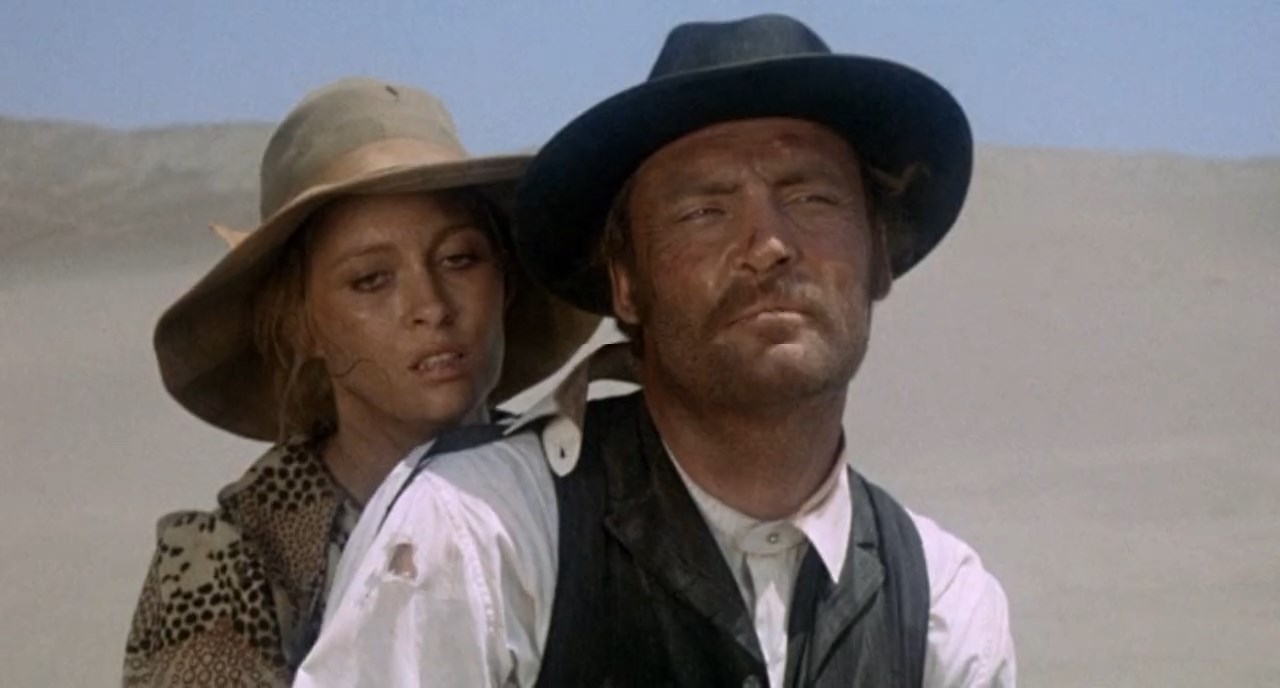
Viewing the Doc Holliday Western “‘Doc'” cold is quite an eye-opener.
You see the cast, wonder why any picture with Faye Dunaway at her post “Bonnie & Clyde” peak isn’t more notorious and note the other novelties in the credits.
New York newspaper columnist Pete Hamill, dabbling in screenwriting in the early ’70s when he was journalism’s hottest comodity, scripted it. He wrote fiction and a couple of other screenplays over his long career, most famously Abel Ferrara’s “King of New York,” a gangster picture starring Christopher Walken. Songwriting legend Jimmy Webb (“By the Time I Get to Phoenix,””MacArthur Park”) did the score.
That kind of fits the MO of little-remembered director Frank Perry, whose most famous films were “Mommie Dearest” and “David & Lisa,” but who regularly assembled pictures out of disparate talents from other fields. “Rancho Deluxe” had quirky novelist Tom McGuane scripting his own offbeat “modern” Western, with singer-songwriter Jimmy Buffett conjuring up a score and the unlikely pairing of Jeff Bridges and Sam Waterston (playing a Native American) in the leads.
Perry made a lot of movies that seemed like better ideas on paper, cult films almost to a one.
“‘Doc'” himself is a rare Western turn by an actor I remember labeled, in a ’70s magazine profile, as “America’s best ‘Hamlet,'” stage legend turned “sensitive” big screen tough guy Stacy Keach. Keach all but stole John Huston’s “The Life and Times of Judge Roy Bean” a year or two before this film, turning a tiny role as outlaw hellion Albino Bob into the most memorable character in the film. He later co-wrote and co-starred in one of the greatest Westerns of them all, Walter Hill’s James Gang epic “The Long Riders.”
Perry stirs this curious brew into another quixotic film on a resume littered with such outings. What stands out 50 years later is the grit he went for, how unwashed, nicked-up and smelly looking everybody is on the trail, away from town, and how unsanitized-for-your-protection these “legends” of the Old West come off.
‘Doc’ Holliday is not John Ford’s drunken tormented, tubercular gentleman gambler, quick to anger, quicker with a gun. He’s a coarse, crude play-the-angles hustler, longing to reconnect with his old pal Wyatt Earp in Tombstone, but not above playing cards for “possession” of the prostitute Kate Elder (Dunaway).
Elder was Holliday’s longtime companion, a Hungarian immigrant named “Big Nose Kate” in Western lore and in screen Westerns (“Wyatt Earp”) that lean on the facts when taking us toward The OK Corral. The John Wayne Western “The Sons of Katie Elder” might have had pretensions of playing around with her legend, in earlier drafts of the screenplay. Dunaway has a little fun with her.
“When I want preaching, I’ll go to church. But for the moment, when I’m on my knees, it ain’t in prayer.”
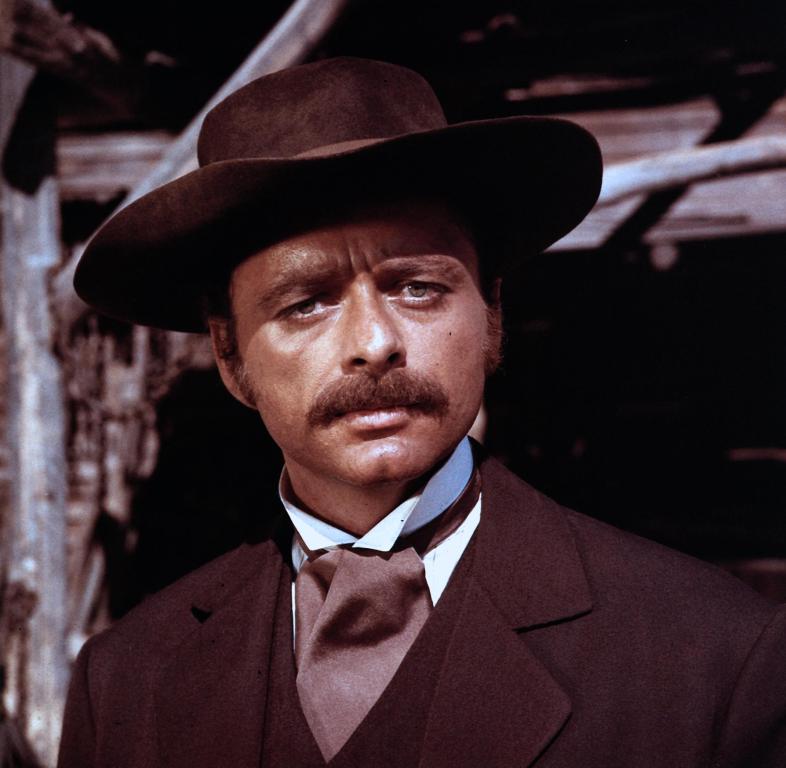
Doc “wins” Kate away from Ike Clanton (Michael Witney) in a seedy cantina in the middle of nowhere and finds himself obligated to drag her along to Tombstone. That’s where Earp (the formidable Harris Yulin) and his brothers have set up shop, corrupt “lawmen” looking to get rich by controlling crime and gambling in another boom town. Doc has been summoned to “run the gambling.”
The striking locations and screen compositions and sometimes-looped sound suggest “Spaghetti Western,” a style a lot of filmmakers/studios were dabbling in after Sergio Leone and Eastwood made them iconic and respectable. Like Leone’s films, it was shot in Spain by MGM, which spent a lot of its European profits there in the ’60s and ’70s.
But Perry was no slouch at shot compositions in his own right, so he wasn’t just mimicking Leone in where he placed the camera. And the tone and themes of the “‘Doc'” fit neatly into Perry’s fascination with sexuality outside the big screen norm. The way Doc and Wyatt lock eyes, especially that first and second time, that’s ’70s cinema “homoerotic” at its most overt.
“‘Doc'” is most interesting, all these decades later, not for any “Brokeback Tombstone” subtext, but for the performances — Dunaway, brassy, sunny and sassy and on the cusp of asserting her power as a star of the era, Yulin brooding and nicely paired with Keach.
Keach lets us see the scheming behind Holliday’s eyes, the amoral drifter playing down his reputation as both a survival strategy and a means of not getting run out of town.
“There’s gonna be trouble Mister Holliday!” The Kid (Denver John Collins) warns.
“Not with me there isn’t!”
Keach makes every card game interesting and even the obligatory “teach me to shoot” scene realistic and riveting. When the hanky comes out and is bloodied, as it always does in depictions of the Holliday and his affliction, Keach makes us believe this is a man who curses his fate, but accepts it.
This Doc Holliday, like all the rest, has a fatalism about his limited future. And there are hints of the moral decay accompanying the physical one, as in every other credible Doc Holliday on screen. A college-trained dentist who left post-Civil War Georgia after contracting tuberculosis, he wouldn’t have troubled “a lady” with his doomed attentions. A prostitute who had nowhere to go but up? Sure. Why not?
“‘Doc'” never quite rises to the novelty of “cult Western,” as its virtues run up against pacing problems, a scattershot script — just a few great snatches of dialogue — colorless supporting players and the sheer over-familiarity of the story undercut the film’s potential.
Keach and Dunaway have long been among my favorite actors of that era. I had one chance to interview her, still regal and every inch the diva when “Don Juan de Marco” came out. And Keach I got to meet and chat up when he tried out the play “Flowers & Photos,” playing photographer Alfred Stieglitz to Margot Kidder’s painter Georgia O’Keefe, and later when Keach all but stole “Nebraska” from Bruce Dern. Fascinating guy, from TV’s “Mike Hammer” to Cheech and Chong’s “Sgt. Stadenko,” he meandered through a very odd and sometimes troubled career.
And any Western with Keach and Dunaway, with hints that Dunaway might not be the hero’s first choice as a bedtime companion, is worth a look.
MPA Rating: R, violence, sexual situations, profanity
Cast: Stacy Keach, Faye Dunaway, Harris Yulin
Credits: Directed by Frank Perry, script by Pete Hamill. An MGM release.
With other films coming out in commemoration of the 100th anniversary of the Tulsa Massacre, the trait that makes Dawn Porter’s “Rise Again: Tulsa and the Red Summer” stand out is the context, and the drama of “proof.”
Her National Geographic crew was filming the day the mass grave that removed any doubt that this tragedy was as awful in scale as claimed. And in 88 brisk minutes (PBS had a doc mini-series about Tulsa in 2019) we learn of most of the events that led up to that last “Red Summer” of several that followed the end of World War I.
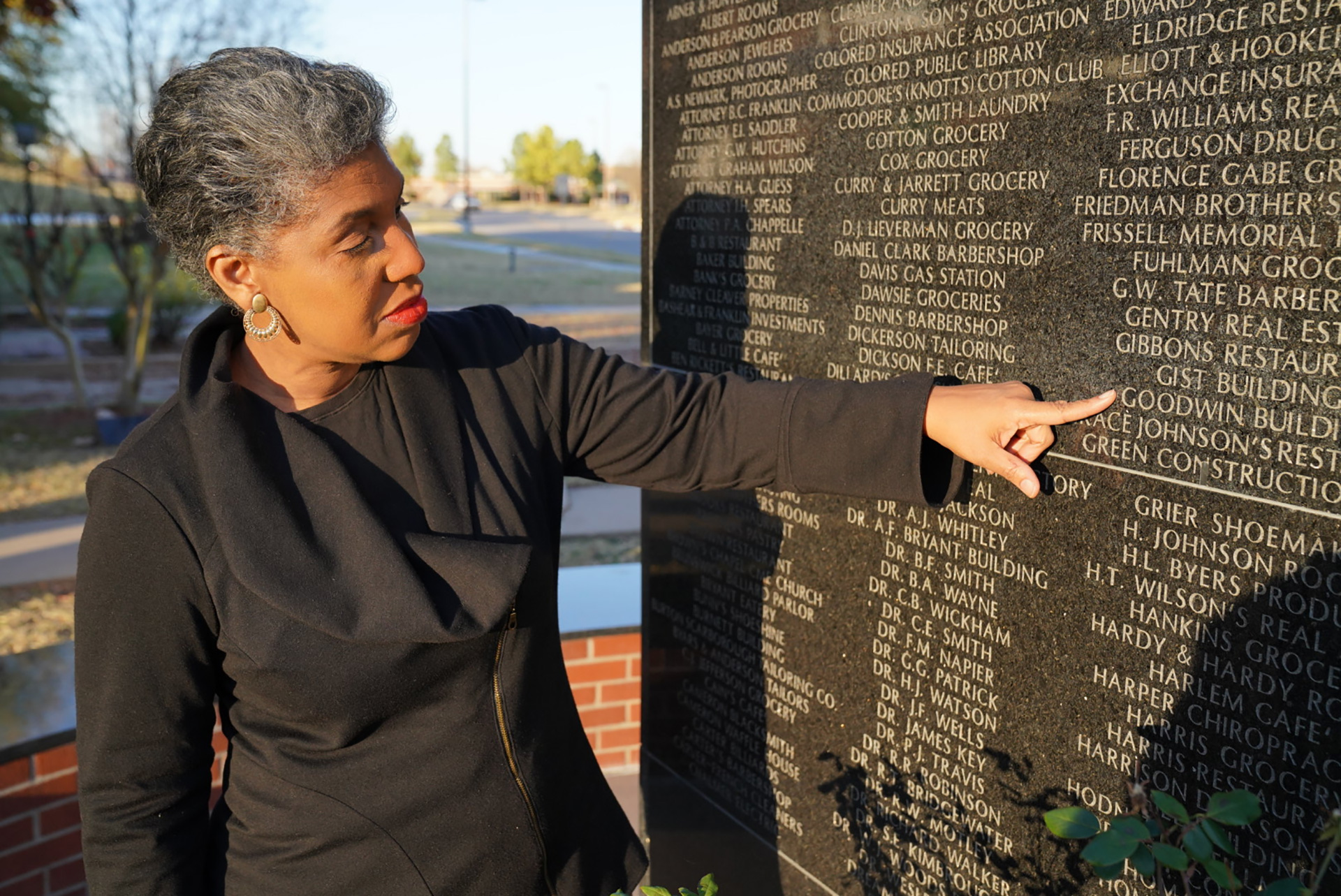
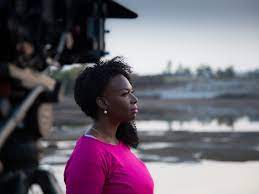
With Washington Post reporter and Oklahoma native DeNeen Brown (below) as journalist and anchor interview, this film visits archives, interviews survivors and a white eyewitness and retrieves interviews with survivors no longer living and audio of historical figures speaking on the state of race in America in the early years of the 20th century.
President William Howard Taft delivers remarks on the pace of progress in African American social and business affairs in the years after slavery. But a few years later, after the first “Red Summer,” largely a reaction to the threat that “progress” represented to white America, poet Claude McKay wrote his “If We Must Die,” and we hear him recite it.
As Brown notes, in cities from Chicago to Knoxville, Atlanta to Elaine, “all it took was a rumor” of an alleged assault or affront, or in Elaine’s case, the threat of Black farmers organizing to get better prices for their labor, for lynch mobs to form.
Brown meets an archivist who shows us the then-governor’s scrapbook revealing how Charles Brough dashed to the scene of the Elaine unrest, participated in it, then promised “hangings” for those Black victims charged with inciting or carrying out the violence, when their real crime was defending themselves and surviving.
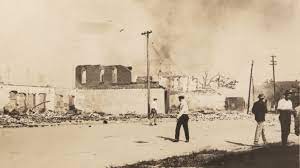
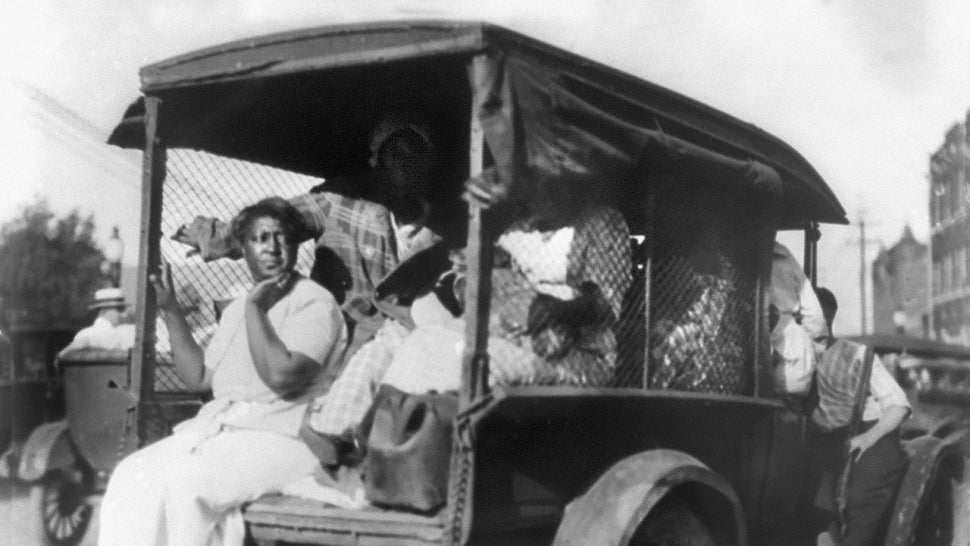
Airplanes circled over Tulsa and are widely believed to have bombed the prosperous Greenwood neighborhood and business district, 35 blocks of the city destroyed in days of racist rage in 1921. Hundreds died, most of the scores and scores of businesses never came back to life.
Brown notes her own newspaper’s ugly part in the summers of unrest, blasting headlines calling for reprisals and violence in Washington, D.C. in that first Red Summer. And we see Tulsa’s laudable commitment to unearth this past when efforts to investigate it more thoroughly were thwarted in the late 1990s.
At a time when America is wrestling anew with what the country “means” and stands for, when “Jim Crow” is again in the headlines thanks to voter suppression efforts in Republican-controlled legislatures across the land, and when grappling with the long history of racial animus that is a stain we never seem to want to acknowledge, “Rise Again” is a sober reminder of the history many want to erase, all but ensuring it’ll repeat itself for the next hundred years as well.
MPA Rating: unrated, archival photos and descriptions of violence
Cast: DeNeen Brown, Oklahoma State Representative Regina Goodwin, Cameron McWhirter, Rev. Dr. Robert Turner and Mayor G.T. Bynum.
Credits: Directed by Dawn Porter. A National Geographic/Hulu release premiering June 18 and 19.
“Skater Girl” is a pleasant “feel good” Indian drama played in a minor key.
It’s sort of a Westernized look at income disparity, lingering “caste” culture and sexism, as it tells the story of an Indian woman raised in London who comes to see the problems of the tiny village of her family’s past as solvable by teaching the kids to skateboard. We see the impact even this tiny bit of joy and “freedom” has there through the eyes of a poor teenage girl who finds herself and her ambition on a board.
Newcomer Rachel Saanchita Gupta is Prerna, a gawky teen who has outgrown her school uniform, but that’s just as well because her family keeps her out of school, making her sell peanuts in the nearby market town, cooking and keeping the house. School is now where she drops little brother Ankush (Shafin Patel) in the morning.
Prerna can’t win for losing. She’s kept out of school, but her stubborn brick-maker dad criticizes her inability to sell peanuts, and lashes out in misguided macho pride whenever her mother suggests other jobs she could do to help support the family. Prerna shows up at school after a teacher berates her for skipping. Too poor to have a textbook? He then humiliates her in front of the class and it’s back to skipping school.
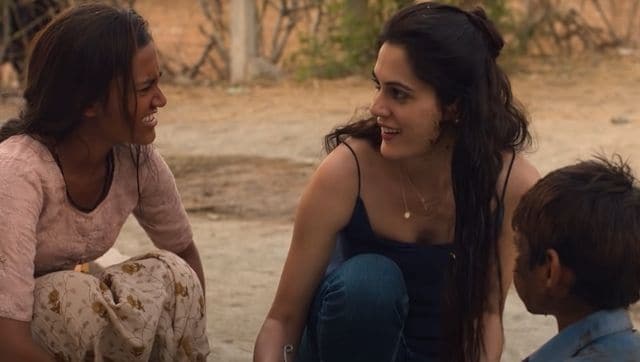
As is the way of such films, a visitor from the Progressive West then shows up and changes her life. Jessica (Amrit “Amy” Maghera of TV’s “Hollyoaks) rolls into the village on a bus, checks in at the modest internet-advertised hotel and wanders the place, looking for vestigial connections. She is struck by the memory of how “one small step” changed her and her family’s fate.
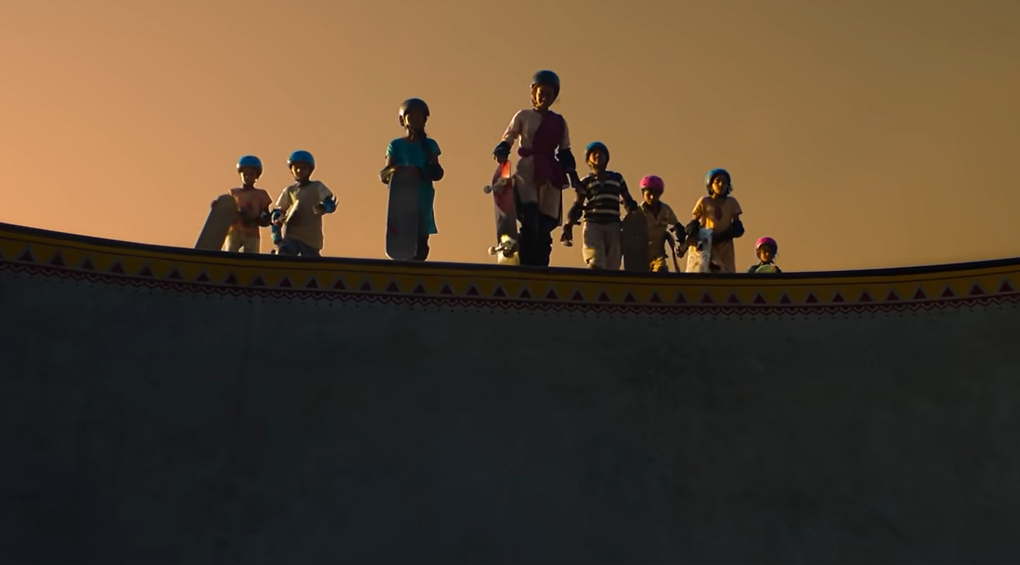
Seeing the “bearing car” Prerna fashioned for her little brother gets her attention. It’s essentially a homemade skateboard. The abrupt arrival of a convenient American-who-knows Jessica, Erick (Jonathan Readwin) allows her to make the connection. He brings his skateboard, shows the kids a little, and next thing you know, Jessica has equipped all the kids, in all castes, with skateboards.
But that won’t change Prerna’s predestined life of grinding poverty and menial labor, or her fate to be married off too-young before she can do anything to improve herself. For that, they’ll need to think bigger.
The amusing things in “Skater Girl” are the way the Westerner accidentally imports anarchy the moment she introduces the children of Khempur, Rajasthan to skateboards. She’s not just “disrupting” these kids’ life paths, she’s upending businesses, dinging the public peace and giving the kids something they’d rather do than attend school.
She’s remaking this town in the West’s image, and the locals are soon in a tizzy over that, as you might expect.
“Doesn’t matter where you go in the world,” Erick cracks, “everybody hates skateboards.”
The blowback is both predictable and still disheartening in an amusing way. But if the kids go back to school they can learn how to impose change the way the father of their country did. WWGD? What would Gandhi do?
There are plenty of cute bits in director and co-writer Manjari Makijany’s film. The skating might be remedial, strictly low-speed, low-skill set shredding.
But that’s the point. Introduce it, get the kids hooked and they’ll never be content to scrub floors or tend fields again. It’s a “small thing” but it could change this village and the kids in it in ways far beyond the inevitable scars from their many inevitable falls.
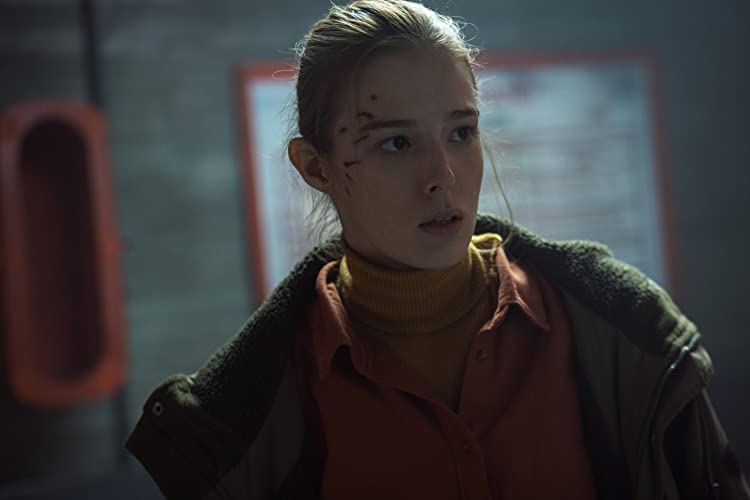
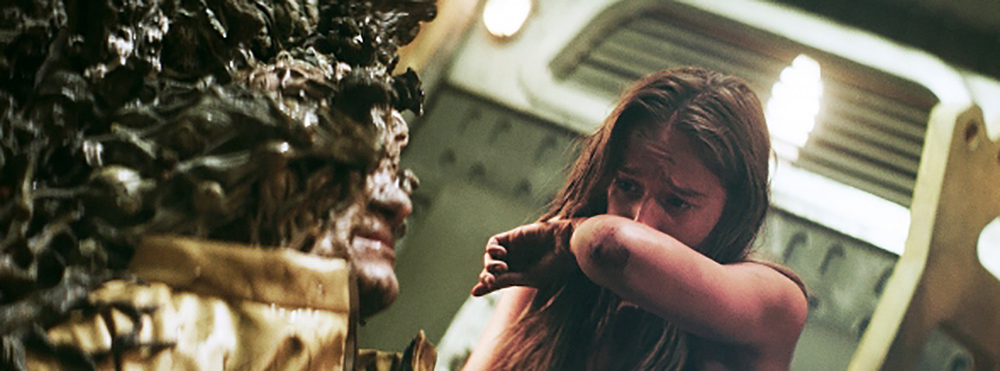
The effects are impressive and the over-dubbing is good enough that most characters you’d swear were speaking their native English on Shudder’s Russian release, “The Superdeep (Kolskaya sverhglubokay).”
But you don’t even need to take the (super shallow) cheap shot that any horror film titled “Superdeep” serves up to pick apart this slow-walked bore. It’s acted, filmed and shot in ways that spoil its limited dramatic/suspense/fright possibilities, a classic 85 minute movie wrapped in a 103 minute package.
It’s the sort of movie where there isn’t much point noting the supporting cast, because you just know this officer, that junior officer, this scientist and that lab tech aren’t going to be around for long. Picked off, like Poe or Agatha Christie characters, one by one.
Anya (Milena Radulovic) is an epidemiologist with empathy issues in the last Gorbachev years of the Soviet empire. She has little problem “following orders” when things go lethally wrong with a vaccine she and colleagues are hastily testing in the opening scene.
Will that come in handy when she’s called in for an emergency at a super secret “deepest bore hole in the world” outside of snowy Murmansk? Something’s gone terribly wrong in a lab and research station buried some 12,000 meters down. She is to “collect samples” from bodies and “leave any rescue mission to the World Health Organization.”
As the WHO doesn’t even know about the lab or what it’s up to, well, just do your duty, comrade.
But one stunned survivor of the accident staggers up to her and lectures her, without knowing her name, credentials or orders.
“There’s nothing worse than betraying our principles!” Although she assures him “I took the Hippocratic Oath,” he, she and we assume it’s the Russian version. First, do what the State says, not “first, do no harm.”
As Anya, an epidemiologist sans facemask (Russian shortcuts) makes a rapid (unpressurized) descent into the Superdeep, she sees “Demons live here” graffiti and hears “It’s hell down there, Hell!” from others. “Superdeep” goes wrong, step by slowly-taken step.
There’s a catalog of camera angles and edits that help most horror films create empathy for characters, build suspense and even reach for pathos when the worst happens. Writer-director Arseny Syuhin either never watched John Carpenter’s “The Thing” or even Jon Amiel’s “The Core,” or simply didn’t feel the need for this strategy as he wasn’t worried about those built-in problems for any “creature feature.”
There’s a lot more to making an effective thriller that sending a pretty scientist to be tested, physically, morally and ethically in an alien environment than “The Superdeep” that he made. The film lacks urgency, stakes, deaths that matter, the works.
But again, the hurtling elevator (up, and down) effects and over-familiar human bodies taken over by something viral and inhuman effects are top tier.
And kudos for Samuel Stewart Hunter for getting the Russian speakers’ words in English (he adapted the dubbed dialogue) to come close to matching the movements of their lips.
Aside from this, “The Superdeep” is a super bust.
MPA Rating: unrated, bloody violence
Cast: Milena Radulovic, Sergey Ivanyuk, Nikolay Kovbas
Credits: Scripted and directed by Arseny Syuhin, English adaptation scripted by Samuel Stewart Hunter. A Shudder release.
I’ve been arguing with people online all week about building up box office expectations for Lin-Manuel Miranda’s first big musical, “In the Heights.”
It’s also showing on HBO Max, and TV is a good place for it.
It’s a watchable film lacking stars, breakout tunes, lump on the throat moments, real drama or much that would bolster its appeal. Inclusive, a cute moment or two and great dancing can’t overcome those missing selling points. And selling the Dickens out of it can’t overcome that lack of pop and pizazz.
It always looked like “Rent” and that’s how it opened $11.4 million. Jon Chu’s directed an underwhelming movie that this time, audiences ignored.
I just caught “Peter Rabbit 2” and while Sony can be pitied for not getting it out on Easter, last year and this year, judging from the joyless Sequel they should be happy with $10.4 million.
New openings let down aside, it’s not like “A Quiet Place 2” ran away with the weekend. $11.65 million.
It rallies for an almost-boffo finale, with James Bond movie rescues and a James Bond Astin Martin — if spies ever drove convertibles.
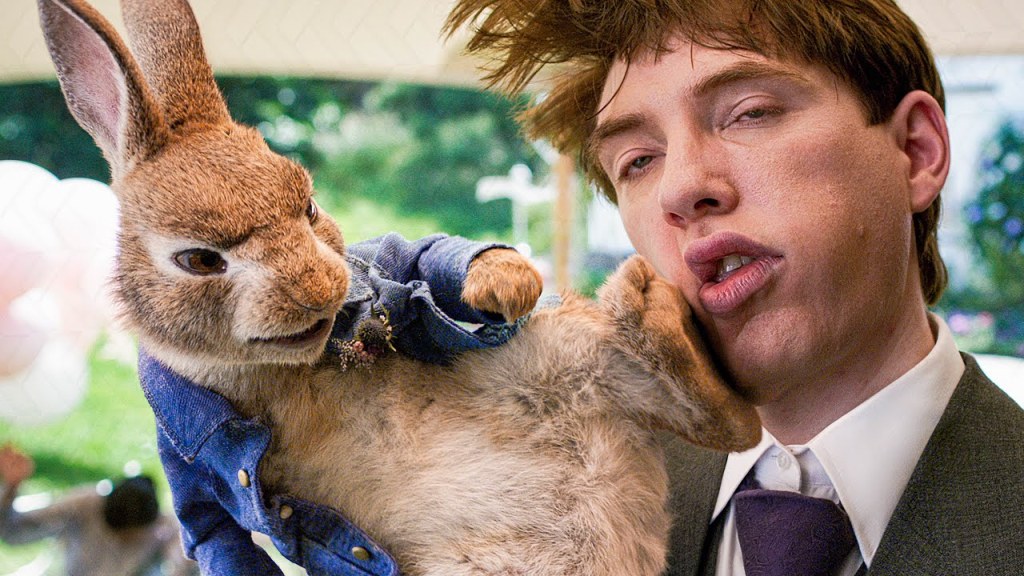
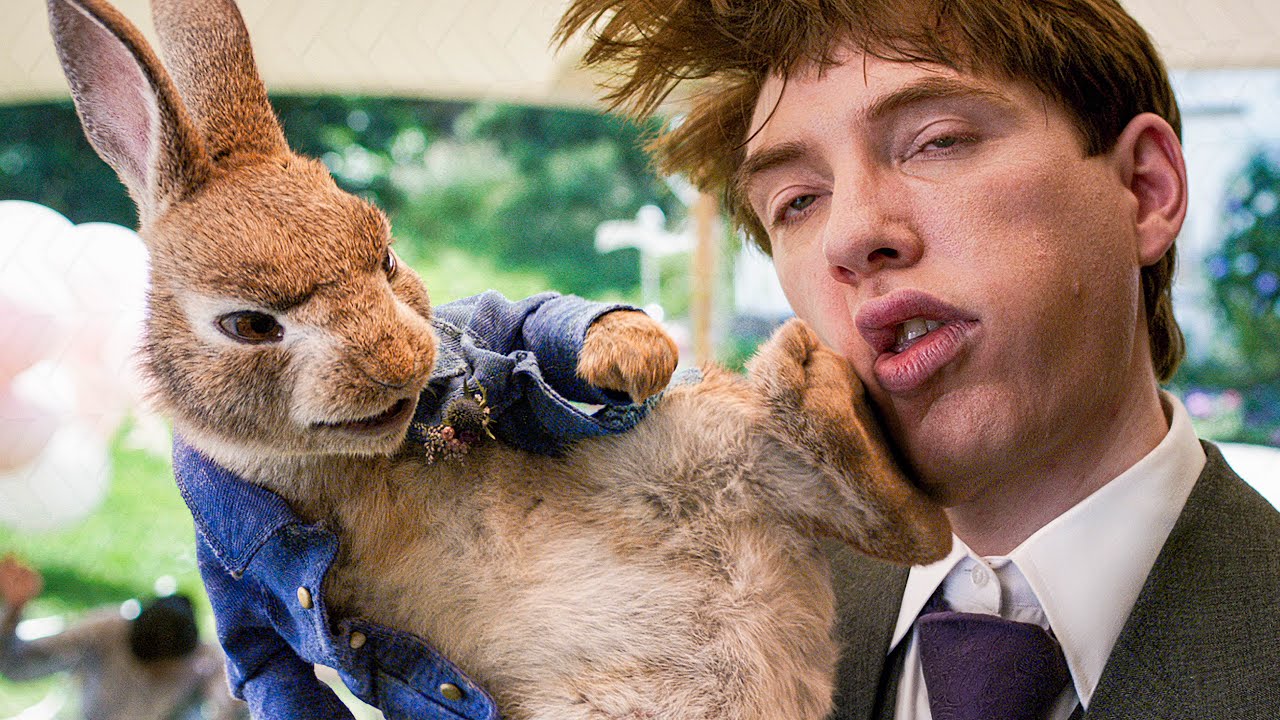
But “Peter Rabbit 2: The Runaway,” is a curiously perfunctory affair, a laughless comedy based on the Beatrix Potter animal darlings of scores of dainty little books created when the world was less cynical, in which the new “Bea” (Rose Byrne) wrestles with selling out to Big Business.
So in a meta sense, it’s a kids’ movie about the cynicism and salesmanship that goes into producing “children’s content.” Hilarious, and ever-so kid-friendly? Not bloody likely.
Bea and rabbit-leery, screams-like-a-teen-girl Thomas (Domhnall Gleeson) marry in the opening scene, in which Peter (voiced by James Corden) fantasizes about lashing out at his former tormenter Thomas at the merest hint of being “triggered.”
As a new publisher (David Oyelowo) woos the newlyweds with promises of riches, and the input of “marketing types” on Bea’s second book, Peter decides to follow his impulse — as usual — and run off to the city.
That’s how he falls in with some artful animal dodgers and their own rabbit Fagin, voiced by “Walking Dead” regular Lennie James. Peter wants to prove he’s not a “goody goody,” that he’s a “baddy baddy.” So naturally he enlists his old farm friends to help with The Big Farmer’s Market Heist.
The slapstick has one moment that made me chuckle, a clever Gleeson-and-stuntman stunt that involves chasing the family Land Rover down a hill. “Screaming like a teenage girl?” That’s a given.
Other laughs are very hard to come by, with the story turning dark as Peter and pals are nabbed to be sold as pets, and we look out from inside the cage as they do, at the horrors of clumsy or ill-intentioned human “owners” who have their lives in their hands.
“THIS is what it’s like to be a pet?”
Little kids will appreciate the drink-seltzer-and-belch gag. Adults will get a chuckle out of a Sony production taking an amusing cheap shot at Disney. Other than that…
COVID-delayed or not, this production has a half-hearted/half-arsed feel, something Corden’s Peter all but admits in the curtain call. Why reward them for that?
MPA Rating: PG for some rude humor and action
Cast: The voices of James Corden, Margot Robbie, Elizabeth Debicki, Lennie James, with Domhnall Gleeson, Rose Byrne and David Oyelowo.
Credits: Directed by Will Gluck, script by Patrick Burleigh and Will Gluck, based on the books of Beatrix Potter. A Sony Columbia release.












 Movie Nation