Classic Film Review: “The Defiant Ones” (1958) holds up a lot better than expected

Some films achieve “classic” status and even become pop culture shorthand, but eventually find themselves dismissed as overly-earnest, “of its time,” or even “self-parody.”

More than one Stanley Kramer production of the ’50s on into the ’70s has suffered that fate. A self-conscious/socially-conscious filmmaker, it’s hard to think of anybody in the modern cinema that who would own that label — maybe Spike Lee, and perhaps one day Jordan Peele.

Kramer took on “Inherit the Wind” and “On the Beach” and “Judgement at Nuremburg,” “Guess Who’s Coming to Dinner” and “Ship of Fools” as a director. He produced the disaffected generation on wheels B-movie classic “The Wild One,” the Hollywood Blacklist-bashing Western “High Noon” and “The Caine Mutiny,” a myth-busting stage drama that took a sober look at the officer classes of the WWII US Navy.

All those social ills exposés, Holocaust remembrances, cautionary anti-nuclear war parables and pointed looks at American racism became Kramer’s reputation.

Dropping in on “The Defiant Ones,” recently screened on The Grio TV, I was struck by filmmaking qualities one forgets when a film ages into a classic so archetypal as to be beyond criticism out its time.

This is the movie that made Sidney Poitier an icon, but Tony Curtis was never taken that seriously as an actor, which explains some of the reason “Defiant” slipped into “dismissable” in some quarters.

It’s a lean racial allegory that preaches without ever seeming preachy, a beautifully shot (one of its Oscars was for Sam Leavitt’s B&W cinematography), well-cut time capsule of America at the birth of the Civil Rights Era.

Whatever star power and “message” appeal it had then, what makes it timeless is its “men on the run” story — two convicts, chained-together, on the lam from Southern justice.

No, it almost never looks like The South. They filmed it in the treeless mountains of Southern California, on backlots and sound stages, faking “swamps” and the like when needed.

The set-pieces — crossing a “raging” (not really) river, crawling out of a deep mud pit, fending off and then captured by the enraged white men of a local town, the single farm mother (Cara Williams) and her son that they stumble upon — can play as predictably corny.

But that on-the-run-in-chains narrative still zips by, and the script, with its get-past-racism-to-find-each-other’s humanity subtext, still pops.

“How come they chained a white man to a black?”

“The warden’s got a sense of humor...They’ll probably kill each other before they go five miles.”

Theodore Bikel’s sheriff character, “up for reelection,” has a hint of a drawl and a pre-Atticus Finch lawyer-turned-lawman notion of justice. He’s not a caricature when he might easily have been one. The script and the humanity Bikel brought to many characters over a very long career, make this guy out of step with his “posse.” He wants these men taken alive, and won’t let others even think about “mob justice.”

Here was a movie that took on the N-word head-on, with Curtis’s racist armed robber using the slur, and the standard defense — the assorted words thrown at white people in response in that day. Poitier’s hard-bitten “Ever heard those used with ‘in the woodpile'” might have opened a few eyes, if not minds, in 1958.

“I ain’t gettin’ mad, Joker. I been mad all my natural life.”

Poitier crackles with gimlet-eyed fury in what became a defining role for him. He didn’t play “angry” very often. Grace, dignity and intelligence were his brand.

Curtis managed to hold his own in a similar temper, first scene to last.

On-the-run stories put us in the dilemma with the characters, second-guessing their choices, using everything we’ve ever seen in such stories (“Cool Hand Luke” stands out) to guess what our criminal anti-heroes will do to get to “freedom.” One is desperate to go north, the other hellbent on heading “south.” Guess who wants to go where?

The film has a not-cynical-enough reporter (Lawrence Dobkin), a racist goon (Claude Akins) in conflict with an older, tougher local (Lon Chaney, Jr.) who won’t let a lynching stain his town’s conscience, the inhumanity of a search-dog trainer (King Donovan) and state trooper (Charles McGraw) in conflict with the sheriff, too many places for America’s moral quandary over the issue of race to be debated.

This could have been “All the King’s Men” or “Twelve Angry Men” and it never manages to be that tough.

But Kramer gets a message he felt America needed to hear and probably still needs to hear on the screen in an artful, just-edgy-enough and still-entertaining film that retains its claim as a “classic,” at least in part thanks to how deeply it’s burrowed itself into the culture.

MPA Rating: “approved,” violence, racial slurs

Cast: Sidney Poitier, Tony Curtis, Theodore Bikel, Lon Chaney Jr,. Charles McGraw, Cara Williams, Lawrence Dobkin and Claude Akins
Credits: Directed by Stanley Kramer, script by Nedrick Young, Harold Jacob Smith. A United Artists release.

Running time: 1:36

Posted in Reviews, previews, profiles and movie news | Comments Off on Classic Film Review: “The Defiant Ones” (1958) holds up a lot better than expected

Documentary Preview: Netflix gives us a different take on “Cat People”

A July 7 doc about “cat fanciers?” Ok.

Posted in Reviews, previews, profiles and movie news | Comments Off on Documentary Preview: Netflix gives us a different take on “Cat People”

Documentary Preview: Eli Roth’s Shark Doc — “Fin”

The Sharkfin Soup fetish that is pointing “Jaws” towards extinction, courtesy of the inventor of “Torture Porn.”

July 13 “Fin” comes to Discovery +.

Posted in Reviews, previews, profiles and movie news | Comments Off on Documentary Preview: Eli Roth’s Shark Doc — “Fin”

Movie Review: Showbiz Devours Stand-up comics — literally — in “Too Late”

Showbiz is littered with “make your deal with the Devil” allegories, a lot of them with Harvey Weinstein as the punch line.

And that’s what the horror comedy “Too Late” toys around with, that “You came into this with open eyes” proviso attached to every horror tale about “what I had to do to get my start in show business.”

More a cute idea for a horror comedy than one that pays off with laughs, “Too Late” is about an “assistant” who works for a comedy “legend” who turns out to be a monster, and not in the Scott Rudin sense.

Vi, short for Violet (Alyssa Limperis, a bit player making the move to leading lady) works for Bob DeVore (Ron Lynch), a grizzled “entertainer” who hosts and books a night club variety series that’s both a star showcase and a place where up-and-comers hope to land their big break.

Violet does menial things like stock Bob’s backstage bar, hoping to make contacts through him that will take her places. She scribbles ideas into an omnipresent notebook, something the other comics there recognize as “You’re a comedian.”

But Bob is an ungenerous C-list jerk, never introducing her, always berating her after using her for everything he finds too unpleasant to deal with himself.

That’s why she also books her own stand-up showcase, never appearing on stage, just providing “a spot” to comics who want to work on their act, polish new material, or even “get discovered” at the coffee shop where “The Death of Comedy” takes place.

Violet’s somebody comics feel the need to kiss up to, even harass, to get on stage at “Too Late.” The women (Kimberly Clark, Mary Lynn Rajskub) are fine. But the guys aren’t above crossing lines, getting abusive or drunkenly angling towards sexual assault. That’s when she gives them their wish — that coveted “spot” on Bob’s show.

Bob even meets them in his well-appointed dressing room afterwards. That’s where he will kill and devour them.

Violet? She’s knows this. That’s how bad she wants a leg up in show business, she sets up (“deserved it”) comics for “dark of the moon” dining where they’re the main course.

“I could make things happen for you!” is Bob’s go-to promise. If only she keeps his secret, sticks with him and toes his line.

Her first qualms about what she does arrives in the person of charming comic Jimmy (Will Weldon). He’s funny, she clicks with him romantically. If only she can keep him away from Vampire Bob.

Directed by D.W. Thomas and scripted by Tom Becker, “Too Late” gets in some amusing stand-up bits about “birth control shoes” (Clark’s bit about women’s footwear that sends non-sexy signals) and the like. As whole though, the film is more light in tone than laugh-out-loud funny.

Bob’s monster make-up is worth a smirk. His lines? Not even that. Perusing his centuries of family photos is almost amusing. Wait, vampires can’t be photographed! Rules are rules!

But the film does a great job of immersing us in a tiny corner of the West Coast comedy subculture — seedy, self-contained, with sometimes arrogant, sometimes talented and always desperately needy stand-ups struggling to work their way up the “paying gig” ladder.

At this level, stand-up is “going on between trivia nights and music open mikes” in bars with disinterested listeners. Self-esteem is hard to come by in this world, especially for Violet, whose roomie (Jenny Zigrino) is constantly ordering her to “value yourself.”

Others, without prompting, ask the hard question. “Why are you booking but not performing?”

The answer is obvious in our leading lady’s presence. Limperis is lightly engaging, but not an outgoing, magnetic or charismatic performer. When a cross Bob barks “Maybe you’re funnier than I thought,” he’s reading a scripted line, not reacting to anything he or we have seen in “Too Late” that suggests that’s the case.

Limperis doesn’t have the presence or comic (or straight woman) chops to carry this.

The presence of Fred Armisen in a bit part, playing the long-suffering lighting director, suggests a “Portlandia” kind of deadpan was what the wits behind the camera were going for. Unfortunately, “Too Late” is more “dead” than “deadpan.”

MPA Rating: unrated, grossout horror violence, drug abuse, profanity

Cast: Alyssa Limperis, Ron Lynch, Will Weldon, Kimberly Clark, Brooks Weldon, Jack De Sena, Jenny Zigrino, Mary Lynn Rajskub and Fred Armisen

Credits: Directed by D.W. Thomas, script by Tom Becker. A Firemark release.

Running time: 1:19

Posted in Reviews, previews, profiles and movie news | Comments Off on Movie Review: Showbiz Devours Stand-up comics — literally — in “Too Late”

Movie Review: Even Swedes fret over their neighbors — “The Evil Next Door”

That first encounter with your new neighbors, after you’ve bought that new-to-you house, is always a little fraught. Especially when this is their introductory line.

“You know what happened there, right?”

No. And where were you BEFORE we made our offer?

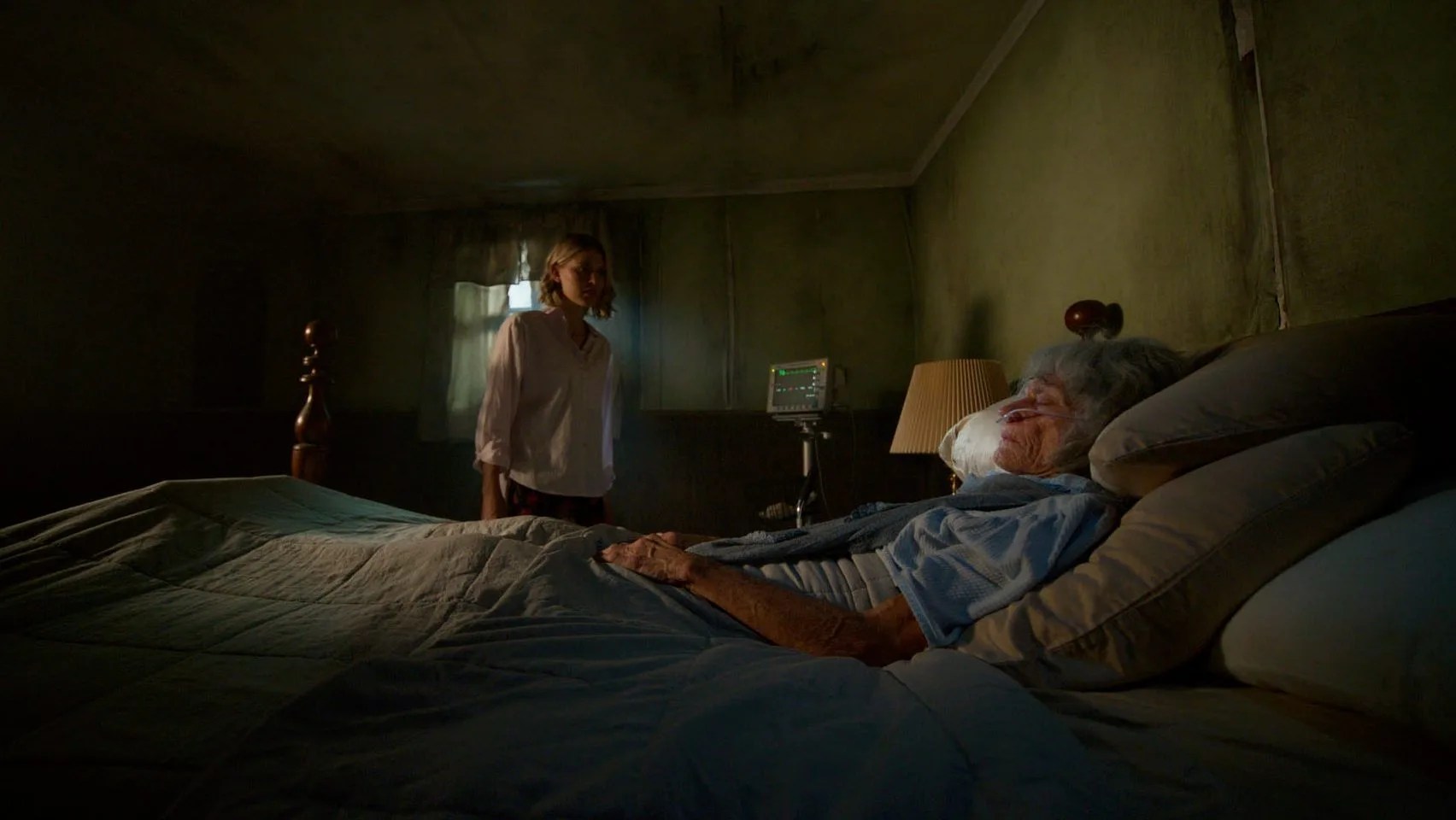
“The Evil Next Door” is a perfectly conventional, somewhat serviceable Swedish horror tale in the haunted house genre, the “something is after our kid” subgenre and the characters-yanked-out-of-the-frame, monster-skitters-around-upside-down school of effects.

It finishes with a nice flourish even if everything that comes before is “seen it before” overfamiliar.

A new family moves into a new house in the suburbs. Shirin (Dilan Gwyn, a dead ringer for Imogen Poots) is newest of all. She’s the new woman in Fredrik’s (Linas Wahlgren) life, and new to motherhood. As they’re picking out this new place, little Lucas (Eddie Eriksson Dominguez) puts two-and-two together and wants to know if she’s to be his “new mommy.”

Shirin hems and haws something like a “yes.” But she has no answer to the five-year-old’s followup.

“Does that mean you’re going to die, too?” Photos of him with his bald mother tell us that story.

The new place is a duplex with an empty half next door. And right from the start, Lucas picks up on something. Doors open by themselves when he’s the only one around. Whispers come from the walls.

As a prologue has shown us a previous “event” in this “inspired by true events” tale, we know what’s coming. Sadly, that goes for pretty much everything about “The Evil Next Door.”

The mechanics of such movies demand that A) Fredrik be out of town working, on weekends, leaving “mother” and child alone, that B) Shirin get hints that something is going on with the kid, who’s bragging about his “new friend” at pre-school, who is talking…to SOMEone, when he doesn’t think she is listening.

Thus, Fredrik doesn’t take Shirin seriously when she raises mild alarm, — “Something is seriously F—ed up around here!” And he and starts to blame her for the fact that his little boy is getting traumatized and physically hurt when Dad isn’t around.

Predictable as it is, the effects and co-writers/directors Tord Danielsson and Oskar Mellander serve up and how they serve them deliver some decent hair-raising moments. It’s just that the movie leading up to them is so generic as to defy accusations of plagiarism.

So many B-movies have used this very plot that “The Evil Next Door” is pretty much in the horror movie public domain the moment it opens.

.MPA Rating: unrated, violence, horrific images, profanity

Cast: Dilan Gwyn, Eddie Eriksson Dominguez and Linus Wahlgren.

Credits: Scripted and directed by Tord Danielsson, Oskar Mellander. A Magnet/Magnolia release.

Running time: 1:28

Posted in Reviews, previews, profiles and movie news | Comments Off on Movie Review: Even Swedes fret over their neighbors — “The Evil Next Door”

Netflixable? Italians seek “Security” in a rich, privileged resort town

“Security” is an Italian mystery stuffed with enough characters — each with a “secret” — that it’s a wonder Stephen Amidon‘s novel wasn’t turned into a limited streaming series instead of a movie.

It’s a wholly Italian tale — in Italian, with English subtitles. But its British screenwriters and director mean that any commentary it slyly makes on Italian “justice” is almost certainly intentional and cleverly cutting. A film of CCTV cameras, a tendency to rush to judgment and off-season small-town gossip, indiscretions and politics, it can’t help but bring to mind the infamous Amanda Knox case, even though there’s no murder and the resemblance is more in its callous disregard for “truth,” or police vigorously pursuing clues, no matter where they might lead.

The title refers to something that’s the biggest concern of the rich of tony Forte dei Marmi, a beach city at the foot of the Apuan Alps. That’s why so many of them have Roberto Santini (Marco D’Amore) on their payroll. He’s an insomniac who always seems to be on the job, checking the beachside, doorlocks or the scores of TV cameras that watch over mansions in the off-season, fielding calls from the well-to-do who winter in Barbados.

“Security” is also what Santini’s wife, Claudia (Maya Sansa) is selling. She’s running for mayor, focused on appealing to wealthy donors and playing to their fears of “undesirables” and “invaders.” Yes, “dog whistle politics” is an international thing.

A teenager (Lavinia Cafaro) popping up on one of those cameras, beaten and bloodied, is our “mystery” here. What happened, who did it, and where was it done?

The carabinieri are a collection of Italian cop stereotypes –immaculately turned-out, stylishly groomed and uniformed, utterly disinterested in “the case,” which they insist is “closed” because of what they interpreted as a “confession” from the girl’s father (Tommaso Ragno), an aged outcast who has a “history” of sex crime in the town.

Santini, without anything resembling jurisdiction or governmental sanction, digs into his videos, wonders what’s been erased from those videos, starts interrogating people and tries to piece together what really happened and what the rich and the lazy cops are covering up.

Henceforth, almost every “break” in this “case,” aside from the girl changing her story and exonerating her father, comes from Santini, a native son of Forte dei Marmi who knows the history and the gossip, and is part of that gossip as well.

He’s got an ex (Valeria Bilello) whose 20ish son might be implicated. That “ex” might not be as “ex” as we first suspect.

He’s got a teen daughter (Gaia Bavaro) who is a classmate of the victim, a kid with her own troubled connection to that family and someone in what amounts to a full revolt against her parents. She’s having a fling at school, and it’s not with a classmate.

And Sabatini’s wife’s political sponsor (Fabrizio Bentivoglio), ridiculously rich with a phobia about being touched, was throwing a party the night of the crime. What will the cameras show about that?

Can Sabatini keep personal prejudices, biased hunches and the like out of his thinking as he tramples privacy rights — as a private security consultant/guard — in pursuit of “the truth?”

The co-writer and director of this is Peter Chelsom, whose best credits have been more comic (“Funny Bones,” “Hear My Song,” “Serendipity”), but who gives these fascinating, tainted characters room enough to make impressions and lets the mystery slowly unravel.

The commentary on Italian justice has to do with conclusions leapt to long ago, something we see happen all over again. The rich play by different rules, the locals have long accepted it and the police and courts are mere functionaries, easily dismissed by the wealthy.

Sabatini? He’s playing outside the rules, “private” security who can look at any video he wants, without legal standing. If there’s one thing the story lacks, it’s overt pressure on this compromised character to do what his paying masters tell him.

“Security” isn’t brisk enough to be a thriller, and the stakes never seem that high. But it walks that tightrope between intriguing and “Well, we HAVE to see how this turns out” without ever losing the plot or turning boring.

MPA Rating: TV-MA, violence, sex, nudity, profanity

Cast: Marco D’Amore, Maya Sansa, Gaia Bavaro, Valeria Bilello, Silvio Muccino, Fabrizio Bentivoglio, Tommaso Ragno

Credits: Directed by Peter Chelsom, script by Amina Grenci, Michele Pellegrini, Peter Chelsom, Tinker Lindsay, based on a novel by Stephen Amidon. A Sky Cinema/Netflix release.

Running time: 1:59

Posted in Reviews, previews, profiles and movie news | Comments Off on Netflixable? Italians seek “Security” in a rich, privileged resort town

Movie Review: Whatever “Zola” wants, Zola…gets?

There’s cultural homage, and the much-reviled “cultural appropriation.” And then there’s whatever the hell it is that Riley Keough, Elvis Presley’s granddaughter, puts on and pulls off in “Zola,” a hilariously dark and dirty road comedy built on a stripper’s “my hand to God this happened” tweets.

Janicza Bravo’s film is a Taylour Paige (the “younger woman” in “Ma Rainey’s Black Bottom”) star vehicle. And she gives it her savvy, sassy, side-eye best as the title character, a Midwestern waitress who gets mixed up with wild child Stefani (Keough) only to tell us the story of how “me and this b—h here fell out“.”

But that drawling, fronting, teasing and “street” sounding Stefani is her own kind of racial riffing, culture appropriating, personal space invading, over-sharing, gum-snapping Queen of Bad Decisions. She’s the perfect foil for no-nonsense Zola’s account of a road trip/”ho’ trip” from Hell.

Because that was Stefani’s doing, what Stefani set up and where Stefani lures Zola, from that first “You dance?” question at the themed restaurant where Zola waitresses, to that farewell drive back over the Sunshine Skyway across Tampa Bay.

It’s “Spring Breakers” with strippers, alleged adults who’re supposed to know better. But Stefani’s sucked Zola in over her head, and over her own childish, dimwitted head as well.

They’re hauled 20 hours down the highway (from Detroit, in the “true” story) to Tampa where a “dancer” can pull in “5Gs a night!”

If you don’t know Tampa as Strip Club Hell, you haven’t been paying attention to why every sports league in America’s Sporting Industrial Complex wants to hold its championships there.

Stefani’s going with her boyfriend, nerdy wannabe-B-Boy Derrek (Nicholas Braun) and the guy (Colman Domingo) who owns the Mercedes SUV, whose name Zola narrates that she doesn’t learn “for two mother (youknowwhatting) days.”

Looking for explanations of this whole…situation? So is Zola.

He “takes care of me” Stefanie euphemizes about the unnamed Mercedes driver. “Stripper translation,” Zola snaps in narration, “He her PIMP.”

There’s a lot of translation, and a lot y’all watching this are just supposed to figure out for yourselves as a weekend for some quick “dancing” cash turns towards an even older profession. Zola, who sexed-up her live-in boyfriend (Ari’el Stachel) so he wouldn’t pout about this “ho’trip”, has to take a hard “pass” on “private dances” and much worse from the charming unnamed SUV dude who turns off the smarmy African American charm and switches on the Jamaican psycho pimp in a heartbeat.

Stefani may think nothing of servicing a Who’s Who of unattractive Tampa rednecks, genitally-deformed “customers.” But Zola?

“No shade. No shame. You do YOU,” but uh-uh. Zola ain’t HAVING that.

Bravo (“Lemon”), who adapted the tweets and the magazine article about them that made them famous, holds a mirror up to downmarket, down-and-dirty American culture in her second feature film, after doing mostly TV — episodes of “Mrs. America” and “Dear White People” and “Divorce.”

The Sunshine State is decorated with strip clubs, Confederate flags and a lot of unseemly things that have little to do with Disney World.

And in Paige, she’s cast an exemplar of “stripper as athlete,” and an adorably deadpan slow-burn reactor to all that is “messy” about Stefani, this situation she finds herself “trapped” in and the Florida and America where all this goes on. It’s not all “money/ti—es” selfies, oh no. There is much that Paige’s Zola is moved to give a side-eye to.

Keough’s Stefani is exhausting, crude, gross and nasty, prattling on in her idea of African American street argot about “dooky-ass” this and “nappy-ass” that. And just for good measure, we see “her” version of the unfolding fiasco, laughable lies, but then again, what’s it say about Zola that she dove into this trip with this foul-mouthed flake she just met?

The soundtrack is peppered with phone-alert “pings” and hip hop road trip sing-alongs (“Hannah Montana” by Migos). There’s a backstage at the strip club prayer that will give you religion.

“Lord, send us NI—S…with culture…and GOOD credit!”

And if it wears you out, just as Harmony Korine’s “Spring Breakers” made you long for spring break to end, that’s kind of on the money, too.

There’s only so much dirty, lowdown Tampa anybody can stand.

MPA Rating: R, for strong sexual content and language throughout, graphic nudity and violence including a sexual assault.

Cast: Taylour Paige, Riley Keough, Colman Domingo, Nicholas Braun, Ari’el Stachel

Credits: Directed by Janicza Bravo, script by Janicza Bravo, Jeremy O. Harris, based on tweets by A’Ziah King and a magazine article by David Kushner. An A-24 release.

Running time: 1:27

Posted in Reviews, previews, profiles and movie news | Comments Off on Movie Review: Whatever “Zola” wants, Zola…gets?

Movie Review: Troubled athlete falls for “Un Ange,” an “Angel” in Senegal

Their eyes lock across a crowded Dakar bar. ‘s She is an exotic Senegalese beauty, he a fit professional athlete from Belgium.

But Fae (Fatou N’Diaye) has something to reveal to the Belgian (Vincent Rottiers) and his brother (Paul Bartel). She is a sex worker, a prostitute, a “whore,” a word we hear bandied about in “Angel (Un Ange),” a tragic Belgian/Senegalese romance about two ships that collide in the night.

“It’s not the end of the world,” he notes (in French with English subtitles), after a moment’s thought. What does he do for a living? He’s a professional cyclist, training and drugging his body “for the fans.” Thierry declares that Fae is no different from him. “We’re all whores.”

“Angel” is a self-consciously arty fever dream about their affair, their very different “but not that different” lives, and that word. We hear “putain” in French and Senegalese and ponder what it means today, and what it might mean to a beautiful woman who prefers to see herself “as a gazelle,” but accepts it. Fae has no other obvious means of supporting herself in a Muslim country where she is harshly judged but tolerated. She can’t come into his hotel without her sex worker “health card.

Thierry and brother Serge have come to Senegal to escape prying eyes, to live it up, await that next contract, hopefully with the team Thierry made his name with.

It’s not a movie about characters with hope, not until they’ve come together. She is trapped, avoiding getting that health card as it puts in writing what she does for a living. That’s not who she is.

Thierry talks about his dreams, and the film takes us into them. Some are nightmares, others mere flashbacks — of trauma, accidents, suicide attempts and doom. Thierry has been a star, but his little bump of coke before boarding the flight tells us that the elaborate blood doping gear he’s somehow gotten into Senegal isn’t his only encounter with controlled substances.

Serge? He’s the crude, on-the-make enabler, carrying drugs for his brother, tempting him with questions about sex with “an African woman.” Serge is white colonialist “privilege,” here to basically let Thierry as a character off the hook in that regard. Thierry is the one who sees “no difference” between himself and Fae, racially, personally or professionally.

Through their night together, Fae finds herself thinking beyond “tourist girl” status, this life where she and her colleagues have sex with foreigners “who are older than we will ever be,” who takes care of her body every bit as carefully as Thierry, because while he is doing it “for the fans,” her diet, attire, braids and make-up are “for me, but also for you.”

And impulsive “wired” Thierry? He’s babbling on extravagantly and oh-so-romantically. She might be his escape, their future might be “together.”

The writer-director Koen Mortier takes great pains to emphasize that “Angel” is a work of “fact mixed with fiction,” in an opening title. That’s understandable, seeing how it’s not-that-loosely based on a up and down life of a real Belgian cyclist.

Mortier uses a fluid sense of time and narrative — events lapse into flashbacks without warning — and the effect is quite dreamlike, with harsh intrusions of reality.

If there’s anything we know about cocaine users, it’s that elation is always followed by a bottoming out, that paranoia often accompanies that, and that there’s little an addict won’t do to instantly “fix” that feeling.

So Rottiers (“Renoir,” “Pompei”) veers from reflective to manic in this performance. His character’s nickname in the cycling world may be nicknamed “The Angel,” but it is N’Diaye’s Fae who is the otherworldly presence, here. Earthy and practical, exotic, fatalistic and ever-rationalizing, N’Daiye (“Metamorphoses”) turns Fae into a cypher, someone we can project a vast variety of values and character traits on.

Because that’s what sex workers do, sell a fantasy.

The cryptic storytelling style makes “Angel” test your patience. But I think it works, a tragic story given a wish-fulfillment fantasy underpinning, and a film that doesn’t flinch from letting harsh reality show its face. That’s the thing about dreams. They never last past the moment we open our eyes.

MPA Rating: unrated, violence, nudity

Cast: Vincent Rottiers, Fatou N’Diaye, Paul Bartel

Credits: Scripted and directed by Koen Mortier, based on a book by Dimitri Verhulst. An Oration release.

Running time: 1:47

Posted in Reviews, previews, profiles and movie news | Comments Off on Movie Review: Troubled athlete falls for “Un Ange,” an “Angel” in Senegal

Movie Review: In Tokyo’s underworld, you can’t kill the “Hydra” without taking off all its heads

When it’s done well, you realize why they call it “fight choreography.”

In the Japanese mystery-thriller “Hydra” (Sorry, Marvel fans.) the brawls mimic the rest of the movie. There’s no talking, rarely even grunts of exertion. Everything happens breathlessly fast, so much so that there’s a do-si-do dance to the life-or-death struggle.

Naohiro Kawamoto choreographed the fights in this minimalist, archetypal underworld collision of cops, mob assassins and vigilantes.

We hear the “whoosh WHOOSH” of arms and legs in fabric, heavy breaths and the muffled “thump” of blows landing. None of this exaggerated post-production “POW, BAM SNAP” stuff here. A knife or a screwdriver pierces flesh with a soft, metallic “shtuck shtuck.”

There’s not much else to focus on in this 77 minute movie, which opens with ten dialogue-free minutes of a cop being killed in a men’s room, the baseball-capped young killer (Satoshi Kibe) making his exit, the “cleaner” (Takashi Nishina) showing up with his aluminum suitcase to dismember the body, take it home, and further whack it to pieces to feed to his tank of carnivorous fish.

Have I sold you on this, yet?

The story takes its allegorical title from a tiny Tokyo pub, where young Rina (Miu) presides, flirtatious Kenta (Tasuku Nagase) is the waiter and stern, silent Takashi (Masanori Mimoto) smokes and broods and cooks back in the kitchen.

But he’s not just “mysterious,” not merely a “quiet old fart.” He remembers customers, sizes up what they need to eat right now (hangovers call for tandoori chicken), cooks and does everything else, it seems, by memory.

And if we know about Japanese cinema semiotics, we can tell he’s a badass just from that familiar unruly mop of hair. Anime to action films, always beware of the dude too busy get a cut or a comb. Takashi can handle himself.

Jiro Kaneko’s script sets up a laughably arch back story that ties Takashi to this job in this place, and an “organization” called “Tokyo Life Group Ltd” that does these “purges.” That’s what they call them.

“We kill people,” the leader (I didn’t catch his name, but I think that’s Tomorowo Taguchi‘s character) intones, in Japanese with English subtitles, to his former go-to-guy, Takashi. “But some people deserve to die.”

Tokyo Life Group has a real jones for corrupt, murderous, date-rapist cops. But the cops might fight back. And if they’re really worried, they’re inclined to hire assassins of their own.

Mimoto (“Alien vs. Ninja”) makes a fine “strong, silent and competent” type. His Takashi doesn’t wear his skills openly, so he’s always getting the drop on the bad guys who come after him or those close to him.

“Who the hell ARE you?” villains inevitably ask, those who have time to utter anything before it’s game on.

The story doesn’t carry “Hydra,” and the characters are so confined to “types” that they’re rarely more than that. But the fight sequences sell it, to those who are on the market for that sort of thing. This B-movie is “So You Think You Can Dance?” for martial arts brawlers, nothing more.

MPA Rating: unrated, violence, sometimes graphic

Cast: Masanori Mimoto, Miu, Takashi Nishiona, Takaya Aoyagi, Tasuko Nagase, Satoshe Kibe and Kazunori Yajima

Credits: Directed by Kensuke Sonomura, script by Jiro Kaneko. A Well Go USA release.

Running time: 1:17

Posted in Reviews, previews, profiles and movie news | Comments Off on Movie Review: In Tokyo’s underworld, you can’t kill the “Hydra” without taking off all its heads

Movie Review: “Werewolves Within,” Laughs without?

The horror comedy “Werewolves Within” didn’t quite do the trick for me. But it’s a great example of how hitting the right tone can keep you watching, even if the “horror” isn’t all that and not nearly enough jokes land.

Screenwriter Mishna Wolff, director Josh Ruben and a collection of generally funny actors from “Veep,” “30 Rock” and “The Unicorn” wring out some of the possibilities of a tale of people trapped in a snowed-in lodge while under assault by werewolves. Yes, they were adapting a video game.

But while they get the tone right and the “types” are filled with comic possibilities, they lean on that hoary murder mystery “gather the suspects by the fire” gimmick at their own peril.

And if there’s one thing that really doesn’t work here, it’s “Are the werewolves outside, or in here with us?” gimmick.

Sam Richardson plays the new Forest Service Ranger in Beaverfield, Vermont. But the town is sharply divided over some rich oil man’s (Wayne Duvall) planned pipeline. It’s become a political bone of contention that has even the seemingly “nice” people there at each other’s throats. And on the day Finn Wheeler arrives, a blizzard is blowing in.

“This is Us” alumna Milana Vayntrub is Cecily, the bantering, on-the-make new postmistress who is Finn’s guide to “the freak show” that is the town. Stoners, wingnuts, at least one of them a bit pervy, a mountain man survivalist (Glenn Fleshler), a rich gay couple (Cheyenne Jackson and Harvey Guillén), and so on. Colorful? A little bit.

There’s a visiting scientist (Rebecca Henderson) “here to stop the pipeline.” And Michaela Watkins stands out as the loopy, small-dog loving gift-shop flake. Uh, don’t get too attached to the dog.

“I don’t mean to be rude, but your dog only barked at Jews….” “And BROWN people.”

Too soon, rich gays. Too soon.

Director Ruben keeps the dialogue exchanges snappy, makes the attacks lightning quick, and plays around with comically quick entrances and exits. But “quick” doesn’t lead to “brisk,” in this comedy’s case. The pacing is off.

There’s zero urgency in their dilemma. Richardson’s ranger isn’t just slow on the uptake, he’s slow reacting.

A few lines score — “What IS this? Dumbass Island?” “Oh don’t tell me we’ve got a Mexican standoff!” “Baby, don’t say ‘MEXICAN.’ Just ‘standoff!

But too many don’t. And as it turns out, the most potent line could be trotted out as the best possible review for this near miss. Which I will…trot out.

“I feel like I’m at one of those dinner theater murder things. I’m having a horrible time and I can’t go home.”

MPA Rating: R for some bloody violence, sexual references and language throughout 

Cast:  Sam Richardson, Milana Vayntrub, George Basil, Catherine Curtin, Cheyenne Jackson, Michael Chernus, Harvey Guillén, Wayne Duvall and Michaela Watkins.

Credits: Directed by Josh Ruben, script by Mishna Wolff. An IFC Midnight release.

Running time: 1:36

Posted in Reviews, previews, profiles and movie news | Comments Off on Movie Review: “Werewolves Within,” Laughs without?