Every filmmaker hopes to get a rise out of her or his audience, to provoke us in some way or other, push our buttons.
So writer-director Zach Koepp can take a bow for achieving that, at least, with his debut feature. I started out exasperated and settled into a seething rage over the 73 minute long miscalculation titled “The Willowbrook.”
A soft-spoken, under-acted, near-whispered “thriller” that does no credit to the word or the genre, it’s about a cultish “influencer” who lures her “followers” to a remote estate house in the middle of winter, people who need to “heal” and “trust the process” on their way to a “transformation.”
Then she drugs them and won’t let them leave. Apparently.
Lacey (Jessica Bishop) likes things very quiet, and “loses it” when there’s noise. She needs silence as the backdrop to her online affirmations about “trusting in the flow of life.”
So there’s a reason for how quiet everybody is, the dull monotone of line-readings. As you can imagine, that makes for a serious insomnia cure of a movie.
Jordan (Erin Day) has been invited to The Willowbrook, owned by Lacey Willowbrook, after an overdose. Her also-orphaned “brother” (Lawrence J. Hughes) comes along for support. But Ace doesn’t question Lacey’s diagnosis of “co-dependency” with Jordan. He accepts quarters up the hill, away from the big house, at The Farm, where the creepy, trigger-happy “muscle” in this operation, Dakota (ChrisBoudreaux) holes up.
The film’s opening scene is a woman (Jay White) fleeing across the snow in her bare feet and pajamas. It’s also pretty quiet — save for a gunshot. We meet the mute guitar player (Kyle Klein) and see Lacey lie to family members who come looking for missing “guests.”
What exactly is going on here? What’s the villain’s motive, the play here? How could that help her online business? Can you grow a cult by kidnapping and drugging people with no financial benefit? Who will break free of the medication and control of Lacey to stage a (probably quiet) rebellion?
Pitching almost the entire movie as a whisper is a disastrous decision for a seemingly simple thriller like this. The movie has no real highs or lows. Everyone is passive save for Lacey, who pegs the shrill meter a time or two in the third act.
Scene after scene frustrates, partly for failing to advance the plot, mostly for just slowly spinning its wheels and lulling the viewer to sleep.
The film’s title is either a bizarre coincidence of an unfortunate choice. An infamous state school for mentally disabled children by that name “Willowbrook” was the big break expose for a once crusading reporter named Geraldo Rivera, and has been the subject of films and books over the decades.
Very little happens at this Willowbrook, and almost nothing happens that’s interesting. And what does happen generates no response because no one raises his or her voice, there’s no rising suspense or management of anything resembling tension.
Which makes one wonder how this trifling misfire got picked up. Might young Mr. Koepp be related to the more famous Koepps of Hollywood, New York, etc? Can’t seem to easily nail that down, unlike this movie, which begs for a stake of holly and an unmarked grave.
Rating: unrated, violence, profanity
Cast: Jessica Bishop, Erin Day, Lawrence J. Hughes, Chris Boudreaux, Christian Olivo, Marc Sudac, Kyle Klein and Jay White
Credits: Scripted and directed by Zach Koepp. A Gravitas Ventures release.
“Bar Fight!” is an 84 minute long break-up “Who gets custody of ‘our‘ regular bar?” comedy that hits the wall at about the 30 minute mark.
Writer-director Jim Mahoney did the offbeat friends playing-a-game comedy “Gatlopp,” sort of “Jumanji” for grownups. That was more original and funnier, with more going for it than this one.
Take away that “Crazy Ex-Girlfriend” Rachel Bloom, who takes-no-prisoners as the mouthy, mean BFF of our heroine, and this would be a “Bar Fight!” that never lands a punch.
Nina (Melissa Fumero) and Allen (Luka Jones) are cheerfully running a Venice yard sale when we meet them. She’s an attorney playing hardball with the hagglers, he’s a “chill” furniture maker serving toddies to everybody who buys something from them.
They’re splitting up, and it’s as amicable a holiday breakup as can be…without a prenup.
There was no argument over the furniture of giant screen TV. But when Allen and his biz partner Milan (Julian Gant) knock off work and hit The Martinez Lounge, of course they run into but Nina and her married-with-two joy-sucking little girls pal Chelsea (Bloom).
“Who gets to stay ‘regulars’?” Much of the staff — bartenders (Shontae Saldana, Daniel Dorr) the scary cook (Dot-Marie Jones), the “pacifist” bouncer (Patrick Byas) — has an investment in who wins. Not the manager (Vik Sahay). And probably not Autumn aka “Florida” (Hope Lauren), the new “actress” waitress from Tampa.
“What goes in a Cape Cod?” “It’s just a vodka-cran(berry juice)!” “Why didn’t they just SAY that?” “Welcome to Los Angeles!”
We get just enough of the staff’s different personae to figure we’re in for a “Waiting…” style riff on the working stiffs in a Venice bar, when “the competition” is dreamt up for Nina and Allen to decide “custody,” and with a vengeance.
The staff throws the feuding couple into “The Big Wheel Race,” “Blind Man’s Darts,” “Human Bowling” and a game to see who can get the “most phone numbers” from members of the opposite sex by closing time.
The games are a lot like that first contest, the Big Wheel (trike) race through the bar, gags played at half speed.
Only the “phone numbers” bit finds much that’s funny, mainly from Bloom’s hilarious riffing on this jerk Nina has to hit on, or that one.
“I feel like we’re in some ‘douche’ ‘Who’s on First?’ time warp!”
The leads are supposed to make us invest in hoping they can work things out, or at least get really ugly as the games heat up. Nothing doing.
Mahoney is on safer ground with the assorted gonzo “types” in the bar, the pushover manager who can’t even talk an older woman into not stealing their copper “Moscow Mule” mugs whenever she comes in, the charming bartender with great people skills and great “game” with the ladies, and zero ambition, that scary cook, the customer who pretends he’s an agent to cadge free drinks…
And then there’s Bloom, the “sidekick friend” living vicariously through her vivacious unattached pal and more than a little manic about it.
She’s funny. “Bar Fight!” isn’t.
Rating: unrated, alcohol abuse, profanity
Cast: Melissa Fumero, Luka Jones, Rachel Bloom, Julian Gant, Patrick Byas, Shontae Saldana, Vik Sahay and Dot-Marie Jones.
Credits: Scripted and directed by Jim Mahoney. An IFC release.
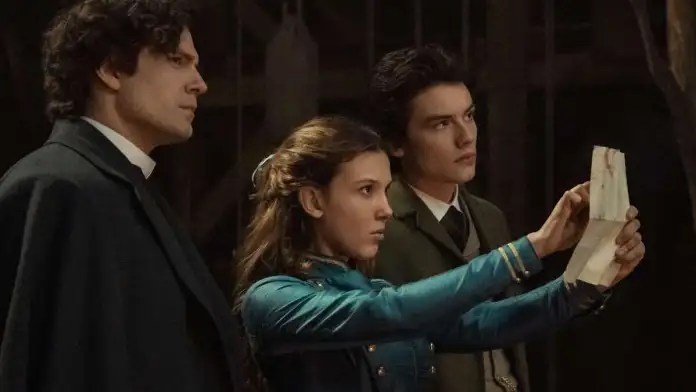
Sure, it’s more juvenile. Some of the comedy’s a bit broader. And heaven knows, that star Millie Bobby Brown takes a few extra “fourth wall” moments — staring, puzzled, amused, alarmed or self-satisfied at the camera.
But “Enola Homes 2” is a proper delight, start to finish, one of the best “juvenile” entertainments of the year.
The Netflix sequel — based on the Nancy Springer “Enola Holmes” books — taps into Victorian British labor history, music hall life, “match girls,” rich oligarchs and every Sherlock Holmes movie tradition and trope for two hours that simply romp by.
Seriously, where was this director Harry Bradbeer fellow when Harry Potter & Co. were slogging through their final years?
The Potter comparison comes to mind because like those pictures, these are dashing to YA film adaptation glory on the backs of an impressive cast growing ever more so.
Brown puts “Stranger Things” in the rear view mirror with these whimsical mystery thrillers. We’ve also got Henry Cavill bringing dash, intensity and a pretty good drunk act as Enola’s famous detective brother Sherlock, the one who keeps telling the kid sister “You should write that down.” Just be glad you’re not the one having to haul him back home to 221-B after a bender.
“It’s like carrying a dead horse, on which sits another dead horse!”
“Pull on every loose thread you find,” she says. And more pointedly and pertinently for our fraught times — “Find your allies. Work with them and you will make more noise than you ever could have imagined.”
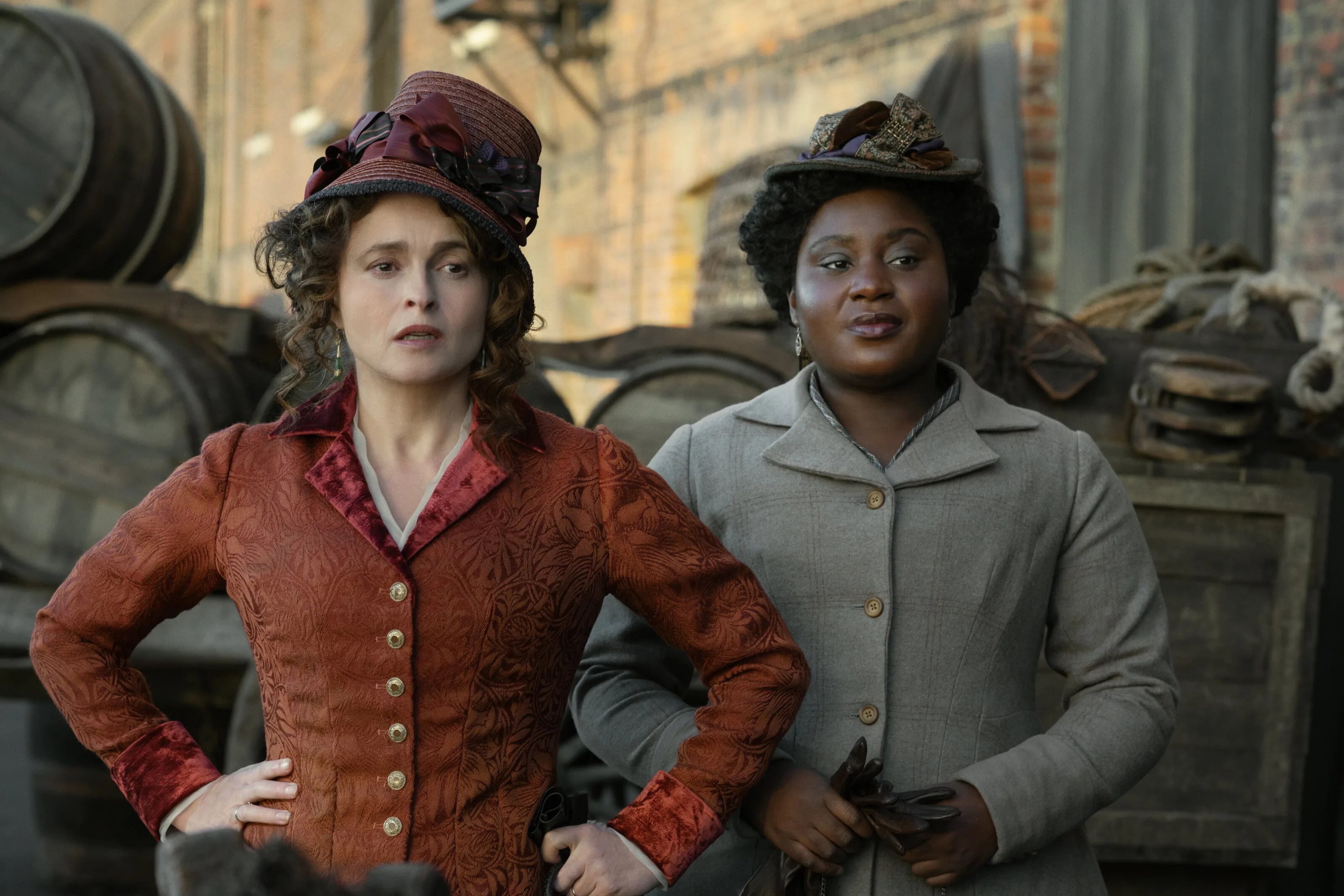
Imagine Netflix launching a YA action franchise that’s fun and furiously feminist. Susan Wokoma is back as Edith, Enola’s land lady and her mother’s fiercest ally.
There are chases and brawls, a ball — Enola needs a quick dance lesson to fit in there — “I’ll lead, you will follow!” “That seems like a mistake.”
Another Potter alumnus, David Thewlis, plays a sinister new cop. What did Hitchcock always say, kids? “Good villains make good thrillers.” There’s more than one, of course.
Yes, Enola admits to us and the camera, “You’ve seen this before.” But it’s just different enough and everybody involved is hitting their stride with “The Wrath of Khan” of Enola Holmes movies. Stream it, watch it with the kids and stay through the credits. You won’t regret it.
Rating: PG-13, bloody images, violence
Cast: Millie Bobby Brown, Henry Cavill, Helena Bonham Carter, Susan Wokoma, Samara Weaving, Louis Partridge, Sharon Duncan-Brewster, Adeel Akhtar, Himesh Patel and David Thewlis
Credits: Directed by Harry Bradbeer, scripted by Jack Thorne and Harry Bradbeer, based on the books of Nancy Springer. A Netflix release.
Kelvin Harrison, Jr. has the title role, that of “Chevalier de Saint-Georges,” fiddler and swordsman Joseph Bologne, playing and competing his way into royal circles in pre-Revolutionary France.
Samara Weaving, Lucy Boynton, Ronke Adekoluejo and Minnie Driver also star, playing folks who either encourage this young 18th century man of talent, or tell him “You don’t belong here…You’re a party trick!”
Sweet, slow and unassuming, “Sam & Kate” is a romantic melodrama that came into being because two Oscar winners relished the chance to act on screen with their acting progeny. So whatever sparks Sissy Spacek and Dustin Hoffman set off in their scenes together are augmented by the pleasure of their kids playing the long-suffering offspring of two very different and sometimes difficult — downright prickly — elderly parents.
A small town in Georgia is the setting. How small? Well, somehow, the folks who might be the only resident Jews there have a church they’re not shy about attending, especially when Christmas programs roll around.
Hoffman plays Bill, a widowed curmudgeon inclined to stir up trouble, even from the seat of a store-provided scooter at their local home improvement warehouse.
“You don’t like me but I like YOU,” is his re-assurance that his kvetching and kvelling to the only employee on duty is all in good fun.
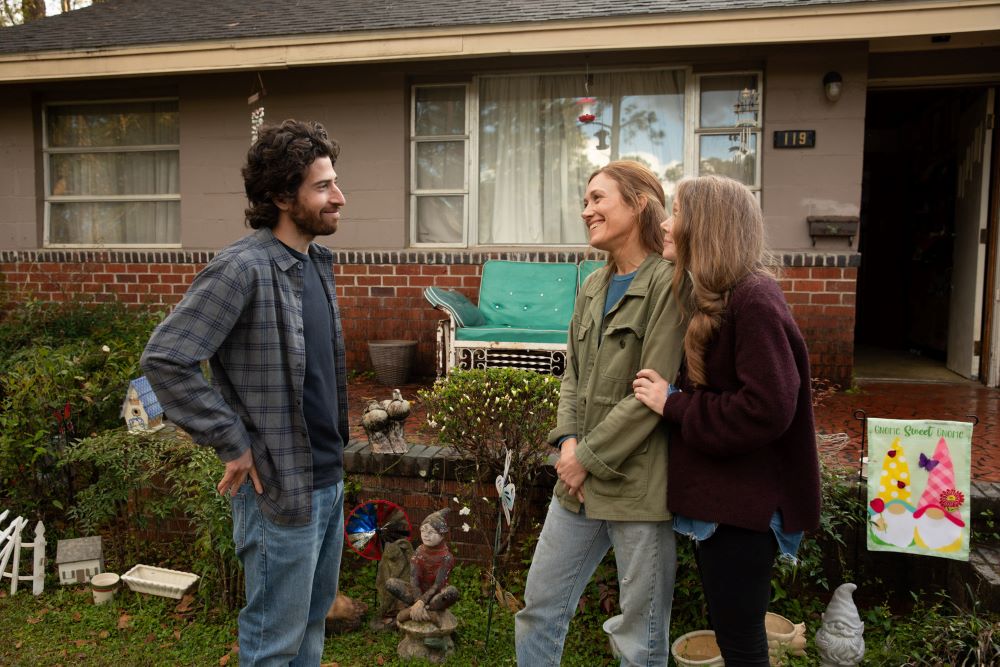
Jake Hoffman is long-suffering Sam, who is over 30, still lives with the old man, still works at the local candy factory and still takes weed brakes with his musician stoner pal (Henry Thomas) and still has no direction in his life and no clue what to do when he first casts his eyes on the lovely bookstore owner with the long, auburn hair.
Kate (Schulyer Fisk) has an electric smile and a friendly manner, even when she’s shooting down this persistent not-really-a-customer who clumsily makes his desire for her phone number obvious.
“I’m not really dating right now.”
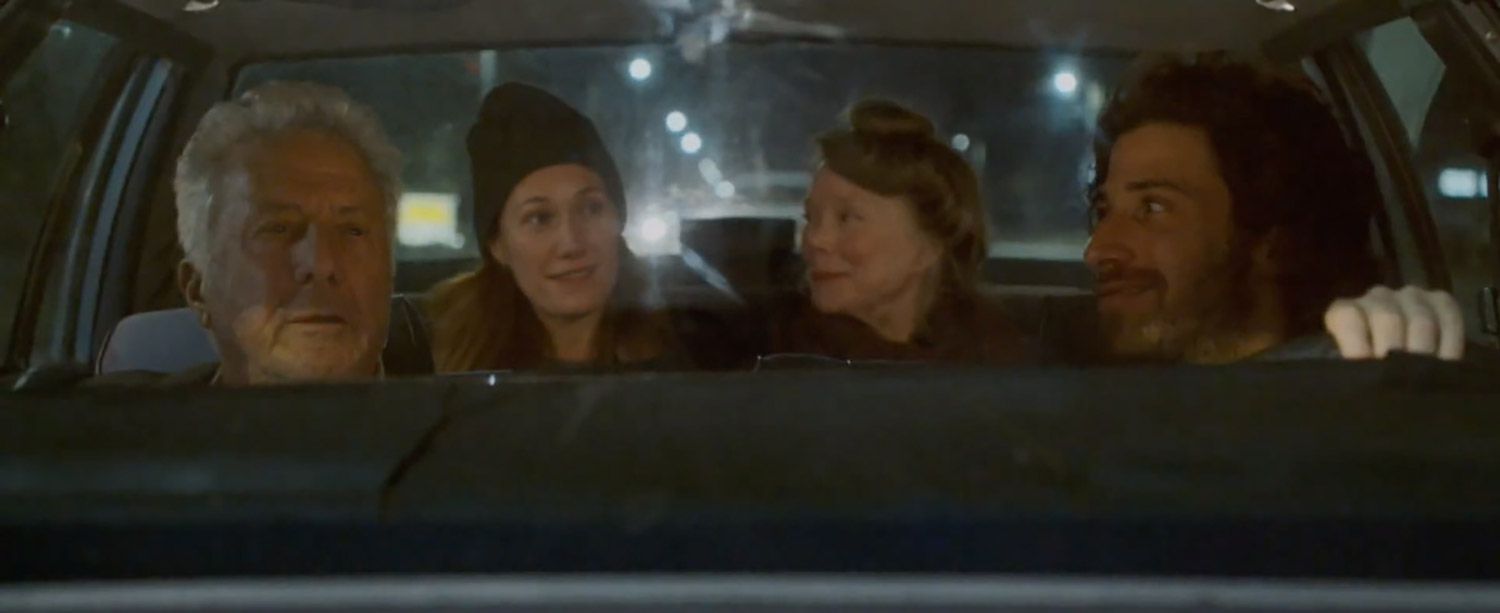
But that church, and that Christmas sermon and performance gives him another chance. Not exactly. Kate’s car won’t start, stranding her and her mom Tina (Spacek) after the service. Jake is quick…to let his mechanically-inclined dad take a look, and just as quick to let Dad suggest that they give the ladies a lift, as it’s not just a dead battery.
Thus begin two sort-of courtships, with bluff and temperamental Bill charmed by the ethereal Tina, and Sam wholly smitten with Tina’s daughter.
But you know how romances and rom-coms work, especially the ones labeled “melodramatic.” We need “obstacles.” Everybody has her or his “secret.” Everybody has “issues.” Some seem solvable, within the 110 minutes of this should-be-90-minute dramedy. Some won’t.
The young couple gets most of the screen time here, even if their accomplished parents out-sizzle and outshine them, especially in the early going.
Hoffman the elder is amusingly brittle and snippy about his “talented” son. “Maybe some day he’ll do something with it.” Bill shrugs off doctor’s orders and knows his days are limited.
“I’m on GRAVY time!”
The father-son arguments here can seem contrived, but relatable. It’s the mother-daughter disagreements that ring truest, downright triggering. Their “secrets” are the bigger ones.
Thomas, the “E.T.” kid, leans into his supporting role and lays back in his line-readings, creating a fun “local character” in just a few scenes. If you’ve not followed the fact that he now sings and plays guitar, you’re in for a treat.
There are just enough of those treats in the painfully “out of your league, dude” attempted courtship of Sam and Kate, and in the sparkle of Spacek and the bite of Hoffman to make this sweet nothing of a movie worth your while.
The character arcs are predictable, and abruptly traversed at times in actor-turned writer-director Darren Le Gallo’s debut feature. Yes, he got lucky with his casting. Yes, few are likely to get that lucky a second time, in that regard.
But as long as their are little lives worth a little intense scrutiny, there’ll be indie films like “Sam & Kate,” pleasant diversions that give legendary stars the indulgence of a victory lap, this time with their kids along for the ride.
Rating: R for some drug use and (profanity).
Cast: Dustin Hoffman, Sissy Spacek, Schuyler Fisk, Jake Hoffman and Henry Thomas.
Credits: Scripted and directed by Darren Le Gallo. A Vertical release.
“The Takeover” is a brisk-enough but seriously formulaic Dutch thriller about a hacker being chased by villains she’s crossed and hunted for a murder she’s been framed for but didn’t commit.
So it’s a little like a lot of “coder/hacker” thrillers. Take Sandra Bullock’s “The Net,” for instance.
There’s some suspicious code that the hacker finds in a Dutch company’s new self-driving bus software.
Wait, there’s a bus? So we know what screenwriters Tijs van Marle and Hans Erik Kraan were doing the weekend they roughed this roughhousing chase picture script out — a Sandra Bullock binge fest!
It’s to their credit that knowing those antecedents doesn’t give the whole movie away. But it’d be seriously short of surprises even if you didn’t pick up on that pretty early on — like two or three scenes in.
Holly Mae Brood (“All You Need is Love”) is Mel, the lovely brunette in peril this time, a hacker taken under the wing of an OG “hacker” turned “cyber security specialist” named Buddy back when Mel was a teen.
That’s a cute scene. She’s shutting down a local airbase’s air traffic control from a PC in her parents’ garage when we meet her. Doesn’t like the noise from all the constant flyovers.
Buddy (Frank Lammers of “Black Book” and “Ferry”) seems sympathetic.
Cut to ten years later, and Mel B. is on her own, working for a company that has to sign off on the software that will run Rotterdam’s first self-driving bus. Mel sees something wrong, sets up a “Trojan Horse” to foil whoever is stealing data from the bus. For an encore, she joins her online international hacking co-op to rob from rich blackmailing hackers and donate “their crypto to charity.”
When two guys break into her apartment, all bets are off. She’s pissed off the wrong SOMEbody somewhere.
She figures out fast that she can’t trust the cops. She figures out faster that somebody’s faked a video that frames her for murder. And with her phone traced and her apartment watched, she has nowhere to run.
EXCEPT for the flat of hapless Thomas (Géza Weisz) a gauche and goofy blind date that went nowhere the night before.
There’s this villain who keeps calling with threats. He (Lawrence Sheldon) is fond of black leather gloves and Audis, just like every other bad guy in a Euro thriller.
“Make the right decision and I won’t kill you,” he purrs — in English because that’s what he speaks in either the Dutch or English-dubbed versions of this.
The chases are routine, the action beats pretty much punched out according to formula and the finale we can see from the film’s second scene.
Still, there are some laughs from the under-estimatable Thomas and Brood runs likes she means it and throws a punch like a hacker who keeps a punching bag in her flat to practice. Which she does.
Not enough here to recommend “The Takeover,” but if you’ve never seen a Sandra Bullock thriller from the ’90s, it’ll all seem new to you.
Rating: TV-MA, violence, profanity
Cast: Holly Mae Brood, Géza Weisz, Frank Lammers, Walid Benmbarek and Lawrence Sheldon
Credits: Directed by Annemarie Van De Mond, scripted by Tijs van Marle and Hans Erik Kraan. A Netflix release.
There wasn’t much point in filming another version of Eric Maria Remaraque’s classic anti-war novel “All Quiet on the Western Front.”
There are other films of it out there, each worthwhile in its own way. And we’ve had “1917,” “The War Below,” “War Horse” and “Journey’s End” in the last few years, taking us deeper and deeper into the horrors of the Western Front meatgrinder of the trenches of France.
So director and co-writer Edward Berger and his German team didn’t “remake” “All Quiet.” They added points of view to the narrowly-focused grunts-eye-view novel.
We see the troubling Armistice negotiations and the first flashes of the original fascist “Big Lie,” that the German army was “stabbed in the back” by “liberal” politicians, ignoring the fact that the army had a hand in starting the war and was wholly responsible for losing it.
A sputtering Prussian general (Devid Streisow) fumes that “The Social Democrats will be the end of mankind!”
The ending is changed just enough to preserve its message of the futility and waste of this most futile and wasteful war, with its staggering slaughter and inhumanity, while soberly fixing on the demagogues who started it and could not wait to foment the dissent that would lead to the next one.
But if you remember the story or earlier films, you will recognize what’s happening and who it is happening to, and lose yourself in another filmed immersion in life and death in the trenches, in “no man’s land” — death by bullet or bayonet, gas or gangrene.
Felix Kammerer is Paul Bäumer, the school boy who joins up with his entire class, which enlists en masse in 1917. Their head master (Michael Wittenborn) exhorts them, “the iron youth of Germany,” to go and make quick work of the French and the British, and the just-declared-war Americans.
Paul and his comrades muster in, endure their first “tests” from their lieutenant, and struggled for 18 months of thin rations and low-survival rates as “dead men walking,” which Paul jokes that they are as they exchange their school uniforms for the army’s.
But Berger — who made “Jack” and has worked in German television — opens his film with a bravura, mostly dialogue-free combat sequence, watching a soldier cope with the shock of shelling, the terror of going “over the top,” the panic of not being able to get his bolt-action G98 rifle to fire and eventually his death.
We see the body picked up, stripped and the uniform washed, patched and recycled. That’s what Paul is putting on, a dead man’s clothes. He’s just a cog in the German war machine, fresh meat for the grinder.
“Truth is the first casualty of war” is underscored, right from the start. These boys are being sent into battle to feed the machine, which despite successes against Russia, has failed to break through in the West. They aren’t warned that three years into this war, Germany is not much closer to winning.
And the fact that Germany is forced to re-use the uniforms of the dead doesn’t suggest “victory” is anywhere in sight.
The novel, like this version of it on screen, tracks the death of innocence — naively stumbling into first combat, seeing comrades fall, one by one, meeting the grizzled veteran/bunker philosopher Katczinsky (Albrecht Schuch). A raid on a French farm here, a flirtation with a farm girl there, all tucked into months of charges or fending off enemy charges, struggling to stay alive as their idealism dies one day at a time.
Berger and cinematographer James Friend — with a little digital help here and there — paint the panorama of war on a wide canvas, a portrait in mud, blood and rotting shades of grey. The fights are close-up, intimate, filmed tight to make them grimly personal.
The soundtrack is silence interrupted by cacophonous combat, grunts and panting and yelps and the whizz of bullets, the rattle of machine guns and blasts from artillery and grenades. Composer Volker Bertelmann brilliantly augments this with a metallic “Inception” inspired score of bass rumbles and brass blasts and the startling crack of drumsticks on a drum’s rim or solitary, abrupt pops on the head of the snare drum.
Daniel Brühl, playing a civilian official negotiating the coming armistice, stands out in the cast by being the most familiar face to international audiences (“”Rush,” “Captain America: Civil War”). The players are good, but Berger seems far more committed to the vast mural he’s painting than to the individual journeys. There was more pathos in the most famous Hollywood version of this story, even in the 1979 TV movie, than anyone here is able to summon up.
I found “1917” more visceral and engaging, “War Horse” more moving. At this point, the novelty of this nightmare has worn off, its ability to shock modern audiences by recreating the cold, gory realities of “The Great War” is gone.
But all involved are to be commended for taking a shot at modernizing a classic novel and rendering it into another lesson that history does repeat itself, that as the philosopher said, “Those who cannot remember the past are condemned to repeat it.”
Rating: R, graphic violence, profanity, smoking
Cast: Felix Kammerer, Albrecht Schuch, Moritz Klaus, Aaron Hilmer, Adrian Grünewald, Devid Streisow and Daniel Brühl
Credits: Directed by Edward Berger, scripted by Edward Berger, Lesley Paterson and Ian Stokell, based on the novel by Eric Maria Remarque. A Netflix release.
The first mystery of “Stars at Noon” is just who and what this character, Trish Johnson really is?
She tells one and all she’s a “periodista,” a journalist. Since she’s paying for her drinks with cordobas, we can guess she’s in Nicaragua. And since she drinks a lot, maybe we buy the “periodista” label.
But she gives no sign she takes notes or photographs. There’s little about her slinky sun dress that says “professional.” Well, not that profession.
That Brit she’s met in the bar of the swank Hotel Intercontinental asks her directly, “Are you for sale?”
“I’m press.” But she doesn’t seem offended, just claiming the proper credentials.
“We’re all press here,” he shrugs. One drink later, things turn back to transactional.
“For a price I’ll sleep with you.”
Mysteries matter in the films of Claire Denis, who makes movies in which story drifts into the background as characters, settings and predicaments move to the fore. Think of her “Chocolat,” French and set in Cameroon, or the Robert Pattinson father-daughter-in-space tale “High Life,” or “White Material.” It’s the patient, meandering storytelling, the ordinary characters who make tenuous connections and conjure up the unexpected, the dreamy tone that sticks with you.
Margaret Qualley plays Trish, bringing that laid-back, go-with-the-flow vibe she brought to “Once Upon a Time…in Hollywood” with her. We don’t know how Trish got into Nicaragua. But we can tell she’s stranded there and that this is getting to her. The “how” and the “why” only become a little clearer with time.
An Army lieutenant (Nick Romano) she has a regular thing with gives her a post coital chewing out.
“You’re NOT a journalist!” “I am TOO!”
A call to a guy she regards as her editor/”employer” (John C. Reilly) back in the States sets her and us straight. No, he’s not sending her money. No, she’s not doing a “piece” for him.
“Just admit to yourself that you’re not a journalist.”
But this Englishman (Joe Alwyn of “Mary Queen of Scots” and “Billy Lynn’s Long Halftime Walk”) she’s watched hanging around with “cops” or “Costa Ricans” intrigues her. There’s an election going on, which she expects to be delayed, whose delays have something to do with why she can’t get out of the country. And the Brit, who might quip unflatteringly about her sex worker status, can meet her price “in DOLLARS.” He might be trouble, but he could be her ticket home.
The film, based on a Denis Johnson novel, serves up Qualley as the prettiest “Ugly American” we’ve ever seen — sexy and unabashed, semi-fluent in Spanish and prone to “when American tanks come and CRUSH your country” tirades when she runs into the petty corruption, the lax Central American “mañana” attitudes and Catch-22s of being stuck in a place with no easy way out.
Somebody broke her phone. Somebody took her passport. And that’s before she takes up with this sketchy, apparently-married and somewhat posh Brit with linen suits and a gun, who says he’s here for “consulting” with an oil company — in the middle of another harrowing election in a corner of the world where that’s the norm.
Denis keeps the intrigues murky and the motives murkier as our couple’s predicament grows more dire. I never bought into the love story supposedly budding here, but that’s kind of the point. Who is using whom?
Is Trish really the one with the spycraft in this “partnership,” clever enough to know how to dodge that tricked-out Jeep full of “Costa Ricans?” Is Daniel in over his head, too?
Costa Ricans seem to be everybody’s favorite villain in Nicaragua, CIA stooges doing the gringos’ dirty work. But that doesn’t mean the “real” CIA won’t show up. He (Bennie Safdie) may be obvious, but he’s not going to admit to owning any part of Trish and Daniel’s predicament, or answer a single direct question, no matter how many ways you ask it.
That diffuse plot and emotional disconnection between the leads creates a remove in the film that keeps it at arm’s length. There are coherence issues as well.
But Qualley conjures up another loose, louche and sometimes shoeless (A jab at Tarantino?) free spirit, this time one drifting through a situation whose difficulties she acknowledges even as she tries to ignore the perils.
As “Stars at Noon” unfolds, Denis summons up memories of lots of movies set in this part of the world or any part of the Third World where elections are held and The Game of Nations is played. The foreigners come in and some locals die, and then the foreigners leave and no one really knows if anything was made better or worse except for the dead. And nobody’s asking them.
Rating: R for sexual content, nudity, language and some violence.
Cast: Margaret Qualley, Joe Alwyn, Nick Romano and Benny Safdie
Credits: Directed by Claire Denis, scripted by Claire Denis and Andrew Litvak, based on a novel by Denis Johnson. An A24 release.
Running time: 2:14
Posted inReviews, previews, profiles and movie news|Comments Off on Movie Review: Claire Denis and Margaret Qualley Serve up Central American intrigue and romance in “Stars at Noon”
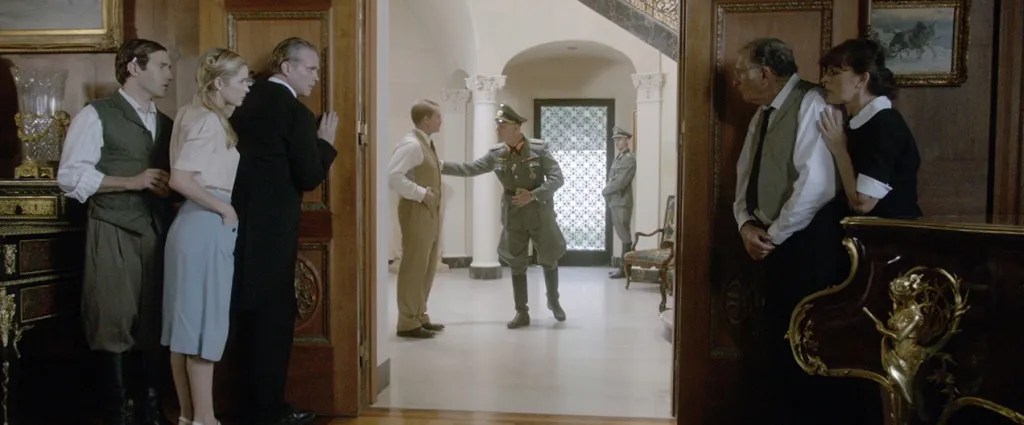
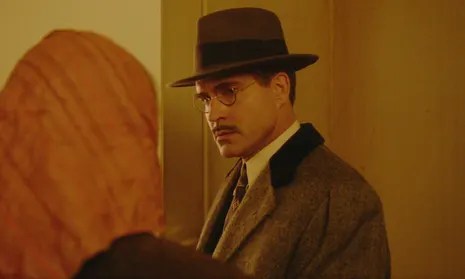
The folks releasing “Resistance 1942” should have kept this WWII thriller’s original title “Burning at Both Ends,” for starters. That’s not only more poetic, but retitling without re-editing the picture you’ve decided to distribute can get you into trouble, too.
Although “Resistance,” which stars Cary Elwes, Greer Grammer (daughter of Kelsey), Judd Hirsch, Sebastian Roché and Jason Patric, has a sequence set in 1942 France, intertitles foolishly, needlessly and quickly advance this fictional claptrap into 1943 and set the entire third act in 1944.
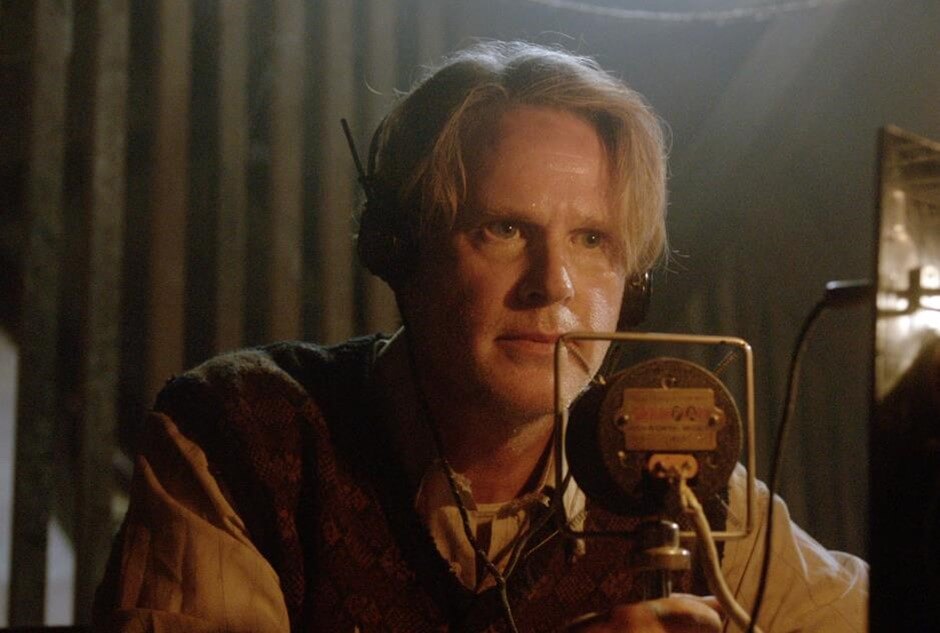
It’s about an underground radio personality who broadcasts from an attic hideaway, a lone voice imploring whoever might be listening to keep “the flame of hope alight…Remember to trim your wicks, my friends. For the darkness soon will pass.”
Elwes is Jacques, that voice in Nazi/fascist occupied Lyon, France. He’s in hiding in an attic with his daughter (Grammer), an elderly Jewish couple (Hirsch and the late Mira Furlan) and another young fellow (T.W. Leshner), sending the young folks out to scavenge for food and retrieve vacuum tubes to keep Jacques’ transmitter/receiver gear in order.
Roché plays the Gestapo officer obsessed with silencing this “Jacques.”
“Interview every man called ‘Jacques’ in this city!” he commands, giving away why the Germans lost the war in a sentence.
The girl is so pretty she gets attention whenever she leaves the attic, and that leads to unwanted uniformed attention. A chase sends her into a random office to hide. And that’s how the banker Andre (Patric) gets mixed up in their plight.
Years pass with them under his protection. But pushy Germans demand a swank Dinner with Nazis gathering in his villa outside the city, putting everybody in their greatest peril ever.
I guess Hirsch’s grandson or somebody sharing his surname came up with the “story” of this screenplay, leaving it to the hapless writers/directors to make it work.
It’s not enough to get the uniforms right, the black leather Nazi overcoats and black leather Nazi gloves, the “Heil Hitlers” and Lugers anti-Semitism and the uneasy collaboration with the Vichy French police. You’ve got to keep the story moving and the suspense building.
After a brief and moving newsreel summary-of-the-war opening, “Resistance” skips forward in time without much narrative reason, and no narrative rhyme. The hidden quintet keeps the Jewish Sabbath and Jacques keeps hope alive, but the story wanders into the weeds when everybody ends up at that swank villa.
Scenes are clunky and disjointed. The dialogue is bad. Elwes and Patric do their best, but they have trouble hiding their dismay at some of the staging and most of the writing. The performances are adequate in the most tepid sense. Playing caricatures instead of characters is challenging.
This is exactly the sort of WWII movie you can do on the (relative) cheap. But before jumping in, you need to know a little more about the radio component of the story and radio components of the day. The Nazis record Jacques’ broadcasts on a 1970s vintage reel-to-reel deck, and the suggestion is given that an awful lot of Frenchmen — and women — had radio transmitter/receivers just like Jacques.
So I guess all those British SOE drops of such gear were for naught? Those were rare, the French police and Germans seized radio gear of all types, and arrested people just for listening to the wrong broadcasts. There’s no instance I could find of any “underground” station like this.
SOMEbody, perhaps the relative of one of the stars who came up with this story, misunderstands the fundamental difference between “underground radio stations” of WWII and “Pump up the Volume.”
Not that the rest of this disorganized dalliance in “Resistance” makes any more sense.
Rating: Unrated, violence
Cast: Cary Elwes, Greer Grammer, Sebastian Roché, Mira Furlan, Judd Hirsch and Jason Patric
Credits: Scripted and directed by Matthew Hill and Landon Johnson. A Quiver release.