
A horror icon is interviewed, and others sing his praises.
June 6, streaming.
A horror icon is interviewed, and others sing his praises.
June 6, streaming.

“Queens on the Run” is a dainty little Mexican marzipan comedy — sort of sweet in the most predictable ways, lighter-than-lightweight and rarely funny.
It’s a “wives bonding” road picture, a little heavy on the “Thelma & Louise,” pero medio culo, as they say in Olde México, in terms of script and execution. “Half-assed.”
Four bored México City women — three of them in marriages of varying degrees of frustration, the other an arrested development case with a Grindr and pink hair dye fixation, pile into a ’64 Ford Fairlane convertible named “Corcholata” (Bottle cap, amigos!) and bomb off for the coast — to Cancún.
Marilu (Alejandra Ambrosi) has two kids and a distracted workaholic husband who has forgotten their anniversary for four years running. So she’s in.
Famela (Paola Núñez) is more happily married, trying to have a baby and wearing out her husband in the process. He, by the way, is in business with Marilu’s husband/marido.
Glamorous writer Paty (screenwriter Martha Higareda) is married to a famous politician and constantly getting botox and “las boobies” worked on, but now her “chi chis” (Mexican slang for “las boobies”) are uneven. Her husband might be cheating.
And single free spirit Estrella (Valeria Vera) is the one who owns Corcholata the red Fairlane ragtop.
Estrella suggests the road trip to her fellow “reinas”(queens). Baby-obsessed Famela has been equally obsessed with her late mother, and thinks scattering Mom’s ashes in the Caribbean would be just the thing. The other two join in with varying degrees of enthusiasm.
They’ have their first mishap during their first sing-along (Shania Twain, of course), are attacked by a chicken truck stampede during a traffic jam, flash a Jeepload of fetching chicos and make their merry way, even picking up a hitchhiker (Claudia Pineda) as if there’s another item to check off their bucket list.
But we’ve seen the heavy-handed forshadowing, all the TV reporting about the drug importer/gun trafficker named El Gavilán or “The Hawk” (Enrique Arreola) like the song. We know they’re about to cross paths. But we have no idea how ham-handedly co-star and screenwriter Higareda will manage that unlikely encounter.
Somehow, these “queens” have to be put “on the run if “Fuga de Reinas” is to achieve its titular destiny.
The screenplay is cut-and-paste, start to finish, with some of the pastes having little connection to logic. The slapstick is OK, what few instances of it we’re treated to. The “girl bonding” stuff is pro forma, and the perils are poorly handled, at least on the page.
But the players are all-in, right through the “impersonate pole dancers” climax, and a couple of moments deliver giggles. Famela is EVER so irked when El Gavilán and his sidekick POINTLESSLY steal the urn with her mother’s ashes. A deranged car chase with gunplay ensues.
And when forgetful hubby Jose arranges a mariachi band at the last minute to serenade his (missing) wife, and the players are all drunk, that’s kind of funny.
The rest? Kind of off-a-cliff, if you know your “Thelma & Louise” analogies.

Rating: TV-MA, violence, near nudity, sexual content, profanity
Cast: Paola Núñez, Alejandra Ambrosi, Martha Higareda, Valeria Vera, Claudia Pineda and Enrique Arreola.
Credits: Directed by Jorge Macaya, scripted by
Martha Higareda. A Netflix release.
Running time: 1:36

The ladies swoon and the clothes, manners and accomplishments make the man as Kelvin Harrison Jr. goes full matinee idol as “Chevalier” de Saint-Georges in a lovely film that is both immaculate period piece and colorfully imagined biography of a music star of pre-Revolutionary France.
Josephe Bologne was the “bastard” son of a French West Indies plantation owner and his slave who gained fame as a fencer, a musician and composer in the last years of the French court of Louis XVI and Marie Antoinette.
Emmy winning TV producer and director Stephen Williams (“Watchmen”) and screenwriter Stefani Robinson (TV’s “Atlanta”) conjure up a story that’s both amazing and mostly true, tracking the dazzling career of someone whose father’s lone righteous act was recognizing his talent and putting him in an exclusive French boarding school, which gave him entry into the very heights of French society.
“You must be excellent,” the barely fatherly father (Jim High) counsels. “Always excellent. NO one may tear down an excellent Frenchman!”
We see the boy fence and fiddle his way to the top, making his name in both fields and challenging the aged-out-of-boy-wonder Mozart (Joseph Prowen, terrific) to a (fictional) “Devil Went Down to Grenoble” fiddle-off in front of an astounded, palpitating audience of new (mostly female) admirers.
Even Marie Antoinette (Lucy Boynton, a vision) becomes a fan girl and names young Joseph Bologne “Chevalier” du St. Georges.
“What will you do now that the world is yours, Chevalier?”
But he is black, “mulatto,” and there are limits to his professional life and personal prospects. Marry a black woman and he will lose his status. Cast his eyes at the wrong white woman of his station and he will face the wrath of France.
Professionally, he’d love to lead the faded Paris Opera. Personally, he’d love to take up with the beautifully-voiced beauty Marie-Josephine (Samara Weaving) and cast her in his new opera “Ernestine.” Her stern, military man of a husband (Marton Csokas, fearsome as always), won’t have any of that.
And making an aging opera diva (Minnie Driver, in full Kristin Scott Thomas mode) jealous isn’t a smart play.


Harrison — he was B.B. King in the recent “Elvis” movie — brings a playful, debonnair touch to this character, a dandy who loved showing off his talents and his manners in his fancy blue suits.
The film necessarily over-simpliflies and condenses this not-quite-forgotten man ahead-of-his-time’s life. His reunion with his mother (Ronke Adekoluego) is given short shrift, as are his dalliances in the politics of that day. Attempting to have this story climax during the French Revolution is an overreach, leaving the later acts looking malnourished and playing as perfunctory, soap operatic and incomplete. The last third of the film drags accordingly.
But Harrison dazzles in a vehicle in which Robinson and Williams present him as a real life T’Challa, smarter, more accomplished, braver and better in a sword fight than any white man in his world. His story makes a fascinating reminder of all the history we’ve forgotten, or been made to forget, and returns an “erased” figure to his rightful place as one of the celebrated men of his age, someone whose long and complex story would take a mini-series to be done justice.

Rating: PG-13 for thematic content, some strong language, suggestive material and violence
Cast: Kelvin Harrison Jr. Samara Weaving, Lucy Boynton, Ronke Adekoluego, Sian Clifford, Minnie Driver and Marton Csokas.
Credits: Directed by Steven Williams, scripted by Stefani Robinson. A Searchlight release.
Running time: 1:47
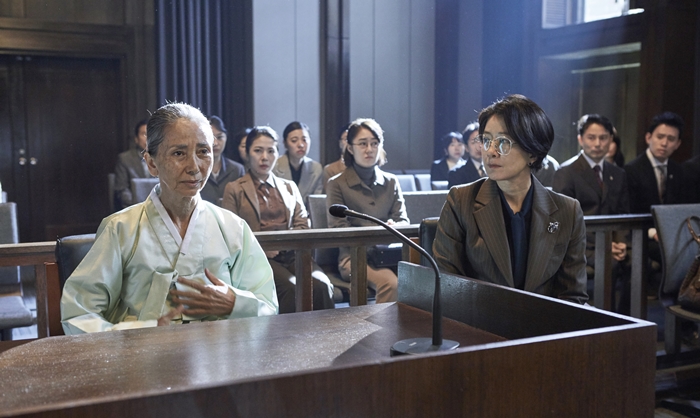
“Herstory” is a gripping and revealing account of a handful of Koreans’ attempt to take Japan to court to secure damages and get an apology for the war crimes they experienced under Japanese occupation before and during World War II.
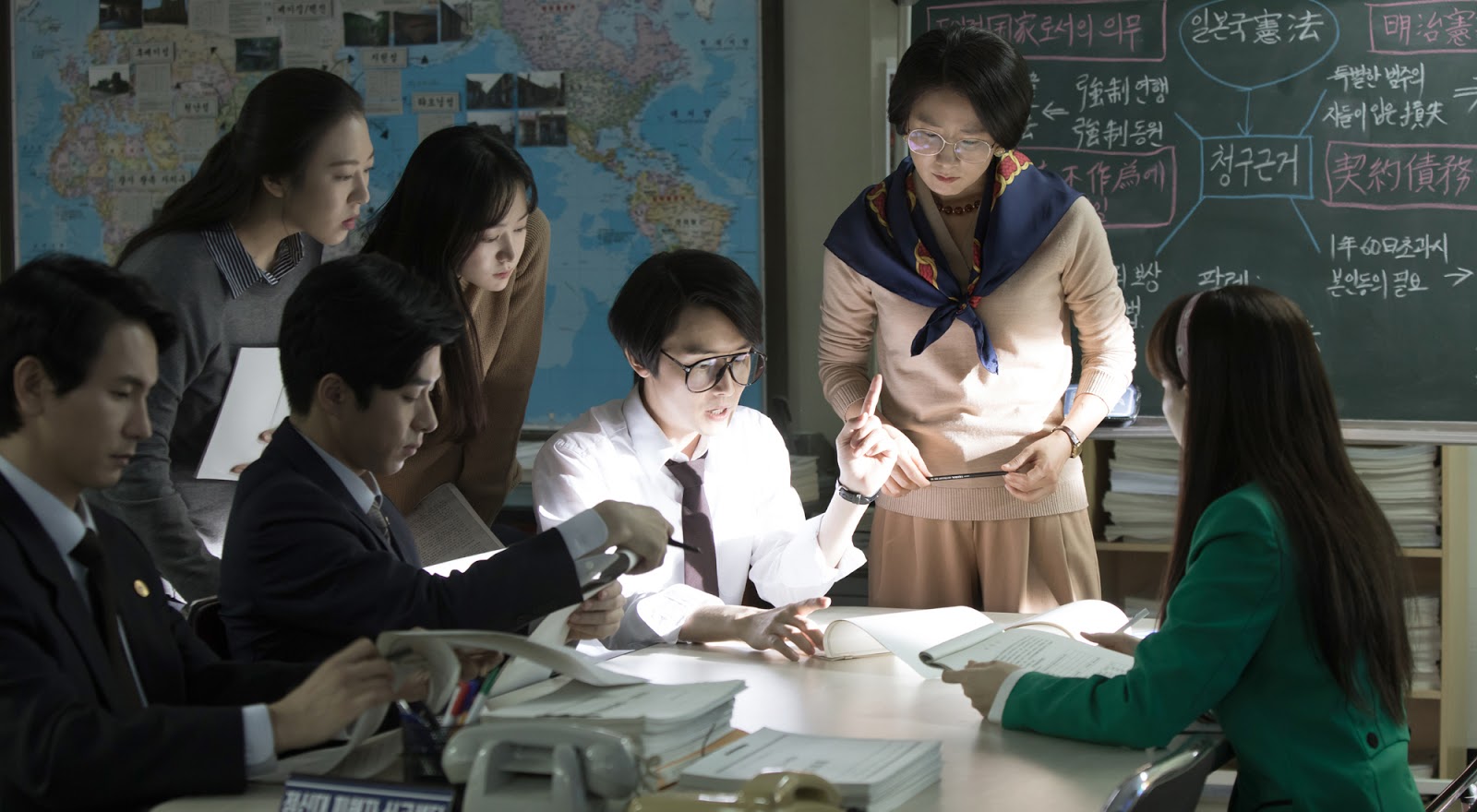
Director Kyu-dong Min (“Memento Mori”) and his screenwriters, who are also three of the stars of the movie, turn a spotlight on Japanese guilt and Japanese justice for a moving and yet sometimes funny film that might glibly be described as “Erin Brockovich Goes to Nuremberg.”
Our crusading “Erin” this time is a single-mom travel agency owner whose legal troubles in the early ’90s shutter her business just as Korea experiences another wave of revulsion over what its people suffered under Japanese occupation (1910-1945).
Moon Jung-sook (Kim Hee-ae, in a sensational turn) is a mouthy, brusque and no-nonsense businesswoman who looked the other way at how a subordinate was luring foreign tourists to her Busan agency (“prostitution tours”) and got jailed for it.
She’s the mother of a rebellious teen whom all her business Women’s Association friends see as a girl she’s neglected in her relentless pursuit of businss.
She’s the one who figures their Women’s Association should set up a non-profit agency where former comfort women — Koreans forced into sex work by Japanese officialdom — and those sent to forced labor camps by the Japanese Army can report their experiences and seek justice. She’ll run it out of her temporarily-closed travel agency offices.
Two things immediately happen. They hear from women and get media attention for that. And the pushback, the shaming, from patriarchal Korean culture, explodes.
Ms. Moon finds herself in furious debate with sexist, quick-to-judge men, even cab drivers, who want this “story” and these women, whom they see as compliant sex workers and a national embarassment, to go away.
But the story gets personal when she finds herself having to hire a new housekeeper because the timid, downtrodden woman (Yong-nyeo Lee) who had been doing the job stops showing up. And visiting her, seeing her disturbed, pushing-50 adult son who beats her up, she learns that her own housekeeper was a “comfort woman,” one of the more eye-rolling euphemisms for “sex slave” in the history of Japanese deflection.
Much of Ms. Moon’s time will be spent convincing each of these women she meets to go public and agree to tell their terrible, heartbreaking stories in court.
Another piece of blowback comes from the assorted Japanese businesses and businessmen whom every businesswoman in her Women’s Association wants to keep as clients. They get outraged.
When the Japanese consulate in the city cancels its big account with Ms. Moon and the consul launches into “I can’t accept your blaming Japan without evidence” and then, right on cue, flips into Japanese victimhood, which is always punctuated with “not to mention the atomic bomb,” the viewer is entitled to get just as furious as Ms. Moon.
Busan is a port town, and she can curse like a sailor.
Having the country that started World War II, conquered much of Asia and occupied it under the most brutal conditions officially deny any responsibility for this and the uncountable war crimes committed by the country, is a bit much. Failing to accept culpability, refusing to apologize for the Rape of Nanking on down to refusing to let films about their WWII barbarism show in what is widely accepted as the most racist country in Asia, is maddening.
Ms. Moon controls her temper — she’s not shy about dropping profane tirades about what she’s learning, nor are some of the more outraged comfort women — and resolves to get Japanese lawyers and take the “damned samurai” to court.

“Herstory” features moving and vexing courtroom scenes as the aged and understandably fearful and furious “grannies” and their champion — who serves as an over-the-top translator in court — are bullied and brushed-off by the judges in Shimonoseki, the Japanese city where some of the women were shipped and where the case must be tried.
The women themselves range from damaged to defiant to mentally ill, with differing stories and degrees of effectiveness as witnesses. Their lives were broken and everything that happened afterwards bears those scars. Anything can trigger flashbacks, some of which are wrenching.
Suk Mun, who co-wrote the script, plays the most convincing witness, Seo Gwi-soon, a woman so determined to get an apology (cash settlements are secondary to most) that she’s willing to show the physical scars and obscene sex-worker tattoos visited upon her by the Japanese.
The most apalling thing about this for many American viewers is seeing the right wing outrage in Japan about this trial and the court’s dogged embrace of Japanese victimhood and Japanese determination to refuse to accept responsibility. Japanese apology culture simply won’t allow it to apologize for the worst things the people and the country ever did?
An American viewer can’t help but see this in the light of America’s hand-wringing over dropping the Atomic bomb on the refuse-to-surrender aggressors in the war, and eventual American acceptance of guilt for the justifiably-condemned racist internment of Japanese Americans during much of the war, guilt which is constantly revived and yet always reported out of context.
Although “Herstory’s” lighter moments are welcome, they can be a bit jarring in a movie whose tone is serious and sad.
But it’s eye opening and heart-breaking, beautifully-acted and another compelling argument for Japan to do what Germany did long ago, accept, admit and apologize for its many cardinal sin war crimes in the first half of the last century. And more’s the pity that it’s just another film on the long list of movies Japan doesn’t allow into the country.

Rating: unrated, war crime and sex crime subject matter, profanity
Cast: Kim Hee-ae, Suk Mun, Kim Hae-sook, Soo-jung Ye, Yong-nyeo Lee, Yeong-ih Lee and Jun-han Kim
Credits: Directed by Kyu-dong Min, scripted by Kim Hae-sook, Soo-jung Ye and Suk Mun. A Well Go USA release.
Running time: 2:00
Your childhood fears writ large. June 2 in a Cineplex near you.
This action pic starring Mr. “Crazy Rich Asian” “Gentleman,” drops digitally for streaming May 16.

The climactic scene in Romanian writer-director Cristian Mungiu’s “R.M.N.” is a jaw-droppingly ugly town meeting. Almost everyone in the tiny Transylanian village of Recia Recfalva have shown up in the community hall to give vent to every prejudice, ignorance and almost comically hypocritical thought in their heads.
“We got rid of the Gypsies, now this?” “I’ve got nothing against those people, as long as they stay in their own country.” We’ve got to “think of our historic community,” the local priest says, joining in.
The “natives” don’t want “foreigners” hired, with E.U. backing, at the last going concern in this dying community — the factory bakery. Not that the natives want to work there. They leave the country for better paying jobs in Germany, France and elsewhere. Where they’re “foreigners.”
And that “historic community?” There’s a lot of yelling to “speak Romanian.” Because maybe half of them are native Hungarian. Others trace their lineage to Germany or Luxemberg or wherever, clinging to that heritage even if their ancesters migrated here 700 years before.
These xenophobes are ranting, starting anti-immigrant Facebook groups and can’t properly identify just who is looking back at them in the mirror. “Lacking self-awareness” has rarely been better illustrated in a movie.
Mungiu, most famous for “4 Months, 3 Weeks and 2 Days,” has taken his time getting us to the outburst. He’s introduced us to Mathias (Marin Grigore), a beefy local who works in a sheep slaughterhouse in Germany until the day his supervisor shows his prejudice with a “F—–g lazy Gypsies” crack.
One head-butt later and non-Roma Mathias is thumbing his way back home, to his quaint and cute village in a scenic corner of the country, just before Christmas. He must deal with his aged sheep farmer, Papa Otto. His lover, the bakery manager Csilla (Judith Slate) is surprised at his return. His wife (Macrina Barladeanu) didn’t expect him to come back. Ever.
And their little boy, Rudi (Mark Edward Blenyesi), has been frightened by something in the woods on his way to school. He’s eight and living in silent terror. He won’t speak and sleeps in the bed with his mother, Ana.
Mathias will walk him to school, lecture him on fear and try all sorts of primitive, brutish things to toughen him up.
“People who feel pity die first,” he says, in subtitled Romanian (and there’s Hungarian and French, and English in the film as well). “I want you to die last.”
And amid all these personal issues, the bakery hires three Sri Lankans to fill jobs no local will take. Neither the owner (Orsolya Moldován) nor the cultured manager and string octet cellist Csilla can see what’s coming.


The film’s title is a pun, as Mungiu noticed the similarity of his homeland’s abbreviation with a brain scan procedure. Whatever tolerance and acceptance the locals show to each other and to the newcomers, what’s beneath that is what counts.
Ancient hatreds, historic cultural feuds that are practically genetic in origin seem to bowl over reason and make one and all blind to the hypocrisy they’re living under. Even the priest may pay lip service to “all God’s children” and push back a bit, but when belligerant locals refuse to let the Catholic immigrants into the church, he lets them.
“R.M.N.” is grounded in its sense of place and allegoric in its messaging. The Europe-wide backlash against E.U. mobility, “shared values” and tolerance merely uncovered prejudices that have always been there and were papered over in Brussels.
A young French conservationist here to “count the bears” finds himself speaking up for The One Europe experiment, and shouted down. The “bears” have always been there, and now is when they’re breaking out their claws, in increasingly totalitarian Hungary, Romania, Poland and Britain.
It’s a fascinating and utterly engrossing film, immersing us in this world, fretting over what we can see coming before the principals do, and relating it to the xenophobia and bigotry out in the open in America, just as it is in backward, rural Transylvania.
“Intolerance” is a “family value” the world over.

Rating: unrated, violence, nudity
Cast: Marin Grigore, Judith State, Macrina Barladeanu, Orsolya Moldován and József Bíró
Credits: Scripted and directed by Cristian Mungiu. An IFC release.
Running time: 2:07

There’s a stately, almost funereal seriousness to Brit director Guy Ritchie’s first combat film.
“The Covenant,” billed as “Guy Ritchie’s The Covenant” so that it isn’t confused with any horror movie titled that, has little of the antic energy and none of the dark, wry fun of the British underworld pictures that made him (“Snatch”) or that characterized his jaunty “Sherlock Holmes” outings with Robert Downey Jr.
But as we settle into this Afghan War story of an American sergeant (Jake Gyllenhaal), his Taliban-arms-and-IED hunting team and his uneasy relationship with their new interpreter (Dar Salim), we see the movie bend away from genre routine. “Covenant” evolves into a tale that travels from mistrust and disrespect towards loyalty and the debts a soldier collects in combat, a “covenant” that eats at this one GI until he can honor it and repay those debts.
Ritchie’s giving us a modern American take on “Gunga Din,” a fictional US military spin on themes from other classic tales of combat valor, the “code” of such men and the psychological cost of survivor’s guilt.
Ritchie makes the violence abrupt yet constantly hanging over the combatants, the fear of betrayal by “allies” palpable and Sgt. John Kinley’s journey one from annoyed tolerance to all-consuming guilt. Kinley cannot forget the way an Afghan like Ahmed (“Game of Thrones” and “Operation Curveball” veteran Dar Salim) risked his life and that of his family to save “Infidels” like Kinley and his men from Ahmed’s own countrymen. The fact that Ahmed was left behind when the promise of a visa to America was part of his deal becomes Kinley’s post-service mission.
The first act sees Kinley’s squad lose two of their own — a combatant and their interpreter. It’s 2018, and their endless search for improvised explosive device factories and Taliban arms caches is deadly detective work, with mistrust of every Afghan — even those in the Army’s employ — a part of the bargain.
Ahmed passes himself off as multi-lingual interpreter, a world-weary and war-weary man perhaps with grudges against the fanatical, murderous Taliban. He says he’s an expert with “engines,” which seems dubious. And when he pokes holes in the intel and the methods of Kinley’s squad, he gets serious “out of your bounds” pushback from the sergeant. That goes on even after Ahmed, who under-translates (leaving out the threats made against him and his family by suspects), proves to be a lot more streetwise than advertised.
Ahmed can read people and read a room, discern a committed killer from a simple everyday countryman with a taste for the pipe.
“I am…a man about town,” he says, by way of explanation.
Ahmed questions decisions, calculates trustworthiness and makes “deductions” that contradict Kinley. Being right all the time makes him a bit of a pain, but gets this team out of more than one jam. Grudging respect comes in baby steps.
The first act of “The Covenant” is about that process, the firefights that result and the ambushes avoided until that one mission “too far” arrives, as it inevitably does. A second act lets us see Ahmed resigned acceptance of an impossible task, a noble act which Kinley will not allow to go unrewarded.
And the third act takes us into the extreme measures that Kinley is willing to take to repay that heavy debt he carries.
The lead performances are all top drawer, with Salim excelling at letting us see the wheels turn even as Ahmed hides most of his cards, giving them up only slowly. Emily Beecham is terrific as the wife and mother “back home” who doesn’t question her husband’s quest. Jonny Lee Miller holds his own as a canny commanding officer who’s learned to look the other way as the need arises.
Spain makes a most scenic substitute for Afghanistan and Ritchie uses the terrain, the technology (occasional digital aircraft) and the situations to maintain tension and suspense in scene after scene.
There’s an expediency to this narrative, one that dispenses with fleshing out most of the supporting characters and back stories and earlier “debts,” that plays around with the conventions of Middle Eastern combat narratives. The firefights are pitiless and realistic even if “the test” of the second act and “the quest” of the third strain credulity.
But the movie’s messaging has a righteous and educational undertone that makes this a worthy addition to the genre. It’s a “Lone Survivor” with better performances and a timeliness that means that the audience that shows up for such a film will be exposed to points of view they might not have considered, that this drawn-out and bitterly-wasteful war had heroes, and not all of them wore a stars and stripes patch on their fatigues.

Rating: R for violence, language throughout and brief drug content
Cast: Jake Gyllenhaal, Dar Salim, Emily Beecham, Jonny Lee Miller, Fariba Sheikhan and Alexander Ludwig.
Credits: Directed by Guy Ritchie, scripted by Ivan Atkinson, Marn Davis and Guy Ritchie. An MGM/STX release.
Running time: 2:01

Crackling scenes mix with clunkers, clever twists meet cliches and its all a hash when it comes to justifying the “team” set up in this mass shooting spree thriller “To Catch a Killer.”
Whatever its other failings and successes, this film has a script that never manages to justify its central premise, pairing up a somewhat inept and troubled young Baltimore street cop with a senior FBI agent brought to solve a New Year’s Eve mass shooting so cunningly planned that we know it won’t be the shooter’s last act of wanton slaughter.
Shailene Woodley plays Eleanor Falco, a 30ish cop whose New Year’s Eve unruly diner call is interrupted by random murders all over central Baltimore. One of the film’s more chilling sequences is the single shot sniper shootings in a hot tub party, a glass elevator, through windows and picking off people at an outdoor skating rink.
Chaos reigns, and Falco finds herself at one shooting scene as forensics quickly determines where the shots came from via laser-angle tracking. When SWAT and other uniforms pile into the high rise condo that gave the shooter his or her vantage point, it blows up.
Falco is the one with the presence of mind to get her fellow cops to videotape other residents as they’re evacuated. That, and the way she faints in the smokey ruins of that apartment, and yet still eyeballs a possible clue, is all it takes for bossy, territorial Special Agent Lammark (Ben Mendelsohn) to take her in, call her a “BPD liaison” and make her his special project, his extra “eyes” on a tragedy that has drawn the world’s attention even as the mayor and governor and their aides figure out ways to CYA.
“Who IS this?” and “Why is she even HERE?” is only asked once in this Damián Szifron (he also directed) and Jonathan Wakeman screenplay, even as it hangs over every damned scene to follow.
Something in Falco, her attention to detail despite wearing “burnout” all over her face, has Lammark asking “What IS it, Eleanor?” over and over, in meetings, on crime scenes and in a helicopter running them all over the city.
We never get a good answer, despite her occasional clever insight.
Of course the screenplay gives each of them secrets, the insecure “credit” seeking FBI agent and the overwhelmed, squeamish policewoman who is patronized, stereotyped and sometimes listened to as this investigation never quite seems as urgent as any shooting with that high a body count should be.


The Woodley/Mendelsohn teaming works well enough, in terms of chemistry. The supporting cast is a fairly colorless lot, with virtually none of them given a scene or enough good moments/lines to make an impression.
And I have never seen a thriller pair-up people who shouldn’t be paired-up and yet are paired-up anyway managed less gracefully. Even a “job shadowing from the Academy” excuse would have been better than this, or at least given us something to hang onto.
The script does a half-hearted job of paying lip service to the buzzwords and politics surrounding mass shootings, “terrorist” or “maniac,” “gun hoarder,” with ex-military or foreign born idealogue or aggrieved angry white male considered, and dismissed, because they’re looking for a “person,” not an archetype.
“He didn’t come here to die and does not want to be found,” Lammark pep-talks his underlings. “We’re going to disappoint him.”
But as Mendelsohn’s agent grandstands and talks of the “book” he’ll Haberman/Bolton out of this crisis, defends his turf, flips between paranoid and self-pitying, coddles Falco and publicly berates her, the odd engrossing or well-conceived moment pops up and makes us take notice.
Then even that fades into the background as we, one more time, wonder “Why is she even HERE?”

Rating: R for strong violent content, and(profanity) throughout.
Cast: Shailene Woodley, Ben Mendelsohn, Jovan Adepo, Michael Cram and Ralph Ineson.
Credits: Directed by Damián Szifron, scripted by Damián Szifron and Jonathan Wakeman. A Vertical release.
Running time: 1:58

I wasn’t nuts about this German drama when I reviewed it, but it’s interesting and well intentioned and stars the great German actor Jurgen Prochnow.
And it’s harmless, something I have to worry about when donating DVDs to public libraries all over the Southeast. With libraries losing funding in fits of rage over the ideas contained in books and films, you don’t want to do more harm than good.
Every vote counts, kids. Every office is ripe for the picking for the ignorant, the hateful and borderline illiterate, especially in “red” state.
Be like MovieNation. Donate those DVDs to your local library.


