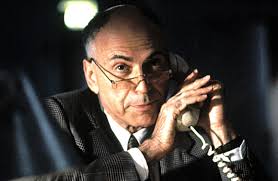
Series Review: Idris Elba wants to talk his way out of a “Hijack”

The creators of the series “Hijack” set two priorities for themselves in their “real time” seven part “seven hour flight” thriller.

Priority one, Get Idris Elba. Priority two, try to squeeze a Big Surprise or two in most every episode.

And although the plot’s a bit of a reach, although we’re treated to several of the quietest air traffic control centers ever depicted on film, although the middle acts drag and although there are a number far fetched moments with an eye-rolling logic all their own, Idris and this story give you enough to justify sticking with it.

I watched it all the way through, and — here’s ANOTHER proviso — “although” I wasn’t blown away, it makes for an intiguing and sometimes tense 5-6 hours of television, even if it does feel like a 100 minute movie padded in the modern streaming style.

You know the drill — tense bits, filler, extraneous characters, zinger, more filler, a blast of suspense aaaaannnnnnd…cliffhanger.

Elba’s a guy who boards Kingdom Air flight 29 from Dubai to London with no luggage, just a jewel box in his pocket. But Sam Nelson isn’t the most suspicious guy in the lot.

He’s the sort who notices things, which we notice with him — the pastor passenger who tries to bribe his way to getting his elderly wife into business class, the irritaable woman wrangling two kids along with their father, snapping at other passengers who give her the look or dare to say something, the sickly elderly Arab man who with nephews, the three girls from some athletic team, etc.

And once the plane is airborne, while Sam may not be privy to all that’s being said, somebody finds something, other folks get involved and the next thing we know, five pistol-packing hijackers have taken over the plane.

Their leader (Neil Maskell) is determined to breach the cockpit, and they’ve done the homework necessary to blackmail the pilot (Ben Miles). But they’re in no hurry at all to let the world know that they have the plane. They aren’t making demands. And the passengers have no clue why this is happening or how they should react.

After 9/11, some assume the worst and manfully plot simple, violent resistance. Others cower.

Sam? He’s got “special skills.” His magic power is negotiating, getting clients, buyers/sellers to “yes.”

Next thing the passengers know, he’s cozying up to “the guy in charge,” offering his services, identifying “issues” that may serve their purpose or more likely his.

“I just want to get home” he says in more than one installment. But that fellow behind the wheel?

“The pilot is a problem.”

The series gives us four distinct points of view, with sidebars built around name supporting players (Ruth Sheen and Simon McBurney) in the later acts.

We’re in the plane with Sam, the hijackers and the 210 other passengers and crew. And we’re in air traffic control, first in Dubai, where Abdullah (Mohamed Faisal Mostafa) gets curious about what’s going on with this Airbus. They’ve got “a situation” or “incident” in progress. Then they don’t.

The pilot “sounded calm.” “They ALL do.” “Pilots?” “No, British people!”

“The plane who cried ‘wolf?'”

An always-late single-mum air controller in London (Eve Myles) is also wondering what’s up with this plane long before it approaches Jolly Olde airspace.

A third point of view concerns Sam’s teen son, his moved-on ex-wife (Christine Adams) — the one who insisted, by text, that he not “get on that plane.” She’s taken up with a new bloke. Daniel (Max Beesley) is a cop. A curious and cryptic text to Marsha from Sam gets Daniel involved, calling in cop favors.

Former partner — in more ways than one — Deevia (Zora Bishop) makes an inquiry and shrugs it off, until Alice the air traffic controller rings up her Counter Terrorism department with a few clues about the “message” the plane’s movement is sending to them.

The government response — mostly British, but including air traffic control and scrambled fighter jets in other countries — is the fourth point of view the series tracks.

Through it all, through the ever more complex “motive,” the shifting dynamics of the criminal gang, the whispering, scheming passengers and crew, Sam works the angles, ingratiates himself here and there to the point where the passngers think he’s “a traitor,” and tries to get one or two chess moves ahead of this seemingly well-oiled criminal machine that’s taken them over with purposes unknown.

There are too many characters to do justice to, creating consistency problems even with Elba’s hero, whose “negotiating” seems so weak a hook to hang his “special skills” on that even the filmmakers abandon it for long stretches.

Get attached to this character or that one, and they are abruptly killed. The first actual violence is all the more shocking because it isn’t perpetrated by the hijackers.

I’m on a fence as to whether Apple TV+ has served up something people will be on tenterhooks for each week, waiting for the next installment. Elba’s good, but the plot hits a few walls and the endless sideshows suck away at the series’ foreward motion and narrative drive.

“Hijack,” like all streaming series, has “dawdling” and beating-round-the-bush built in.

If you’re into Idris playing a character who’s a talker not a fighter, he doesn’t disappoint. The series? It leaves us short of our destination.

Rating: TV-MA, violence

Cast: Idris Elba, Neil Maskell, Zora Bishop, Eve Myles, Max Beesley, Ben Miles, Kate Phillips, Christine Adams, Kaisa Hammarlund, Mohamed Faisal Mostafa, Ruth Sheen and Simon McBurney

Credits. Created by George Kay and Tim Field Smith. An Apple TV+ release.

Running time: Seven episodes @44-50 min. each

Posted in Reviews, previews, profiles and movie news | Comments Off on Series Review: Idris Elba wants to talk his way out of a “Hijack”

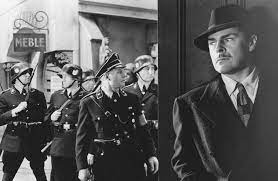
Classic Film Review: Fritz Lang and “Bert” Brecht’s “Hangman Also Die!” Bad history, good 1943 WWII noir

There is a superbly-detailed, thrillingly-pitched and well-acted film account of the 1942 Czech assassination of “Reichsprotektor” Reinhard Heidrich, the murderous Nazi nicknamed “The Hangman” during his military rule of occupied Czechoslovakia during World War II. It’s titled “Anthropoid,” and it stars Cillian Murphy (the upcoming “Oppenheimer”) and came out a few years back.

Exiles Fritz Lang, the celebrated playwright Bertolt Brecht and composer Hanns Eisler turned the story of the Nazi hunt for the assassin into a film noir, “Hangmen Also Die!” that came out less than a year after the actual events depicted, in the middle of World War II. The director and the screenwriters got almost everything historic wrong in this 1943 thriller.

But the filmmaker who gave us the prototype for the “hunted man” thriller with “M” still gets a stylish, tense and crackling picture out of events no one outside of Nazi Germany, Czechoslovakia, the Czech government in exile or the London planners and trainers of the assassins had any details about at the time. Two trained Czech soldiers were airdropped into the country to kill Heydrich and “prove” Czechoslovakia’s resistance to German domination.

Lang (“Fury,” “The Ministry of Fear”) and Brecht (“The Threepenny Opera”) don’t show us the killing, just the hunt for the man (Brian Donley) who carried it out, an underground made up mostly of communist resisters and a country that does its damnedest to ensure the killer is never caught, even at the cost of the lives of hundreds of their countrymen.

As Nazis chase off the getaway-cab driver (Lionel Stander), a bystander, Mascha (Anna Lee of “How Green Was My Valley,” “Fort Apache” and “The Ghost and Mrs. Muir”) sees the culprit, and misdirects the Nazis in their hot pursuit.

When our assailant can find no safe house in Prague to hide in, he tracks his benefactor down and lays low in the apartment she shares with her family, including her history professor/father (Walter Brennan) who figures out who this stranger his engaged-daughter lets in must be.

“Dont let yourselves be snowed under at Valley Forge,” he advises his family.

A dozen famous character actor faces adorn the cast of Czech patriots (Byron Foulger) or traitors (Gene Lockhart), with Lang showing a real flair for casting mostly expats to play the assorted heinous Nazis, including Tonio Stewart and “The Cabinet of Dr. Caligari” veteran Hans Heinrich von Twardowski as a vulpine and venomous Heidrich.

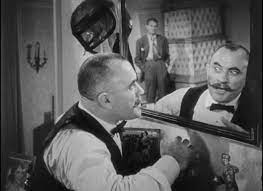
But the player who stands out here is the Austrian ex-pat Alexander Granach, deftly getting across cunning, efficiency and a comically-Bavarian addiction to beer as the Gestapo Inspector Gruber, who runs informants, reads clues and grills suspects in his pursuit of the man the locals label a heroic “executioner” but whom the German occupiers tar as an “assassin,” with a “blood debt” to be paid by hundreds of Czechs rounded up as hostages for execution if the people don’t turn in the real killer.

Over the course of the narrative, the assassin, Dr. Sovboda (Donlevy, best-known for playing heavies) feels the guilt of a man whose act will cause the deaths of many innocents and Mascha will journey from a woman frantic to save her hostage father to someone who is peer-pressured into understanding that this is bigger than her or her father or any Nazi reprisals

The screenplay, which has come to be thought as more and more the work of Brecht by Brecht scholars and less attributable to his collaborators, has tiny hints and writ-large examples of his communist politics, something that got past studio editing and censorship during World War II, when the Soviet Russians were the West’s allies in the fight to crush fascism.

Group scenes of “the resistence” and street scenes of The People badgering and threatening Mascha as they would anybody who wants to go to “Gestapo Headquarters” of her own free will have a proleterian agitprop feel. And the mobs’ way of flinging the “V-for-victory” salute is a lot more chilling now that we’re far enough removed from that era to see this as Brecht and Lang’s equating one “mob” with another.

Brecht, credited co-writer John Wexley and actor Stander were among those later blacklisted for having communist sympathies during the Hollywood “witch hunt,” and witchhunter Sen. Joseph McCarthy labeled this film subversive in the 1950s, which caused it to disappear from public showings until the mid-70s.

But at the time of release, the film was premiered in mid-America to some fanfare and nominated for a couple of Academy Awards. Composer Hanns Eisler, an expat who often scored Brecht’s plays in Europe, grabbed one of those nominations for his score, which folds Czech composer Bedřich Smetana’s  patriotic tone poem “The Mouldau” into a few scenes.

The best reason for a film buff to dive into “Hangmen Also Die!” is that it’s quintessentially Fritz Lang, first shadow to its “NOT” “The End” finale.

Shadows and silhouttes abound, with a production design that almost seamlessly incorporates stock footage of Prague’s skyline, churches and clock towers into the gloomy, oppressed streets created on studio backlots.

The Austrian Lang wasn’t shy about leaning hard into war-era stereotypes of Germans, the sadistic officer classes empowered by the Swastika to be the beasts the world had come to believe they were in 1914-1918.

But the “heroes” here and the rather lax way the film treats the manhunt in the early acts don’t fall into the normal parameters of film noir, and truthfully, despite jumping right into the immediate aftermath of an assassination, “Hangmen Also Die!” takes a while to get going.

Only Granach’s scenes where he closes the net on the doctor, Mascha and their enablers have much in the way of suspense in them.

“Sorry sir. Once you work for the Gestapo you work for the Gestapo!”

But when the third act kicks in as one trap closes and then opens and another is sprung, Lang’s craft and skill transcend the “look” of a Fritz Lang film and pull us into the the nervous energy of a showdown, a double-cross and “a big frame-up.”

It might not be one of Lang’s very best, but the only script Brecht ever got filmed in Hollywood and the usual Lang flourishes make “Hangman” — which was almost titled “No Surrender,” a running theme of the film and an exclamation point in its finale — a must-see movie for any true cinephile.

Rating: “approved,” violent and “racy.”

Cast: Brian Donlevy, Anna Lee, Walter Brennan, Gene Lockhart, Alexander Granach, Lionel Stander and Hans Heinrich von Twardowski.

Credits: Directed by Fritz Lang, scripted by Bertolt “Bert” Brecht, Fritz Lang and John Wexley. A United Artists release on Tubi, Amazon, Youtube, etc.

Running time: 2:14

Posted in Reviews, previews, profiles and movie news | Comments Off on Classic Film Review: Fritz Lang and “Bert” Brecht’s “Hangman Also Die!” Bad history, good 1943 WWII noir

Netflixable? SerioComic Hijinx among three Mexico City Makeup Artists — “Making it Up?

Well-cast and acted with sympathic warmth and wit, “Making it Up” is an object lesson in the shortcomings of relying on voice-over narration to tell your story on screen.

It’s a dark, maddeningly-manic and almost cute dip into loving someone whose mental illness renders them toxic to be around. And writer-director Guillermo Calderón (“Neurda”) makes the infuriating decision to talk the damned thing to death with that anti-cinematic lazy screenwriter’s crutch, voice-over storytelling.

The story is about a friends/lovers triangle involving Ana (Paulina Gaitán), her childhood pal/recent-ex Alexandra (Ilse Carlos) and the friend Ana falls back on (Regina Blandón) whenever Alex melts down, lashes out, goes off her meds or on a bender.

Rita has a roomie, but takes in Ana when her makeup partner/life partner Alex melts down again. Free spirited, flat-broke Rita narrates our story, mostly a tale of makeup artists in a makeup-obsessed culture — weddings to parties to drag shows — whose customers are many and whose bills are always to be paid “mas tarde.”

Alex and Ana have had their latest split, but as Alex is “green-eyed,” aka “a whitey,” she has access to higher-end clients than the drag queens and other deadbeats Rita does, when she reaches out to Ana again, they’re not in a position to turn her down.

Rita flits around the wedding party, not doing her share of the mass making-up the job calls for, drinking and promising and lying and then declining to pay Ana and Rita their full fee when the job is done.

Alex is toxic, high-maintenance and exhausting. Alex, as we’ve seen in the opening scene, is in the fast lane headed towards a breakdown and a mental hospital.

“Making it Up” discusses — via the constant voice-over narration by Rita — the appeal or lack of appeal in marriage in modern Mexico among modern women, the “covering-up” that goes on in their world and their work and the endless “forgiveness” that goes on when you care about someone who can’t keep themselves from setting fire to this or that corner of your life.

Friends are betrayed, men are grasped at, used and abandoned. And Alexandra’s so casual about it all she can barely remember what this week’s grudge is or who she’s feuding with over it.

The “marriage” thing is introduced time and again in the voice-over, but only enters the narrative in the finale. The toxic relationship unfolds, scene after scene, on the screen. We don’t need that explained to us in voice-over, and despite that, it is.

The script leans on Rita’s myriad observations of the obvious, or inane bits of filling in the blanks.

“The rule is,” she says, in Spanish with English subtitles,” “if you don’t have money, call a friend who works in a club.”

There’s a better movie in this than Calderón’s final cut of “Making It Up” suggests. Cut two-thirds of the narration out and let the characters and the sensitive performances do the heavy lifting they’re so very qualified to do and I dare say we’d see that better movie. We’d certainly hear it.

Rating: TV-MA, sexual situations, profanity

Cast: Paulina Gaitán, Regina Blandón, Ilse Carlos, Tamara Vallarta, Fabrizio Santini and Emmanuel Varela.

Credits: Scripted and directed by Guillermo Calderón. A Netflix release.

Running time: 1:21

Posted in Reviews, previews, profiles and movie news | Comments Off on Netflixable? SerioComic Hijinx among three Mexico City Makeup Artists — “Making it Up?

Movie Preview: Pete D and Shailene and Ferrara and Seth and Paul Dano get that GameStop “Dumb Money”

You’ve got Seth Rogen and Nick Offerman and I guess Vincent D’Onofrio as hedge fund villains upbended when a youngish investor/online influencer (Paul Dano) convinces Nerdword that these jerks shouldn’t be allowed to destroy the beloved but outmoded video game retailer GameStop.

You remember the story. The movie looks plucky and fun, kind of “Big Short” only with nerds.

“Dumb Money,” directed by the guy who brought us “Lars and the Real Girl” and “I, Tonya” opens Sept 22.

Posted in Reviews, previews, profiles and movie news | Comments Off on Movie Preview: Pete D and Shailene and Ferrara and Seth and Paul Dano get that GameStop “Dumb Money”

Movie Preview: A Very Disturbing Trailer to a Spree Killer Thriller — “The Passenger”

The whole vibe of this Aug 4 MGM+ release is unsettling.

A wimpy kid trapped in the company of a psychopath, slaughtering folks from the life of that kid as a sort of “lesson” to “change” or “save” a “loser?”

Grim but arresting, I have to say.

Posted in Reviews, previews, profiles and movie news | Comments Off on Movie Preview: A Very Disturbing Trailer to a Spree Killer Thriller — “The Passenger”

BOX OFFICE: “Indy” Arrives, “Flash” exits — Harrison Ford’s Curtain Call Cashes in with a $60 million opening weekend, “Ruby Gillman” bombs

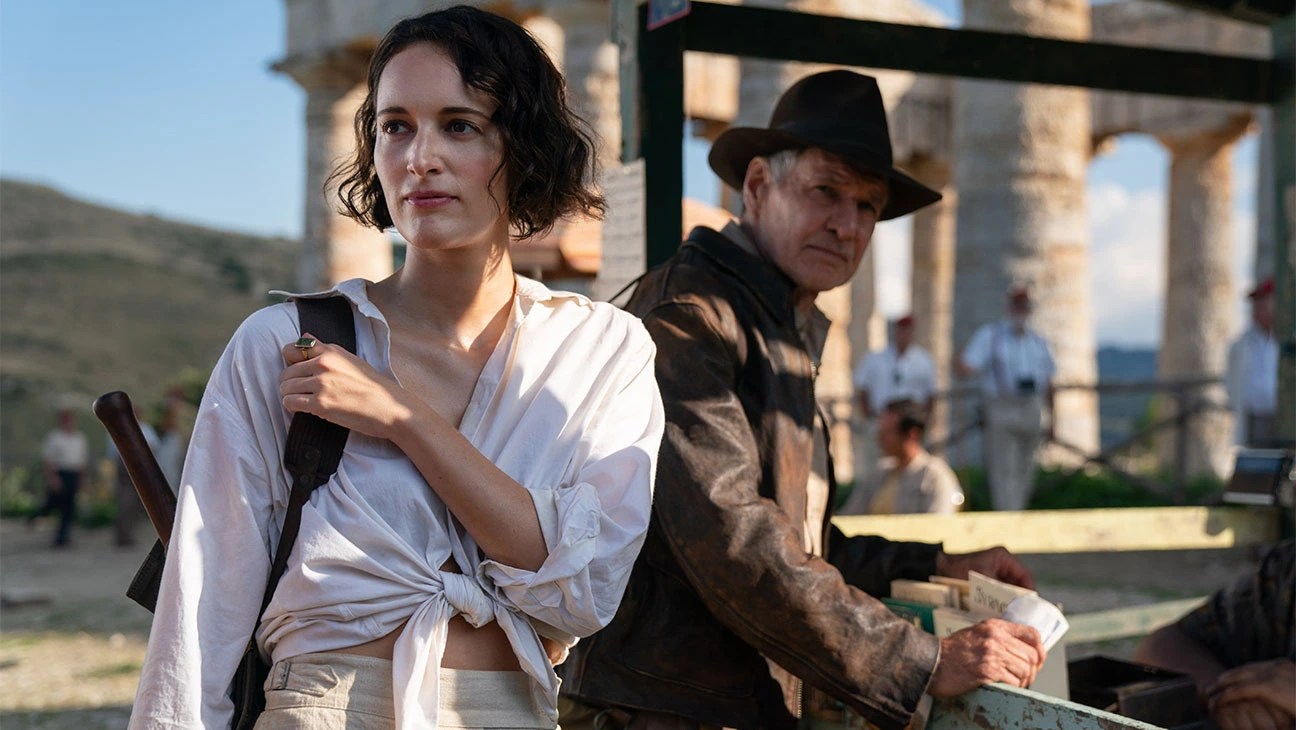
The final “FINAL” installment in the 43 year old Indiana Jones franchise, “Indiana Jones and the Dial of Destiny,” is making an exit worthy of a series that going on three generations have been showing up for.

No, the movie’s not the breathtaking treat that the best of the five films were, but sentimental value counts for something, and our affection for Harrison Ford, John Rhys-Davies and Karen Allen and one last fight against those damned Nazis is worth over $60 million, maybe $60 million in North America this weekend, $80 million or so by the time July the 4th’s last fireworks have fizzled, according to Deadline.com.

No, reviews haven’t been dazzling. It’s a winded franchise with an old — de-aged or not — leading man, VERY old for an action hero. But even the reviewing shrugs and outright pans let a little sentiment poke through. Take the kids and the grandkids and see it, at a drive-in if there’s one near you, if you’re nostalgic.

As it reportedly cost $250 million to make and another $50 to market, it won’t be breaking even in the US unless it holds screens into August.

This extended holiday weekend’s other big wide release, the kids’ cartoon “Ruby Gillman: Teenage Kraken” is so instantly forgettable I had to look up the danged title to see if it was “teen” or “teenage.”

Dreamworks is running on fumes and this “Shrek-ish” Mermaids vs. Kraken comedy, so thin on laughs and so dimly lit in many scenes that it might encourage adults to nap while the kids ponder its mystery, should clear $6million, but not by much, per Deadline.

That is nothing less than disastrous. It’s a rare summer when both Pixar and Dreamworks deliver movies nobody is hyped to see.

“Spider-Man: Across the SpiderVerse” continues to rake in the cash, though, a $12-14 million three day weekend should give it second place at the box office in its fifth week of release.

That bests “Elemental” ($10 million+), and “No Hard Feelings” ($7-8). If your teen son would rather see “Spider-Verse” again than catch Jennifer Lawrence giving her all to get a teenager ready for college, that’s peer pressure. And maybe Sonny needs some different peers. Just saying.

Warners must be in “move on” mode as the latest crapulent “Transformers” dog rounds out the top five, pushing “The Flash” into early box office oblivion just a couple of weeks into its release. It drops to #8. Ouch.

Here’s the updated Sunday PM projection from BoxOfficePro.

Posted in Reviews, previews, profiles and movie news | Comments Off on BOX OFFICE: “Indy” Arrives, “Flash” exits — Harrison Ford’s Curtain Call Cashes in with a $60 million opening weekend, “Ruby Gillman” bombs

Classic Film Review: Norman Lear fires the First Shot in the Culture Wars? “Cold Turkey” (1971)

The golden age of big screen satire began, more or less, with 1964’s “Doctor Strangelove, or How I Learned to Stop Worrying and Love the Bomb,” peaked with “Network” (1976) and wrapped up with “Being There” and “Life of Brian” in 1980.

Movies like “M*A*S*H,” “The Loved One,” “The Hospital”and “Nashville” made their marks in a pre-blockbuster era when studios could operate in the black (barely) with more adult fare and mostly modest budgets.

“Cold Turkey” (1971) was one of the lesser lights of that satiric era. But the film satire came out mere months before its writer, director and producer Norman Lear would unleash “All in the Family” and become perhaps the most important voice in American TV, possibly ever.

Lear’s “culture divide” TV comedies are prefigured in this broad, all-star farce. He started the work of taking on sacred cows — “the Silent Majority,” “salt of the Earth” middle America and its generally contradictory values, hypocritical mores and often deranged politics — in “Cold Turkey.”

He sent up American “get mine” greed, science skepticism, a country that paid lip service to small town America while everyone living in small town America was striving to get out.

Lear’s TV work reveals him as an unabashed champion of urban America, its great cities — flawed though they were and remain.

His hook was a country that learned, conclusively, that smoking causes cancer in 1964, with warnings added to tobacco product packaging 1965, and yet the added step of banning tobacco advertising had to be taken in 1970 because damning evidence or not, we weren’t quitting fast enough.

“Cold Turkey” would be about cynical Big Tobacco’s efforts to gild its “public health/humanitarian” image by encouraging American cities and towns to quit, with a $25 million reward for any town able to do it for 30 days.

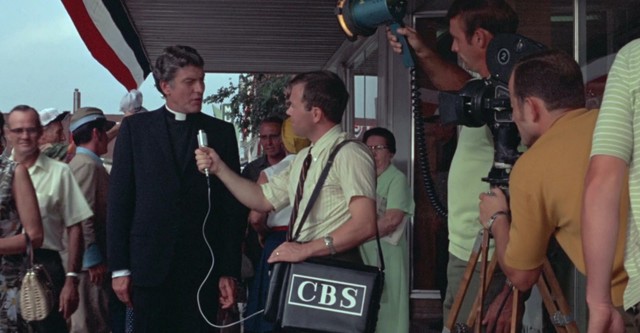
The one place to have a shot does so by having a local preacher package the message in the form of a dying town’s spiritual and economic revival. Eagle Rock, Iowa desperately needs the money. It’s emptying out, dying.

But the smokers are too addicted and too self-centered to pitch in willingly. Ultra conservatives see the mass abandonment of tobacco as “Big Government” manipulation run amok, until that is, they get to be the “enforcers” of everyone else’s behavior, conservatism’s wet dream.

As the town’s notoriety grows, our flawed, self-dealing preacher — he longs for a promotion to “Dearborn” — sees the local profiteering, the shortening of tempers and the abandonment of a common civic good and common civility. And then Big Tobacco’s operatives show up to “monitor” and if possible, cheat and tempt the town lose lose the “30 days without smoking,”” “Project Cold Turkey contest.

It stars a Who’s Who of American sitcoms to come in the ’70s, many of them produced and/or created by Norman Lear. There’s Jean Stapleton, about to become America’s ditzy mom in “All in the Family,” Barnard Hughes playing another “Doc,” Bob Newhart and his old pal/co-star Tom Poston, Paul Benedict as a hippy hypnotherapist (“The Jeffersons”), Barbara Cason and Graham Jarvis of “Mary Hartman, Mary Hartman” and Vincent Guardenia (“All in the Family,””Maude”).

The great radio and TV comics Bob Elliott and Ray Goulding (Bob & Ray) send up every “newsman” of the day, posting as Hugh Upson (Hugh Downs), Walter Chronic (Cronkite), David Chetley (Brinkley, and Huntley), occasionally framed in a an angelic light, the way America revered its TV anchors back then,

What sticks in the memory is how the comedy is reliant on some amusingly off-color language, the residue of Robert Altman’s sleeper hit “M*A*S*H” spilling over the rest of cinema, opening the door for “Blazing Saddles” and the like.

A string of laughs come from aged character actress Judith Lowry, playing a member of the far right Christopher Mott Society (the movie’s John Birchers), free at last to refer to this action or that idea as “It’s a bull-sh–!” I wonder if her usage was a mistake they left in the final cut?

Newhart, broadly playing the PR guru who comes up with Valiant Tobacco’s “Nobel Prize,” stands out in memories of the film for this being quite unlike most any character Newhart ever played — venal, eye-bugging, amoral and comically cruel.

Poston and Hughes play two memorable versions of the “weakest” smokers in town — Hughes, a stressed-out doctor who “never operated on anybody without a cigarette,” and Poston as the rich tippler who can’t give up smokes without giving up booze. As he even drinks while he drives, that ain’t happening.

“The booze bone is connected to the smoke bone and the smoke bone is connected to the head bone and that’s the word of the Lord!”

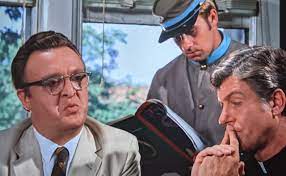
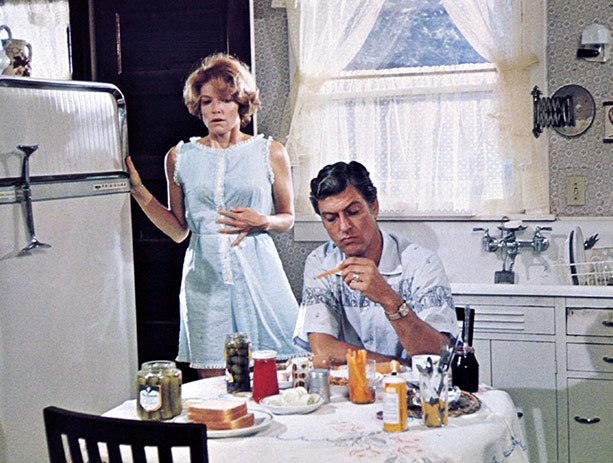
Dick Van Dyke and Pippa Scott play the pastor his his bored, addicted wife who at least finds relief in “the physical act of love” pushed on everyone, including her husband, as a means of coping with withdrawal.

But the culture war politics of the picture didn’t hit me in any previous viewing the way it does now. The film literally opens with a shot of the Confederate flag flying over the mansion of a Southern tobacco baron (Edward Everett Horton, in his final screen appearance).

When Big Tobacco makes a push to “police” and force its products on tiny Eagle Rock, population 4006, who do the send as enforcers? The Sons of the Confederacy, riding in a truck and trailer converted to look like a steam locomotive and rail cars.

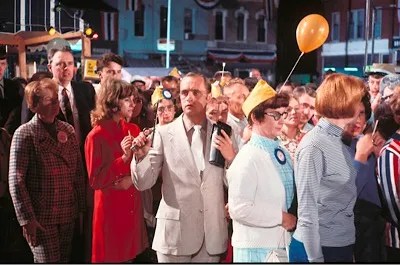
A comically chilling moment — local white Iowa kids, wearing the paper masks being sold to tourists bearing the images of the white town council, chase a lone Black child through the mobbed street scene, littered with casual Confederate Army reenactors.

Here was Lear, over 50 years ago, tying American backwardness and resistance to common sense and social progress to that font of all bad ideas — Confederate historical revanchism and the racism, conservative Protestantism and general bullheaded ignorance that goes hand in butternut glove with it.

The first musical joke in the movie is a banjo picking out the “Magnificent Seven” theme as Newhart’s “Wren” pushes the elderly tobacco patriarchy Horton around his grounds, selling him on his “biggest idea since creation,” an Alfred Nobel-inspired “change the subject from smoking-causes-cancer” contest.

That’s a reminder that this was the first film score by future Oscar-winner Randy Newman, who also sings “He Gives Us All His Love,” the ironic religious theme song to the film.

Nobody in this cast cost a fortune, and shooting it in tiny Greenfield, Iowa wasn’t the most expensive proposition. It wasn’t a complete bomb upon release, although it only made 1/8th what “M*A*S*H” earned — over $11 million — yet 30 times what Mel Brooks’ spoof-not-satire “The Producers” earned a couple of years before when it bombed on initial release.

Some of the laughs are aging better than others, but the reason to watch “Cold Turkey” today might be in recollecting its Culture Wars significance, its post-tipping point in the struggle with Big Tobacco moment in time, and in the array of talent Lear put on the screen at a bargain price.

There is literally no other movie that packaged Newhart and Poston and Van Dyke and Scott (an underrated comedienne, as evidenced here), the legendary character player Horton and the character actor actor legend in the making M. Emmett Walsh in the same movie.

And watching it anew, we don’t get to act surprised at how crackpot our politics have become, because “Cold Turkey” was stripping the “righteous rural” label right off of Middle America and folksy Iowa, way back in 1971.

Rating: PG-13 for smoking content throughout, innuendo and profanity

Cast: Dick Van Dyke, Bob Newhart, Pippa Scott, Tom Poston, Vincent Guardenia, Barnard Hughes, Barbara Cason, Judith Lowry and Edward Everett Horton.

Credits: Scripted and directed by Norman Lear. An MGM/UA release on Youtube, Amazon, Tubi etc.

Running time: 1:39

Posted in Reviews, previews, profiles and movie news | Comments Off on Classic Film Review: Norman Lear fires the First Shot in the Culture Wars? “Cold Turkey” (1971)

Alan Arkin, one of the Great Ones — 1934-2023

Alan Arkin, who passed away today at the grand old age of 89, was one of the great comic actors of his generation and a couple of generations that followed.

He was one of my all-time favorites, and if he wasn’t one of yours, maybe you need to see a few more of his movies.

An Oscar winner for “Little Miss Sunshine,” he shone even more brightly in his debut film, the comedy classic “The Russians are Coming, the Russians are Coming.”

He provided old school Hollywood chutzpah in “Argo,” was the long-suffering shrink John Cusack’s hitman worries to death in “Grosse Point Blank,” held down his half of one of the funniest films of all time, “The In-Laws,” and dignified many a big screen and small screen production — “Escape from Sobibor” comes immediately to mind.

He was as good as funnymen get, and scary enough to make “Wait Until Dark” work. Really, actors don’t come with more in their tool kit than Arkin had.

I was hunting down an interview I did with him 11 years ago when he was slated to come to the Florida Film Festival. He became ill and didn’t make it there to a planned showing of “Russians are Coming,” so I had to eat the interview and not publish it. Dammit. We talked about “Russians” and his family born facility with the language and how that movie put him on the map in the biggest possible way.

He’ll be missed, especially by people who know good screen comedy and the comics who make it.

RIP.

Pluto TV will be running a string of Arkin’s hits today under their Pluto’s Staff Picks” channel — “Russians,” “Glengarry Glen Ross,” “Sunshine Cleaning,” etc.

Posted in Reviews, previews, profiles and movie news | Comments Off on Alan Arkin, one of the Great Ones — 1934-2023

Netflixable? A Gay Parable in action-animated fantasy form — “Nimona”

With its same sex-coupled hero, its shapeshifting “monster” heroine at war with the “small minded,” its score adorned with “The Banana Splits Song,” a street sax player covering “Careless Whisper,” and characters testing a futuristic car sound system with a little “metal” — “Breaking the Law” by Judas Priest, whose lead singer Rob Halford is gay — one could get the idea that the Netflix animated action comedy “Nimona” is kind of Pride Month appropriate.

It’s a fast and sometimes funny fantasy with an anime vibe. Jokes and sight-gags are more important than plot originality or coherence or characters that are little more than caricatures. And it’s a parable, about the “monsters” we’ve always feared, the “unknown” which we fear instinctively and the labeling we seem to need to do by reflex.

Our title character, Nimona, is a smart-mouthed badass, a shapeshifter with a yen for “breaking stuff” and rejecting labels. What…is…she?

“I’m NIMONA!”

“That’s not an answer!” But in the minds of the makers of the movie, it is.

Riz Ahmed voices knight-to-be Ballister, the first commoner ever to be entrusted with protecting this ancient kingdom that has survived, thanks to knights trained by “The Institute,” into the age of hover-cycles and laser-swords.

“Monsters” are what they’re trained to battle, even though nobody goes outside the walls of the city (How do they…eat?) or can remember the last time they saw a monster. The creed handed down to the knights is “never let your guard down.”

Ballister Boldheart will join his partner Ambrosious Goldenloin (subtle as a leather parade) in the knights and take up the sacred duty.

But upon receiving his sword from the queen (Lorraine Toussaint), his sword “goes off” and kills her. He loses his arm in the scuffle to escape. Sir Goldenloin (Eugene Lee Yang) and the doltish “bro” Sir Thoddeus Surebland, aka “Todd” (Beck Bennett of course) are charged with tracking the “Queen Killer” down.

That’s when this brawling, short-haired pixie Nimona (Chloë Grace Moretz) hears about him, decides he needs a “sidekick,” and pitches in with the “breaking stuff” to help get him out of the jam and maybe “find the real killer.”

Mayhem ensues, as Ballister and his replacement mechanical arm are saved time and again by the shake-shifting dynamo who loves the idea of teaming with “the villain” and who growls “METAL” any time some opportunity for a fight comes up, or a fight that’s just finished is worth relishing.

“She” can be “He” if need be, young or old — whale, gorilla, ostrich, rhino or shark, depending on the situation. Just don’t “label” her and for the love of Gloreth — the founding queen of the kingdom — DON’T call her a “monster.”

The animation is in what is starting to look like a Netflix house style, characters with sharp features, angular edged settings, a distinct “Klaus” color palette. The film began life as a Blue Sky production and Annapurna produced it via outsourced animation houses.

The action’s throughline is simple enough, but the jerky, pieced-together feel of the narrative betrays the half-a-dozen writers given a “story” credit here. It’s kind of nonsensical in ways you usually only see in anime.

It’s got a class consciousness that we figure will be the subtext right up to the point when the gay references begin. The messaging and the jokes are prioritized, with the gay musical cues punctuated by Nimona, having taken the form of a whale, crashing through the knights’ locker room and showers.

Cold in here?”

Yeah, that penis shrinkage joke will go over the heads of kids. But animated or not, is this really a children’s film? Pretty much.

But positive “don’t judge” messaging and all, it plays like a project more invested in representation and that gay-tolerant subtext than in its actual text. How many kids will give a hoot that George Michael and Rob Halford’s music is referenced and that Rupaul is in the voice cast?

But Moretz makes the title character a wired verbal dervish, all energy and ideas. She’s helped Ballister outfit his “evil lair.”

“Evil lair..Evil LARRY! That’s a totally metal VILLAIN name. You should totally…”

“NEVER gonna happen.”

The various pink critters her character changes into are cute enough sight gags accompanying her almost non-stop banter.

And if kids lose their fear over the color pink watching this, so much the better.

Those are a saving graces for a well-animated film whose middling story might otherwise render it an animated also ran.

Rating: PG

Cast: The voices of Chloë Grace Moretz, Riz Ahmed, Frances Conroy, Eugene Lee Yang, Rupaul, Beeck Bennett and Lorraine Toussaint.

Credits: Directed by Nick Bruno and Troy Quane, scripted by Robert Baird and Lloyd Taylor, based on the novel by ND Stevenson. A Netflix release.

Running time: 1:42

Posted in Reviews, previews, profiles and movie news | Comments Off on Netflixable? A Gay Parable in action-animated fantasy form — “Nimona”

Movie Review: Cinematic Crap on a Georgia Cracker –“The In-Law Gang!”

One of the gifts or curses of reviewing films for decades is that ability to spot a fiasco in the first few frames.

Some movies start off with promise and lose it. Some stumble but give you the hope that they’ll settle down. But a “fiasco” is a movie that makes one wonder why it was ever made, why those who made ever thought they were capable of faking “competence” in their script, on a set directing a 20-30 day shoot and in the finished product — 97 minutes of screen time.

“The In-Law Gang!” is bad from the get-go, and only gets worse the more “going” it gets through.

A flatly-acted opening scene shows a holiday meal the abruptly ends when the hostess wields the carving knife in a manner that underscores “This is OVER.” No escalation to that moment, no acting signs of heightened emotions and fury. Just a limp direct insult or two and bam, “knives out.”

The credits that follow are the most banal collection of street signs and ariel shots ever to underscore credits. Is Macon, Georgia, the setting? Atlanta?

The Vegas Elvis impersonator wedding chapel scene that marries Cassie (screenwriter and star Jessie Jaylee) and John (Nashawn Kearse) features the impersonator singing “Love Me Tender,” whose copyright usage might have cost more than the movie, and the rustling sounds of fabric against microphone.

That’s great, because much of the movie sounds off-mike. No, most movies don’t merit release with such amateurish blunders in the finished film.

The story is about that marriage, and the war on it waged by the mother of the groom (LaShonda “Lala” Courtney) and her minions.

“Operation: Broken Marriage is in full effect!”

The insults, by one and all, are right to Cassie’s face — at meals, at meetings, around the Christmas tree.

“Let’s hope John is better at picking presents than he is at picking wives!”

Simple as that plot is, the movie wanders all over the place trying to flesh that big fat nothinburger into something that employs a LOT of actors.

Characters wander into the tale without properly identifying themselves or being identified by others.

“Heated” arguments have no heat. Sets look like something whipped up with no time and no money (a restaurant that looks like what it is, a briefly-rented storefront).

And blown lines abound, a common trait shared by many a film meriting the label “fiasco.”

“You act like I was asked to be born…” “Why argue over something of such less importance?”

Does nobody know the mother tongue well enough to know they’ve blown a line and ask for another take? Was it scripted this way?

Is director J. Jesses Smith deaf? Or was this the best take he could get?

The acting’s bad, with only established player Clifton Powell coming off as “belongs on a movie set.”

Our screenwriter/leading lady, her leading man and the hip hop music video director behind the camera would have been better served burning this misfire rather than letting the world know you don’t know what the hell you’re doing.

Rating: unrated, decorated with F-bombs and songs with F-bombs

Cast: Jessie Jaylee, Nashawn Kearse, LaShonda ‘LaLa’ Courtney, Clifton Powell

Credits: Directed by J. Jesses Smith, scripted by Jessie Jaylee. An Entertainment Squad release.

Running time: 1:37

Posted in Reviews, previews, profiles and movie news | Comments Off on Movie Review: Cinematic Crap on a Georgia Cracker –“The In-Law Gang!”