Movie Preview: Love and Betrayal in the Indonesian Civil War — “Before, Now & Then”

This Silver Bear winner from the Berlin Film Fest takes us back to 1960s Indonesia for a sultry tale of infidelity and the secrets women keep from each other and their men.

A lot more Indonesian cinema is making its way abroad thanks to Netflix. But the good stuff goes to Film Movement, with “Before, Now & Then” slated for Aug. 25 release.

Posted in Reviews, previews, profiles and movie news | Comments Off on Movie Preview: Love and Betrayal in the Indonesian Civil War — “Before, Now & Then”

Classic Film Review: Laughton is Maigret, in pursuit of “The Man on the Eiffel Tower”(1949)

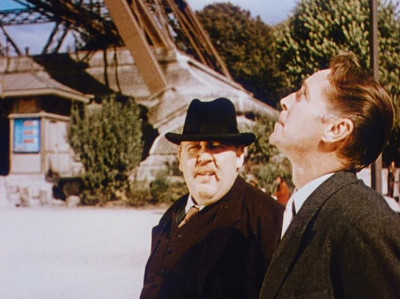
For a “lost” film and legendary “problem” production, “The Man on the Eiffel Tower” (1949) certainly offers up a lot of delights for a cinephile.

If you’re looking for the film that convinced the great Charles Laughton that he should try his hand at directing, the one that pointed him towards “The Night of the Hunter,” this was it. Burgess Meredith is the credited director. The notoriously imperious Laughton, who drove no less than Alfred Hitchcock to distraction, had insisted his co-star take over just a couple of days into production, as original director Irving Allen was experienced but something of a hack.

Laughton, according to lore, directed the scenes that Meredith acted in. He got a taste, an idea actors and crew would listen to him without being just a star who threw his weight around, and “Hunter” became possible.

Meredith, eight years younger than Laughton, only claimed four directing credits in a screen career that covered 60 years. But like Laughton, he’d been around the theater and cinema for decades and knew his way around a script, a cast and a set. He shot this in (Ansco) color on location in Paris in post-war 1948, the first Hollywood film to be shot in color in the City of Light.

It’s fun, surprisingly polished, a near “noir” in color at times, with sharp performances and sequences that delight and dazzle over 75 years later.

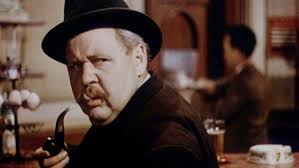
And Laughton’s version of the plump, pipe-puffing police Commissaire Maigret of mystery novelist Georges Simenon, is a wry, deliciously detailed turn and a rarity in the Laughton canon. For once on screen, the great man was almost adorable.

An impoverished knife sharpener (Meredith) responds to money pressure from his beautiful, hotheaded lady love (Belita) by attempting a burglary of a rich American woman. He breaks in, only to find her dead, stumbles and drops his glasses. The killer is still there, steps on the glasses and gets him out.

Stumbling Heurtin could not have known that the victim was the main hope of her ne’er do well ex-pat nephew Bill Kirby (Robert Hutton), a man who avoids work even as his wife (Jean Wallace) meets his mistress (Patricia Roc) and ponder his poverty.

A stranger sends Kirby a note, a “million francs” offer of a murder for hire. That same stranger is the fellow who led near-sighted Heurtin home, promising to get him out of jail if he takes the rap.

Maigret visits the crime scene, notes “the work of a burglar who took nothing,” and suspects the man whose left-behind glasses mean “he practically signed his name” to the crime of being a patsy. He sets a trap to see who might be the real killer, allowing Heurtin to escape.

That’s what turns up the blustery, dashing pauper Johann Radek, played with a malevolent glee by Franchot Tone. He is cunning, as the first time we see him all we see are the shoes he chose to cover in burlap bags for the crime. We also notice the rope he uses for a belt. He’s broke.

Radek wears his overcoat like a cape and his intelligence like a great point of pride. He will match wits with “the over-stuffed bloodhound” Maigret, who seems baffled by the “animal” he’s caught’s tendency to prattle on, to self-identify as a suspect and boast of each and every alibi that the police seem to provide.

The man is under suspicion and perpetually under foot.

“By the way, there’s one thing I’d like to know. Am I following you, or are you following me?”

Laughton’s Maigret lets the antic Radek throw around cash, throw theories into the wind and generally hold forth as Maigret suffers his presence, empties his pipe by rapping it on a handy stone wall, and warily sizes this murderous Czech “genius” up.

Laughton’s beer-swilling performance is playful, a prototype for the way Peter Falk played “Columbo.” Maigret consults a handwriting expert about an incriminating letter sent to a local paper. After hearing the man leap to many a conclusion, he wonders, “Tell me, what do you do when a girl writes you a love letter?”

Our handwriting expert offers that he avoids such letters. Or will, if he ever gets one.

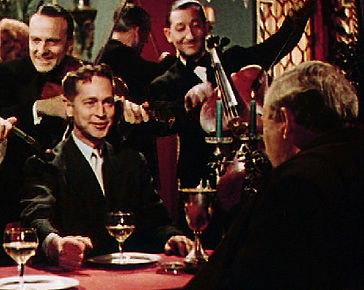
My favorite scene is a brilliant bit of Radek holding forth at a cafe as the frenetic old school Viennese style house string orchestra almost drowns the blowhard out. Tone, who plays this guy with the most wicked gleam, seems downright tickled at this bit of business Meredith cooked up.

“Man on the Eifel Tower” is also a grand color postcard of post-war Paris, with tanks still standing as monuments to the occupation and foreigners flocking to the capital, leaving the dark alleys to the sinister.

RKO was cheeky enough to credit “The City of Paris” as fifth-billed supporting player in the film, as Meredith & Co. use not just the Tower, but many famous attractions as backgrounds for an outdoor cafe scene or a chase across the Seine and across the city.

“Man on the Eifel Tower” has a bum reputation that seems more inspired by its troubled history and generic and sometimes perfunctory plot than its execution.

Laughton makes a grand Maigret. Tone dazzles, and the titular Tower and the city that surrounds it play their parts with style, panache and just a hint of grit. And all of it is captured on not-quite-as-vivid Ansco color in a “lost” film that is well worth tracking down on your favorite streamer.

Rating: approved

Cast: Charles Laughton, Franchot Tone, Jean Wallace, Patricia Roc, Robert Hutton, Belita, Wiflrid Hyde-White and Burgess Meredith

Credits: Directed by Burgess Meredith (with Irving Allen and Charles Laughton), scripted by Harry Brown, based on a story by Georges Simenon. An RKO release on Tubi, Amazon, Youtube, etc.

Running time: 1:36

Posted in Reviews, previews, profiles and movie news | Comments Off on Classic Film Review: Laughton is Maigret, in pursuit of “The Man on the Eiffel Tower”(1949)

Movie Review: Got a “need for speed?” “Gran Turismo”

“Gran Turismo” is a beautiful looking film.

Jacques Jouffret photographed it like the slickest car commercial you’ve ever seen, and Austyn Daines and Colby Parker Jr. edited us right into and inside the race cars and the races recreated here.

It’s plays. It’s also damned entertaining. Don’t anybody tell you otherwise.

The script about plucky “gamer” underdog driving real race cars works, the production throws lots of whiz-bang effects at us — race cars digitally-assembling around our video gamer-turned-driver hero, and Neil Blomkamp — in a return to form — directs the hell out of it.

If you’re not into cars, racing or “the ultimate” race-simulation video game — “Gran Turismo” — if you’ve not opted to catch this is an enhanced-experience cinema (I saw it in a Regal 4DX seat/sound/air/lights/spray house), maybe you won’t be as impressed as I was.

It plays. Hell, I was worried about getting a ticket or burning out a clutch on the way home, for what that’s worth.

“Gran Turismo” is the first “video game movie” to have an actual real-world story to work with, of a “virtual” racing gamer turned into a real world LeMans/Nurburgring sports car Gran Turismo racer.

So the tropes almost write themselves.

Welsh lad Jann Mardengorough (Archie Madekwe) can never convince his retired-footballer dad (Djimon Hounsou) that he’s not “wasting” his life playing PlayStation’s “Gran Turismo.”

You’ve got the Nissan marketing whiz (Orlando Bloom) who figures a competition to put a “Gran Turismo” gaming champ behind the wheel of a competitive race could turn a generation that’s giving up on cars and the “driving” experience on to their sport and their brand.

And there’s David Harbour as the grousing, skeptical one-time-driver now race-car engineer and coach at a driving academy that will choose their Chosen One.

“This is NOT a game,” he barks. “I ‘m going to prove to you that you DON’T have what it takes!”

At a track/school with inspirational quotes from Dale Earnhardt and Colin McRae emblazened on its walls, 19 sedentary gamers from around the world are made to hit the gym and run laps as Harbour’s Jack Salter yells snide insults about their condition, scary descriptions of “g-forces” and “split-second” decisions and “killing yourself” or someone else with a mistake.

There’s something inspiring about the genuine meritocracy depicted here. If an arcade shows you punching out the fastest lap in the UK, US, Spain or wherever, you’re eligible.

The movie also gets a dig in at “press ready” and “marketing friendly” arguments pitched as considerations for who is “selected” to be backed for a season and a chance to get a racing license driving Nissan GTRs.

Nope. That’s not a meritocracy.

The college-age kid who emerges from this weeding-out competition gets his pre-race mellow on with Kenny G and Enya recordings, pines for a girl “back home” and has something to prove to his footballer father and brother, to his arch rival (Josh Stradowski) and the other drivers who dismiss “gamers,” and after his first big wreck, to himself.

Yes, it’s a familiar story arc, and yes there’s a lot of Sony Playstation and Nissan Nismo Racing love (advertising) in all this. But Blomkamp & Co. juice and goose the track scenes with a blur of tricks the “Fast & Furious” geezers will be copying, mark my words.

The film’s 2:15 pass by a lot faster than that.

Any movie that gives Hounsou a couple of great moments, pairs him up with ex-Spice Girl Geri Halliwell (as his wife, Jann’s Mum), gives Harbour’s big-screen career a reset and brings Orlando Bloom back from the dead can’t be bad.

Any picture that makes “Orinoco Flow” and smooth jazz a running gag, and the drink of kings a running incentive — “Champagne is for the PODIUM!” — is OK in my book.

My advice? See this in an enhanced, seat-shifting-and-shaking cinema, hold on to your beer (“Champagn is for the PODIUM!”) and give yourself over to “Gran Turismo,” a celebration of a game for the ages, a great “true” (ish) underdog story and a surprisingly fun popcorn picture at the end of a summer for the record books.

Rating: PG-13, racing violence, profanity

Cast: Archie Madekwe, David Harbour Orlando Bloom, Gerry Halliwell, Josh Stradowski, Takehiro Hira Thomas Kretschmann and Djimon Hounsou.

Credits: Directed by Neil Blomkamp, scripted by Jason Hall and Zach Baylin, based on the simulator/video game. A Sony release.

Running time: 2:15

Posted in Reviews, previews, profiles and movie news | Comments Off on Movie Review: Got a “need for speed?” “Gran Turismo”

“Gran Turismo” in Regal 4DX time!

Got my notebook, two pens — real movie critics take notes and an Eagle Scout is always”prepared” — and my seat set to rumble and shake at my favorite local Regal Cinema, aka “the office.”

This could be fun, and in any event, this is the way this bad boy was meant to be experienced.

“Gran Turismo” opens later this month. The 25th?

Posted in Reviews, previews, profiles and movie news | Comments Off on “Gran Turismo” in Regal 4DX time!

Movie Review: A Pregnant Couple Copes with the “Last” Russian assault on Ukraine — “Klondike”

“Klondike” is a stark, immersive drama about being trapped on the front lines of a new war when all hell breaks loose.

The “new war” was the last Russian-backed assault on Ukraine, the so-called “separatists” uprising in Donetsk Oblast, Russian-instigated and Russian-backed. That was in 2014. Writer-director Maryna Er Gorbach builds her “true events” parable around a singular tragedy of that war, the Russian missile that brought down a Malaysian passenger jet over the village of Hrabove.

But that’s just one tragedy facing a very-pregnant Irka (Oksana Cherkashyna) and her ethnic Russian husband Tolik (Sergey Shadrin), who live outside of Hrabove.

He’s frantic to get her out. She’s Ukranian, and almost in denial about what happens all around them as she deflects and changes the subject whenever Tolik tries to hustle her out the door.

Even a “mistake” artillery round that takes out the wall to their living room doesn’t shake her. She goes through the motions of tidying up, weeping with fury.

And it’s not like they can go anywhere. Tolik’s AK-47-wielding pal Sanya (Oleg Shevchuk) has requisitioned it, running errands for “the guys.” Sanya is Russian, guilt-ridden and concerned, not enough to give the car back, but enough to give Tolik instructions — “Kill the cow, the boys are starving” and “sell the chickens” before the undisciplined mob the Russians were paying to revolt stole them.

Sanya even passes on the Russian password to his friend.

And then Irka’s brother Taryk (Oleg Shcherbina) returns to the family farm from Kyiv to urge her out, help where he can and rage at the Russian “separatist” sympathizer brother-in-law whose baby she is carrying.

Fires burn in the distance, gunfire echoes their way every to often, “mistakes” are acknowledged.

“I’ll build back your house,” Sanya promises. “When the Russians arrive, we’ll live like nobles!”

And then the biggest mistake of all happens, a colossal blunder and international incident that reminded the world of Russia’s inability to shed its “villains of history” mantle.

Writer-director Gorbach (“Omar and Us,” “Love Me”) tells this tale out of order, wrong-footing the viewer and forcing us to come to the movie rather than the other way around.

We see the results of the artillery round, the efforts of Taryk to make his sister take cover. What she’s holed-up for only becomes clear when Tolik fixes their TV dish long enough to see what crashed in their village, the bodies scattered far and wide from Flight 17.

There’s ghoulish cell phone video footage of the “separatists” going through the wreckage (Sanya included), desperate to find the black box and cover up their crime.

“Amateurs,” a plainclothes Russian pulling the strings mutters about these camo-clad clowns, at one point.

“I think they should think less and think which side to shoot” Irka fumes at her oft-drunken husband as she goes through the motions of “cleaning my house.”

Taryk is depicted as a hotheaded patriot. But the most interesting character, and most put-upon, is Tolik. Shadrin makes this fellow shellshocked with impotent rage at his ever-lying “idiot” (In Russian and Ukranaian with English subtitles) “friend” Sanya, begging his turning-away-from-him wife and bickering with his shorter, younger brother-in-law.

The confusion that the picture engenders cleverly mimics “the fog of war.” The inhumanity of such blood-feud conflicts depicted here prefigures the fresh Russian atrocities of their latest invasion.

And the shocked inability to focus on what one must do despite the pull of pretending, saying and repeating “it’ll all be over soon” is vividly recreated in this small-scale version of a larger scale tragedy to come.

Rating: unrated, violence

Cast: Oksana Cherkashyna, Sergey Shadrin, Oleg Shcherbina and Oleg Shevchuk.

Credits: Scripted and directed by Maryna Er Gorbach. A Samuel Goldwyn release.

Running time: 1:40

Posted in Reviews, previews, profiles and movie news | Comments Off on Movie Review: A Pregnant Couple Copes with the “Last” Russian assault on Ukraine — “Klondike”

Netflixable? Gay Ghost helps find his killer, “Marry My Dead Body,” Taiwan’s Oscar Contender

“Marry My Dead Body” is a daft and somewhat slow-footed Taiwanse action comedy about a homophobic cop who learns tolerance by marrying a ghost, who then helps him Crack the Big Case.

It’s a tad obvious, a bit dated, as it’s late to the “lose your homophobia” story trope. But it almost gets by thanks to some laugh-out-loud bits and a sweet streak that runs throughout.

Wu Ming-han (Greg Han Su) is a gruff, macho oaf whom we meet as he’s busting a guy in a gym locker room, going off on “YOU people,” as his manhandles a naked and apparently gay drug suspect.

Ming-han isn’t shy about dropping the f-slur. That does him no good in his precinct, and gets him nowhere with the cute, no-nonsense policewoman (Gingle Wang) he crushes on.

But it’s his clumsiness on the job — a reckless car chase that ends with her getting the bust and him collecting evidence tossed out of the suspect’s vehicle — that really upends his life. He picks up drug packets and “a red envelope.”

I mean, how can you be Chinese and not be wary of the of a ghost marriage proposal? He’s picked up the particulars of a recently-deceased gay man, Mao Mao. And as he does, a flock of old woman pounce on him, all smiles, and tell him what he’s done.

He’s married. To a guy.

“You should be more open minded,” they gush (dubbed, or in Guoyu/Mandarin with English subtitles). There’s no getting out of it, lest you want “a life of misfortune.” Because a rejected ghost marriage “will bite you on the ass.”

He doesn’t believe it until he’s the victim of several accidents, and trouble at work.

That’s when he starts seeing ghosts, one ghost in particular. That would be slightly-flamboyant Mao Mao (Po-Hung Lin). Ming-han must “fulfill (his) dying wish so that (he) can be reincarnated.”

Simple enough. He’s here. He’s chatty. But Mao Mao’s fickle, with a LOT of “dying wishes.”

“Stop global warming” is the first. Awww. Sweet.

Dying wish 2? Adopt, or adopt-out, Mao Mao’s Jack Russell terrier.

Meeting with the dead man’s dad, getting hold of Mao Mao’s phone to remove explicit photos, visiting his lover, it’s a LONG list.

As none of these seem to move the “reincarnation” needle, they and we start to figure out that maybe finding the driver who hit-and-ran-and-killed Mao Mao will give him peace.

A cop, demoted from a team trying to bust a big drug dealer (Chen-Nan Tsai) is now out hunting for clues that other “scumbag cops” Mao Mao’s dad said couldn’t be bothered to track down.

Director and co-writer Wei-Hung Lin’s picture meanders a bit on its way towards a derivative and pre-ordained conclusion and leaves a loose-end or two that nobody gets around to tidying up.

But it’s got all this homophobic-puncturing humor in it, about “bottoms” and the make-over necessary to “pass” in a gay nightclub and “dumb straight guy” references.

The ghost gets all zombie-scary when he demands something, a sort of threat. And of course the ghost can “possess” nearby people, including Ming-han, sent prancing down the street nude, at one moment, just to to make a point.

There are laughs here, and sweet twists in the relationship with the dead man’s intolerant father. The leads pull off the “meet cute” and “quarrel cute” routines with touch and skill.

But the pacing is leaden. There’s a lot of dead screen time between the lone car chase and an action-packed climax. I’d say there’s enough funny and exciting material for an 80-85 minute action comedy with a bit of bounce to it.

“Marry My Dead Body” is yet another promising picture edited to Netflix standards — not for pace, but to pad the time spent watching — quantity over quick quality, every time.

And this is the movie Taiwan submitted as Best International Feature contender at the Oscars?

Rating: TV-MA, violence, nudity, gay slurs and innuendo

Cast: Greg Han Su, Po-Hung Lin, Gingle Wang and Chen-Nan Tsai

Credits: Directed by Wei-Hao Cheng, scripted by Wei-Hao Cheng, Lai Chih-liang and Sharon Wu. A Netflix release.

Running time: 2:07

Posted in Reviews, previews, profiles and movie news | Comments Off on Netflixable? Gay Ghost helps find his killer, “Marry My Dead Body,” Taiwan’s Oscar Contender

Movie Preview: A different spin on the Immigrant Narrative — “Marisol”

A college-bound teen is falsely accused, and her future unravels when it does.

“Marisol” is undocumented.

Sept. 1.

Posted in Reviews, previews, profiles and movie news | Comments Off on Movie Preview: A different spin on the Immigrant Narrative — “Marisol”

BOX OFFICE: “Voyage of the Demeter” sinks, “Barbie” blows past half a $billion, “Oppenheimer” and “TMNT: Mutant Mayhem” abide

Gothic horror period pieces, even violent R-rated ones, prove a hard sell as the low-star-power “The Voyage of the Demeter” didn’t make it to the $1 million mark on in Thursday night previews.

A $750K take points to an opening weekend well under $10 million –$6.5 is where it seems headed as of Sat. AM — barely enough crack the top five.

The reviews didn’t help. Maybe the fact that horror fans uh, know how the “Voyage” that brought Dracula to England turned out was a turn off. I’d argue that we need a “star” who “looks” like a human(ish) Dracula for that to come off.

That means another weekend with your plastic feminist pal’s who fun to be with, “Barbie” talkies over $33, outperforming expectations once again, with the film clearing the $500 million mark (North America) on Friday. The worldwide box office is well-over $1 billion, and still counting.

It is now officially the biggest blockbuster ever directed by a woman, and a much better film than “Wonder Woman,” I must say. The political ramifications of this feminist satire could be chilling. To SOME “Barbie” bashers.

“Oppenheimer” is having an epic summer for a movie that will never win a single weekend at the box office, and a three hour+ film at that, adding in $18.8 million+ as it clears the $250 million mark. A lot of that money is IMAX and 70mm projection cash, an “event” movie that looks like it.

Both of these films have Oscar potential, even though summer blockbusters tend to fade in the memory come awards season.

“Teenage Mutant Ninja Turtles: Mutant Mayhem” might have challenged “Oppenheimer” for that #2 spot, but will clear $15 or so itself this weekend. It will clear the $75 million mark by Monday of next week.

“The Meg 2: The Trench” fell just short of $13 million expected to be added to its bottom line. It’s earned over $40 million.

“Demeter” will nudge “Haunted Mansion” out of the top five with that $6.5, meaning the Disney dud ($5.6) should finish its run in August without clearing the $75 million mark.

Bleecker Street’s “Jules” is older audience counter-programming that is playing in enough theaters to do better than the $834k it earned.

“Demeter” and losing more screens should push “Sound of Freedom,” the sleeper hit of the summer, well into the rear view mirror –$4.8, 8th place, behind “Talk to Me.” It won’t hit $200 million, but $175+ is all found money for Angel Studios, which may have found a business model that works, but they won’t be able to buy 20th Century film at bargain basement prices a second time. Only so many patrons are going to buy extra tickets to push your next movie into the black and make it seem a bigger hit than it was. Yeah, I saw people doing that.

“Elemental,” for those keeping Disney/Pixar score, hung around long enough to clear the $150 million mark this week. That’s what having almost no animated kiddie competition will do for you.

Final estimates via @BoxOfficePro

Posted in Reviews, previews, profiles and movie news | Comments Off on BOX OFFICE: “Voyage of the Demeter” sinks, “Barbie” blows past half a $billion, “Oppenheimer” and “TMNT: Mutant Mayhem” abide

Classic Film Review: McGoohan and Mingus in a Jazz “Othello” — “All Night Long” (1962)

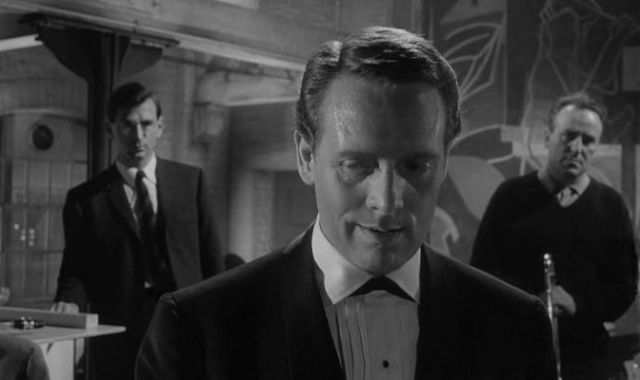
With those darting eyes, sinister glare and a voice that could cut leather, Patrick McGoohan was an actor born to play Iago. But the only time the American-born, British-and-Irish-raised star of “Danger Man” (“Secret Agent Man” in the States), “The Prisoner” and more than his share of films and plays ever got to tackle one of Shakespeare’s great villains was in a movie set in the world of jazz.

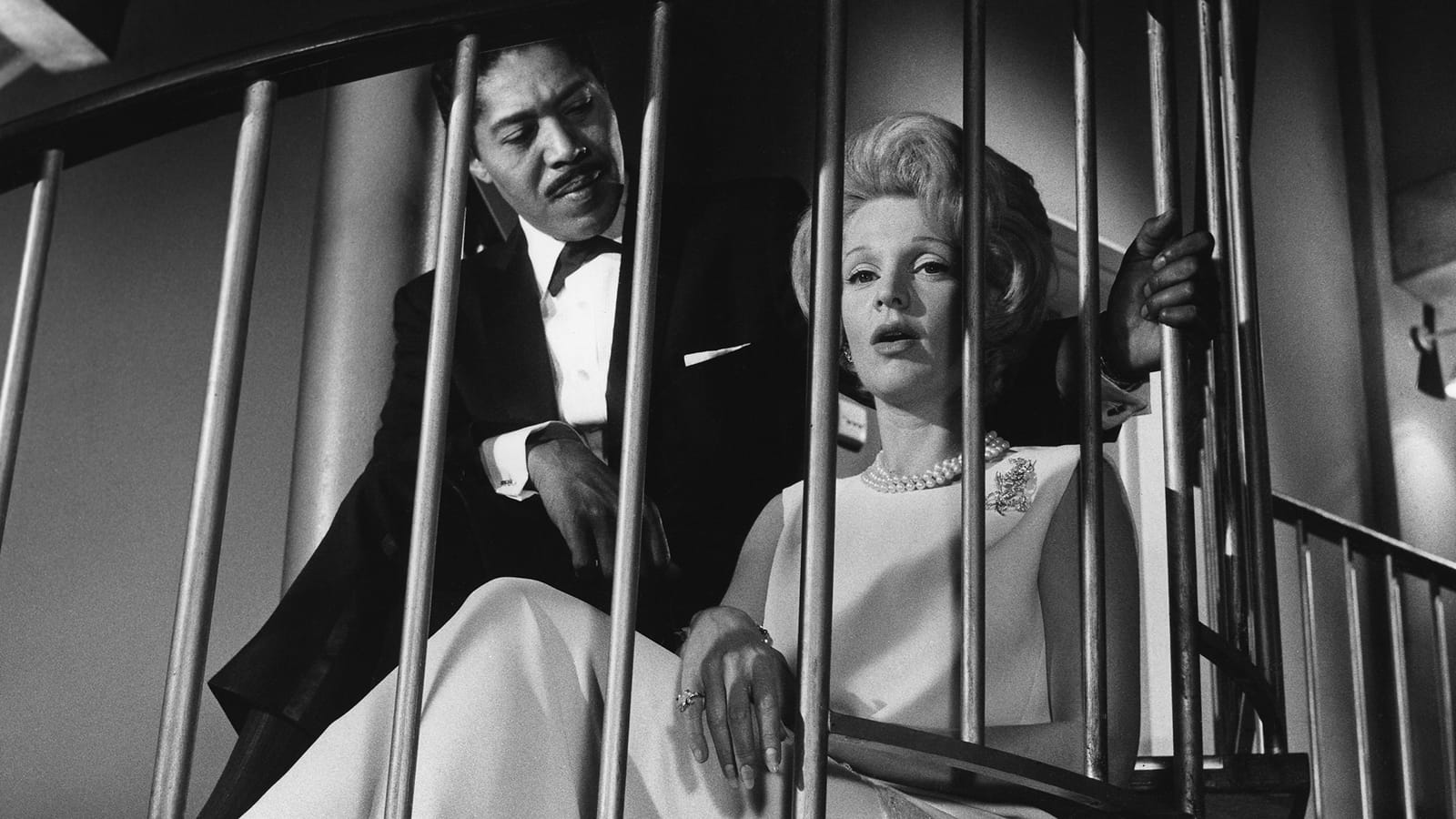
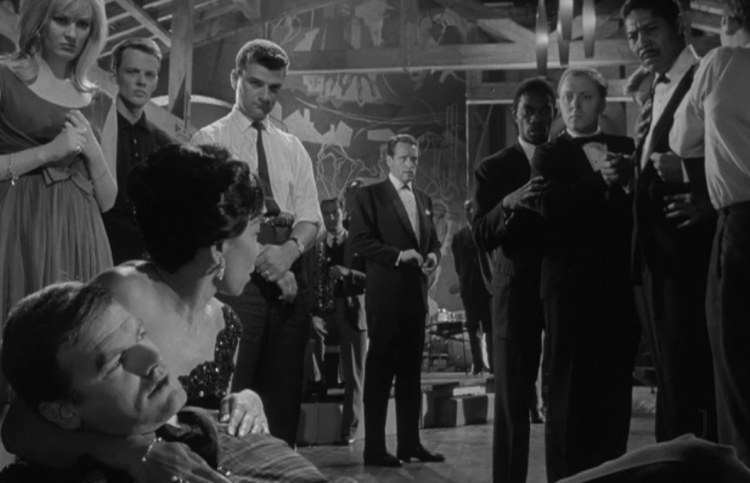
“All Night Long” is a shadowy, inky-black/milky white and oh-so-hip artifact, a film full of jazz and jazz greats and Patrick McGoohan at his most villainous, set in London on the cusp of the “Swinging ’60s. Even if it isn’t the most satisfying and edgy modernization of “Othello,” it’s got the cast and camera work of a classic.

And in McGoohan, it’s got a great Iago, here named Johnny Cousin — “Cousin Johnny” in the jazz world — a drummer with big band dreams and devious means of achieving them.

Nel King and Paul Jarrico — a Blacklisted screenwriter who was “Peter Achilles” in the film’s credits — turned Shakespeare’s story of mistrust and treachery into a single-night-in-the-1960s drama with interracial marriage and pot-smoking jazzmen as titilating subtexts.

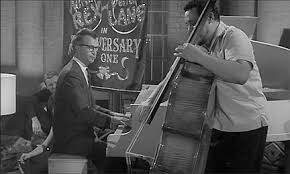
Veteran director Basil Dearden (“Frieda,” “Dead of Night”) and “The Third Man” cameraman Ted Scaife shot “All Night Long” as a late nod to film noir and editor John D. Guthridge helped turn their arresting images into a veritable long-form jazz music video. Real players appeared in supporting roles — Dave Brubeck and Charles Mingus have a duet, and John Dankworth, Tubby Hayes and others pitched in writing tunes and playing in the big ensemble formed and reformed here during this jazz party, playing themselves.

McGoohan? He learned to play the drums and had a drumming coach on set. The sinister scheming part of the role came naturally.

A rich Brit jazz fan (Richard Attenborough) throws a surprise party for a couple of London jazz luminaries, piano-playing bandleader Rex (Paul Harris) and his wife of one year, former jazz singer Delia (Marti Stevens).

Rod Hamilton is such a jazz fan that he turned a warhouse into a multi-level flat with a big open living room built for loud parties and live performances by his many friends in jazz. Mingus is there, practicing his upright bass when Rod gets home.

The surprise party may have a second “surprise,” as Delia’s been rehearsing a number to sing for her husband, despite his wish/command that she retire. The snarkier of the evening’s guests, at drummer Johnny’s prompting, note the “solitary confinement” an accomplished singer agreed to when she married the controlling Rex, who figures he’s “gotten her properly trained,” by now.

Johnny wants to branch out and lead his own band. He wants Delia to sing for it. And he’s not keen on her professional and personal rebuffs, so much so that he sets a plot in motion to wreck the marriage and tie her to horn player Cass (Keith Hamilton), at least in the eyes of Rex.

Johnny also has to stir up problems with Cass and his girl (María Velasco, giving an edge to the film’s second interracial couple), cajole Cass into falling off the wagon, as far as “funny” cigarettes go, and make use of Rod’s in-house tape recording system among his many machinations to break this marriage/band apart and get his own launched.

How far will things go?

Harris gives a performance that takes some of the racial stereotyping out of Shakespeare’s “Moor,” a tad too subdued to suggest a man of mercurial moods and capable of violence.

And the finale “modernizes” the climax to “Othello” in ways that suggest Civil Rights era sensitivities that rob the production of much of the pathos and tragedy of the play.

But there is far too much good going on here to discount this film for those failings. A heated debate about the philosophical nature of music almost turns violent, as quoting someone who claimed that “jazz is appreciated by three groups — Negroes, adolescents (pre Beatles, Motown, etc) and intellectuals” and its implied “Which are you?” was fighting words.

Rex questioning his wife’s joining his “alien world” isn’t referring to jazz. It’s about her marrying a Black man. Johnny’s teasing all that “Rex wouldn’t refuse Delia tonight even if she asked him to move to Johannesburg!”was pretty cutting edge in the UK of ’62.

There’s a lot going on here, even if you’re not a jazz buff. And almost all of it spins around McGoohan, his eyes mostly hooded shadows, his smirk Iago-incarnate. Betsy Blair of “Marty” plays Johnny’s long-suffering wife, and alert viewers will spy an unbilled dancer Geoffrey Holder, as himself, a dancer-guest at the party.

So you’ve got the only actor to turn down playing James Bond twice, and “The Saint” as well, co-starring with a future Bond villain (“Live and Let Die”). Cute.

A recent British Film Institute restoration of “All Night Long” makes the visuals shimmer and the music pulse and pound through a dynamic range uncommon for that era of film. Whatever its shortcomings, the performances archived here — jazzmen and McGoohan — make “All Night Long” a classic you’ll want to remember to catch, even if you think “Lionel Ritchie” every time you hear the title.

Rating: “approved,” violence, drug content

Cast: Patrick McGoohan, Paul Harris, Marti Stevens, Keith Mitchell, María Velasco, Richard Attenborough, Charles Mingus, John Dankworth and Dave Brubeck.

Credits: Directed by Basil Dearden, scripted by Nel King and Paul Jarrico, based on “Othello” by Wm. Shakespeare. A Rank Org. release/BFI restoration on Tubi, Amazon, et al.

Running time: 1:31

Posted in Reviews, previews, profiles and movie news | Comments Off on Classic Film Review: McGoohan and Mingus in a Jazz “Othello” — “All Night Long” (1962)

Netflixable? Gal G. goes Super Secret Agent in “Heart of Stone”

Another month, another bloated but watchable big bang of a Netflix action movie.

Gal Gadot stars in “Heart of Stone,” a sort of “Kingsmen” riff on all-knowing/all-powerful off-the-books secret agents and their secret agency menaced by even more secretive evil agents and their evil agency.

It’s dumb, but watchable. It’s got a crackling car chase, servicable fights and an epic pair of aerial effects scenes that would do James Bond proud.

Dumb how? Inane dialogue that’s meant to be pithy and punchy.

“Three vehicles, lots of guns.

“Yeah, I could tell from all the bullets!”

“Are you trying to KILL us?”

“Pretty much the opposite, actually.”

Gadot is an MI6 operative, a hacker whose job it is to stay “in the van,” gaining access, hacking phones, opening doors and directing the “agents.” But with a notoriously murderous arms dealer about to escape the mountaintop Alpine casino (How very…Bond.), she doesn’t.

Her team (Jamie Dornan, Jing Luis and Paul Ready) may be in the dark, but it turns out “Stone” is a mole, code-named Nine of Hearts. Her “real” control is the mysterious Jack of Hearts (Matthias Schweighöfer) and her real “boss” is Nomad, the King of Hearts (Sophie Okonedo).

The Charter is a multi-national NGO — an agency led by ex-spies of many nations and run on the probabilities, predictions, paths set up and missions hacked and arranged by an all-seeing/all-knowing computer, “the closest mankind has to perfect intelligence.”

It’s called “The Heart.” And it isn’t anywhere anyone can get at it. Or so they think, until others come for it. There’s a newer, younger hacker (Alia Bhatt) toying with her elders.

That on-the-nose title sets up bad puns, which aren’t played for laughs.

“So I should have listened to ‘The Heart.'”

Well, ugh.

But the chases, brawls and Bondian set-pieces keep this blundering-on-past-its-payoff thriller on the move and perfectly watchable, even if we wince every couple of minutes at the outlandish tech, the over-the-top villainy and the “Bugs Bunny Physics” of impossible stunts.

And Gadot and her stunt team make a willowy, reasonably believable runway-ready heroine “super” in all but name.

There’s not much heart (ahem) to any of this, and most of the twists are hackneyed and predictable. But in the world of overlong, under-edited made-for-Netflix action, it’s on a par with the “Extraction(s),” “Hidden Strike,” “Spiderhead” and “Ava” films the streamer trots out, pretty much one per month.

Rating: PG-13, violence and lots of it

Cast: Gal Gadot, Jamie Dornan, Sophie Okonedo, Jing Lusi, Alia Bhatt, Matthias Schweighöfer and Glenn Close.

Credits: Directed by Tom Harper, scripted by Greg Rucka and Allison Schroeder. A Netflix release.

Running time: 2:03

Posted in Reviews, previews, profiles and movie news | Comments Off on Netflixable? Gal G. goes Super Secret Agent in “Heart of Stone”