
Rainn Wilson, Beau Bridges and Kevin Sussman are in the supporting cast of this series adaptation of the feminist novel by Bonnie Garmus.
Looks very good.
October 13, this premieres on Apple TV+.
Rainn Wilson, Beau Bridges and Kevin Sussman are in the supporting cast of this series adaptation of the feminist novel by Bonnie Garmus.
Looks very good.
October 13, this premieres on Apple TV+.
BAFTA winner Monica Dolan stars in this amiable, moving road picture/”artist in the moment of discovery/re-discovery” drama from director Carol Morley of “The Falling.”

You glance at the credits to “Bitter Victory,” a World War II in the Libyan desert thriller starring Richard Burton, Curd Jürgens, Ruth Roman, Nigel Green and Christopher Lee, the only true “war” movie of director and co-writer Nicholas Ray, and you wonder, “Wait, how’d I miss this?”
The answer turns out to be, “Just lucky, I guess.”
Ray owes his screen immortality to “Rebel Without a Cause” (1955) and much of his reputation as an auteur to the films that led up to it — “They Live By Night,” “Johnny Guitar” and “In a Lonely Place.” But everything changed for him after “Rebel,” and he found himself working on a larger canvas, for higher stakes for much of the rest of his career.
The telling title on his post-James Dean resume is the other “war movie” he was on board to direct, the bloated 1960s epic “55 Days in Peking,” which he quit days into production, and finished off with a heart attack a short time afterwards. He handled the epic scale of “King of Kings” as well as could be expected. But “combat” and wasn’t his thing, unless it was limited to a simple gunfight or knife fight.
“Bitter Victory” is a groaning psychological thriller wrapped in a desert commando mission package. It opens with a string of tedious, unhurried, cinematically and militarily slack “assigned a mission” scenes confined to soundtstages meant to pass for Cairo and improves only somewhat when it moves out of doors for its trek through the Libyan Desert.
Ray handles firefights with so little care that they had to be replayed in fast-motion. He fretted not at all at how “tiny smoke bomb” every grenade explosion looked and was so careless with little matters like big explosions used as “a distraction” not distracting the hapless German guards from marching their rounds at their Benghazi headquarters, the object of this commando raid.
But stabbings and summary executions the filmmaker tackled with a bit more relish.
Curd Jürgens is cast against type as British Major Brand, a desk officer assigned a mission to retrieve “documents” from Gen. Erwin Rommel’s HQ. It’s the low ebb of the North African campaign, with the Brits who aren’t retreating on the front lines (too) comfortably cosseted in Cairo.
The reality was a bit more panicked, history told us.
Ray directs us through an enthusiastic training gym where soldiers are going at it with stylized dummies, tackling, stabbing and choking them with gusto.
Major Brand has no combat experience, doesn’t speak Arabic or German and isn’t someone who’s ever commanded men in the field. Not to worry, his second, Captain Leith (Burton) is similarly inexperienced. He’s a pre-war archaeologist who speaks Arabic, a “volunteer,” but also “an…intellectual.” And “Welsh,” the commanding officer (Anthony Bushell) huffs.
That’ll work out, we’re sure.
Why, let’s have Leith meet Brand’s wife (Ruth Roman). Turns out Leith and Jane have history, which enflames Brand a bit.
And thus the real reason Ray took this job comes to light. This will be a to-the-death slap-fight through the desert, with Leith questioning Brand’s bravery aka “manhood” and Brand failing tests of that, but cunningly pondering ways to get rid of Leith.


This French co-production betrays a certain sloppiness, pretty much start to finish. “Bitter Victory” predates the golden age of “military advisors,” and bears little resemblence to the better combat films of the era.
Ray dispensed with sequences like the parachute behind the lines business but never spared a moment of bare-teeth snarling between the subordinate officer (Burton) and his inferior superior.
The supporting cast was pretty unhappy, as casting, according to Christopher Lee (one of the sergeants in the 30 man commando unit), who said the men all drew lots as to who would play what.
Thus variety show ham Harry Landis got a few closeups, acting out a combat mission with his fingers on a table, accompanied by vocal sound effects, and Nigel Green, at his best in “Zulu” a few years later, stands out as the unit sadist. Nobody else got a chance to make his mark.
Burton gets all the good lines — “You have the Christian decency that forbids killing a dying man but ignores the work of a sharpshooter…You’re afraid to go in and kill with your bare hands. That’s what makes a soldier and destroys you as a man…The fine line between war and murder is distance.”
That makes the war of wills that supposedly drives the picture lopsided. Jürgens has a shifty-eyed close-up or two, Burton explodes or suffers mightily and “Bitter Victory” staggers onward ever onward in faint hope of a draw but always destined to fall well short.

Rating: “approved,” violence, innuendo
Cast: Richard Taylor, Curd Jürgens, Ruth Roman, Nigel Green, Christopher Lee, Harry Landis, Anthony Bushell and Raymond Pellegrin.
Credits: Directed by Nicholas Ray, scripted by René Hardy, Gavin Lambert and Nicholas Ray. A Columbia release on Amazon, Tubi, etc.
Running time: 1:41 (1:22 in the first U.S. version)
This Sept. 29 release, about a literal “lady killer,” is from Soi Cheang, and looks like a step up from his many “Monkey King” thrillers.
This Sept. 29 release (streaming on Shudder) is from the screenwriter of “The Tunnel” and could be a subtitled scare, for those who don’t mind reading the reactions in Norwegian.


On the film festival circuit, one sees a lot of indie films that invite us to appreciate them via the literary practice of “biographical criticism.” A festival-goer learns of what the filmmaker’ went through to get their story on screen, often from the filmmakers making appearances to support their movie.
We’re told who the unknown actors starring in it actually are, how little the movie cost, and big lumps of back-story are added to our appreciation of it by all that extra information floating around — festival programs, “director’s notes,” etc.
But a good film has everything you need to know about its story and its characters right there on the screen and in the sountrack. It’s self-contained and self-explanatory.
Director and co-writer Linh Tran’s “Waiting for the Light to Change” collected the big prize at this year’s Slamdance (contra-Sundance) Film Festival. It’s a gentle, moody melodrama that goes beyond being “a film that makes you come to it.”
There is information “out there” about its plot and characters that isn’t necessarily conveyed on the screen. Back story is either half-muttered in a single moment, or omitted and included on the IMDb page description of the film.
Tran was loathe to even have characters even identify each other by name so that we can make those associations and get into the movie quicker. She didn’t take care to get clear audio takes from her actors, who like many confuse mumbling for underplaying, a problem that’s only gotten worse over the years as filmmakers ignore it or forget to focus on it, because they know what their characters are saying. They have a script right in front of them, after all. Viewers don’t.
I watched “Waiting” with headphones, and re-watched passages to make sure of the omissions I was sure were missing in all the half-swallowed dialogue. There are things we know about it (again, IMDb) that aren’t necessarily explained on the screen and the soundtrack.
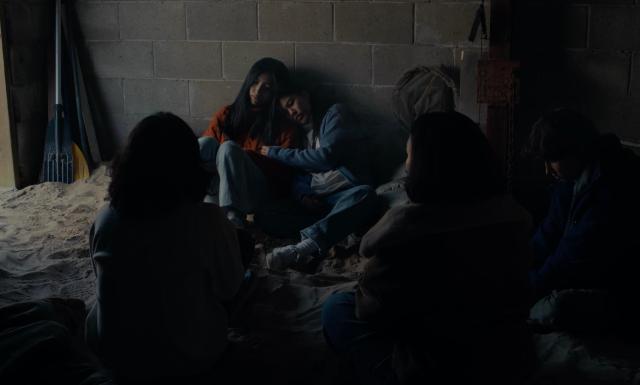
The movie is a wintry story of five people, some of them friends, wrapped up in a low stakes, slow-danced romantic do-si-do while gathered at a house on one of the Great Lakes.
Amy and Kim (Jin Park, Joyce Ha) are friends with mutual relatives, or so we gather from Lin (Qun Chi), who has just come over from China and laments a missing cousin from their ranks.
Jay (Sam Straley) is a just-fired chef who smokes almost constantly, and suggests almost everyone with him in this or that moment enjoy a puff. It’s his grandmother’s lake house, and no he didn’t make the call to ensure the key was there before they arrived.
That sets up a moment for Kim and Amy to bond over having to pee in the backyard, thus demonstrating their intimate connection.
Kim, we eventually gather, is in a relationship with Jay. Amy, we eventually figure out, knew him first.
When Jay’s friend Alex arrives, a shared joint gets Amy’s ardor up. But is Alex is her first choice to share a warm embrace by chilly lakeside?
“Maybe it’s better to long for something that to have it,” Amy opines.
Amy, we also gather, has changed. She never comes out and says “Back when I was fat,” but that’s in the plot description if not the dialogue.
“Do you think if we met now we’d still be friends,” Kim wants to know?
In limited group dynamics like this script, we have character “functions” laid out for us plainly. “Outsider” Lin is a witness with decent command of English and no inhibitions about sharing gossip as to who just kissed whom.
The guys are not-quite-charming lumps, with Jay moping and smoking about his lost job and maybe jealous of Alex, who brought his guitar and thus might be catnip to Amy or Kim.
The performances are mostly understated, with Park having the broadest, most overt character to play. We can wonder why she’s acting as if she’s romantically making up for lost time, or we can read on IMDb that she’s “recently undergone dramatic weight loss” and have that simplistic cause-and-effect added on, ex post facto.
I liked the tone and the limited arcs the characters play out. Up to a point. Scenes are smartly conceived and well-played.
But I don’t care how much or how little the film cost. There isn’t much going on here, and even some of that isn’t explained on the screen between the opening shot and the closing credits, which is where it counts.

Rating: unrated, adult situations, alcohol and pot abuse, profanity
Cast: Jin Park, Joyce Ha, Qun Chi, Sam Straley and Erik Barrientos.
Credits: Directed by Linh Tran, scripted by Jewells Santos, Linh Tran and Delia Van Praag. A Freestyle release.
Running time: 1:29
Awards season awards bait from Netflix? “Nyad,” about the swimmer turned broadcaster turned AARP-aged “one last hurrah” woman who attempted to swim from the U.S. to Cuba, will play in theaters in October before moving to Netflix later in the month.
Foster plays the loving partner and wife who fears she’s going to die in the attempt.
There’s a “Nefarious” vibe to this Sept. 22 release, with a murderous chuch shooter (McCord) telling her interrogator (Cain), with a “Hell is real” and “deal with the Devil” message.
Sept. 22 in theaters, streaming shortly thereafter.



“Friday Night Plan” is a genial but utterly generic “get-to-the-big-party” teen comedy, a slow-footed Indian version of a universal formula that was never limited to just Hollywood, which has taken many a swipe at it over the decades (“Can’t Hardly Wait,””Booksmart,” “House Party”).
“Plan” is set among private school kids in Mumbai, in particular two mismatched siblings, played by Babil Khan (son of famed Indian actor Irfan Khan) and screen newcomer Amrith Jayan.
Sid, short for Sidhartha (Khan) is a studious senior at the International School of Mumbai, fretting over where to go to college, worried about grades and condemned to sit the bench on the school soccer team. He is tentative about life, and timid around classmates, a bit of a wallflower.
Sixteen year-old Adi (Jayan) is his irritating, overreaching little brother, forever “embarassing” Sid, pretty much since birth, a fact we see verified in flashbacks. Adi thinks he’s figured out how to live and thrive in school, by hanging out with Sid, his teammates and the “cool” kids.
Only Sid isn’t “cool.” Until that is, he scores the only goal that beats archrival Global School of Mumbai. A flash of notoriety, amplified by Adi’s hype, and the next thing Sid knows, he’s invited to the weekly “Friday Night Plan,” a cool kids cut-loose party. Adi will tag along, despite Sid’s best efforts. And Adi will nag Sid into asking “the prettiest girl in school” (Medha Rana) to the prom.
It wouldn’t be a teen party movie without single (widowed) mom (Juhi Chawla) being “out of town” on business. She’s told Sid to keep an eye on his brother, and stay away from her Skoda Superb sedan.
Also part of the formula, Adi’s cool super-smart and cute classmate Nitsy (Aadhya Anand) is hot-girl Natasha’s little sister Nitsy. She will be Adi’s conscience, as we know the smarmy kiss-up is about to get himself and Sid into a night of trouble.
The few laughs come from one Goth classmate’s reaction to Sid’s new “stardom” — “You’re metal!” (in Hindi, or dubbed into accented English) and the idea that the junior member of the family has to instruct his older brother in beer pong, or whatever it’s called by the cool kids of Mumbai.
Director and co-writer Vatsal Neelakantan (“Inside Edge”) dawdles through the predictable waypoints of this day-and-a-night-and-morning-after tale of partying, pranking and growing up. He wastes screen time showing us how irritated a local cop is to be caught in the soccer teams’ prank battle, shifting attention away from the kids, who at least get to turn a karaoke moment into a production number.
This genre story, almost always told with a “Ferris Bueller” flush of affluence, has a universality that kids from many cultures can connect with, and a warm familiarity that its many prior incarnations turn into expectations among adults watching it.
It’s a shame that the tale, like its hero, is so tentative, timid and slow in getting us where we know he and the film are taking us.
Rating: TV-14, teen partying, profanity
Cast: Babil Khan, Amrith Jayan, Aadhya Anand, Medha Rana and Juhi Chawla
Credits: Directed by Vatsal Neelakantan, scripted by Vatsal Neelakantan and Sapan Verma. A Netflix release.
Running time: 1:49

 Movie Nation