A little power pop from 1981 is the big musical moment in Kevin Smith’s farewell to the 1994 movie and characters that made him famous.
The song’s messaging fits into the film’s sentimentality. But it’s not exactly hip or cutting edge. Jay would have bitch-slapped Silent Bob for hauling out the boom box for this golden oldie, back in the day.
A real dance challenge for a couple of 50 year olds channeling their trip hop past. But it’s the upbeat highlight of the film, a song Smith might’ve loved as a tween. Maybe he just liked the lyrics as they pertain to the film. Or maybe it’s all he could afford, rights wise.
One sobering piece of knowledge worth considering every time you hear the “official” version of something deadly involving a police officer is the one thing almost every cop is a genuine expert in.
They know just what they can get away with, and how to get away with it.
That truism hangs over “Unidentified,” the first film in a planned “Romanian Trilogy” by “Miracle” (the second film) filmmaker Bogdan George Apetri. Because from the minute we meet detective/inspector Florin Iespas (Brogdan Farcas), he seems off.
Florin is haggard and unshaved, like a young Liam Neeson staggering through a long bout of insomnia. He’s bickering his his chatty boss (Vasile Muraru) about a case he wants to take from another cop. A couple of hotels have burned down. The same guy owned them. Florin in sure he can “close this case in two days.”
The first thing that strikes you about his chief is how much he loves hearing himself talk. He’s got all these jokes he likes to trot out to the never-laughing Florin. The second thing is how unconcerned he is over justice, whether or not someone getting away with murder (two cleaning women died in the hotel fires).
So what if the detective on the case is on vacation? He’s not reassigning it. If it’s “cleared,” or not, so what? Go get some sleep, and put in a good word for my niece who wants to attend your fiance’s music conservatory.
“Unidentified” is a thin mystery barely concealed by a character study of a cop’s obsession. Florin copies the file on the sly and starts sweating the “Gypsy” he’s fingered as a suspect (Dragos Dumitru). Florin trots out his “theory” about what’s happened, makes threats and “sweats” the guy — breaking all sorts of protocols in addition to violating the guy’s civil rights.
When we see Florin visiting the service station where this suspect works, and then staking out the last hotel in the chain that had two other properties catch fire, we start to ask questions. When we see him hit himself in the face with his gun butt, we have our first answer.
Somebody’s in for a railroading. But to what end?
Apetri takes into a corner of never-filmed Romania (Piatra Neamt, his hometown) for a story of a man unraveling right before our eyes. Farcas gives Florin a sort of sedated mania, a tall man capable of things, dodging calls by creditors, ignoring orders and off on a vendetta with his own agenda.
We hear him ask if the lives of those killed were worth nothing, and the emotion feels forced, manipulative. The clever conceit of this character and Farcas’ performance of him is the viewer suspects things even as the grounds for those suspicions comes at us unexplained and piecemeal. Florin seems sketchy from the get-go.
Apetri shows us plenty of actions that aren’t explained, that keep the viewer wondering “What’s this guy’s game?” But we have enough to piece it together, and pretty early on.
As a mystery thriller, “Unidentified” plays a tad draggy and sluggish. Apetri, working in the style of those old “Columbo” TV movies, squeezes a simple, obscure whodunit/who’s doing it with 90 minutes worth of incidents into a slack two hour movie.
We have the clues. We’ve even got a hint of how everything will turn out based on the laissez faire attitudes, prejudices and tribalism of the police we meet.
Apetri still does a good job of not letting the obviousness weigh his story down.
Rating: unrated, violence
Cast: Brogdan Farcas, Dragos Dumitru and Vasile Muraru
Credits: Directed by Bogdan George Apetri, scripted by Bogdan George Apetri and Iulian Postelnicu. A Film Movement release.
The whiff of fall sends a movie critic into reveries of Toronto, where the annual film festival (TIFF) is underway again. It’s a lovely city that hosts a first rate festival. Is the shoe museum still open?
A movie like Mercedes Bryce Morgan’s “Fixation” triggers other memories, of the oddities one finds in that festival’s eclectic-by-design/serious and yet eccentric-by season-of-the-year programming.
Fall is when the weirder works of Canadians Guy Maddin and Atom Egoyan make their appearance, movies previewed pre-fall at TIFF. Many’s the early morning when I gave myself over to the onanistic excesses of whatever Lars von Trier or his ilk was trotting out this year, staring at my watch as I wondered where this was going and how much longer it would go on.
“Fixation” is a psychological thriller and murder mystery by genre. What it turns out to be is a bizarre burlesque of mental illness, memory and psychotherapy.
Hell, it even has Stephen McHattie, who played a self-serious but comically unethical psychotherapist on “Seinfeld,” as a possibly ingenious, probably demented head-shrinker.
Remember the simplistic dream interpretations of Hitchcock’s “Spellbound?” It’s a bit like that, with a touch of “Truman Show” and hints of Von Trier, et al in its elaborate fever-dream cure.
Maddie Hasson of “Malignant” and TV’s “Mr. Mercedes” stars as Dora, a young patient at a peculiarly designed, oddly-staffed mental hospital. She’s there under court order, we gather. She’s under the care of Dr. Clark (McHattie) and his colleague, who likes to go by “Doctor Melanie” (Genesis Rodriguez).
Something about the questions Dr. Melanie asks, the tests Dr. Melanie administers and the peculiar, severe hair and makeup (think Tim Burton’s mates) she exhibits makes one wonder what Dr. Mel is all about.
Something awful happened between Dora and her brother. Just mentioning the name “Griffin” triggers her. We hear he was a taxidermist, and the mind reels at what might have transpired thanks to that detail.
Dora? She seems rational and patient right up to the moment she isn’t. She wants her freedom, can’t figure out how long she’s been there and is starting to have trouble distinguishing her reality from whatever the hell her mind takes her.
But the solution may be simple, Doctor Melanie insists. Just stick to Dr. Clark’s program. “Step One: Submission,” Step Two: Immersion with the Past,” “Step Three: Integration with the Present,” and so on.
“He’s chosen you,” she’s assured. Only she isn’t “assured.” We figure that out when she bites a nurse’s ear off to get out.
Morgan and her co-writers put Dora through a memory play of her life — recreating her past, confronting her present, reckoning with what happened and what she’s accused of.
It’s a vamp of what real therapy looks and feels like.
Hasson plays a reluctant participant in this “play acting” cure, befuddled and outraged, crushed and defiant. She’s an arresting presence, and the sparring scenes with Rodriguez and later McHattie have the feel of something with heft, even if the substance isn’t there to back that up.
With extreme close-ups, creative “stage” lighting that takes us through sets that look like sets (on purpose), Morgan’s made a flashy, technically-interesting but shallow pirouette through paranoia.
It’s got a certain promise to it, with the viewer and Maddie straining to determine which threats are real, which are in her head and which are thrown at her to put them in her head. But once the third act “explaining” begins, we and our heroine realize just how far in advance we saw all this coming even as we sneak another glance at our timepieces, wondering when and if this will ever end.
Rating: unrated, graphic violence, profanity
Cast: Maddie Hasson, Genesis Rodriguez, Atticus Mitchell, Gita Miller and Stephen McHattie
Credits: Directed by Mercedes Bryce Morgan, scripted by William Day, Mercedes Bryce Morgan and Katrina Kudlick. (No Distributor Yet).
“Steal from one,” the old saying goes, “and you’re a plagiarist. Steal from many, you’re a bloody genius.”
Something like that.
Writer-director Steve Stone almost makes a sci-fi fan viewing party game out of the antecedents for his thriller “Deus,” which is about a spacecraft sent to investigate a freshly-arrived “sphere” in orbit around Mars.
There’s a hint of “Contact” and a movie that Carl Sagan must have seen before writing it, “When Worlds Collide,” in its uber-rich oligarch (veteran character actor Phil Davis) who is writing the checks.
The ship’s design mimics “2001” and “2010” and “Alien,” which also provide generous inspirations for portions of the plot. That can be summed up by a line a character says in response to the single word the “sphere” transmits as its identification — “Deus.”
“How do we know it isn’t what it says it is?”
I caught elements of “The Black Hole,” “Event Horizon,” “Dark Star” and a movie that predates even that one, “Satellite in the Sky,” whose penultimate image haunts me, even though I only saw it once on TV as a child.
But after all that borrowing, and after rounding up “Pitch Black” and “Stargate” alumna Claudia Black, “Eastenders” veteran Richard Blackwood, the always-working Scot David O’Hara (“Braveheart” to “Agents of S’H.I.E.L.D”) and Davis (“Vera Drake,” “Nicholas Nickleby,” “Cassandra’s Dream”), Stone fails to get his players to perform the urgency and shock of this “discovering, ” ofand fails to convey any sense of the momentous event he’s showing us.
The oligarch may tell the crew of the good ship “Achilles” — yes, the engine-bearing pod of the structure is called “The Heel” — that they’ve been sent to solve “the greatest mystery ever encountered by the human race.” But damned if any of these astronauts act like it. Just another day, another punch of the timeclock.
Black plays the scientist on board the girder-linked ship, with Blackwood the skipper, and O’Hara, Charlie MacGechan, Crystal Yu and Branko Tomovic as the crew.
They’ve left an Earth in mid-environmental collapse to go check out this thing that’s parked itself in orbit around Mars.
It is what is says it is? And even if it is, should they, as Ulph (O’Hara) suggests, “blow the f—er up?”
The ultimate question in a sci-fi movie, really.
Predictably, somebody on the crew goes all messianic and crazy upon encountering the god sphere. People die. And dead people park themselves in our heroine’s head when she gets nearer my deus to thee.
The generally blase performances are a mild distraction from the parade of tropes — “hibernation” cryo-sleep pods, hexagonal halls and sliding doorways, a lot of darkness and few if any actual places to sit. Not much “strapping in for landing” here. And one crewmember is…a blogger? What, the podcasting fad is over in the near future?
The ideas the film wrestles with are more down to Earth than religious, and interesting enough. And the approach to the plot and the production design kind of hold your interest.
But the cast seems to have bee directed into narcolepsy. There’s nothing here that they’d care to wake up and get us involved with.
Rating: unrated, violence, profanity
Cast: Claudia Black, Richard Blackwood, David O’Hara, Charlie MacGechan, Crystal Yu, Branko Tomovic, Lisa Eichorn and Phil Davis
Credits: Scripted and directed by Steve Stone. A Darkland Distribution release.
Fierce, furious and feminine, “The Woman King” is an action picture that isn’t so much “released” as “unleashed.
It’s a period piece built around history’s real Amazons — the all-female palace guard of the Kingdom of Dahomey. Oscar winner Viola Davis stars in it, heading a cast of equally formidable women who march us through a fictional but historically-sound story of resistance, fighting the good fight and stirring up “good trouble” in an Africa “corrupted” by the racist European slave trade.
Talk about a movie of its moment.
Women headline this. Women produced it, including Davis and her acclaimed-actress friend Maria Bello (who also gets a “story” credit). Gina Prince-Bythewood takes what she learned making “Old Guard” and applies it to a much better script — by Dana Stevens. And women on screen charge through it, battling abusers, enslavers, Africans and Europeans to set things to right in a small kingdom threatened at all sides by larger powers.
As depicted here, the Agojie were the Green Berets of their era — a committed combat elite. They were an African, asexual (apparently) Sacred Band of Thebes, women trained from youth to fight and work as a unit because Dahomey was losing so many of its men to larger kingdoms’ addiction to the slave trade.
Davis plays Nanisca, general of this corps. With her fearsome lieutenants (wonder women Lashana Lynch and Sheila Atim), she is tasked with carrying out the policies of the new king, Ghezo (John Boyega). And what Ghezo wants is to get out from under the domineering thumb of the Oyo Empire.
Dahomey pays the Oyo tribute, and still Oyo goons and their allies raid villages and take captives to sell to the Portuguese. The film opens on Nanisca and her ululating Dahomey Team Six staging a merciless counter-raid to free hostages and butcher the bad guys who stole them.
The film’s story is largely seen through the eyes of a petite teen (South African newcomer Thuso Mbedu) who will not accept her father’s arranged marriage to a much older man who thinks slapping her in front of her dad will seal the match.
Nawi is physically smaller than the rest of her recruiting class. She is mouthy, talking back to the battle-scarred general, who lectures them “We need SMART warriors. The dumb ones die quickly.”
With a little instruction and a lot of training and discipline, maybe she’ll make the cut.
“Always obey Izuke,” a lieutenant (Lynch, of “No Time to Die” and “Captain Marvel) snaps. Nawi pauses, confused. “I am Izuke!”
Oh.
A towering, ruthless new general (Jimmy Odukoya) is their Oyo foe. He leads from horseback, and is most intent on grabbing hostages for the Portuguese (Hero Fiennes Tiffin and Jordan Bolger) who show up at the slave port controlled by the Oyo.
Nanisca must mold her fighting force, shake off off her injuries and advancing years, battle her own trauma, outsmart her foes and out-maneuver the king’s wives and persuade her monarch that maybe Dahomey should opt out of this slave trade economy altogether.
The script has some old fashioned touches. One of the Portuguese (Bolger) is the son of a kidnapped Dahomeyan mother, and could be somebody’s love interest. The “change our economy” to get out of slave trading messaging seems revisionist and “modern.”
Prince-Bythewood and the screenwriter haven’t yet mastered the perfect drop-the-mike moment, giving the ending an anti-climactic touch or two…or three.
But the production design, the training sequences, the visceral, breathless and just-plain-cool combat, the singing, dancing, parading and mourning by an impressive cast drive the picture and pull us along with it.
Davis lets us see a seriously badass broad’s vulnerable side, mastering the fight choreography and reminding us at every moment that she’s one of the best actresses of her generation. She’s the thespian rising tide that lifts every other performance around her.
Lynch, Odukoya, Atim and Mbedu are her stand-out support. And Boyega seems perfectly cast as a young, impressionable king who’d like to impose his will on all his subjects, but with the good sense to listen to the tougher-than-him woman with the better ideas.
“The Woman King” reminds us that the real history we don’t know makes for a great story, and a grand action yarn. You want to learn where all the good parts and “realistic” elements of that comic book movie “Black Panther” and its sequel came from? Gaze upon “The Woman King,” and be thrilled.
“The Bengali” is a lovely home movie about finding one’s roots, a simple tale that connects a New Orleans family to its West Bengal patriarch, who came over from India in the late 19th century.
School teacher Fatima Shaik grew up hearing the stories about her grandfather, Mohamed Musa Shaik, and seeing the hookah he’d brought over from India when he landed in New Orleans in 1893. She’d heard the lore about him being an “Oxford” man, from Calcutta, about him having land back in the old country.
The hookah, family homes and family members were lost in Hurricane Katrina. That adds impetus to her quest.
With Indian American filmmaker Kavery Kaul as her translator and the person documenting this journey, she’d go back to Calcutta — or a village close to it — and see how much of this “lore” was fact, and how much was just grandpa over-selling his past.
Through Fatima, a devout Louisiana Catholic, we learn of a number of immigrants from India who made their way to the port of New Orleans and how interested her family and her adult daughters are in this part of their lineage. As Gandhi discovered, growing up in South Africa, people of Indian and later Afro-Indian descent were “Black” to the dominant, segregationist white culture. Being fair-skinned, Fatima’s family felt an “otherness” that appears to have equated with rootlessness.
So she takes off on a big adventure, a stranger in a strange land, but a place that lingers in her DNA and that might jibe with family memories.
Weaving the Cajun accordions of New Orleans with the tablas and sitars of India into the score, Kaul follows, aids and assists Fatima, who works extra hard not to come off as the stereotypical “ugly American.” That’s not easy, as she is an ever-smiling, inquisitive foreigner who asks a lot of question. She stands out in the crowds of her grandfather’s country, and sets off alarm bells in locals every time she mentions “my grandfather’s land.”
Kaul, being more Indian than her film’s subject, becomes the person the locals confide in as she and Fatima track, via an old letter to an Indian lawyer, the village where Mohamed grew up and the land he might have left behind when he emigrated.
Kaul is the one a mistrusting local man says “I can’t tell if she’s black or white” to, who overhears Muslim villagers gripe “She’ll sing Catholic songs,” whom a village elder lectures “She’s from another religion so she can’t be one of us.”
Fatima smiles, tries to teach local girls the “second line” Mardi Gras dance from New Orleans, and never quite figures out how that the way to defuse the local paranoia might be saying “I’m not here to make a claim on his land.” Because as far as we know, that could be her intent.
“Why are you asking SO MANY QUESTIONS?” more than one local wants to know.
In “greedy, wasteful” America, as she knows the locals see “us,” most of “us” know better than to verbally renounce our property rights, after all.
Her encounters with the Catch-22 rabbit hole of Indian bureaucracy — ancient and English-inculcated record keeping, without any hint of English “efficiency” — are as amusing as they are frustrating.
“Madam, I KEEP the records. I can’t SEARCH the records!”
As you can guess by the fact “The Bengali” was finished and merited a release, there is a warm (ish) payoff to their efforts.
That, and the unknown history it dips into, makes the film rewarding enough to merit a look, even if it never quite transcends its limited “home movies made by a professional filmmaker” reach.
Rating: unrated
Cast: Fatima Shaik, Kavery Kaul
Credits: Scripted and directed by Kavery Kaul. A Dada Films release.
It always circles back to “Clerks” for Kevin Smith.
Jersey’s DIY indie filmmaker may have taken his shots at leaving Jay and Silent Bob and Dante and Randal et al. But those guys and that New Jersey convenience store they inhabit are his safe space. They’re what made him a nerd culture icon and kept him in the public eye when the non “Clerks” content let him down, as it often did.
But some of us got the warm fuzzies for the “final” Jackass movie, which showed us those once-young pranksters hitting 50, getting old and taking it in the ‘nads one more time in a stupidly funny picture that welcomed a COVID-weary nation back to the multiplex.
And that’s kind of the goal of “Clerks III,” a nostalgic wallow in Smith’s Quick Stop-driven career and the motley crew of Jersey crudes who populate the Smithverse.
Smith returns to the scene of the comic crime, still home to the characters that tickled us so back in 1994, for an unfunny, sentimental visit that pretty much kills this “franchise” off — literally.
The widowed Dante (Brian O’Halloran) now co-owns the local Quick Stop with big-talking, swaggering loser Randal (Jeff Anderson). The video store next door long ago shuttered, its “VHS and Nintendo Rentals” sign papered over with “THC.” But inside, videotapes line the shelves as if the place has been declared a state historic site.
The guys are still playing rooftop boot-hockey, still allowing drug dealers Jay (Jason Mewes) and Silent Bob (Smith) to peddle their wares out front.
Everybody’s deep-dive into “Star Wars” minutia is ongoing. And they’re still attempting the same alliterative put-downs — “Elon Muskrat,” “Motley Crewneck.”
It’s in the middle of one of those colorless putdown rants aimed at their employee, Elias (Trevor Fehrman), who’s now into “Christian crypto,” that Randal faces “The Widowmaker.” He has a heart attack, which he survives. His life-changing epiphany?
“I’m gonna make a MOVIE about my life!”
He’ll call it “Inconvenienced,” and as it shakes out, Randal and Dante will play themselves and others will show up and say and perform all the goofy nonsense they’ve witnessed and heard from customers as “clerks” for three decades.
Silent Bob will be their DP, who speaks just long enough to give a diatribe on the merits of shooting in black and white.
This could be fun, in a weary “meta” sort of way.
But unlike the lowdown, grungy and quippy “Clerks,” “Clerks III” — shot in color — has the look of a self-distributed Youtube sitcom pilot. With about as many laughs.
Everybody looks pretty well-preserved, all things considered — thinning hair dyed, plenty of makeup. Smith, 52, looks tanned and as fit as he’s ever been.
The Quick Stop blouses are new and freshly-pressed, making the store and the characters within in it look bland and unlived in. Where’s the mileage?
In the years since “Clerks,” writer-director Smith had a heart attack, and other cast members had addiction issues and health scares. There’s a lot of disappointment built into this movie, in front of and behind the camera. And that just isn’t amusing.
Smith folds mortality, grief and regret into the story to give it depth, but the strain of being glib about those elements shows. Scene after scene plays out without so much as a chuckle.
Some of what weighs on the picture is how the rest of the world has shifted around this 1994 bubble of cute and cutting edge “Jersey style.”
In the ensuing decades, weed has largely been legalized and the culture has coarsened in step with those crude, cursing “Clerks.”
Yes, the first words in this sequel begin with an “f” and end with “you.” We all talk like that now.
The “donkey” act bits and sexual vulgarisms don’t just feel played-out. They feel old.
Still, a lot of friends agreed to do cameos. Amy Sedaris is a goofy-but-not-funny surgeon, Justin Long is a less-funny tight-lipped nurse, with Kate Micucci, Bobby Moynihan, Sarah Michelle Gellar and Mr. Sarah Michelle — Freddie Prinze, Jr. — Fred Armisen, Danny Trejo and Ben Affleck checking in. None of them elicit more than a grin.
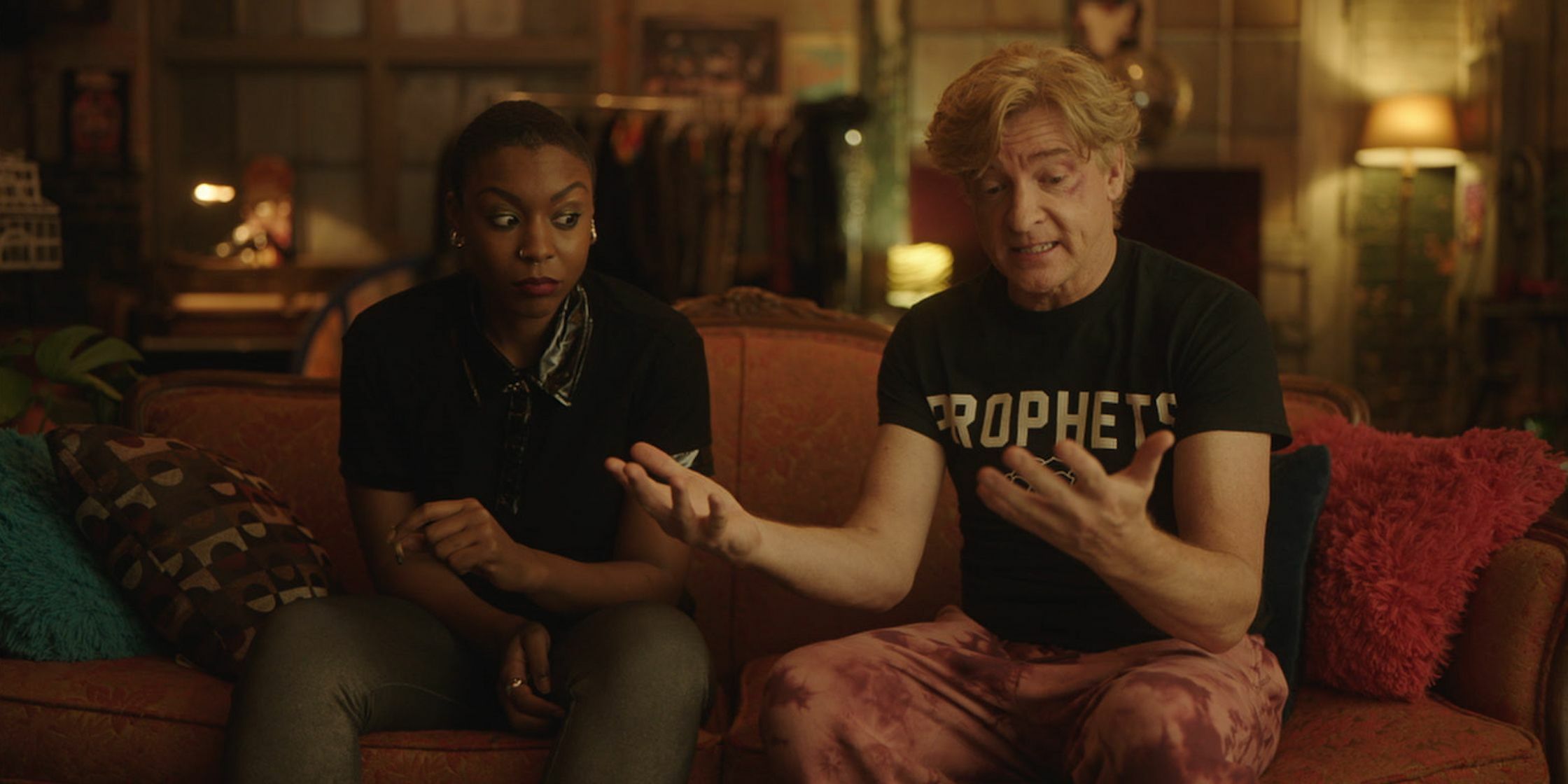
But an hour into the film, things threaten — briefly — to improve. Jay and Silent Bob are set to recreate their boom-box dance moment. But Jay’s a literalist when it comes to “dancing like no one’s watching.” Everybody has to leave the set as Silent Bob plays Jefferson Starship’s “Find Your Way Back” and the duo channel their pre-AARP card-in-the-mail selves, if only for a moment.
The movie starts to feel sweet. Bringing back Dante’s old loves — the irritable, still-living exes (Marilyn Ghigliotti and Jennifer Schwalbach Smith) — and the one who died (Rosario Dawson, acting in a better movie than the one surrounding her) — plays.
But that warm moment is fleeting and “Clerks III” continues its slog to the finish, an edgy comedy that’s lost its edge, a franchise whose expiration date passed long ago.
Rating: R, lots and lots of profanity, drug use
Cast: Brian O’Halloran, Jeff Anderson, Trevor Fehrman, Marilyn Ghigliotti, Jason Mewes, Kevin Smith and Rosario Dawson
Credits: Scripted and directed by Kevin Smith. A Lionsgate release.
When we meet Justin Long’s actor character AJ in the new thriller “Barbarian,” he’s a Hollywood lad on the make, a guy with a TV pilot about to be picked up sporting down the coast with the top down in a vintage Alfa Romeo Spider not too many years removed from the model Dustin Hoffman drove in “The Graduate.”
Apt.
A giddy AJ is singing along to the car’s sound system. And what’s that patter song he’s singing along to?
Why, a tune that was new at the same time the car was, a song inspired by “Jungle Book” author Rudyard Kipling.
“The Movie,” a “comical” hostage “thriller” about a deranged no-talent who home-invades a has-been movie star’s house to force her to be in his film, is not autobiographical. That needs to be said.
It is not funny, exciting, scripturally witty, cinematically interesting or acted in any way that threatens at any moment to change all the things it’s not.
It’s the kind of disaster that hits my in-box, with begging/badgering messages from a publicist hired by the distributor or (more likely) by the delusional self-distributing filmmaker who hasn’t taken the parade of “pass” and “no” replies from studios/distributors seriously.
Jarrod Pistilli, sort of a more-annoying-even-less-amusing version of Jamie Kennedy, is the pushy “delivery” guy who brings a package to faded star Janet, played by Bonnie Root, who lets us feel her pain. We even sense its on-set presence between takes.
Walter the delivery guy wants her to read his script, wants her to film his script, and has delivered a huge box with all his filmmaking gear for the eventuality that he lashes her to his delivery dolly and production begins.
The most generous way to look at this amateurish riff and an amateur trying to shoot a “POV” picture with a helmet cam as he co-stars in it is as a lark that did not work and never should have seen the light of day. Nothing wrong with trying and failing. But “never seen the light of day” is the phrase that pays here.
I take no pleasure eviscerating no-budget delusions. The Wisconsinites who thought they could make a movie about race in the trenches of World War I…in Wisconsin, stick in my mind. The only people who read the reviews of such invisible disasters are those who made the movie, or their check-writing/enabling/participation trophy-praising parents. And they’re enraged, not knowing the many times others on the team heard the word “No,” and “No” for good reason.
The fact that bottom-rung distributor Gravitas picked “Movie” up suggests the filmmakers thought they had something, that they tried to get higher rungs on the distribution ladder to distribute it. Gravitas finds a nugget in their corner of the cinema ghetto every now and then. All they risk here is pocket change, and another ding on their reputation.
But a note to writer-director Michael Mandell. Your family, who probably helped finance it, the other funders — Kickstarter, etc. — won’t tell you the truth. If every other distributor is saying “Nope,” take it to heart. Otherwise, some mean old movie critic is going to type a hole right in your “The Next Kubrick” dreams.
Distributors used to be gate keepers for indie cinema, raising standards by turning away junk. Publicists fulfilled at least some of that function, too. In this day and age, it’s down to critics alone. Apparently.
Naming your movie “The Movie?” Unfathomably stupid.
And that publicist whose pitched this? Lady, you’re on my list.
Rating: unrated, PG-13ish
Cast: Bonnie Root and Jarrod Pistilli
Credits: Scripted and directed by Michael Mandell. A Gravitas Ventures release.
Even those of us long in on the joke of Neil Labute’s He Man Woman Haters Club dramedies, ironic depictions of toxic masculinity wrapped in male affirmation, have to find “House of Darkness” a trial.
His latest horror riff on emasculated men and emasculating women — remember, he was entrusted with “The Wicker Man” remake, and turned it into a misogynistic mess — is a a thoughtfully half-baked attempt to graft his big themes onto what is obviously a vampire’s revenge, pretty much from the moment we read its title.
“House” is like a filmed play with misandric and misogynistic subtexts, and might be the talkiest 88 minute movie in history. No kidding, Justin Long. If you weren’t paid by the word here, you need a better agent. Or accountant.
Cinematically-static if well-acted, and dramatically-flat throughout, it’s an end-of-the-date story of gamesmanship, competing agendas and differing interpretations of what’s going on in a coupling towards copulation sense.
It’s a #MetToo movie with fangs, dull fangs. Labute, who gained fame with his brutal satire “In the Company of Men,” set out to sell a “Men are from Mars, Women are from Transylvania” version of the battle of the sexes. It doesn’t work.
Long plays a BMW’d social climber who takes the lovely Mina (Kate Bosworth) home to her remote “castle” after meeting in a bar.
He is right on the cusp of chivalrous, offering to walk her to her door, seeing as how “dark” and “scary” this corner of nowhere is to a city guy. Then he’s got to be getting back, he insists. No expectations, no “come in for a drink” pretexts presumed. He is persuaded to change his mind.
“Lead the way,” he enthuses. “I have been, ever since we met,” she says.
No, he doesn’t know her name at this point, or she his. But we can hear what a Chatty Cathy he is, talking himself into rhetorical corners where he admits he “fibs” a lot, among other things.
“How did we get on this subject?”
“To make you uncomfortable.“
Abnd we can see that she has the cocksure confidence of a beautiful blonde, “forward,” and not coy about it. She has him inside, sitting by the fire, sipping wine and talking away before he knows it.
The dialogue of their little mating pas de deux, with him questioning her about the house, property and the family and her testing him, is the best thing in the film, even if Labute is anything but subtle about what he’s doing with it.
“‘Sexy,’ he calls her, with an “Is that OK to say any more without setting the women’s rights movement back too far?” proviso.
The “filmed play” touches come from the obvious melodramatics — characters disappearing off camera, others abruptly appearing for “shock” value, our “hero” dozing off and having on-the-nose nightmares when he does This clunker is so tediously theatrical — told in what feels like (never-ending) real-time — you can practically hear the coughs, yawns and squirming in the seats of a theater audience as you’re watching it.
And the payoff, when it comes, is both expected and so gory and over-the-top that if “Barbarian” doesn’t end up being a new horror pigeonhole for Long’s career, “House of Darkness” could see to that.
I’ve followed Labute since the beginning of his career. Plucking his themes out of whatever stories he choses to tell, in whatever genre, is a favorite game among critics. But with this and with his almost-as-disappointing “Out of the Blue,” you have to wonder if his hot button issue/cutting edge days are gone, or if his favorite “hot button” — men standing up for masculinity — isn’t as out of date as the TV series he’s just finished filming, “American Gigolo.”
Rating: R, graphic violence, sexual situations, profanity
Cast: Justin Long, Kate Bosworth, Gia Crovatin and Lucy Walters
Credits: Scripted and directed by Neil Labute. A Saban Films release.